
Project Due Diligence: The Owner’s Representative Guide | R. Construction Solutions
An owner’s representative is your dedicated advocate during project due diligence — a construction and real estate professional who investigates physical, financial, environmental, and regulatory conditions on your behalf, then consolidates every finding into a single, clear go/no-go recommendation. According to Port City Group, that investigation spans feasibility studies, site analysis, entitlement assessment, pro forma modeling, and financing evaluation. The result is not a stack of third-party reports you have to interpret yourself. It is a synthesized picture of what you are actually buying, what it will cost to build, and where the deal can go wrong. For real estate investors, developers, and owners, that clarity is the difference between a confident acquisition and an expensive surprise.
Key Takeaways
An owner’s representative during project due diligence consolidates technical, legal, financial, and site findings into a go/no-go recommendation that protects your capital and gives you negotiating leverage before you close.
| Point | Details |
|---|---|
| Hire before signing | Engage your owner’s rep before the purchase agreement is signed to preserve maximum negotiating leverage. |
| Define authority in writing | Specify exactly what the rep can approve, sign, or commit to — vague authority creates liability gaps. |
| Require named staff | The specific individuals running your diligence must be named in the contract, not just the firm. |
| Expect a risk register | Every material finding should appear in a prioritized risk register with estimated mitigation costs and recommended owner actions. |
| Use findings to negotiate | A quantified risk register and revised pro forma are your tools for price adjustments, escrow holdbacks, and closing conditions. |
Table of Contents
- What does an owner’s representative actually do during due diligence?
- What topic areas does an owner’s rep cover during due diligence?
- How does an owner’s rep run the due diligence process?
- What deliverables does an owner’s rep produce, and how do they affect your decisions?
- How do you hire and contract an owner’s rep for due diligence?
- A practical checklist and sample scope for your owner’s rep engagement
- What expert oversight actually changes in a deal
- Sources
What does an owner’s representative actually do during due diligence?
The owner’s representative role is fundamentally rooted in agency. Per LegalClarity, the rep advocates for the owner, manages the teams doing the work, and operates with a clearly defined scope of authority. That is the critical distinction from a project manager or general contractor, who are accountable to delivery and their own margins. Your rep’s only job is to protect your interests.
During the project due diligence process, a qualified owner’s rep performs the following core duties:
- Coordinate consultants — engage and manage geotechnical engineers, environmental consultants, title attorneys, surveyors, and specialty inspectors.
- Review and synthesize reports — read every third-party deliverable and translate technical findings into business-level risk language the owner can act on.
- Verify underwriting assumptions — cross-check the pro forma against actual site conditions, permit timelines, and contractor cost data.
- Stress-test budgets and schedules — identify where contingency is thin and where schedule assumptions are optimistic.
- Assess constructability — evaluate site access, logistics, phasing, and whether the proposed design can be built within budget and schedule.
- Prepare a risk register — document every identified risk with likelihood, estimated impact, and recommended mitigation.
- Produce a go/no-go recommendation — synthesize all findings into a clear recommendation with supporting rationale.
Owner’s rep vs. project manager: a quick comparison
| Factor | Owner’s Representative | Project Manager / GC |
|---|---|---|
| Fiduciary stance | Owner’s advocate only | Delivery and margin accountability |
| Decision authority | Advises and recommends; approves within defined limits | Executes within contracted scope |
| Engagement timing | Pre-acquisition through close | Post-award through construction |
| Primary output | Risk register, due diligence report, go/no-go | Schedule, budget, and scope delivery |
When should you bring in an owner’s rep? Before you sign a purchase agreement or option contract, if at all possible. CRE Construction Partners notes that owner’s reps provide the most value on ground-up development, major renovations, adaptive reuse, multi-site acquisitions, and for owners who lack in-house project oversight or are located out of state. The earlier the engagement, the more leverage you have to negotiate or walk away cleanly.
Pro Tip: One of the most overlooked tasks in due diligence is aligning entitlement assumptions with your underwriting model before the diligence period closes. If your pro forma assumes a 90-day permitting timeline and the municipality is running 180 days, that gap can unwind your entire return. A good owner’s rep catches this early, when you can still negotiate a price adjustment or an extended closing.
What topic areas does an owner’s rep cover during due diligence?
Procore’s construction due diligence library defines due diligence as an early-stage risk mitigation process that examines physical, financial, environmental, and legal conditions so stakeholders understand what they are buying before capital is committed. Your owner’s rep structures that process across several distinct disciplines.
Site and structural review
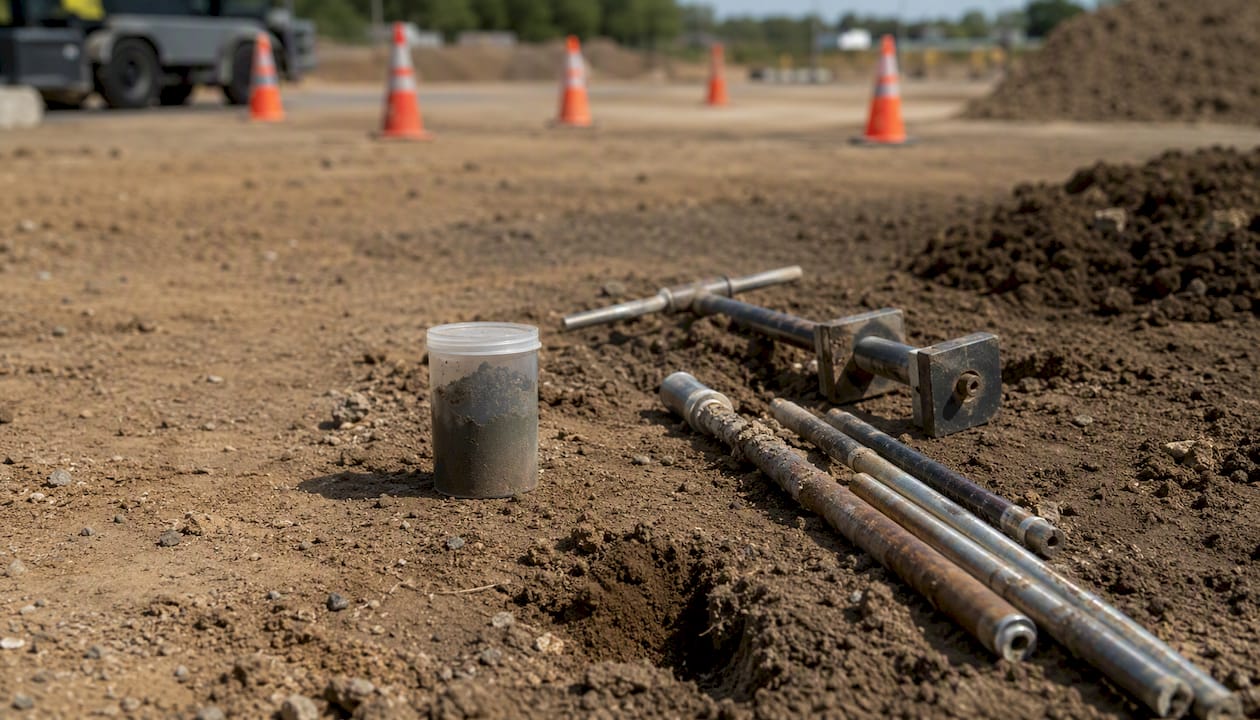
The rep coordinates a geotechnical report and structural inspection to identify soil conditions, foundation risks, and existing building deficiencies. The failure mode here is hidden structural damage or poor soil bearing capacity that drives unexpected foundation costs — sometimes six figures or more on a mid-size project.
Environmental assessments
A Phase I Environmental Site Assessment is the standard starting point. If the Phase I identifies recognized environmental conditions, a Phase II follows with soil and groundwater sampling. Contamination discovered post-closing becomes the buyer’s liability. Your rep ensures the scope of environmental work matches the site’s actual risk profile.
Title and lien searches
The rep works with title counsel to review the title commitment for encumbrances, easements, deed restrictions, and outstanding liens. Unresolved liens or access easements can block financing, limit development rights, or require costly legal remedies. CSUSM’s glossary of construction terms confirms that title searches and lien searches are standard due diligence deliverables on any construction project.
Zoning and entitlements
The rep verifies current zoning, allowable uses, density limits, setbacks, and parking requirements against the proposed project program. Entitlement risk is often the largest single source of schedule uncertainty on development projects. A rep who has worked in the target municipality knows which variances are routine and which are genuinely contested.
Permits and municipal approvals
Beyond zoning, the rep maps every permit required — building, grading, demolition, utility connection, fire, and specialty permits — and gets realistic timeline estimates from the authority having jurisdiction. Permit timelines vary dramatically by market and project type.
Surveys and utility locates
An ALTA/NSPS land title survey confirms property boundaries, easements, and encroachments. Utility locates identify existing infrastructure that affects site planning and construction sequencing. Conflicts between proposed construction and existing utilities are far cheaper to resolve on paper than in the ground.
Constructability and access/logistics
The rep evaluates whether the design can be built efficiently given site constraints: crane placement, material staging, traffic management, and neighboring property impacts. A design that looks clean on paper can be operationally difficult and expensive to execute on a constrained urban site.

Market and financial underwriting
The rep stress-tests the pro forma against current contractor pricing, material costs, and comparable project data. If the underwriting assumes costs that the market cannot support, the rep flags the gap before you close. Tools like Buildberry can support market and feasibility modeling at this stage.
Schedule and critical-path assumptions
The rep reviews the proposed project schedule for realistic sequencing, lead times for long-lead equipment, and weather or seasonal constraints. Optimistic schedules compress contingency and inflate projected returns — a rep who has managed similar projects knows where the schedule will slip.
How does an owner’s rep run the due diligence process?
Matterport’s overview of the owner’s representative role emphasizes that reps serve as the owner’s single point of contact, organize documentation, coordinate stakeholders, and limit cost and schedule risk through proactive oversight. Here is the practical workflow you should expect.
-
Kickoff and document request (Days 1–3). The rep issues a document request list to the seller, broker, and existing consultants. Target documents include existing surveys, environmental reports, title commitments, permit history, utility bills, and as-built drawings.
-
Consultant engagement (Days 3–7). The rep engages and scopes third-party consultants: geotechnical engineer, environmental firm, title attorney, surveyor, and specialty inspectors as needed. Scope alignment at this stage prevents scope gaps and duplicate work.
-
Site inspections and field verification (Days 7–21). The rep coordinates site visits, attends inspections, and documents conditions. Digital documentation tools — 3D capture, photo logs, condition reports — reduce the need for repeated site visits and improve the quality of records for remote owners.
-
Report review and synthesis (Days 14–28). As third-party reports arrive, the rep reviews findings, flags material issues, and begins building the consolidated due diligence report and risk register. Common bottlenecks at this stage: environmental labs running slow, title cures requiring seller action, and permit history gaps requiring municipal records requests.
-
Financial stress-testing (Days 21–30). The rep reconciles third-party findings against the pro forma. Cost adjustments for remediation, structural repairs, or permit delays are quantified and modeled against the deal economics.
-
Go/no-go recommendation (Days 28–45). The rep delivers the consolidated due diligence report, prioritized risk register, and a clear recommendation. This deliverable is the basis for any price renegotiation, escrow request, or termination decision before the diligence period expires.
Timing varies by project complexity. A straightforward commercial acquisition may complete diligence in 30 days. A ground-up development with environmental conditions and entitlement uncertainty can run 60–90 days or longer.
What deliverables does an owner’s rep produce, and how do they affect your decisions?
The Port City Group makes the point directly: diligence outputs are negotiation tools. A prioritized risk register with quantified remediation estimates strengthens requests for price adjustments, escrows, or holdbacks at closing. Here is what you should expect to receive.
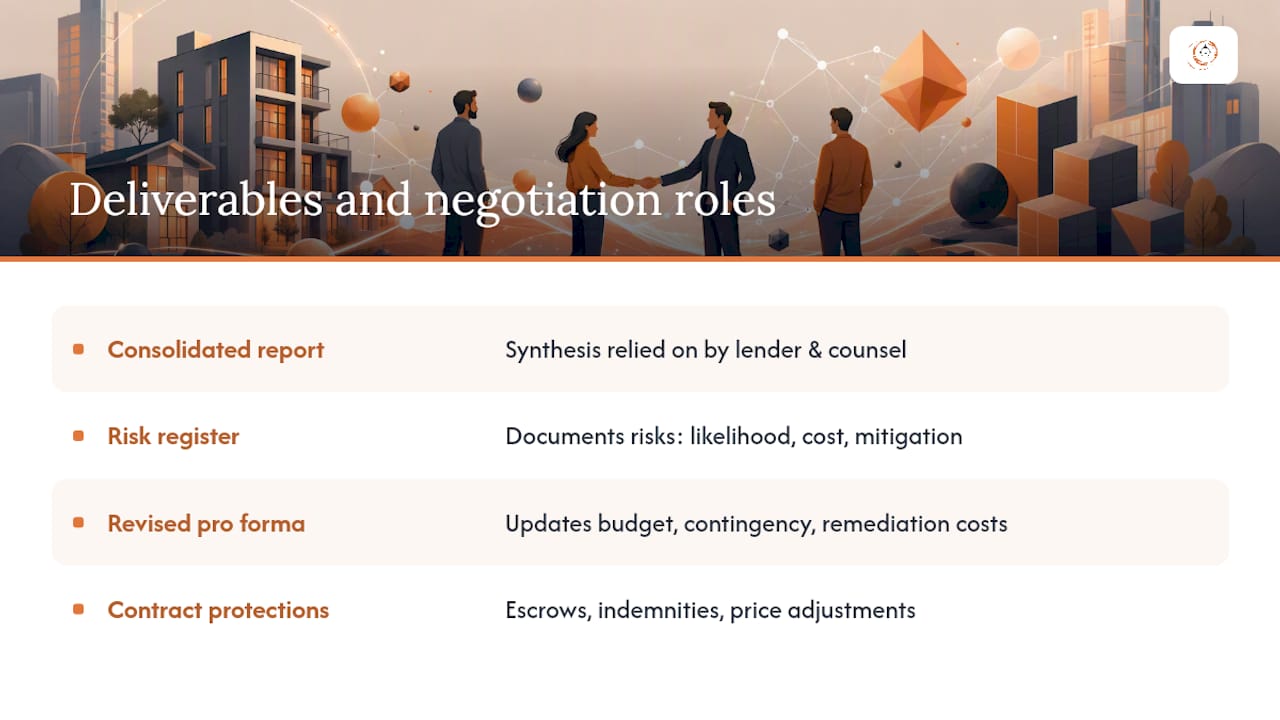
Consolidated due diligence report. A single document that synthesizes all third-party findings — geotechnical, environmental, title, survey, permit, and structural — into a narrative organized by risk priority. This is the document your lender, equity partner, and legal counsel will rely on.
Prioritized risk register. A structured table documenting each identified risk with the following fields: risk description, likelihood (high/medium/low), estimated financial impact, recommended mitigation action, estimated mitigation cost, and owner decision point. The risk register is what converts a stack of technical reports into a decision framework.
Revised pro forma and contingency adjustments. The rep updates the project budget to reflect actual conditions: remediation costs, structural repairs, permit fees, extended schedule contingency, and any scope changes required by code or site conditions. If the revised numbers no longer support the deal, you know before you close.
Recommended contract and closing protections. Based on findings, the rep recommends specific protections: seller representations and warranties, environmental indemnities, price adjustments, repair credits, escrow holdbacks, or closing conditions tied to permit approvals or title cures. These recommendations go directly to your legal counsel for negotiation.
Common due-diligence deliverables — Phase I environmental assessments, title commitments, geotechnical reports, surveys, and permit lists — form the backbone of the rep’s synthesis, as noted in CSUSM’s construction terms glossary. The rep’s value is not producing those documents. It is reading them, connecting the dots, and telling you what they mean for your deal.
How do you hire and contract an owner’s rep for due diligence?
The American Bar Association notes that terminology, scope, insurance, and authority for owner’s representatives vary significantly. Best practice is to specify scope, insurance limits, and dispute-resolution terms before the engagement begins. The NAR owner’s representative agreement framework confirms that well-structured agreements include scope, compensation, termination and suspension clauses, insurance, indemnification, and supporting-material requirements.
Here is a practical hiring process.
-
Define your project type and complexity first. A ground-up industrial development requires different expertise than a retail adaptive reuse. Match the rep’s track record to your asset type.
-
Verify local entitlement experience. Municipal relationships and knowledge of local permitting timelines are not transferable. Ask for specific projects completed in the same jurisdiction.
-
Confirm named project staff. Firms win work with senior staff and deliver with junior staff. Require that the specific individuals who will run your diligence be named in the contract. This is non-negotiable.
-
Check references on similar projects. Ask references: How did the rep handle a finding that threatened the deal? How often did they visit the site? What was their reporting cadence? Did they identify issues the owner had not anticipated?
-
Review insurance certificates. Require professional liability (errors and omissions) and general liability coverage. Confirm limits are appropriate for your project size.
-
Define authority limits in the contract. Per LegalClarity, owners should clearly define what the rep can approve, sign, or commit to. For due diligence engagements, this typically means the rep can engage pre-approved consultants within a defined budget but cannot commit the owner to any purchase, contract, or expenditure above a defined threshold without written approval. Avoid agreements that grant broad signatory authority without corresponding insurance and experience.
Fee structures: what owner’s reps typically charge
| Fee Model | Typical Range | Best Fit |
|---|---|---|
| Hourly | $100–$200/hr | Narrow-scope or short diligence periods |
| Lump sum | $5,000–$25,000 | Well-defined scope, fixed diligence timeline |
| Percentage of construction cost | 1%–3% | Complex, full-cycle engagements |
Factors that drive cost upward: project complexity, number of consultants to coordinate, environmental conditions, entitlement uncertainty, and geographic distance from the rep’s base.
Red flags to watch for:
- Vague deliverables with no defined report format or risk register
- No named project staff in the proposal
- Overbroad signatory authority without corresponding insurance
- No professional liability coverage
- Fee structures with no cap on reimbursable expenses
- Reluctance to provide references from similar project types
For guidance on evaluating construction consulting proposals, R Construction Solutions LLC has published a practical scoring framework owners can adapt for owner’s rep selection.
A practical checklist and sample scope for your owner’s rep engagement
Use this sample scope as a starting point when drafting an RFP or a consulting agreement for an owner’s representative during due diligence. Adapt it to your project type and diligence period.
Sample scope of services — owner’s representative, due diligence phase:
- Issue and manage document request list to seller and existing consultants
- Engage, scope, and coordinate all third-party consultants (environmental, geotechnical, title, survey, structural, specialty)
- Attend and document all site inspections; maintain photo and condition log
- Review all third-party reports; prepare written summary of findings and material risks
- Stress-test project budget and schedule against actual site conditions and consultant findings
- Prepare and maintain prioritized risk register with likelihood, impact, mitigation cost, and recommended owner action for each item
- Coordinate entitlement review with local planning and permitting authorities; confirm timeline assumptions
- Deliver consolidated due diligence report with go/no-go recommendation prior to diligence period expiration
- Provide recommended contract and closing protections to owner’s legal counsel
Checklist: what to request in a proposal and verify before signing
- Named project manager and lead consultant who will staff the engagement
- Sample due diligence report from a comparable project (redacted for confidentiality)
- Sample risk register format
- Current certificate of insurance showing professional liability and general liability limits
- Three references from similar project types in the past three years
- Clear description of reporting cadence and owner communication protocol
- Defined reimbursable expense policy with a cap or pre-approval threshold
Two practical points from Rowena Tulacz’s advisory experience: First, negotiate continuity of key staff into the contract. If the named project manager leaves the firm mid-engagement, you want the right to approve their replacement or terminate without penalty. Second, require that the rep’s scope explicitly includes entitlement coordination. Many standard owner’s rep agreements treat permitting as a construction-phase task. During due diligence, entitlement risk is often the most consequential variable in the deal, and it needs to be covered before you close.
For a broader look at types of construction consulting services and how to scope them, R Construction Solutions LLC has published a detailed guide that owners can use alongside this checklist.
What expert oversight actually changes in a deal
The most consistent pattern in owner’s rep due diligence work is this: the issues that matter most are rarely the ones the owner anticipated. A developer acquires a site assuming a straightforward commercial build. The Phase I comes back clean. The title commitment looks standard. Then the geotechnical report identifies expansive soils requiring a specialized foundation system, and the permit history reveals an unpermitted addition that triggers a full code compliance review. Neither issue was visible in the marketing materials or the seller’s disclosures.
With an owner’s rep coordinating the process, those findings surface during the diligence period, get quantified, and become the basis for a $400,000 price reduction request and a seller-funded escrow holdback for the permit resolution. Without that oversight, the owner closes, discovers the issues during construction, and absorbs the cost with no recourse.
That is the practical value of the role: not just finding problems, but finding them at the moment when you still have leverage to do something about them. If you are evaluating a deal and want to understand what a structured due diligence engagement would look like for your project, R Construction Solutions LLC can walk you through the scope and help you determine the right level of oversight for your asset type and risk profile.

Sources
The resources below are worth bookmarking if you are evaluating owner’s rep engagements or deepening your understanding of the project due diligence process.
Procore’s construction due diligence library is a solid starting point for understanding what the process covers across physical, financial, environmental, and legal dimensions. The American Bar Association’s analysis of owner’s representative roles covers the legal and contractual nuances that owners and their counsel should address before signing an engagement agreement. NAR’s owner’s representative agreement framework outlines the standard contract elements to expect. For a practitioner’s perspective on why early engagement matters, Port City Group’s article on owner’s representatives for investors and developers is direct and useful. Matterport’s overview covers documentation and coordination practices, including digital tools that benefit remote owners.
For owners who want to understand how to protect themselves when hiring a construction project manager — and how that role compares to an owner’s representative — R Construction Solutions LLC has published a practical guide covering qualifications, contract terms, and red flags. To request a proposal or discuss a specific project, visit R Construction Solutions LLC’s consulting services page.
This article is general information, not a substitute for advice from a qualified lawyer. Consult a qualified legal professional about your own circumstances before acting on anything here.
- Why Every Real Estate Investor and Developer Should Have an Owner’s Representative - Port City Group
- Owner’s Representative in Construction: Role, Scope & Fees - LegalClarity
- Construction due diligence - Procore Library
- Real estate owner’s representative — Matterport blog
- Owner’s Representatives—Emerging Roles, Responsibilities, and Legal Issues - American Bar Association
- Owner’s Representative Agreement - NAR
- Glossary of construction terms - California State University San Marcos (CSUSM)