
Contractor Business Assessment: A Guide to Improving Performance | R. Construction Solutions
A contractor business assessment is the systematic evaluation of a contractor’s financial health, operational capacity, safety performance, and project history to inform strategic decisions. This process goes far beyond a quick profit check. It examines key performance indicators (KPIs) like liquidity ratios, gross margins, cash flow efficiency, and backlog levels to give you a complete picture of where your business stands and where it can go. Frameworks like CPARS (Contractor Performance Assessment Reporting System) and tools like valuation calculators are widely used in this process. Understanding what is contractor business assessment explained correctly is the first step toward using it to your advantage.
What core financial and operational metrics are evaluated in contractor business assessments?
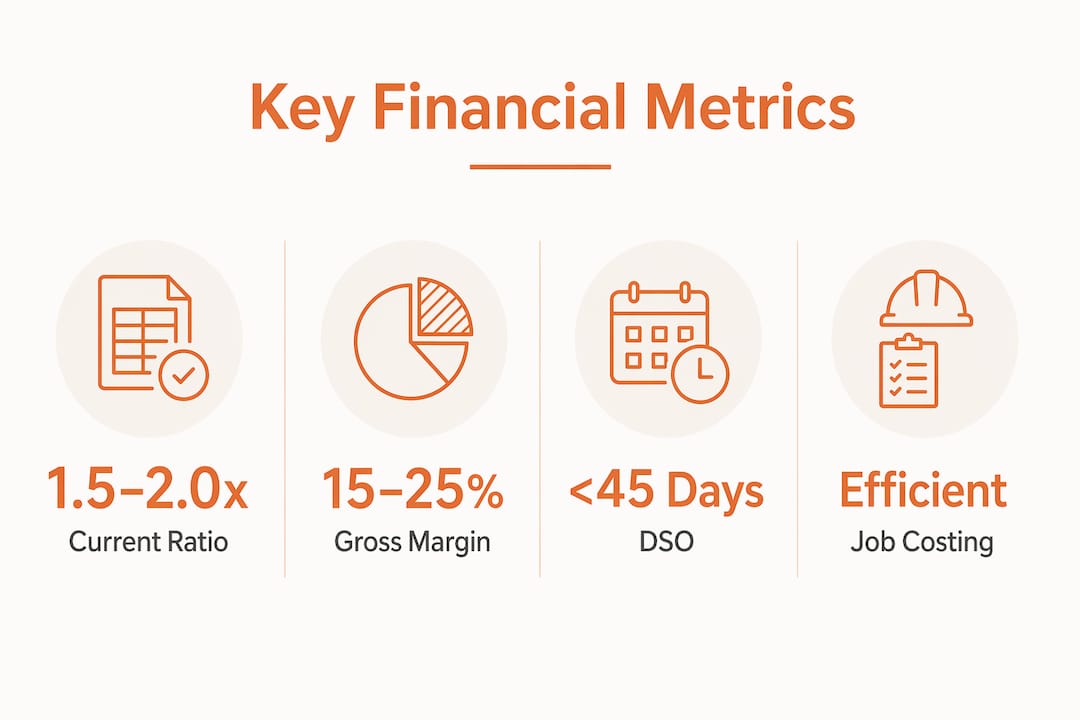
A contractor business evaluation covers five financial areas, each with a specific benchmark that signals business health or risk. These are not arbitrary targets. They reflect what lenders, buyers, and project owners actually look at when deciding whether to work with you.
The five key financial benchmarks are:
- Liquidity (current ratio): Target 1.5–2.0x. A ratio below 1.0 is a red flag that signals you cannot cover short-term obligations.
- Profitability (gross margin): Target 15–25%. Margins below this range indicate pricing or cost control problems.
- Cash flow (DSO): Target under 45 days. Days Sales Outstanding measures how quickly you collect payment after completing work.
- Job costing variance: Target under 5%. Variance above this level points to estimating errors or field execution problems.
- Backlog: Target 3–6 months of work. Too little backlog signals revenue risk; too much can strain capacity.
Beyond financials, a complete contractor business analysis covers operational dimensions. Prequalification evaluates four core areas: financial health, safety record (measured by EMR and DART rates), technical capability, and operational capacity. Your Experience Modification Rate (EMR) directly affects your insurance costs and your ability to win certain contracts. A high DART rate signals frequent workplace injuries, which raises red flags for general contractors and project owners alike.
Pro Tip: Maintain a 5–90 day cash reserve alongside your current ratio target. Liquidity ratios tell you about balance sheet strength, but cash reserves tell you about day-to-day survival during slow payment cycles.

| Metric | Target | What It Signals |
|---|---|---|
| Current ratio | 1.5–2.0x | Ability to meet short-term obligations |
| Gross margin | 15–25% | Pricing strength and cost control |
| DSO | Under 45 days | Payment collection efficiency |
| Job costing variance | Under 5% | Estimating and field execution accuracy |
| Backlog | 3–6 months | Revenue stability and capacity balance |
How do contractor business assessments inform valuation, financing, and strategic decisions?
A contractor business assessment is not just an internal health check. It directly determines how much your business is worth and whether you can access financing or win larger contracts. Small to mid-sized contractors typically sell for 2.5–5x annual profit, and that multiple is driven almost entirely by the metrics covered in your assessment.
Valuation is more nuanced than a simple revenue multiple. Buyers and lenders look at normalized earnings, which strip out one-time costs or owner perks to show true recurring profit. They also examine your service mix. A contractor with recurring maintenance contracts commands a higher multiple than one who depends entirely on new construction bids. Recurring revenue components can increase valuation multiples by 1–1.5x. That single factor can be worth hundreds of thousands of dollars in a sale or financing negotiation.
Capacity assessments also affect contract eligibility directly. Government and institutional buyers use formulas that factor in working capital multiples and net tangible assets to determine how large a contract you can handle. If your working capital is thin, you may be disqualified from projects that would otherwise fit your technical profile.
“Valuations must be connected to specific operational realities, including owner dependence and fleet condition, to be credible.” — Simply Business Valuation
Buyers also scrutinize customer concentration. If one client represents more than 30% of your revenue, that is a risk factor that reduces your valuation. The same logic applies to labor variance. Wide swings in labor cost per job signal that your field operations are unpredictable, which makes future earnings harder to forecast. Understanding how to assess contractor business performance across all these dimensions is what separates contractors who get top-dollar valuations from those who leave money on the table.
What are best practices and common pitfalls in contractor business assessments?
The most common mistake contractors make is tracking too many metrics without understanding which ones actually drive decisions. Private equity evaluations focus on four numbers: DSO, gross margin per job, customer concentration, and labor variance. These four metrics dominate valuation discussions because they directly affect cash flow, risk, and earnings predictability.
Here are four best practices that separate reliable assessments from superficial ones:
-
Use evidence-based documentation for safety. Generic safety policy binders do not satisfy serious buyers or prequalification reviewers. Site-specific hazard logs that reflect actual project conditions reveal true risk management capability. Safety prequalification is more credible when it includes direct evidence from past job sites, not just templated policies.
-
Evaluate subcontractors through direct reference questions. Effective subcontractor assessment relies on direct reference questions, specifically whether projects were completed on time and within budget, rather than formal paperwork alone. This approach surfaces operational risk that documents miss.
-
Monitor bonding capacity alongside your current ratio. Bonding capacity and backlog metrics help predict project funding ability and risk. A current ratio below 1.0 will typically disqualify you from bonded projects, regardless of your revenue size.
-
Avoid generic dashboards. Tracking 40 KPIs creates noise, not clarity. Focus your contractor performance review on the metrics that buyers, lenders, and project owners actually use to make decisions.
Pro Tip: A 30-day difference in DSO can require 50% more working capital during a business transition. Reducing your DSO by even two weeks has a direct, measurable impact on your valuation and your cash position.
Improving your construction estimating process is one of the fastest ways to reduce job costing variance and gross margin volatility, two of the metrics that assessors scrutinize most closely.
How can contractors use assessment results to drive growth and project efficiency?
Assessment results are only useful if you act on them. The importance of contractor assessments lies not in the report itself but in the changes it drives. Here is how to translate findings into real operational and financial improvement.
- Target liquidity first. If your current ratio falls below 1.5x, prioritize collecting receivables faster and reducing short-term debt before taking on new contracts. Thin liquidity is the most common reason contractors stall at a revenue ceiling.
- Use gross margin by job to identify problem work types. If your residential remodel margins consistently run below 15% while your commercial tenant improvement margins hit 22%, that data tells you where to focus your business development efforts.
- Strengthen safety compliance as a growth tool. A lower EMR reduces your insurance premiums and opens doors to contracts that require prequalification. Safety is not just a compliance issue. It is a competitive advantage.
- Build financial discipline over years, not quarters. Durable financial discipline over 5–10 years is what produces top valuations. Contractors who chase quick fixes before a sale rarely achieve the multiples they expect.
- Engage specialized consulting support. Generic business advisors rarely understand construction-specific metrics like backlog, bonding capacity, or EMR. Working with consultants who have hands-on construction experience accelerates improvement and reduces the risk of misreading your own data.
Rconstructionsolutions has helped mid-sized contractors scale from $5 million to $50 million in revenue by applying exactly this kind of structured, metrics-driven approach. The process starts with an honest assessment, then builds a plan around the gaps it reveals. You can explore sustainable growth strategies that other contractors have used to turn assessment findings into measurable results.
Key takeaways
A contractor business assessment is the most reliable tool you have for understanding your financial position, improving project efficiency, and building a business that attracts financing, contracts, and buyers at the right price.
| Point | Details |
|---|---|
| Five core financial metrics | Target current ratio 1.5–2.0x, gross margin 15–25%, DSO under 45 days, job costing variance under 5%, and backlog of 3–6 months. |
| Valuation is metrics-driven | Contractors typically sell for 2.5–5x annual profit; recurring revenue and low DSO push multiples higher. |
| Four metrics dominate buyer decisions | DSO, gross margin per job, customer concentration, and labor variance are the numbers private equity and buyers focus on. |
| Evidence beats paperwork | Direct reference checks and site-specific safety logs reveal operational risk more accurately than generic documentation. |
| Long-term discipline wins | Sustained financial improvement over 5–10 years produces better valuations than short-term fixes before a sale or financing event. |
What I’ve learned from years of contractor business evaluations
Most contractors I work with are surprised by the same thing: their business looks healthy on the surface but has a structural weakness hiding in one or two metrics. The most common culprit is DSO. A contractor billing $8 million a year with a 75-day DSO is carrying roughly $1.6 million in receivables at any given time. That is capital that cannot be used for payroll, equipment, or growth. Fixing that single metric can change the entire financial profile of the business.
The other pattern I see repeatedly is over-reliance on one or two large clients. Contractors who built their business on a strong relationship with a single general contractor or developer are often shocked to learn that this concentration is the biggest discount factor in their valuation. Diversifying your client base is not just a risk management move. It is a direct investment in your business’s worth.
What I find most valuable about a rigorous contractor performance review is that it forces honest conversations. Owners who have never looked at gross margin by job type often discover that a significant portion of their work is barely breaking even. That discovery is uncomfortable, but it is also the starting point for real improvement. Assessments done right do not just measure where you are. They show you exactly where to go next.
The contractors who benefit most from assessments are the ones who treat them as a recurring practice, not a one-time event before a sale or a loan application. Annual reviews build the financial discipline that compounds over time and produces the kind of business that commands top-tier valuations and attracts the best projects.
— Rowena
How Rconstructionsolutions supports your business assessment process
Rconstructionsolutions brings over 30 years of hands-on construction experience to every contractor business evaluation it conducts. The team understands the difference between a current ratio on a spreadsheet and what it means for a contractor trying to bond a $4 million project next quarter.

Whether you need a full construction consulting engagement or access to practical tools and templates to run your own assessment, Rconstructionsolutions has resources built specifically for contractors. The Sandbox at Rconstructionsolutions offers templates and frameworks you can put to work immediately. For contractors ready to move from assessment to action, the consulting team provides personalized evaluations and growth plans grounded in real construction operations, not generic business theory.
FAQ
What is a contractor business assessment?
A contractor business assessment is a structured evaluation of a contractor’s financial health, safety record, operational capacity, and project history. It uses specific KPIs like current ratio, gross margin, DSO, and backlog to measure business performance and viability.
What financial metrics matter most in a contractor business evaluation?
The five most critical metrics are liquidity ratio (target 1.5–2.0x), gross margin (15–25%), DSO (under 45 days), job costing variance (under 5%), and backlog (3–6 months of work).
How does a contractor assessment affect business valuation?
Assessment results directly influence your valuation multiple. Contractors with strong metrics and recurring revenue typically achieve 2.5–5x annual profit in a sale, while weak DSO or high customer concentration reduces that multiple significantly.
How often should contractors conduct a business assessment?
Annual assessments build the financial discipline that produces top valuations over time. Contractors who assess only before a sale or loan application rarely have enough time to correct the weaknesses that assessors find.
What is the difference between a contractor prequalification and a business assessment?
Prequalification is a pass/fail evaluation used by project owners to vet contractors for a specific contract. A full contractor business analysis is broader and covers valuation, growth strategy, financing readiness, and long-term operational health.