
Bonding Capacity and Business Growth: A Strategic Guide for Contractors | R. Construction Solutions
Bonding capacity is defined as the maximum amount of bonded work a contractor can sustain at one time, and it directly determines which projects you can bid, how fast you can grow, and how credible your business looks to owners and lenders. The role of bonding capacity in business growth is not a side conversation for your accountant. It is the ceiling on your entire expansion strategy. Surety companies, working capital ratios, and your WIP schedule all feed into a number that either opens doors or closes them. If you are a contractor planning to scale from $5 million to $20 million or beyond, understanding this number is non-negotiable.
How is bonding capacity calculated and what factors influence it?
Bonding capacity is not a single formula. Surety underwriters assess your entire business picture before assigning limits, and the criteria go well beyond your bank balance.

The two core limits every contractor needs to understand are the single-project limit and the aggregate limit. The single-project limit caps the size of any one bonded contract. The aggregate limit caps the total bonded work you can carry simultaneously. Critically, underwriters use estimated cost to complete rather than original contract value when calculating how much of your aggregate capacity is consumed. That means a large project you are 80% through still occupies space on your capacity until it closes out.
Surety underwriters evaluate your capacity against several specific criteria:
- Working capital: Your current assets minus current liabilities. Sureties often apply a 10 to 15x multiplier on net quick assets to establish a baseline aggregate limit. Retaining earnings rather than distributing them is the fastest way to move this number.
- Net worth: Total equity in the business. A growing net worth signals financial stability and supports larger bond programs.
- Financial statements: CPA-reviewed or audited financials unlock access to larger bond programs. Internally prepared statements cap your eligibility at lower tiers.
- WIP schedule: Your work-in-progress report is a live underwriting document. Inaccurate WIP schedules reduce bonding capacity because sureties rely on them to assess your current obligations and risk exposure.
- Experience and management depth: Your track record on similar project types, your team’s qualifications, and your internal systems all factor in. A contractor with strong financials but no experience in a new project type will face limits.
- Backlog composition: The size and concentration of your current backlog directly affects how much room you have to bid new work. A heavy backlog in a single project type or with one owner raises red flags.
The surety underwriting criteria exist because sureties need confidence that you can cover payroll, materials, and subcontractors while waiting on payment. Your bonding capacity is, in effect, a real-time snapshot of your business health.
Why bonding capacity directly impacts growth opportunities
The practical consequences of a low or stagnant bonding capacity show up fast when you start pursuing larger work. Here is how the impact of bonding on growth plays out in real contracting scenarios:
- You cannot bid what you cannot bond. Public contracts at the federal, state, and municipal level require performance and payment bonds on virtually every project above a threshold. If your aggregate capacity is consumed or your single-project limit is too low, you are disqualified before the first page of your bid is read.
- Simultaneous projects become impossible. A contractor with a $5 million aggregate limit cannot run three $2 million jobs at once. Growth through volume requires aggregate capacity, not just single-project strength.
- Private owners use bonding as a prequalification filter. General contractors and developers increasingly require bonding on commercial subcontracts. A low capacity signals financial fragility and costs you relationships before they start.
- Your credibility with lenders depends on it. A strong bonding capacity signals credibility to owners, lenders, and partners. Banks view a healthy surety relationship as third-party validation of your financial management.
- Neglected capacity becomes a hard growth ceiling. Contractors who focus on revenue without managing their bonding position often hit a wall at $10 million or $15 million in revenue. The surety will not move the limit until the underlying financials justify it, regardless of how busy you are.
The importance of bonding capacity goes beyond any single contract. It is the mechanism that either accelerates or throttles your ability to compete for the work that actually builds a business.
Strategies to increase your bonding capacity
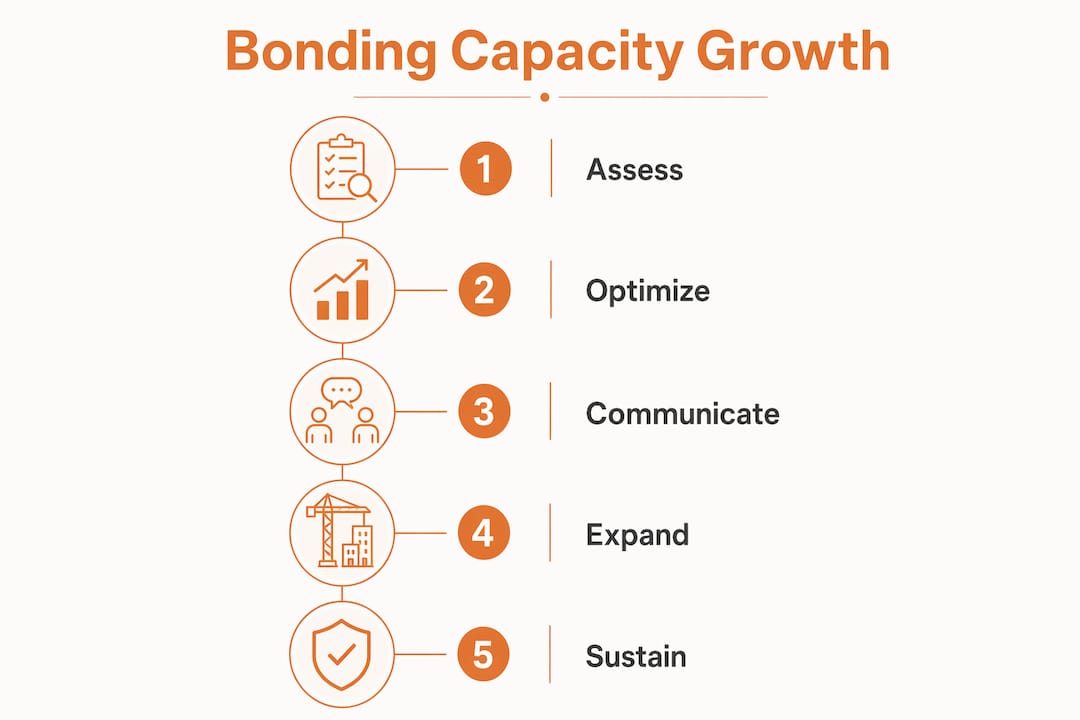
Improving your bonding capacity is a 12-month discipline, not a quick fix. Capacity increases require consistent financial improvements communicated early to your surety. Contractors who approach their surety 30 days before needing a larger bond almost always hear no.
The core financial disciplines that move the needle are:
- Retain earnings. Every dollar you pull out of the business as a distribution reduces working capital and net worth. Sureties see this. Contractors who reinvest profits consistently build capacity faster than those who distribute aggressively.
- Clean up your accounts receivable. Sureties discount aging receivables and overbillings when calculating adjusted working capital. Receivables over 90 days are often excluded entirely. Tightening your AR collection cycle directly increases the working capital figure your surety sees.
- Upgrade your financial statements. Move from internally prepared financials to CPA-reviewed, then to audited statements as your revenue grows. This single step can unlock access to significantly larger bond programs.
- Maintain a monthly WIP schedule. Treat your WIP report as a dynamic document, not an annual exercise. Monthly reconciliations with conservative cost-to-complete estimates demonstrate operational control and reduce underwriting risk.
- Diversify your backlog. Concentration risk, meaning too much work with one owner or in one project type, reduces capacity. A diversified backlog of projects at different stages of completion gives sureties more confidence.
- Communicate your growth plan. Share your 12-month and 3-year revenue targets with your surety annually. Underwriters who understand your trajectory can plan capacity increases proactively rather than reactively.
Pro Tip: Ask your surety for a written breakdown of exactly what is limiting your current capacity. Most contractors never ask this question. The answer tells you precisely where to focus your financial improvements for the next 12 months.
The table below shows how specific financial actions translate to bonding capacity outcomes:
| Financial action | Expected capacity impact |
|---|---|
| Retain $200K in earnings | Increases working capital and net worth directly |
| Upgrade to CPA-reviewed financials | Unlocks mid-tier bond programs |
| Reduce AR aging below 60 days | Increases adjusted working capital calculation |
| Monthly WIP reconciliation | Reduces underwriting risk, supports larger limits |
| Diversify backlog by owner and type | Removes concentration risk flags |
Common misconceptions and pitfalls in managing bonding capacity
The most damaging belief in construction is that revenue alone drives bonding capacity. It does not. A contractor doing $20 million in revenue with thin margins, aging receivables, and a bloated backlog can have less bonding capacity than a $7 million contractor with clean financials and a disciplined WIP process.
“Bonding capacity depends on financial strength, management ability, operational capacity, and track record, not just revenue or past performance.” — Integrity Surety
Rapid growth without matching operational controls is one of the most common ways contractors damage their surety relationship. When revenue doubles in 18 months but internal systems, project management depth, and cash flow controls do not keep pace, sureties interpret this as increased risk. The result is a capacity freeze or reduction at exactly the moment you need more room to grow.
Outdated or inaccurate WIP reporting is another frequent pitfall. Contractors who update their WIP quarterly or only at year-end give sureties a stale picture of their obligations. Conservative projections and a clean profit fade history are what underwriters want to see. Errors here reduce capacity materially.
Sudden requests for large capacity jumps also trigger underwriting scrutiny. If your current aggregate limit is $8 million and you ask for $20 million with no prior communication, your surety has no context for the request. Proactive relationship management with annual reviews and growth plan discussions is what makes large capacity increases possible.
Pro Tip: If you are working with a broker who only contacts your surety when you need a bond, find a broker who treats your bonding program as a year-round strategic relationship. The difference in capacity outcomes is significant.
Understanding how bonding influences business development means recognizing that your surety is not just a vendor. They are a financial partner whose confidence in your business directly affects your growth ceiling.
Key takeaways
Bonding capacity is a strategic growth asset that requires active financial management, consistent surety communication, and disciplined operational controls to increase over time.
| Point | Details |
|---|---|
| Capacity is not just revenue | Sureties assess working capital, WIP accuracy, backlog, and management depth. |
| Two limits matter | Single-project and aggregate limits both constrain bidding; manage both actively. |
| 12-month timeline | Capacity increases require a full year of financial discipline and early surety communication. |
| WIP is a live document | Monthly reconciliations with conservative estimates reduce underwriting risk materially. |
| Relationship drives results | Annual growth plan discussions with your surety enable proactive capacity increases. |
What I have learned about bonding capacity after 30 years in construction consulting
Most contractors treat bonding capacity as a reactive problem. They hit a wall on a bid, call their broker in a panic, and discover their limit is too low. By that point, the opportunity is gone and the fix takes a year. That pattern is entirely avoidable.
What I have seen work consistently is treating bonding capacity the same way you treat your equipment fleet or your key personnel. You plan for it, you invest in it, and you review it regularly. The contractors who scale from $5 million to $50 million without hitting a surety wall are not the ones with the highest revenues. They are the ones with the cleanest financials, the most accurate WIP reports, and the strongest surety relationships.
The other thing I want to be direct about: your bonding capacity is a reflection of your entire business health. If your capacity is stuck, it is telling you something about your financial controls, your backlog management, or your operational depth. That feedback is valuable. Use it to identify exactly where your business needs to improve, not just to chase a higher number.
Proactive process improvement in construction is what separates contractors who grow sustainably from those who grow fast and then stall. Bonding capacity is one of the clearest indicators of whether your business is ready for the next level.
— Rowena
How Rconstructionsolutions helps contractors build bonding capacity

Rconstructionsolutions works directly with residential and commercial contractors to build the financial controls, WIP discipline, and operational systems that surety underwriters want to see. With over 30 years of hands-on construction experience, the team at Rconstructionsolutions has helped mid-sized firms scale from $5 million to $50 million by addressing the exact financial and operational gaps that limit bonding capacity. If you are ready to stop hitting ceilings and start competing for larger projects, explore the construction consulting services that Rconstructionsolutions offers. You can also access practical tools and templates through The Sandbox to support your bonding and growth planning.
FAQ
What is bonding capacity in construction?
Bonding capacity is the maximum amount of bonded work a contractor can carry at one time, set by a surety company based on financial strength, experience, and operational controls. It includes both a single-project limit and an aggregate limit.
How long does it take to increase bonding capacity?
Increasing bonding capacity typically takes 12 or more months of consistent financial improvements, including retaining earnings, cleaning up WIP, and improving accounts receivable. Last-minute requests to sureties almost always fail.
Does higher revenue automatically increase bonding capacity?
No. Revenue alone does not drive bonding capacity. Sureties evaluate working capital, net worth, WIP accuracy, backlog composition, and management depth, so a high-revenue contractor with weak financials can have lower capacity than a smaller, well-managed firm.
What is a WIP schedule and why does it matter for bonding?
A WIP schedule is a work-in-progress report that tracks the status and cost-to-complete of all active projects. Sureties use it as a primary underwriting document, and inaccuracies or outdated entries directly reduce your bonding capacity.
How does bonding capacity affect bidding on public contracts?
Public contracts above certain dollar thresholds require performance and payment bonds. If your single-project limit or aggregate capacity is insufficient, you are disqualified from bidding regardless of your experience or qualifications.