
Evaluating Construction Consulting Proposals: 2026 Selection Guide | R. Construction Solutions
Proposal evaluation is the structured process of scoring consulting submissions against defined criteria to select the partner best aligned with your project goals. For contractors and construction managers, this process directly affects project efficiency, cost control, and team collaboration. A solid evaluate construction consulting proposals guide does not start with price. It starts with qualifications, methodology, and fit. Balanced evaluations weight qualifications at 75% and fees at just 25%, which means the cheapest bid is rarely the right one. Getting this process right separates projects that finish on time and on budget from those that spiral into change orders and disputes.
What are the essential components of a strong construction consulting proposal?
A strong proposal is not a brochure. It is a structured document that proves the consultant understands your project and has a plan to deliver results. Knowing what to look for makes the construction consulting proposal review faster and more objective.
Every credible proposal should include these eight core sections:
- Executive summary: A concise statement of the consultant’s understanding of your project goals and constraints
- Scope of services: A clear, specific description of what is and is not included
- Exclusions list: A detailed record of work explicitly outside the engagement
- Methodology and work plan: The step-by-step approach the consultant will use
- Team biographies: Named individuals with relevant credentials and project roles
- Milestone schedule: Defined deliverables tied to dates or project phases
- Fee structure: A breakdown of fixed, variable, and contingency costs
- References: Verifiable contacts from comparable past projects
The exclusions list deserves special attention. Most contractors overlook the exclusions list, yet its presence signals that the consultant has thought carefully about scope boundaries. Its absence is a red flag for incomplete due diligence. A consultant who does not define what they will not do is setting up future disputes over change orders.
Milestone schedules matter just as much. Vague timelines like “deliverables within 60 days” give you no accountability lever. A proper schedule ties each deliverable to a specific date and links it to a project phase. That structure protects you when delays occur.
Pro Tip: If a proposal is missing the exclusions list or milestone schedule, do not assume the consultant forgot. Ask directly. Their response tells you more about their working style than the proposal itself.
How to create a weighted evaluation framework for consulting proposals
A weighted scoring framework turns subjective impressions into objective decisions. Without one, your team defaults to gut feel, which tends to favor whoever presented last or whoever had the lowest price.
A professional scorecard weights criteria across multiple dimensions. A proven breakdown looks like this:
| Evaluation Criterion | Weight |
|---|---|
| Approach and work plan | 20% |
| Team qualifications and availability | 20% |
| Relevant experience | 15% |
| Commercial terms and fee structure | 15% |
| Problem understanding and fit | 10% |
| Value claims and ROI evidence | 10% |
| Risk identification and controls | 10% |
This framework accounts for 100% of the decision and forces evaluators to justify scores in each category. The 20% weight on approach and work plan reflects a core truth: a consultant who cannot explain their methodology clearly will not execute it well on site.

Score each criterion on a consistent scale, such as 1 to 5, where 1 means the proposal fails to address the criterion and 5 means it exceeds expectations with specific evidence. Multiply each score by its weight to get a weighted total. Compare totals across all submissions.
The commercial terms category at 15% covers more than the bottom line. It includes payment schedules, change-order triggers, and liability clauses. A proposal with a low fee but no change-control language is a financial risk, not a bargain.
Pro Tip: Have each evaluator score independently before any group discussion. Independent scoring before group discussion reduces groupthink and surfaces genuine disagreements that lead to better decisions.
What are best practices for evaluating fees and financials in proposals?
Fee evaluation is where contractors most often make costly mistakes. The total number at the bottom of a proposal tells you almost nothing useful on its own.
Evaluating fees requires looking beyond the bottom line. Ask for a breakdown that separates fixed fees, variable costs tied to scope changes, and contingency allowances. That breakdown tells you where the financial risk sits. A fixed fee with no contingency line may look attractive until a site condition changes and the consultant issues a change order for work you assumed was included.
Watch for these red flags when reviewing financials:
- Vague assumptions: Phrases like “based on standard conditions” without defining what standard means
- No change-control language: Proposals that do not specify how scope changes are priced and approved
- Lump-sum fees with no task breakdown: No visibility into where the money goes or how to verify delivery
- Contingency buried in the total: Hidden contingency inflates the base fee and obscures real cost
- Missing reimbursable expense policy: No cap or definition for travel, printing, or third-party costs
When prices are within 5% of each other, the financial details in the proposal, not the total, determine which submission offers better value. That 5% threshold is where the exclusions list and milestone schedule become the deciding factors. A proposal with a slightly higher fee but a detailed exclusions list and clear change-control terms is almost always the lower-risk choice.
How to assess team qualifications and cultural fit alongside technical merits
The team section of a proposal is where many contractors stop reading too soon. Named individuals matter more than firm reputation. A well-known consulting firm that assigns junior staff to your project delivers junior results.
Cultural fit and team seniority are critical factors in project execution. A proposal written by a senior partner but staffed by recent graduates is a common pattern that causes project failures. Ask directly: who will be on site, how often, and what authority do they have to make decisions?
Assess team qualifications using these criteria:
- Named individuals vs. generic roles: The proposal should list actual people, not just job titles
- Relevant project experience: Look for projects of similar size, type, and complexity, not just industry experience
- Availability commitment: Confirm the percentage of time each named person will dedicate to your project
- Decision-making authority: Identify who can approve changes without escalating to a partner not involved in day-to-day work
- Communication style: Ask for a sample report or deliverable from a past project to assess clarity and format
Cultural fit affects daily collaboration in ways that technical scores cannot capture. A consultant who communicates formally through weekly written reports may frustrate a project manager who needs quick answers on site. Mismatched communication styles create delays. Ask how the team handles urgent issues and what their typical response time is for field questions.
You can find a deeper breakdown of the right questions to ask a construction consultant before you sign anything. Those questions surface team dynamics that proposals rarely reveal on their own.
How to implement the evaluation process collaboratively and avoid common pitfalls
A structured process protects you from the two most common evaluation failures: price obsession and template compliance focus. Expert buyers focus on ROI and problem resolution rather than who checked the most boxes on a standard form. That shift in mindset changes which proposals rise to the top.
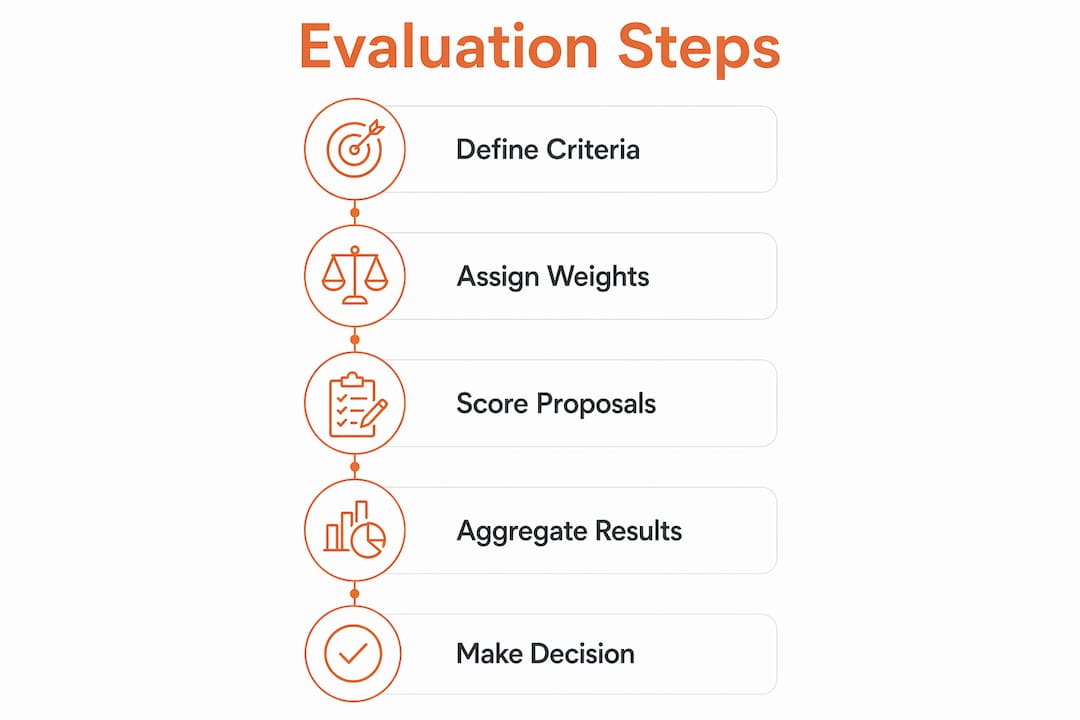
Follow these steps to run a consistent, bias-resistant evaluation:
- Align stakeholders before you open any proposal. Agree on the weighted criteria and scoring scale before anyone reads a submission. Changing the criteria after reading proposals introduces bias.
- Distribute proposals simultaneously. All evaluators should receive submissions at the same time to prevent informal discussions that skew scores.
- Score independently. Each evaluator completes their scorecard without consulting others. This step is non-negotiable for objective results.
- Convene a scoring review meeting. Share individual scores, identify large gaps, and discuss the reasoning behind outlier scores.
- Shortlist and conduct interviews. Invite the top two or three firms to present. Use the interview to test team chemistry and probe weak sections of the proposal.
- Document the decision. Record scores, discussion notes, and the rationale for the final selection. This protects you if the decision is questioned later.
Four fundamental questions guide the best evaluations: Does the consultant understand your business? Can they solve the specific problem? Does the team fit your working style? Is the cost defensible against the expected return? If you cannot answer yes to all four after reading a proposal, request clarification before scoring.
Pro Tip: Run a structured debrief with your team after the decision is made. Note what the winning proposal did better than the others. That record becomes your benchmark for the next evaluation cycle.
Key Takeaways
Selecting the right construction consultant requires a weighted scoring framework that prioritizes qualifications, team fit, and financial transparency over the lowest fee.
| Point | Details |
|---|---|
| Weight qualifications heavily | Score qualifications at 75% and fees at 25% to avoid selecting on price alone. |
| Require an exclusions list | A detailed exclusions list signals due diligence and reduces change-order disputes. |
| Score independently first | Each evaluator should score alone before group discussion to prevent groupthink. |
| Assess named team members | Confirm who will actually work on your project, not just who wrote the proposal. |
| Look beyond the fee total | Break fees into fixed, variable, and contingency to identify hidden financial risk. |
What I’ve learned from watching contractors evaluate proposals the wrong way
After working through dozens of consulting proposal reviews with contractors across residential and commercial projects, the pattern I see most often is this: teams spend 80% of their discussion time on the fee and 20% on everything else. Then they wonder why the project stalls six weeks in.
The exclusions list is the most underrated section in any proposal. I have watched contractors sign agreements without reading it, only to face change orders for work they assumed was included. That is not a consultant being dishonest. That is a contractor not doing the work of evaluation.
The other mistake I see regularly is treating cultural fit as a soft factor. It is not. A technically excellent consultant who cannot communicate clearly with your site superintendent will cost you more in rework and delays than a slightly less credentialed firm that works well with your team. I have seen projects derailed not by bad technical advice but by a consultant who sent formal reports when the team needed a phone call.
My honest recommendation: use the weighted scorecard, but also trust what you observe in the interview. If the proposed project lead seems disengaged or unprepared in a 45-minute presentation, that behavior will show up on your job site. The proposal is the consultant at their best. The interview is closer to reality.
Choosing the right construction business consultant is a decision that compounds over time. A good fit accelerates your growth. A poor fit sets you back months. The structured process described here is not bureaucracy. It is protection.
— Rowena
How Rconstructionsolutions supports your proposal evaluation process
Rconstructionsolutions brings over 30 years of hands-on construction experience to every engagement, which means the team understands exactly what a strong proposal should contain and what red flags look like in practice.

Contractors working with Rconstructionsolutions get access to tailored construction consulting services built around real project outcomes, not generic frameworks. Whether you are reviewing your first consulting proposal or refining a process you have used for years, the team can help you build a scoring system that fits your project type and risk tolerance. You can also access practical tools and templates through The Sandbox, a resource library designed specifically for contractors who want to work smarter on every project.
FAQ
What is the standard weighting for construction consulting proposals?
Balanced evaluations weight qualifications at 75% and fees at 25%. This weighting prioritizes expertise and project fit over cost alone.
Why does the exclusions list matter in a consulting proposal?
The exclusions list defines what the consultant will not do, which prevents scope disputes and change-order conflicts. Its absence signals incomplete due diligence.
How do I avoid bias when scoring multiple proposals?
Have each evaluator score independently before any group discussion. Independent scoring prevents groupthink and surfaces genuine disagreements that improve the final decision.
What fee breakdown should I request from a consultant?
Request a breakdown that separates fixed fees, variable costs, and contingency allowances. Proposals without this breakdown hide financial risk in the total number.
How do I evaluate team qualifications in a consulting proposal?
Look for named individuals with relevant project experience, confirmed availability percentages, and clear decision-making authority. Generic role titles without named people are a red flag.