
Questions to Ask a Construction Consultant: Contractor's Guide
A construction consultant is a specialist hired to improve project efficiency, reduce operational risk, and transfer practical knowledge to your team. Knowing the right questions to ask a construction consultant before signing any agreement separates contractors who get measurable results from those who get expensive reports that collect dust. This guide covers construction consultant interview questions across five critical areas: experience and qualifications, delivery model, success metrics, problem-solving approach, and pre-engagement testing. Named industry leaders like Burns & McDonnell and GISI Consulting set the benchmark for what rigorous consulting engagement looks like, and the questions below hold any consultant to that same standard.
What questions to ask a construction consultant about experience?
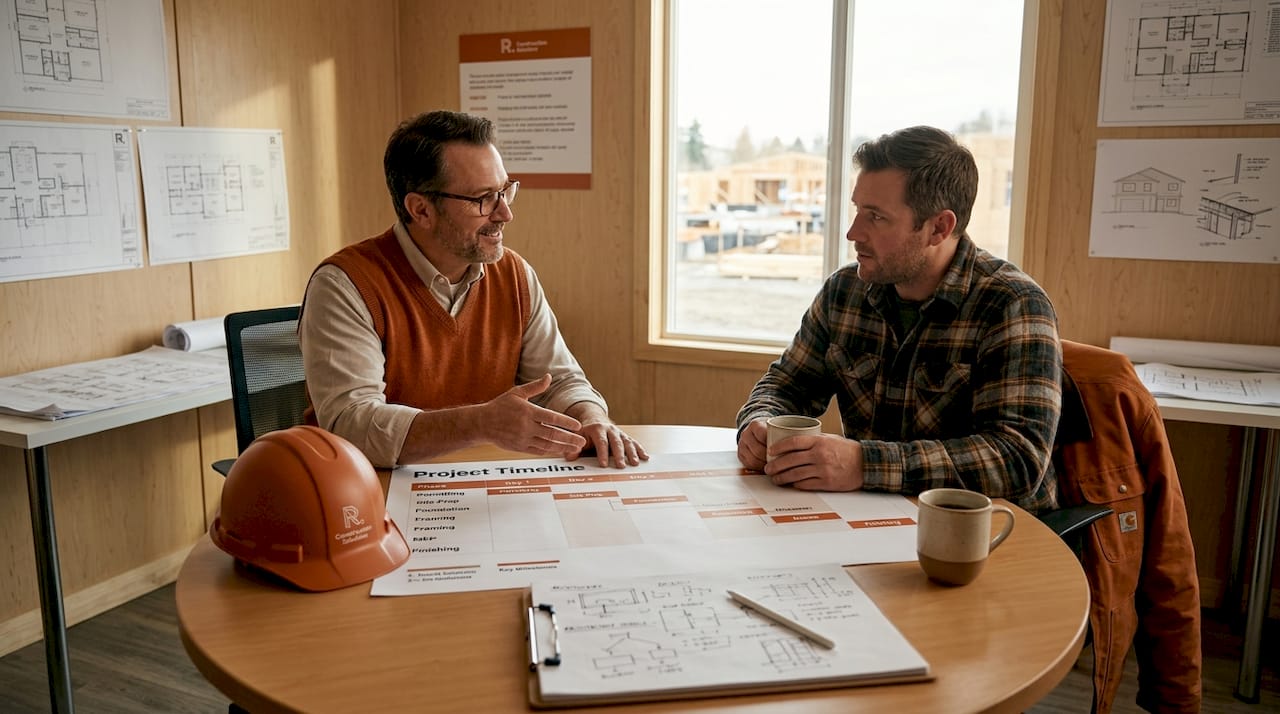
Experience questions are the fastest way to separate credible consultants from polished presenters. Ask specifically about projects that match your scale, trade type, and complexity. A consultant who has only worked on commercial high-rises will give you generic advice on residential tract development, no matter how impressive their portfolio looks.
Start with these targeted questions:
- “Which projects in your portfolio are most similar to mine in scope and budget?” This forces specificity. Vague answers signal a shallow bench.
- “Who specifically will be assigned to my project day to day?” Consulting firms often sell with senior engineers but deliver with junior staff. High staff turnover and opaque delivery leads to inconsistent work and knowledge transfer failures. Get names in writing before you commit.
- “Are you licensed, bonded, and insured for this project type?” This is a baseline requirement, not a bonus. Request certificates, not verbal assurances.
- “Can you provide three references from projects similar to mine, and may I contact them directly?” A logo list on a website proves nothing. A direct conversation with a past client reveals turnaround time, communication quality, and whether the consultant delivered what they promised.
The most credible consultants integrate field-proven experts early in the engagement to ground advice in operational reality rather than theory. Ask whether their team includes personnel with actual trade experience, not just project management credentials.
Pro Tip: Ask a behavioral question like “Tell me about a project where your recommendation was rejected by the client. What happened next?” Consultants who answer honestly demonstrate the transparency and commercial awareness you need in a real working relationship.
How to clarify the consultant’s delivery model and scope boundaries
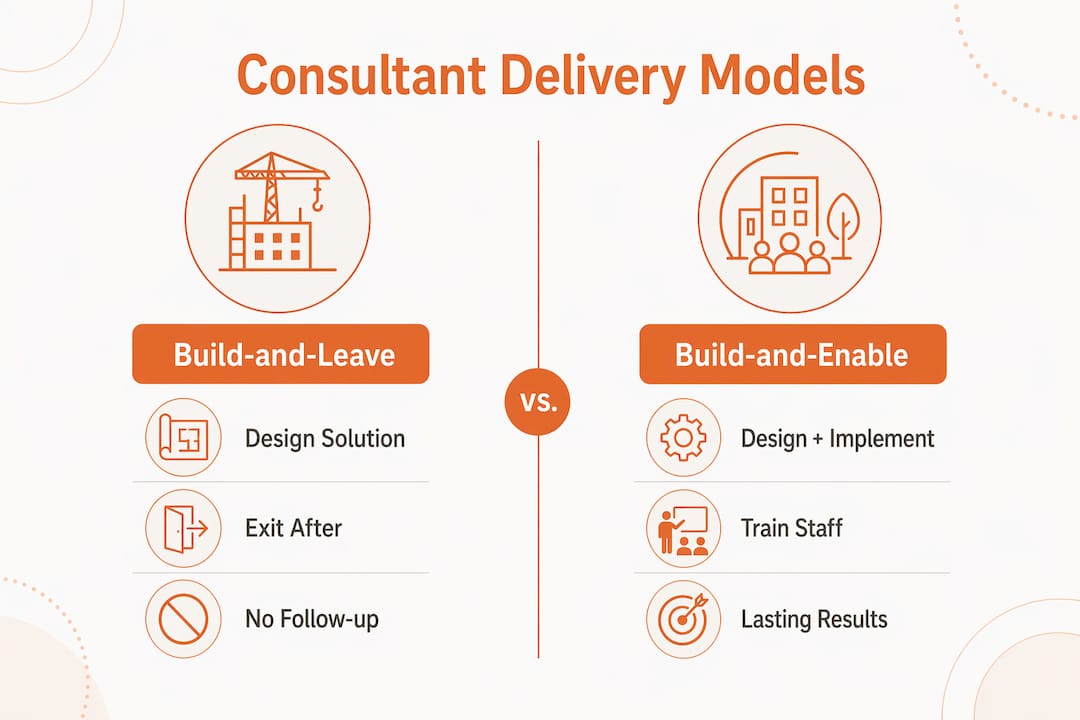
Delivery model questions protect you from the most common consulting failure: a finished report with no one left to implement it. The construction industry uses two fundamentally different models, and knowing which one you are buying matters enormously.
| Delivery Model | What It Means | Best For |
|---|---|---|
| Build-and-leave | Consultant designs the solution and exits | One-time audits, compliance reviews |
| Build-and-enable | Consultant designs, implements, and trains your team | Operational improvement, long-term efficiency |
The build-and-enable model produces lasting results because it transfers capability to your staff. Ask directly: “Will your team train my people to maintain this process after you leave, or does ongoing performance depend on retaining you?” A consultant who cannot answer this clearly is likely operating in build-and-leave mode regardless of what their proposal says.
Scope boundaries must be defined in writing, specifying exactly what the consultant owns and what remains your responsibility. Typical scopes include safety audits, training programs, and site inspections, but each requires explicit definition to avoid mid-project gaps. Ask for a written scope document before any work begins, and review it line by line.
Also probe how the consultant coordinates with your existing team and subcontractors. Questions like “How do you handle conflicts between your recommendations and our current subcontractor agreements?” reveal whether they understand field realities or only work in controlled environments. The best consultants treat your existing team as partners, not obstacles. You can review how consulting responsibilities and ownership should be structured before your first meeting to set clear expectations.
What metrics should a construction consultant provide?
Metrics questions separate consultants who deliver results from those who deliver activity. Effective consultants measure beyond vague KPIs and explain success with real operational improvements tied to your specific project conditions.
Ask these questions directly:
- “How do you define project success, and what specific metrics will we track?” If the answer includes phrases like “improved communication” or “better alignment,” push harder. You want numbers: reduced rework percentage, faster permit turnaround, lower cost per square foot.
- “Can you show me a case study where you recovered a troubled project? What were the measurable outcomes?” Consultants should provide specific case studies demonstrating how they navigate project recovery and risk sizing. A consultant with no recovery experience has not been tested under real pressure.
- “How do you evaluate and communicate risk before it becomes a problem?” This reveals whether they use structured risk registers, informal gut checks, or something in between.
- “How often will you report progress, and in what format?” Weekly written updates with defined KPIs are the standard for accountable engagements. Monthly verbal summaries are not.
The difference between a vague promise and a tangible outcome is documentation. If a consultant cannot show you a past client’s before-and-after metrics, they are asking you to trust their reputation instead of their results. That is a risk you do not need to take.
Understanding how process improvement drives measurable outcomes in construction gives you a baseline for evaluating whether a consultant’s proposed metrics are realistic or inflated.
What problem-solving and communication questions reveal consultant fit?
Communication questions uncover how a consultant behaves when things go wrong, which is exactly when you need them most. A consultant who only delivers good news is not a partner. They are a liability.
Use this numbered sequence of questions to assess fit during your initial meeting:
-
“Describe a time you disagreed with a client’s project decision. How did you handle it?” This tests whether they advocate for the right outcome or simply defer to whoever is paying. You want a consultant who pushes back professionally, not one who tells you what you want to hear.
-
“Give me an example of delivering bad news to a client. What was the situation and what was the outcome?” Handling failure and delivering bad news are key experience indicators. Consultants who cannot recall a single difficult conversation are either inexperienced or evasive. Neither is acceptable.
-
“How do you manage communication with multiple stakeholders, including subcontractors, owners, and inspectors?” This reveals whether they have a structured communication plan or rely on informal relationships that break down under pressure.
-
“Do you coach and train our internal team, or do you replace our existing workflows?” The best consulting partnerships combine AI with expert human insights to train and enable internal teams rather than simply replacing workflows. A consultant who cannot articulate a training component is building dependency, not capability.
-
“What is your process when a project goes off schedule or over budget?” The answer should include a defined escalation path, not a vague commitment to “work through it together.”
Pro Tip: Use situational questions rather than hypothetical ones. “Tell me about a time when…” produces real evidence. “What would you do if…” produces rehearsed answers that reveal nothing about actual behavior under pressure.
When and how to test a consultant before full engagement
A trial project is the most reliable way to evaluate a construction consultant before committing to a full engagement. Small test projects reveal fit beyond portfolio review by exposing turnaround times, communication quality, software compatibility, and team continuity under real conditions.
Structure your pilot engagement around these evaluation criteria:
| Evaluation Criterion | What to Measure | Red Flag |
|---|---|---|
| Deliverable quality | Accuracy, completeness, format | Vague outputs with no defined metrics |
| Responsiveness | Reply time to questions and change requests | Delays over 24 hours without explanation |
| Team continuity | Same personnel throughout the pilot | Staff changes mid-project without notice |
| Tool compatibility | Works within your existing software stack | Requires you to adopt their proprietary systems |
| Scope adherence | Stays within agreed boundaries | Scope creep without written change orders |
Define your go/no-go criteria before the pilot begins, not after. If the consultant delivers the pilot on time, within scope, with clear documentation and consistent personnel, you have strong evidence they can perform at full scale. If any of the red flags above appear during a small engagement, they will multiply on a large one. The pilot also tests whether the consultant’s operational improvement approach aligns with how your team actually works in the field.
Key takeaways
Asking the right questions before hiring a construction consultant is the single most effective way to protect your project budget, timeline, and team capability.
| Point | Details |
|---|---|
| Verify personnel, not just credentials | Ask who will do day-to-day work and get names in writing before signing. |
| Demand written scope boundaries | Specify consultant ownership and client responsibilities to prevent mid-project gaps. |
| Require measurable success metrics | Push past vague KPIs and ask for documented before-and-after results from past projects. |
| Use behavioral interview questions | Situational questions reveal real judgment and transparency better than hypothetical ones. |
| Run a pilot project first | A small test engagement exposes communication quality, team continuity, and tool fit before full commitment. |
What I’ve learned about picking the right construction consultant
After working with contractors across residential and commercial sectors for over three decades, the pattern I see most often is this: contractors spend more time evaluating equipment purchases than they spend evaluating consultants. A $50,000 piece of equipment gets a full spec review. A $50,000 consulting engagement gets a 30-minute call and a proposal review.
The consultants who consistently deliver results share one trait: they are uncomfortable with vague scope. They push back on unclear deliverables. They ask you hard questions before you ask them. That behavior during the sales process is the clearest signal of how they will behave when the project gets difficult.
I have also seen contractors get burned by firms that present senior partners during the pitch and rotate in junior staff the week work begins. The fix is simple: name the personnel in the contract. If the firm resists that request, walk away.
The most underrated question in any construction project inquiry is “What does done look like?” Consultants who answer that question with specific, measurable criteria are the ones worth hiring. Consultants who answer with process descriptions and deliverable lists are telling you they measure activity, not outcomes. That distinction matters more than any credential on their resume.
— Rowena
How Rconstructionsolutions helps contractors get consulting right
Rconstructionsolutions brings over 30 years of hands-on construction experience to every engagement, working with both residential and commercial contractors to improve workflows, reduce operational waste, and build internal team capability. Their construction consulting services cover safety audits, process improvement, estimating automation, and training programs tailored to your specific trade and project type. Unlike generic consulting firms, Rconstructionsolutions assigns experienced practitioners who have worked in the field, not just managed from the office. Mid-sized firms scaling from $5 million to $50 million have seen measurable income growth through their personalized approach. If you are ready to engage a consultant who can answer every question in this guide with documented evidence, contact Rconstructionsolutions for a tailored consulting assessment.
FAQ
What are the most important questions to ask a construction consultant?
Ask about their relevant project experience, who will do the day-to-day work, how they define success with specific metrics, and what their scope boundaries are in writing. These four areas reveal whether a consultant can deliver real operational improvement or just a polished report.
How do I evaluate a construction consultant’s qualifications?
Request proof of licensing, bonding, and insurance, then verify references directly with past clients rather than relying on a portfolio or logo list. Ask specifically about projects that match your scale and trade type.
What is the difference between a build-and-leave and build-and-enable consultant?
A build-and-leave consultant designs a solution and exits, while a build-and-enable consultant implements the solution and trains your team to maintain it. The build-and-enable model produces lasting operational improvements because it transfers capability rather than creating ongoing dependency.
Should I run a trial project before hiring a construction consultant?
Yes. A small pilot project reveals turnaround time, communication quality, team continuity, and software compatibility before you commit to a full engagement. Define your go/no-go criteria before the pilot begins so the evaluation stays objective.
What questions reveal how a consultant handles problems?
Ask for a specific example of delivering bad news to a client and how they managed disagreements on project decisions. Consultants who cannot recall a difficult situation are either inexperienced or unwilling to be transparent, both of which are disqualifying for a serious engagement.