
Why Contractors Hire Outside Consultants: 2026 Guide
Contractors hire outside consultants to access specialized expertise, objective analysis, and proven methodologies that internal teams cannot reliably provide on their own. This practice, formally known as external consulting engagement, gives construction firms a direct path to faster problem resolution, reduced operational friction, and measurable gains in project efficiency. Whether you are managing a $5 million residential operation or scaling toward $50 million in commercial work, understanding why contractors hire outside consultants is one of the most practical decisions you can make for your business in 2026.
Why contractors hire outside consultants: the core strategic case
The fundamental reason contractors bring in outside consultants is access to knowledge they do not already have in-house. Construction projects involve estimating, scheduling, contract management, dispute resolution, and technology adoption. No single internal team masters all of these at a high level simultaneously. Outside consultants fill those gaps with precision.
Consultants provide an unbiased perspective that internal staff simply cannot replicate. When your team has worked the same way for years, they develop blind spots. They become attached to legacy systems, familiar workflows, and established relationships. A consultant walks in without that baggage and identifies root causes that your team has been working around for months.

The benefits of hiring consultants extend beyond fixing problems. They also validate strategic decisions. When you are considering a major investment in AI-driven estimating tools or restructuring your project management workflow, a consultant with cross-industry expertise can confirm whether your direction is sound before you commit resources. That external validation carries weight with stakeholders, lenders, and partners.
Here is what outside consultants consistently bring to contractor engagements:
- Niche technical knowledge in areas like construction law, scheduling software, or subcontractor management that your team lacks
- Neutral third-party perspective free from internal politics or loyalty to existing processes
- Structured problem-solving frameworks developed across multiple industries and project types
- Cross-pollination of ideas from sectors outside construction that translate into practical workflow improvements
- Speed of deployment measured in days, not the 23-plus days a standard hiring process requires
Pro Tip: Before engaging a consultant, write down the three specific outcomes you want within 90 days. Consultants perform best when they have a defined target, not an open-ended mandate to “improve things.”
How do outside consultants improve operational efficiency?
The financial case for external consulting is direct. Consultants deliver cost savings up to 30% compared to permanent hires, because you convert fixed labor costs into flexible, project-based expenses. You pay for the expertise when you need it and stop when the work is done. No salary, no benefits, no long-term overhead.
Beyond cost structure, the productivity gains are significant. Companies that act on consultant recommendations for workflow and technology optimization report 20 to 50% productivity improvements. For a contractor running multiple job sites, a 20% productivity gain in scheduling or procurement can translate directly into faster project delivery and more bids completed per quarter.
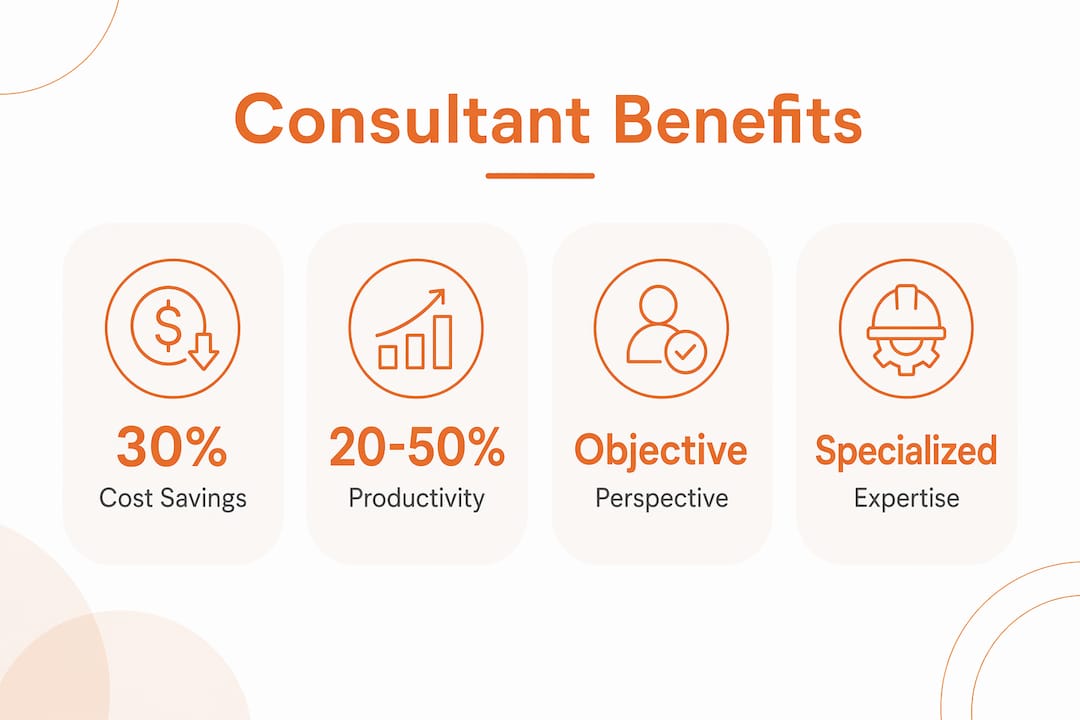
The table below shows how the consultant model compares to a full-time internal hire across the factors that matter most to contractors:
| Factor | Outside consultant | Full-time internal hire |
|---|---|---|
| Time to deploy | Days | 23+ days average hiring process |
| Cost structure | Project-based, flexible | Fixed salary plus benefits |
| Expertise depth | Specialized and current | Generalist, may require training |
| Objectivity | High, no internal bias | Lower, subject to internal politics |
| Productivity impact | 20–50% improvement reported | Gradual, dependent on onboarding |
Leadership focus is another critical factor. When your project manager or operations lead spends weeks managing a dispute, diagnosing a scheduling breakdown, or troubleshooting a subcontractor conflict, they are not bidding new work, building client relationships, or planning the next phase of growth. Delaying consultant engagement increases internal friction and diverts leadership focus in ways that cost far more than consultant fees.
“The true hidden cost of managing complex issues internally is not the time spent solving the problem. It is the opportunity cost of the bids not submitted, the hires not made, and the growth initiatives that stall while your best people are distracted.” — SJ Civil
Rconstructionsolutions has seen this pattern repeatedly with mid-sized contractors. When leadership is pulled into operational firefighting, growth stalls. Bringing in a consultant to handle the specific issue restores capacity at the top of the organization, which is where the highest-value decisions get made. You can explore how this plays out in practice through process improvement for construction firms that have made this shift.
What are the key contractual considerations when engaging consultants?
Getting the contractual framework right protects both you and the consultant. A formal Consulting Agreement with clearly defined scope, payment terms, confidentiality provisions, and intellectual property rights is not optional. It is the foundation of a productive working relationship.
The most important clauses to include in any consulting agreement are:
- Scope of work: Define deliverables, timelines, and what is explicitly out of scope to prevent scope creep
- Independent contractor status: Confirm the consultant operates independently, uses their own tools, and serves multiple clients
- Confidentiality: Protect your project data, pricing, client lists, and proprietary processes
- IP ownership: Specify who owns any systems, templates, or processes developed during the engagement
- Payment terms: Set clear milestones, invoicing schedules, and conditions for final payment
Misclassification risk is real. If a consultant works exclusively for you, uses your equipment, and follows your daily direction, tax authorities may reclassify them as an employee. U.S. companies must issue Form 1099-NEC for consultants paid over $600 annually, and the IRS applies a multi-factor test to determine worker classification. Maintaining economic independence for your consultant, including control over their methods and a diverse client base, reduces that risk significantly.
Pro Tip: Ask your consultant for a client list or references before signing. A consultant who works with multiple clients in your sector is easier to classify correctly and typically brings broader, more current knowledge to your project.
The comparison below highlights the key differences between a properly structured consulting engagement and a misclassified arrangement:
| Characteristic | Properly classified consultant | Misclassification risk |
|---|---|---|
| Tool ownership | Consultant owns their tools | Client provides all equipment |
| Work direction | Consultant controls methods | Client directs daily tasks |
| Client diversity | Multiple clients | Exclusive to one client |
| Tax documentation | Form 1099-NEC issued | Payroll taxes may apply |
When should contractors bring in outside consultants?
Timing matters. Bringing in a consultant too late means you have already absorbed the cost of the problem. Bringing one in too early on a straightforward issue wastes budget. The right moment is when the problem exceeds your team’s current capacity or expertise, not after it has compounded into a crisis.
Here are five clear indicators that signal it is time to engage external expertise:
- Your leadership team is spending more than 20% of their time on a single operational problem rather than on growth, client relationships, or new bids.
- A project phase requires specialized knowledge your team does not have, such as construction law, advanced scheduling software, or dispute mediation.
- You are scaling rapidly and your existing workflows cannot support the volume without breaking down.
- An external audit, dispute, or compliance issue requires a neutral third party to assess the situation objectively.
- You are evaluating a major technology investment, such as AI-driven estimating tools, and need validation before committing capital.
Once you decide to engage, the selection process matters as much as the timing. Review the consultant’s track record with contractors at your revenue level. Ask specific questions about their methodology and how they measure results. Rconstructionsolutions recommends reviewing questions to ask a construction consultant before your first meeting to set clear expectations from the start.
Successful contractor-consultant partnerships also require internal buy-in. A consultant can diagnose the problem and design the solution, but your team has to implement it. If your project managers or operations staff resist the changes, the engagement will underdeliver. Assign an internal point of contact who has the authority to act on consultant recommendations and the credibility to bring the team along.
Key takeaways
Contractors who engage outside consultants strategically gain faster problem resolution, lower operational costs, and the leadership capacity to focus on growth rather than firefighting.
| Point | Details |
|---|---|
| Cost efficiency | Consultants reduce costs up to 30% versus full-time hires by converting fixed labor into flexible project-based fees. |
| Productivity gains | Workflow and technology improvements driven by consultants produce 20 to 50% productivity increases. |
| Objective expertise | Consultants identify root causes internal teams miss due to bias, familiarity, or attachment to legacy processes. |
| Contract clarity | A formal Consulting Agreement with defined scope, IP rights, and independent contractor status protects both parties. |
| Timing is critical | Engage consultants when problems exceed internal capacity, not after they have compounded into costly crises. |
What I have learned about contractors who wait too long
I have worked with contractors across residential and commercial sectors for over three decades, and the pattern I see most often is not that contractors do not value outside expertise. It is that they wait too long to use it.
The hesitation is understandable. Bringing in an outside consultant can feel like admitting your team cannot handle the job. But that framing is wrong. The contractors who grow fastest are not the ones who handle everything internally. They are the ones who recognize the difference between what their team does well and what requires a different kind of expertise.
I have watched mid-sized firms spend six months managing a scheduling dispute internally, only to bring in a consultant who resolved it in three weeks. The cost of those six months, in leadership time, delayed bids, and team friction, far exceeded what the consultant charged. Early consultant engagement prevents exactly that kind of compounding loss.
The contractors I respect most treat consultants as a permanent part of their operating model, not a last resort. They bring in specialists for estimating reviews, compliance checks, technology transitions, and growth planning. They do not wait for a crisis. They use external expertise proactively, the same way they use attorneys or accountants. That mindset shift is what separates firms that scale from firms that plateau.
My honest advice: stop thinking of a consultant as a cost and start thinking of them as a multiplier. The right engagement, at the right time, with the right scope, pays for itself in weeks, not years.
— Rowena
Ready to put expert consulting to work for your firm?
Rconstructionsolutions was built specifically for contractors who want real results, not generic advice. With over 30 years of hands-on construction experience, the team at Rconstructionsolutions has helped mid-sized firms grow from $5 million to $50 million by fixing the operational problems that hold growth back.

From AI-driven estimating tools to workflow diagnostics and compliance support, the construction consulting services at Rconstructionsolutions are tailored to your specific project type, revenue stage, and growth goals. Whether you are a residential contractor managing subcontractor relationships or a commercial firm scaling into new markets, the team delivers personalized strategies that produce measurable outcomes. Explore the full range of consulting services for contractors and find out where outside expertise can make the biggest difference for your operation.
FAQ
Why do contractors hire outside consultants instead of promoting internally?
Outside consultants bring specialized expertise and an objective perspective that internal promotions cannot replicate. They also deploy in days rather than weeks, with no long-term salary or benefits commitment.
What is the biggest financial benefit of hiring a consultant?
Cost savings up to 30% versus a permanent hire, combined with productivity improvements of 20 to 50%, make consulting engagements one of the highest-return investments a contractor can make.
How do I protect my business when hiring an outside consultant?
Use a formal Consulting Agreement that defines scope of work, confidentiality obligations, IP ownership, and independent contractor status. Issue Form 1099-NEC for any consultant paid over $600 in a calendar year.
When is the right time to bring in a construction consultant?
The right time is when a problem exceeds your team’s current expertise or when leadership is spending significant time on operational issues instead of growth. Waiting until a situation becomes a crisis increases both the cost and the complexity of the solution.
Can outside consultants help with technology adoption in construction?
Yes. Consultants with construction technology experience can evaluate, implement, and train your team on tools like AI-driven estimating platforms and project management software, reducing the risk of costly failed implementations.