
Construction Consulting Services for Contractors: A 2026 Guide | R. Construction Solutions
Construction consulting services are defined as specialized professional support that improves project performance, controls costs, and reduces risk across every phase of a construction project. For contractors and construction managers, knowing the types of construction consulting services available is the difference between reactive problem-solving and proactive project control. Firms like Rconstructionsolutions, BFAB Construction, and Equitas Consulting each represent distinct consulting disciplines, from project management and cost estimating to claims support and owner’s representation. The right consulting mix depends on your project type, contract structure, and growth goals.
1. What are the main types of construction consulting services available?
Construction advisory services span six core disciplines, and each one targets a specific failure point in project delivery. Construction consulting services commonly include project management consulting, cost estimating, schedule and delay analysis, constructability review, and claims support. Understanding each type helps you engage the right expert at the right time rather than calling in help after a problem has already compounded.
- Project management consulting covers planning, coordination, and oversight from preconstruction through closeout. A project management consultant helps you build realistic schedules, assign accountability, and track KPIs across trades.
- Cost estimating and budget consulting involves reviewing bids, benchmarking unit costs, and tracking expenditures against the approved budget. This discipline catches scope gaps before they become change orders.
- Schedule and delay analysis uses critical-path method analysis to identify float consumption, delay causation, and schedule recovery options. Schedule consultants produce delay causation studies that are essential in dispute scenarios.
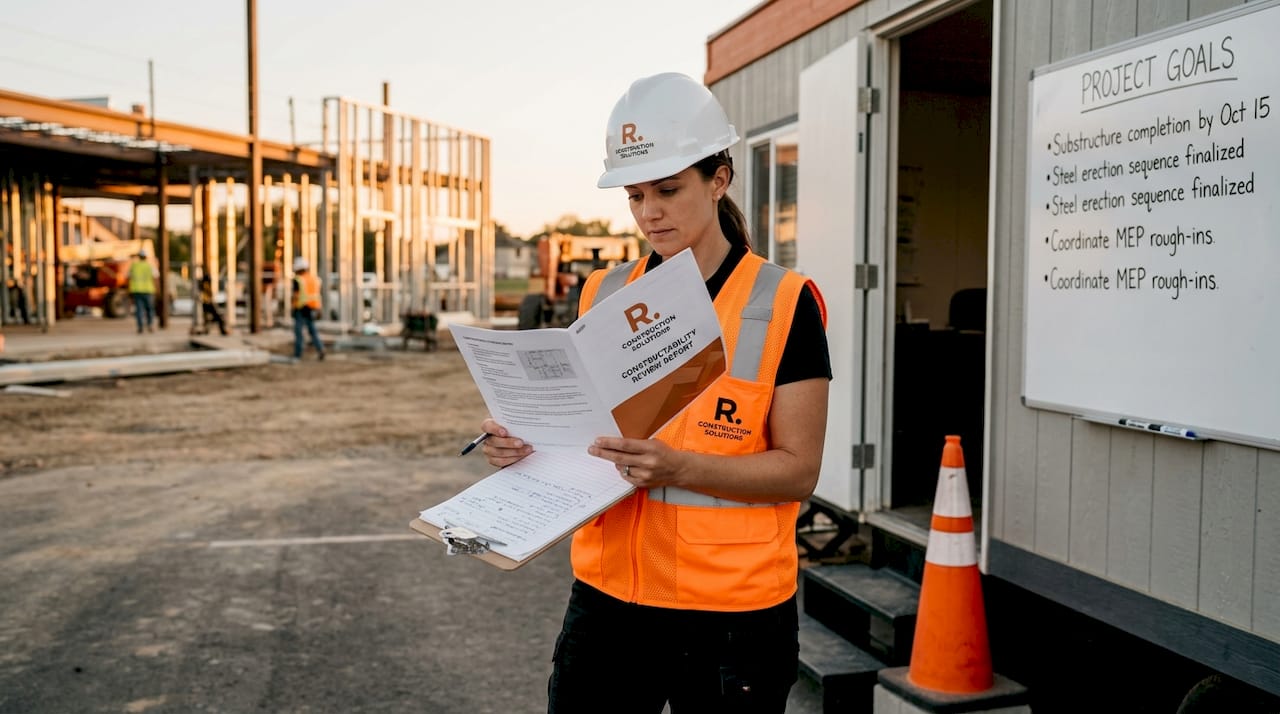
- Constructability review assesses whether a design can be built efficiently, safely, and within budget before construction starts. This service alone reduces rework costs that would otherwise surface mid-project.
- Claims and dispute support provides documentation strategy, notice review, and resolution guidance when contract disputes arise. Claims consultants do not replace legal counsel but prepare the factual record that legal teams rely on.
- Owner’s representative services place an independent advocate on site to manage the general contractor on behalf of the owner. This role is covered in detail in section five.
Pro Tip: Engage a constructability reviewer during design development, not after construction documents are issued. Catching a coordination conflict on paper costs a fraction of what it costs in the field.
Each of these construction consultancy options addresses a distinct risk category. Contractors who map their project risks first, then match consulting services to those risks, get measurably better outcomes than those who hire generically.
2. How advisory, procurement, and financing consulting support construction projects
Strategic advisory services operate upstream of construction, during feasibility, procurement, and financing decisions. Advisory services include due diligence, feasibility studies, contract advisory, procurement strategy, and scenario-based investment advice. This is where the financial and contractual framework of a project is set, and errors at this stage are the most expensive to correct later.
Feasibility studies determine whether a project is worth pursuing at all. They model costs, timelines, revenue assumptions, and risk scenarios so owners and contractors can make informed go or no-go decisions. Contract advisory services then define how procurement will be structured, which delivery method fits the project, and what risk allocation the contract should reflect.
Procurement and financing consulting is particularly critical for large infrastructure projects where funding mixes, public-private partnerships, and long-term risk planning must be resolved before a single contract is signed. Procurement decisions made at inception affect cost, schedule, and contractor selection for the entire project life cycle.
Early advisory engagement aligns scope, budget, and timeline before commitments are made. Contractors who participate in this phase, rather than waiting for a contract to be handed to them, gain a competitive advantage in pricing accuracy and risk awareness.
The practical benefit for contractors is direct. When you understand the procurement strategy your client is using, you can price risk more accurately, structure your bid more competitively, and anticipate the contract terms you will be managing. Construction advisory services at this stage are not just for owners. They are equally valuable for contractors who want to enter projects with clear eyes.
3. What specialist consulting services address claims, disputes, and complex contract management?
Claims consulting is the most misunderstood type of building consulting because most contractors engage it too late. Claims consulting is most effective when engaged early, not just at the dispute stage, enabling proper documentation and issue mitigation from the start of the project.
Specialist claims consulting retainers work differently from one-time expert engagements. Here is how a retainer-based claims consulting model typically operates:
- Contract award engagement. The claims consultant reviews the contract, identifies risk clauses, and establishes a notice and documentation protocol before work begins.
- Ongoing document review. Monthly advisory sessions cover correspondence, notices, and site records to keep the claims file current and structured.
- Real-time conduct monitoring. Claims consulting involves reviewing notices before they are served and monitoring engineer conduct under contracts like FIDIC in real time, not after the fact.
- Contemporaneous claims development. As delay events or scope changes occur, the consultant develops the claims narrative and supporting records in parallel with project execution.
- Dispute preparation. If a dispute escalates, the project team has a structured, contemporaneous record ready for arbitration or mediation rather than scrambling to reconstruct events.
Pro Tip: Treat your claims consultant as part of the project delivery team, not as a specialist you call when things go wrong. Embedding them early means your documentation is dispute-ready from day one.
Effective claims consulting treats notices and records as continuous operational workflows integrated with project execution, not as legal cleanup tasks. This distinction matters because courts and arbitrators weigh contemporaneous records far more heavily than reconstructed timelines. Contractors who build this discipline into their project operations reduce both the frequency and cost of disputes.
4. How an owner’s representative differs from a construction manager
The distinction between an owner’s representative and a construction manager is contractual, not just operational. Owner’s representatives manage the general contractor on behalf of the owner without assuming contractual delivery responsibility. A construction manager at risk, by contrast, holds the construction contract and carries financial exposure for cost overruns and schedule failures.
This difference has direct implications for contractors. When you are working under an owner’s rep model, your contractual counterpart is still the owner. The rep acts as the owner’s eyes and ears, reviewing your change orders, monitoring your schedule, and reporting on quality. When you are working under a construction manager at risk, that entity is your client and carries the delivery risk.
Owner’s representative typical duties include:
- Site presence and daily observation
- Trade contractor coordination and interface management
- Change order review and recommendation to the owner
- Budget tracking and cost reporting
- Schedule monitoring and variance reporting
- Quality benchmark enforcement
Owner’s representative services align incentives by avoiding the conflicts of interest inherent in contractor-led oversight, protecting budget and schedule priorities without the motivation to approve change orders that benefit the contractor. This model gives owners independent advocacy, which is why it is increasingly common on public and institutional projects.
Early involvement of owner’s representatives during design and team selection phases results in better control over scope, quality, schedule, and cost. For contractors, this means the owner’s rep who engages during design will already understand the project intent, the budget constraints, and the quality benchmarks before your crew arrives on site. That clarity reduces ambiguity and change order disputes.
| Role | Contractual responsibility | Primary function |
|---|---|---|
| Owner’s representative | None. Advocates for owner. | Independent oversight, reporting, change order review |
| Construction manager at risk | Yes. Holds delivery contract. | Manages subcontractors, carries cost and schedule risk |
| General contractor | Yes. Holds construction contract. | Executes the work, manages trades |
Understanding which model applies to your project shapes how you communicate, document, and price your work. Contractors who recognize the owner’s rep model early adjust their documentation practices accordingly and avoid the friction that comes from misreading the chain of authority.
Key takeaways
The most effective construction consulting strategy matches specific service types to specific project risks, engaged early and integrated into the project team rather than called in reactively.
| Point | Details |
|---|---|
| Match consulting to risk | Identify your project’s top risk categories first, then select consulting services that address those specific gaps. |
| Engage claims consultants early | Retainer-based claims support from contract award produces structured, dispute-ready records throughout the project. |
| Advisory services belong upstream | Feasibility, procurement, and contract advisory consulting should be engaged before commitments are made, not after. |
| Owner’s rep vs. construction manager | These roles carry different contractual responsibilities; knowing which applies changes how you document and communicate. |
| Constructability review saves money | Reviewing designs for buildability before construction starts eliminates rework costs that compound quickly in the field. |
What I have learned about choosing the right consulting mix
After working with contractors across residential and commercial projects, the pattern I see most often is this: contractors engage consulting services too narrowly and too late. They hire a schedule consultant after a delay claim has already been filed, or they bring in a cost estimating consultant after a bid has been submitted at a loss. The consulting value is real, but the timing erases most of it.
The contractors who get the most from their consulting relationships do three things differently. They define the scope of consulting engagement in writing before work begins, they integrate the consultant into their project communication channels rather than treating them as an outside vendor, and they act on consultant recommendations within the same reporting cycle rather than deferring until the next milestone.
I also see contractors default to broad, generalist consultants when their project actually needs a specialist. A firm scaling from five million to fifty million in revenue needs a different consulting mix than a firm managing a single complex infrastructure project. Rconstructionsolutions addresses this directly by tailoring service packages to the contractor’s actual stage of growth and project type, which is a more honest approach than selling a one-size-fits-all retainer.
The uncomfortable truth is that most construction disputes and budget overruns are not caused by bad execution. They are caused by poor documentation, unclear contract interpretation, and late engagement of the people who could have prevented the problem. If you are reading this article, you are already ahead of the contractors who wait until the problem is visible to ask for help. Use that advantage. Match your consulting questions to your project’s specific risks, engage early, and treat your consultants as part of the team.
— Rowena
How Rconstructionsolutions supports contractors with tailored consulting
Rconstructionsolutions brings over 30 years of hands-on construction experience to contractors and construction managers who need more than generic advice. Their construction consulting services cover project management, cost estimating, workflow analysis, and business growth strategy, all tailored to your firm’s size and project type. Whether you are a general contractor managing trade coordination or a construction manager tracking KPIs across multiple projects, Rconstructionsolutions builds a consulting plan around your actual operations.
Mid-sized firms working with Rconstructionsolutions have scaled from five million to fifty million in revenue by applying structured process improvements and AI-driven estimating tools. If you are ready to move from reactive management to proactive project control, explore how general contractor consulting from Rconstructionsolutions can deliver measurable results for your business.
FAQ
What are construction consulting services?
Construction consulting services are specialized professional advisory functions that support contractors, owners, and construction managers in improving project performance, controlling costs, and resolving disputes. Services range from project management consulting and cost estimating to claims support and owner’s representation.
When should a contractor engage a claims consultant?
Claims consulting is most effective when engaged at contract award, not after a dispute has already escalated. Early engagement allows the consultant to establish documentation protocols and monitor notices in real time throughout project execution.
What is the difference between an owner’s rep and a construction manager?
An owner’s representative advocates for the owner without holding contractual delivery responsibility, while a construction manager at risk carries the construction contract and financial exposure for cost and schedule performance. The distinction determines your contractual counterpart and documentation obligations.
How does constructability review reduce project costs?
Constructability review identifies design conflicts and buildability issues before construction starts, eliminating the rework costs that result from discovering those conflicts in the field. Catching a coordination problem on paper costs a fraction of what it costs once crews are mobilized.
What types of building consulting help with procurement and financing?
Feasibility studies, contract advisory, and procurement and financing consulting help owners and contractors evaluate project viability, structure funding, and define risk allocation before contracts are signed. These services are particularly critical for large infrastructure and public-private partnership projects.