
How to Choose the Right Construction Business Consultant
A construction business consultant is an independent advisor who helps contractors improve project performance, control costs, and build sustainable operations. Hiring the right one can save 10–20% of total construction costs by preventing avoidable planning and execution mistakes. That figure represents real money on a $5 million project. To choose the right construction business consultant, you need to evaluate three things before anything else: independence, relevant expertise, and alignment with your current growth phase. This guide gives you the criteria, the questions, and the red flags to make that decision with confidence.
What qualifications should you look for in a construction business consultant?
The most important credential a construction business consultant can hold is independence. A true consultant acts exclusively on behalf of the owner, not the contractor or subcontractor. That distinction protects your interests when budget pressures create competing priorities on site.
Beyond independence, look for these core qualifications:
- Construction project management experience. The consultant should have direct experience managing projects similar in type, size, and phase to yours. A residential remodeling expert is not automatically qualified to advise on commercial ground-up construction.
- Technical literacy. The best advisors can read plans, interpret schedules, and speak fluently with field crews. Field-aware coaches translate complex strategy into language that resonates with both site teams and executives.
- Cost control and estimating knowledge. Consultants who understand estimating, change order management, and KPI tracking add measurable value from day one.
- Familiarity with digital tools. Proficiency with BIM platforms, project management software, and AI-driven estimating tools signals that the advisor can help you modernize your workflows, not just advise on paper.
- Business coaching skills. Technical knowledge alone is not enough. The right advisor also understands cash flow, hiring, and scaling operations. Rconstructionsolutions, for example, has helped mid-sized firms grow from $5 million to $50 million in revenue by combining field knowledge with business leadership coaching.
Credentials like PMP certification, LEED accreditation, or membership in the Construction Management Association of America (CMAA) provide a useful baseline. They confirm professional standards but do not replace the need to verify project-specific experience.
Pro Tip: Ask every candidate to walk you through a project where their advice prevented a cost overrun. The specificity of their answer tells you more than any resume.

When evaluating construction consultants, also confirm they have no financial relationship with any contractor, supplier, or subcontractor who might work on your project. Conflicts of interest are common and rarely disclosed upfront.
How do you evaluate and compare proposals from construction consultants?
Comparing proposals is where most contractors make their first mistake. They receive three documents with different formats, different assumptions, and different scopes, then try to compare them on price alone. That approach leads to scope creep, cost overruns, and broken expectations.
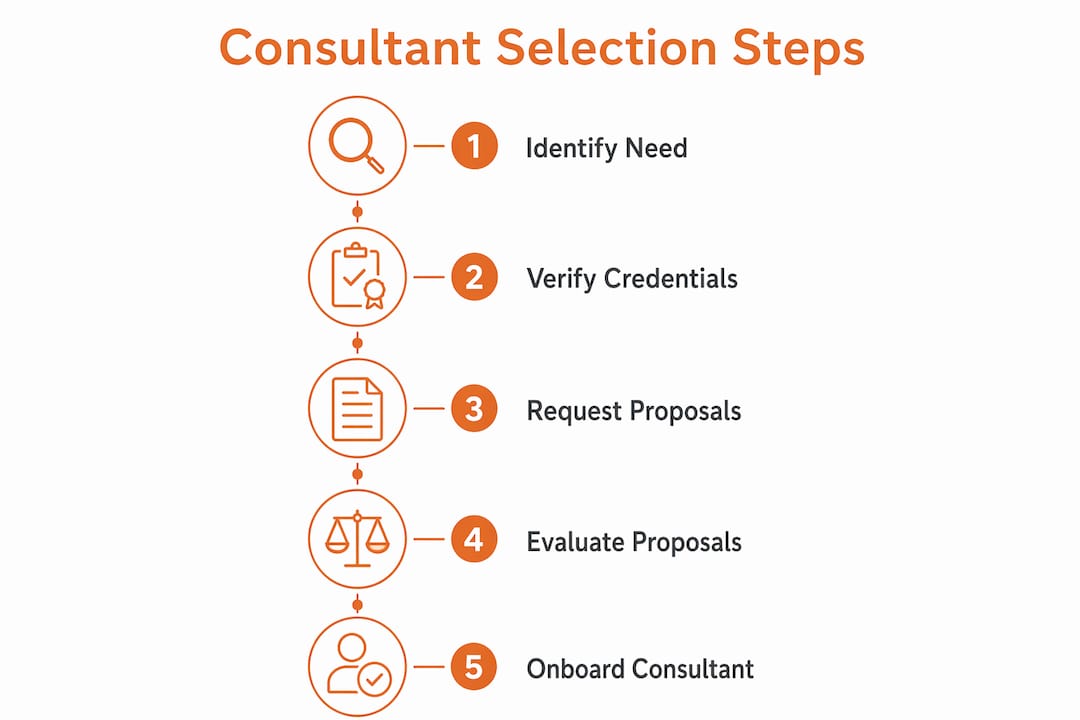
The fix is standardization. Defining clear project goals and explicit assumptions in your request for proposal forces every consultant to respond to the same baseline. It also reveals which firms ask clarifying questions versus which ones submit generic responses.
Use a scoring matrix to evaluate each proposal across these five criteria:
- Technical approach. Does the proposal address your specific project type, phase, and risk profile? Generic methodology descriptions are a red flag.
- Team quality. Who exactly will work on your project? Confirm that the senior consultant named in the proposal is the one showing up on site, not a junior associate.
- Fee structure. A trustworthy firm provides an open-book fee structure with no hidden scope exclusions. Vague language around “additional services” is a warning sign.
- Risk management approach. Ask how the consultant identifies and communicates risks. Proactive risk disclosure separates experienced advisors from reactive ones.
- Communication plan. Confirm reporting frequency, escalation protocols, and who owns each deliverable.
| Evaluation criterion | What to look for | Red flag |
|---|---|---|
| Technical approach | Project-specific methodology | Generic or templated response |
| Team quality | Named senior consultant on site | Bait-and-switch with junior staff |
| Fee structure | Itemized costs, no hidden exclusions | Vague “additional services” language |
| Risk management | Proactive disclosure process | No mention of risk protocols |
| Communication plan | Defined reporting cadence | Unclear ownership of deliverables |
Using a scoring system and involving your project manager, operations lead, and finance contact in the evaluation reduces bias. It also builds internal buy-in before the engagement starts, which matters when the consultant later recommends changes to how your team works.
Pro Tip: Run a short paid discovery session with your top two finalists before signing a full contract. A two-hour working session reveals how they think, communicate, and handle pushback far better than any proposal document.
What steps help contractors onboard and collaborate with a consultant effectively?
Selecting the right advisor is only half the work. How you bring them into your organization determines whether the engagement delivers results or stalls in confusion.
Start with a written governance structure before the first meeting. Define who the consultant reports to, what decisions they can make independently, and what requires your approval. Without this clarity, small issues snowball into big problems by week three.
Key onboarding steps that protect the engagement:
- Set a communication rhythm. Weekly check-ins, monthly progress reports, and a clear escalation path for urgent issues keep everyone aligned. Silence between meetings is where projects drift.
- Share your full operational picture. Give the consultant access to your financials, scheduling data, and past project post-mortems. Consultants who work with incomplete information give incomplete advice.
- Define the governance boundary. Effective consulting engagements require owners to shift from executing daily tasks to governing outcomes. That shift feels uncomfortable at first. It is also necessary for the engagement to work.
- Protect consultant independence. Do not route the consultant’s recommendations through your general contractor or subcontractors before acting on them. That path compromises the advice.
- Assign an internal point of contact. One person on your team should own the relationship, track deliverables, and flag issues early.
Pro Tip: Document every recommendation the consultant makes and your response to it. This creates accountability on both sides and gives you a clear record if scope disputes arise later.
Rconstructionsolutions structures its engagements with defined governance frameworks from day one. That approach reduces friction and keeps the focus on measurable outcomes like workflow efficiency, scheduling accuracy, and cost control.
Common mistakes to avoid when selecting a construction business advisor
Most selection errors are predictable. Knowing them in advance saves you time, money, and a failed engagement.
- Choosing on price alone. The lowest fee rarely reflects the best value. A consultant who charges less but lacks experience with your project phase will cost you more in rework and missed risks.
- Ignoring compatibility. Compatibility with your company culture and growth phase is as important as credentials. A consultant who thrives in large commercial firms may struggle to advise a 15-person residential contractor scaling its first commercial project.
- Skipping the independence check. Failing to verify that your consultant has no financial ties to contractors or suppliers on your project is one of the most costly oversights in construction consulting.
- Skipping proposal standardization. Sending vague project briefs produces vague proposals. You cannot make a sound decision when each proposal answers a different question.
- Resisting the governance shift. Owners who stay in execution mode undermine the consultant’s ability to advise objectively. The owner role transition to governance is a practical requirement, not a suggestion.
The pattern behind most of these mistakes is the same: contractors treat consultant selection like hiring a subcontractor. It is not the same process. A subcontractor delivers a defined scope. A consultant shapes how you think about and manage your entire project. That distinction changes every step of the selection process.
Key takeaways
Choosing the right construction business consultant requires verifying independence, matching expertise to your project phase, and standardizing your evaluation process before comparing proposals.
| Point | Details |
|---|---|
| Verify independence first | Confirm the consultant has no financial ties to contractors or suppliers on your project. |
| Match expertise to your phase | A consultant experienced with your project type and growth stage prevents costly mismatches. |
| Standardize your RFP | Define clear goals and assumptions so every proposal answers the same question. |
| Use a scoring matrix | Evaluate proposals on technical approach, team quality, fees, risk, and communication. |
| Commit to the governance shift | Moving from execution to oversight is required for the consulting engagement to deliver results. |
What I’ve learned about finding the right construction advisor
After working with contractors across residential and commercial sectors, the single biggest predictor of a successful consulting engagement is not credentials. It is whether the consultant can hold a direct conversation with both a field foreman and a CFO without losing either one.
Most contractors I talk to focus their evaluation on certifications and project lists. Those matter. But I have seen PMP-certified consultants completely lose a crew because they could not translate their recommendations into field-level language. And I have seen advisors with no formal certification transform a contractor’s scheduling and cash flow because they understood the actual pressure points of the business.
The other thing I would push back on is the instinct to hire fast. When a project is already in trouble, the urgency to bring in help can lead you to skip the independence check, accept a vague proposal, or hire someone who worked well for a peer but is a poor fit for your growth stage. Slow down the selection process by one week. Run that paid discovery session. It will save you months of frustration.
The contractors who get the most from their consulting relationships are the ones who treat the advisor as a genuine partner, share the uncomfortable financials, and actually shift into governance mode. That last part is the hardest. It is also where the real results come from.
— Rowena
How Rconstructionsolutions helps contractors find the right consulting fit
Rconstructionsolutions brings over 30 years of hands-on construction experience to every engagement. The team works with both residential and commercial contractors, combining technical field knowledge with business growth strategy.
Whether you are scaling from $5 million toward $50 million or trying to fix a workflow that is costing you on every project, Rconstructionsolutions builds a plan around your specific operation. The team uses AI-driven estimating tools, structured governance frameworks, and KPI tracking to deliver results you can measure. Explore the full range of construction consulting services to see how a tailored engagement can improve your project outcomes and support long-term growth. Contractors can also access practical templates and tools through The Sandbox to support their work between consulting sessions.
FAQ
What does a construction business consultant actually do?
A construction business consultant advises contractors on project management, cost control, workflow efficiency, and business growth. Unlike a project manager embedded in a contractor’s team, a true consultant operates independently to protect the owner’s interests.
How do I know if a construction consultant is truly independent?
Ask directly whether the consultant has any financial relationship with contractors, suppliers, or subcontractors on your project. An independent advisor should be able to confirm this in writing without hesitation.
What is the biggest mistake contractors make when hiring a consultant?
The most common mistake is selecting on price and credentials alone while ignoring compatibility with company culture and project phase. A poor fit costs more in the long run than a higher consulting fee.
How long does it take to see results from a construction consulting engagement?
Results depend on project scope and the contractor’s readiness to shift into a governance role. Most contractors see measurable improvements in scheduling accuracy and cost control within the first 60–90 days of a structured engagement.
What should a construction consultant’s proposal include?
A strong proposal includes an itemized fee structure, a named project team, a defined communication plan, and a clear risk management approach. Vague scope language or missing fee details are red flags that signal poor transparency.