
Why Generic Consultants Fail Construction Firms
Generic consulting fails construction firms because advisors without field experience deliver recommendations that cannot survive contact with real project conditions. This is the defining pattern behind most construction consulting failures: advice that looks sound on paper but collapses during execution. Research from Construction Executive confirms that most failures originate in misaligned project setups before a single shovel hits the ground, not from slow crews or bad estimators. Understanding why generic consultants fail construction firms starts with three structural problems: shallow requirements gathering, design-phase cost fixation, and absent executive sponsorship.
Why generic consultants fail construction firms at the handoff stage
The bid handoff problem is the most expensive and least discussed failure point in construction. An estimator builds a bid using desk-based assumptions, then hands it to a field team that had no input and no opportunity to validate those numbers against site conditions. 74% of premature starts cause direct productivity losses because field reality never matches what was assumed at the desk. That statistic means nearly three out of four projects that start before assumptions are validated will bleed profit from day one.
Generic consultants rarely fix this because they treat the handoff as a documentation exercise. They create a checklist, run a kickoff meeting, and move on. What they miss is the internal politics underneath the process. Departments protect their own interests instead of the whole project, turning handoff meetings into self-preservation rituals rather than honest profit-protecting conversations. Estimators do not flag unrealistic labor assumptions because it reflects poorly on the bid. Field supervisors do not push back because they want the work. Small misalignments compound into serious cost overruns before the first week ends.
The fix requires a structured, repeatable handoff process that removes individual judgment calls from the equation. When the process is standardized, no single person carries the burden of raising uncomfortable truths.
- Validate field assumptions before the bid is submitted, not after award
- Include foremen and superintendents in preconstruction reviews, not just project managers
- Document scope gaps explicitly so field teams know what was excluded from the estimate
- Assign a single point of accountability for reconciling estimate assumptions against site conditions
- Set a go/no-go checkpoint at mobilization to confirm assumptions still hold
Pro Tip: Build a one-page assumption log into every bid package. It forces estimators to state their key assumptions in writing, and it gives field teams a reference point when conditions differ. This single document has resolved more disputes than any contract clause.
How design-phase decisions limit what consultants can fix later
Up to 80% of lifecycle costs are locked in during the design phase, which means a generic consultant hired after design completion can realistically influence only 20% of total project cost. This is not a consulting quality problem. It is a timing problem that generic advisors rarely acknowledge when they take the engagement.

The deeper issue is overdesign. BCG X identifies a pattern where multiple stakeholders independently add conservatism to their portion of the design, each acting rationally from their own risk perspective, but collectively inflating costs without adding real value. A structural engineer tightens tolerances. A mechanical engineer adds redundancy. An architect specifies premium finishes where standard would perform equally well. No single decision is unreasonable. The combined effect is a project that costs 15 to 30 percent more than necessary before construction begins.
Generic consultants lack the construction-specific depth to challenge these decisions. They cannot distinguish between a tolerance that protects structural integrity and one that simply reflects an engineer’s personal preference for safety margin. Specialized advisors who understand contractor experience and project phases can identify where conservatism adds cost without adding value.
| Design-stage cost driver | Late-stage consulting impact |
|---|---|
| Tolerance tightening by engineers | Cannot be reversed without redesign and re-approval |
| Premium material specifications | Substitution requires owner approval and schedule time |
| Redundant mechanical or electrical systems | Removal triggers code review and liability questions |
| Conservative structural sizing | Structural recalculation needed, rarely cost-effective |
| Fragmented accountability across disciplines | No single party owns the cost consequence |
The table makes the constraint clear. By the time a generic consultant arrives, most of the cost structure is already fixed. Firms that want real cost control need specialized advisory input at design development, not at construction documents or later.
What does poor requirements gathering look like in construction consulting?
One in five consulting projects fail to deploy at all, and nearly half overrun budgets or miss deadlines. The root cause in most cases is not a bad strategy. It is a discovery process that never captured what the firm actually needed. Generic consultants conflate requirements documentation with gathering, producing polished deliverables that reflect manager opinions rather than operator realities.
In construction, this failure has a specific shape. A consultant interviews the VP of Operations and the CFO, documents their priorities, and builds a recommendation around those conversations. The foreman who runs three crews and knows exactly where the scheduling software breaks down never gets asked. The project engineer who manually re-enters data between two systems because the integration does not work is not in the discovery scope. The result is a recommendation that solves the problems leadership thinks exist, not the ones that actually cost money.
Structured, evidence-based discovery improves on-time, on-budget delivery by 70%. That improvement comes from surfacing conflicts early, before they become change orders or disputes. A rigorous requirements process for construction consulting looks like this:
- Map all stakeholders by role and workflow, including field operators, estimators, project engineers, and accounting staff. Do not limit discovery to management.
- Conduct structured interviews with a consistent question set across all stakeholder groups. Unstructured conversations produce inconsistent data that cannot be compared or prioritized.
- Collect physical evidence: pull actual reports, review existing workflows, examine the systems people use daily. Stated requirements and actual workflows frequently conflict.
- Surface and document conflicts explicitly before presenting recommendations. If estimating and operations have incompatible definitions of “project complete,” that conflict must be resolved in discovery, not during implementation.
This process takes longer than a two-day kickoff workshop. That is precisely why generic consultants skip it. They are optimizing for speed to deliverable, not accuracy of diagnosis. Firms that ask the right questions upfront before hiring a consultant can identify whether the discovery process will be rigorous enough to produce usable results.
Why do consulting recommendations get ignored in construction firms?
Implementation failure results from absent executive sponsorship and weak internal alignment, not from poor strategy quality. A consultant can produce a technically sound recommendation and watch it sit in a shared drive for six months because no one with authority has committed to driving it forward. This is one of the most consistent patterns in construction consulting failures.
Construction firms have a specific organizational dynamic that makes this worse. Projects are the primary unit of work, and project teams operate with significant autonomy. A corporate-level consulting recommendation that requires changes to how field teams operate will face resistance from superintendents and project managers who see it as interference from people who have never run a job. Without a sponsor who has cross-functional authority and genuine credibility with field operations, that resistance wins every time.
Simplifying recommendations and co-creating executable plans directly improves client buy-in. The word “co-creating” matters here. When field supervisors and project managers help shape the implementation plan, they own it. When a consultant hands them a 40-page report, they ignore it. Process improvement in construction succeeds when leadership commits visibly and early, and when the first 30 days produce at least one concrete, visible win.
Pro Tip: Before any consulting engagement begins, identify the executive sponsor by name and get a written commitment to three specific actions they will take in the first 30 days. If that commitment is not forthcoming, the engagement will stall. This is not a soft requirement. It is the single strongest predictor of whether recommendations get implemented.
What are the real financial consequences of generic consulting failures?
The legal case Eiger v Ridge produced £2.5 million in damages against a construction cost consultant who failed to update cost reports and did not manage conflicts of interest properly. The case is a direct illustration of what happens when generic advisory services treat construction cost reporting as a routine deliverable rather than a professional obligation with real financial stakes. Outdated cost assumptions, missing updates, and undisclosed conflicts are not administrative failures. They are professional negligence risks.
Beyond legal exposure, the financial consequences of ineffective construction consultants accumulate through rework, disputes, and lost profitability. Or-equal substitutions alone cost construction billions annually because generic consulting under-specifies the verification steps needed at substitution review boundaries. A substituted product that fails inspection triggers rejection, reorder, schedule delay, and potential liquidated damages. Generic advisors who do not understand these verification requirements create exposure that firms carry long after the consulting engagement ends.
| Financial risk category | Typical source | Impact on firm |
|---|---|---|
| Cost report errors | Outdated or unverified assumptions | Contract disputes, legal liability |
| Substitution failures | Missing verification at review boundaries | Rework costs, schedule delays |
| Premature project starts | Unvalidated bid assumptions | Productivity losses from day one |
| Failed implementation | No executive sponsor, complex deliverables | Sunk consulting fees, no improvement |
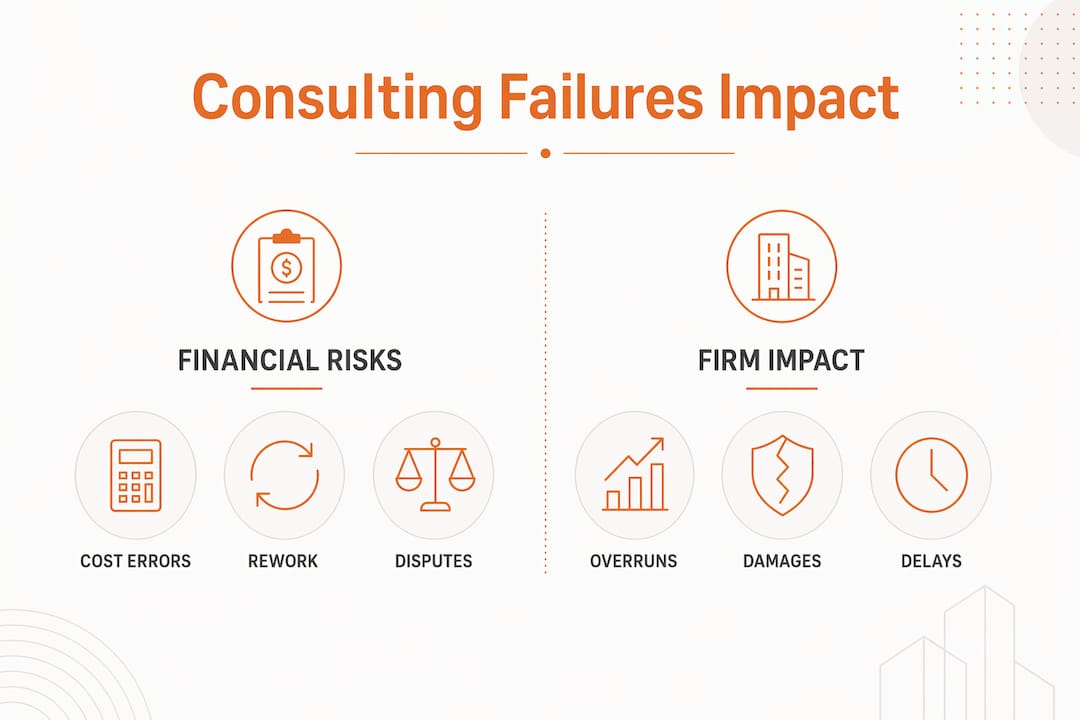
Construction firms that rely on specialized consulting services rather than generic advisors reduce exposure across all four categories because the advisor understands the verification requirements, the handoff risks, and the organizational dynamics that determine whether recommendations get executed.
Key takeaways
Generic consulting fails construction firms when advisors lack field knowledge, skip rigorous discovery, and deliver recommendations without securing the internal authority needed to execute them.
| Point | Details |
|---|---|
| Handoff failures start early | Unvalidated bid assumptions cause productivity losses before construction begins. |
| Design phase controls most costs | 80% of lifecycle costs lock in at design, limiting late-stage consulting impact. |
| Discovery depth determines outcomes | Structured requirements gathering improves on-time delivery by 70% versus ad hoc interviews. |
| Executive sponsorship is non-negotiable | Without a named sponsor and cross-functional authority, recommendations stall regardless of quality. |
| Generic advice carries legal risk | Cases like Eiger v Ridge show that outdated cost reporting creates professional negligence exposure. |
What I’ve learned from 30 years of watching consulting engagements succeed and fail
I have seen firms spend $80,000 on a consulting engagement and implement exactly nothing from it. I have also seen a focused three-month engagement with a mid-sized general contractor produce a 40% reduction in estimate-to-field variance and a measurable increase in gross margin. The difference was never the quality of the recommendations. It was always the quality of the discovery process and the presence of a committed executive sponsor.
The construction industry has a specific problem with generic consulting: it attracts advisors who are excellent at producing frameworks and weak at understanding why a superintendent will not change how he runs his daily huddle. Field operations in construction are built on trust, habit, and hard-won experience. A consultant who has never managed a subcontractor relationship, never dealt with a material delivery that arrived three days late, and never had to explain a cost overrun to an owner does not have the credibility to change how those operations run.
What I advocate for, and what Rconstructionsolutions is built around, is the opposite approach. Start with rigorous discovery that includes field operators. Identify the executive sponsor before the engagement begins. Break every recommendation into actions that can be completed in 30 days or less. Measure results against KPIs that the firm already tracks, not metrics invented for the consulting report. And specialize. Construction is not a generic business context. It rewards advisors who understand estimating, scheduling, subcontractor management, and field operations from direct experience.
The firms I have seen grow from $5 million to $50 million did not get there by following generic business advice. They got there by fixing the specific operational problems that were costing them margin on every job.
— Rowena
How Rconstructionsolutions helps construction firms avoid these pitfalls
Construction firms deserve consulting that understands their world from the ground up.
Rconstructionsolutions brings over 30 years of hands-on construction experience to every engagement. The firm’s specialized consulting services are built around the exact failure points this article covers: rigorous requirements discovery, estimator-to-field alignment, executive sponsorship frameworks, and AI-driven tools like automated estimating that produce measurable results. Mid-sized contractors scaling from $5 million to $50 million have used these services to reduce rework, close estimate-to-actual gaps, and build the operational systems that support sustained growth. If your firm is evaluating consulting options, explore tailored solutions for general contractors to see what specialized advisory actually looks like in practice.
FAQ
Why do generic consultants fail construction firms so often?
Generic consultants lack construction-specific knowledge of estimating, field operations, and subcontractor management, so their recommendations do not account for how construction projects actually run. Research confirms that most failures trace back to misaligned project setups and shallow discovery, not strategy quality.
What is the bid handoff problem in construction?
The bid handoff problem occurs when estimates built on desk-based assumptions are passed to field teams without validation, causing productivity losses from the first day of work. Construction Executive research shows 74% of premature project starts result in direct productivity losses for this reason.
How does requirements gathering affect consulting success?
Structured requirements gathering that includes field operators, not just managers, improves on-time and on-budget delivery by 70% compared to unstructured discovery. One in five consulting projects fail to deploy at all when requirements gathering is shallow or misaligned.
What role does executive sponsorship play in consulting outcomes?
Without a named executive sponsor who holds cross-functional authority, even technically sound consulting recommendations fail to gain adoption inside construction firms. Securing sponsorship and delivering a visible win within the first 30 days are the two strongest predictors of successful implementation.
How can construction firms choose a better consultant?
Firms should ask consultants to describe their discovery process in detail, name the executive sponsor requirement upfront, and provide examples of construction-specific implementations with measurable results. A consultant who cannot answer those questions with specifics is likely to deliver generic advice that does not translate to field reality.