
Construction Consulting Engagements: A Guide for Project Managers | R. Construction Solutions
A construction consulting engagement is a formal, scoped advisory arrangement where an expert consultant guides construction owners, contractors, or project managers through specific decisions, risks, and deliverables across defined project phases. Unlike a contractor who builds or a project manager who coordinates daily operations, a construction consultant provides independent oversight and strategic advice without holding a construction contract or direct execution responsibility. Understanding what is construction consulting engagement explained in practical terms means recognizing it as a structured professional relationship governed by a Statement of Work, defined fee model, and measurable outputs. Rconstructionsolutions has spent over 30 years structuring these engagements for residential and commercial contractors, and the difference between a vague advisory arrangement and a well-defined engagement is the difference between wasted fees and real project control.
What is a construction consulting engagement?
A construction consulting engagement is defined by key activities including feasibility analysis, budget review, scheduling support, risk identification, bid reviews, and progress reporting across the project lifecycle. This distinguishes consulting from execution roles. The consultant does not manage subcontractors or hold a construction contract. Their value is in the quality of their advice, the independence of their oversight, and the specificity of their deliverables.
The term “consulting engagement” is the recognized industry standard for this type of arrangement. You may also encounter it called construction advisory services or construction project consulting, but all three refer to the same core model: a scoped, time-bound, deliverable-driven relationship between an expert advisor and a project owner or contractor. The engagement begins with a proposal and ends with a formal completion report or handoff, not an open-ended advisory relationship.
Common deliverables within a construction consulting engagement include schedule assessments, risk registers, constructability reviews, bid analysis reports, and coordination updates. These are tangible outputs, not just hours of advice. That distinction matters because output-based deliverables create accountability that hour-based proposals simply cannot. If your consultant’s proposal is measured in days rather than documents, that is a red flag worth addressing before you sign.

What are the typical phases of a consulting engagement?
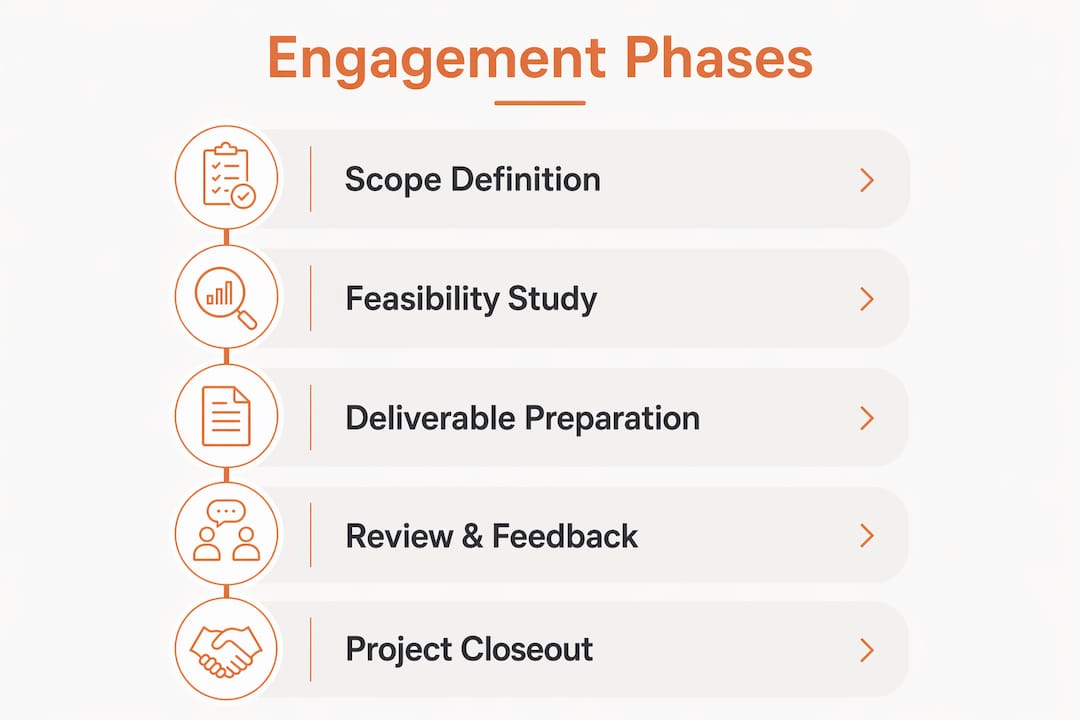
A well-structured construction consulting engagement moves through four phases: proposal and scoping, kickoff, delivery, and completion with reporting. Each phase has defined entry and exit criteria. Skipping or rushing the scoping phase is the most common reason engagements fail to deliver value.
- Proposal and scoping: The consultant and client agree on the specific problem to solve, the deliverables to produce, the timeline, and the fee structure. A strong Statement of Work explicitly covers scope boundaries, tangible outputs, milestone dates, payment terms, and approval processes. Items outside the scope should be listed explicitly to prevent assumptions from becoming disputes.
- Kickoff: Both parties confirm access to project documents, communication protocols, key contacts, and decision-making authority. This is where you define who approves deliverables and how quickly responses are expected.
- Delivery: The consultant executes the agreed scope, producing reports, assessments, or coordination outputs on the agreed schedule. Progress is tracked against milestones, not hours.
- Completion and reporting: The engagement closes with a final deliverable, summary report, or handoff document. Open items are documented and either closed or transitioned to a follow-on scope.
Fee models vary by engagement type. Time-and-materials suits rescue or schedule recovery work where scope is uncertain. Fixed fees work well for defined reviews like a bid analysis or constructability check. Retainers cover ongoing advisory support, and retainer agreements commonly specify minimum terms, scheduled service cadences, and mandated response times for urgent issues like claims or dispute windows.
Pro Tip: Always request a sample deliverable from a prospective consultant before signing. Seeing an actual schedule assessment or risk report tells you more about their capability than any proposal narrative.
How does construction consulting differ from contractor and project management roles?
The distinction between a construction consultant, a contractor, and a project manager is not just semantic. It determines accountability, authority, and conflict of interest. Misunderstanding these boundaries leads to scope creep, liability confusion, and poor project outcomes.
| Role | Primary Function | Authority | Accountability |
|---|---|---|---|
| Construction consultant | Advisory, oversight, risk management, decision support | Recommends, does not direct labor | Deliverables and advice quality |
| General contractor | Physical execution, labor and materials management | Directs subcontractors and field operations | Contract completion and quality |
| Project manager | Day-to-day coordination, schedule, and budget tracking | Coordinates but may lack independent oversight | Schedule, budget, and team alignment |
| Owner’s representative | Protects owner’s interests, monitors contractors | Reviews pay apps, RFIs, change orders | Owner’s budget and schedule protection |
The owner’s representative model is a specialized form of construction consulting that deserves specific attention. Owner’s representatives act independently to protect the owner’s interests, managing stakeholder alignment and contractor coordination without a conflict of interest. Their contract-defined responsibilities include pay application review, RFI and submittal handling, and change-order evaluation. They do not assume construction contract liabilities. This independence is precisely what makes them valuable. A general contractor has a financial incentive to approve change orders. An owner’s rep does not.
Project managers embedded within a contractor’s organization face a similar conflict. They serve the contractor’s interests, not the owner’s. A construction consultant engaged directly by the owner fills the gap that internal project managers cannot. Understanding consulting versus contractor roles is the first step toward structuring an engagement that actually protects your interests.
What are best practices for structuring a consulting engagement?
Structuring a construction consulting engagement correctly from the start prevents the most common and costly problems: scope creep, undefined authority, and unmet expectations. The following practices reflect what separates high-performing engagements from frustrating ones.
- Define the problem before defining the scope. A precise problem statement drives everything else. “We need help with our schedule” is not a problem statement. “We need an independent assessment of our CPM schedule to identify float erosion and critical path risks before the owner’s 90-day review” is.
- List what is out of scope explicitly. Scope specificity and deliverable clarity are the two most critical factors in engagement success. If the consultant will not attend site meetings, say so in writing. Assumptions left unaddressed become disputes.
- Define authority boundaries clearly. The consultant recommends. The client decides. If the consultant has authority to approve submittals or direct contractors, that must be explicitly stated in the engagement letter. Ambiguity here creates liability for everyone.
- Measure success by outputs, not effort. An engagement measured in hours lacks accountability. Define success as the delivery of specific reports, completed reviews, or resolved issues. This shifts the conversation from “how much time did you spend” to “did you solve the problem.”
- Align the fee model to scope certainty. Fixed fees work when the scope is clear. Time-and-materials protects both parties when the scope may evolve. Retainers suit ongoing advisory needs where the volume of work fluctuates by project phase.
- Establish communication protocols upfront. Who receives reports? What is the response time for urgent questions? How are scope changes requested and approved? These details belong in the Statement of Work, not in an email chain three weeks into the engagement.
Pro Tip: Pre-construction service agreements need clear deliverables and acceptance criteria that link early consulting services to the trigger conditions for the main construction contract. Skipping this step is how constructability reviews become rework disputes.
What practical benefits can construction consulting engagements deliver?
The benefits of construction consulting are most visible when an engagement is structured around specific, measurable outcomes rather than general advisory support. Here is what well-executed construction advisory services consistently deliver:
- Early risk identification. Consultants reviewing schedules, budgets, and contract terms before construction starts catch problems that field teams miss under execution pressure. Identifying a subcontractor gap or a procurement lead-time conflict in pre-construction costs a fraction of what it costs to resolve mid-project.
- Objective budget and schedule analysis. An independent consultant reviewing a general contractor’s schedule has no incentive to approve optimistic float assumptions. That objectivity is the core value of independent construction project consulting.
- Improved stakeholder alignment. Consultants who facilitate coordination between owners, designers, and contractors reduce the communication failures that cause most project delays. A single coordination update report distributed weekly eliminates the “I didn’t know” conversations that derail progress meetings.
- Reduced contractor conflicts. Independent oversight creates accountability. When contractors know that pay applications, RFIs, and change orders are reviewed by an owner’s representative with contract authority, the quality and accuracy of those submissions improves.
- Controlled costs on complex projects. Mid-sized firms that engage construction consultants during scaling phases, particularly those moving from $5 million to $50 million in revenue, consistently report fewer cost overruns and better margin control. The consultant’s role is to protect the owner’s budget from the contractor’s natural incentive to expand scope.
- Faster dispute resolution. Consultants with claims experience who operate under retainer models provide timely responses during claims or dispute windows, where delays in expert input can cost far more than the retainer fee.
Key takeaways
A construction consulting engagement delivers measurable value only when it is built on a precise scope, output-based deliverables, and clearly defined authority boundaries from day one.
| Point | Details |
|---|---|
| Define the engagement formally | Use a Statement of Work covering scope, deliverables, timeline, fees, and approval processes. |
| Choose the right fee model | Match time-and-materials, fixed fee, or retainer to your scope certainty and project phase. |
| Separate advisory from execution | Consultants recommend and oversee; contractors execute. Mixing these roles creates liability and conflict. |
| Measure outputs, not hours | Deliverable-based engagements create accountability that hour-based proposals cannot. |
| Engage early for maximum value | Pre-construction consulting prevents the cost overruns and schedule failures that mid-project intervention cannot fully recover. |
Why vague consulting scopes are the real project risk
After working in and around construction consulting for over three decades, the pattern I see most often is not a bad consultant. It is a bad engagement structure. Owners hire experienced advisors and then hand them a scope that reads like a job description instead of a project brief. “Provide general oversight and advisory support” is not a scope. It is an invitation for frustration on both sides.
The largest cause of consulting engagement failures is poor scopes with vague authority and undefined success criteria. I have seen this play out on projects of every size. The consultant shows up, does their best work, and the client feels they got nothing concrete. The consultant feels they were never given the access or authority to actually solve the problem. Both are right.
What I tell every contractor who asks how to hire a construction consultant: start with the problem, not the person. Write down the specific decision you need help making or the specific risk you need managed. Then find a consultant whose deliverables directly address that problem. Ask to see questions to ask a consultant before you sign anything. The right consultant will welcome that conversation. The wrong one will avoid it.
Output-based evaluation is not just a best practice. It is the only way to hold a consulting engagement accountable. If you cannot point to a document, a decision, or a resolved issue at the end of the engagement, the scope was wrong from the start.
— Rowena
Take your next project further with Rconstructionsolutions
Rconstructionsolutions brings over 30 years of hands-on construction experience to every engagement, working directly with residential and commercial contractors to structure advisory relationships that produce real results. Whether you need an owner’s representative for a complex commercial build, a pre-construction risk review, or ongoing retainer support as your firm scales, the team at Rconstructionsolutions designs engagements around your specific project challenges, not generic templates.
Explore construction consulting services built around defined scopes, measurable deliverables, and the kind of independent oversight that protects your budget and schedule. If you are a general contractor looking to tighten project controls, visit the consulting for general contractors page to see how structured engagements translate into margin protection and growth.
FAQ
What is a construction consulting engagement?
A construction consulting engagement is a formal advisory arrangement between an expert consultant and a construction owner or contractor, defined by a specific scope, deliverables, timeline, and fee structure. It is distinct from a construction contract because the consultant advises and oversees rather than executes physical work.
How does a construction consultant differ from a project manager?
A construction consultant provides independent advisory oversight without holding a construction contract or managing labor, while a project manager coordinates day-to-day operations within the contractor’s organization. The key difference is independence: a consultant’s accountability is to the client’s outcomes, not the contractor’s schedule.
What fee models are used in construction consulting engagements?
The three primary fee models are time-and-materials for uncertain or evolving scopes, fixed fees for well-defined reviews or assessments, and retainers for ongoing advisory support across project phases. Selecting the right model depends on how clearly the scope and deliverables can be defined at the outset.
What should a Statement of Work include for a consulting engagement?
A strong Statement of Work covers the specific scope, explicit out-of-scope items, tangible deliverables, milestone dates, payment terms, approval processes, and authority boundaries. Including what is excluded is as important as defining what is included, because assumptions left unaddressed become disputes.
When should you bring in a construction consultant?
The highest-value point to engage a construction consultant is during pre-construction, when schedule, budget, and contract risks can still be addressed before they become field problems. Mid-project engagement is valuable for recovery and claims support, but early involvement consistently produces better cost and schedule outcomes.