
Construction Monitoring Services Explained for PMs | R. Construction Solutions
A construction monitoring service is defined as the appointment of an independent professional to provide objective oversight of a construction project, verifying quality, schedule, and budget compliance on behalf of lenders, investors, or project owners. The monitor does not run construction. Instead, they act as the client’s eyes on site, verifying outcomes and flagging issues before they become costly problems. This role is formally known as development monitoring or construction loan monitoring in the industry, and it sits at the intersection of risk management and project accountability. For project managers and contractors, understanding this service is the first step toward using it to protect your projects and your clients’ investments.
What does a construction monitoring service actually mean?
Construction monitoring is the independent oversight process that verifies a project’s physical progress, workmanship quality, and financial compliance against the original contract documents. It is not project management, and it is not daily supervision. The monitor operates on a periodic basis, typically tied to funding milestones or draw cycles, and produces auditable reports that support decision-making by lenders and investors.
The term “construction monitoring service” is widely used in SEO and client-facing contexts, but the recognized industry terms are development monitoring and construction loan monitoring. Both describe the same core function: an independent third party confirms that what the contractor says is built is actually built, and that the money being drawn matches the verified progress on site. This distinction matters because it shapes the monitor’s authority, liability, and reporting obligations.
Lenders rely on this service because borrower-reported data carries inherent bias. A developer has every incentive to report progress optimistically to unlock draw payments. The monitor removes that bias by conducting physical site visits, reviewing contract documents, and producing evidence-based reports. This is why monitoring protects lenders from financial exposure on construction loans that can run into tens of millions of dollars.
What activities does construction monitoring include?
The scope of a construction monitoring engagement covers several distinct activities, each tied to a specific risk or compliance requirement. Understanding the full scope helps project managers set expectations and prepare their documentation accordingly.
Core monitoring activities include:
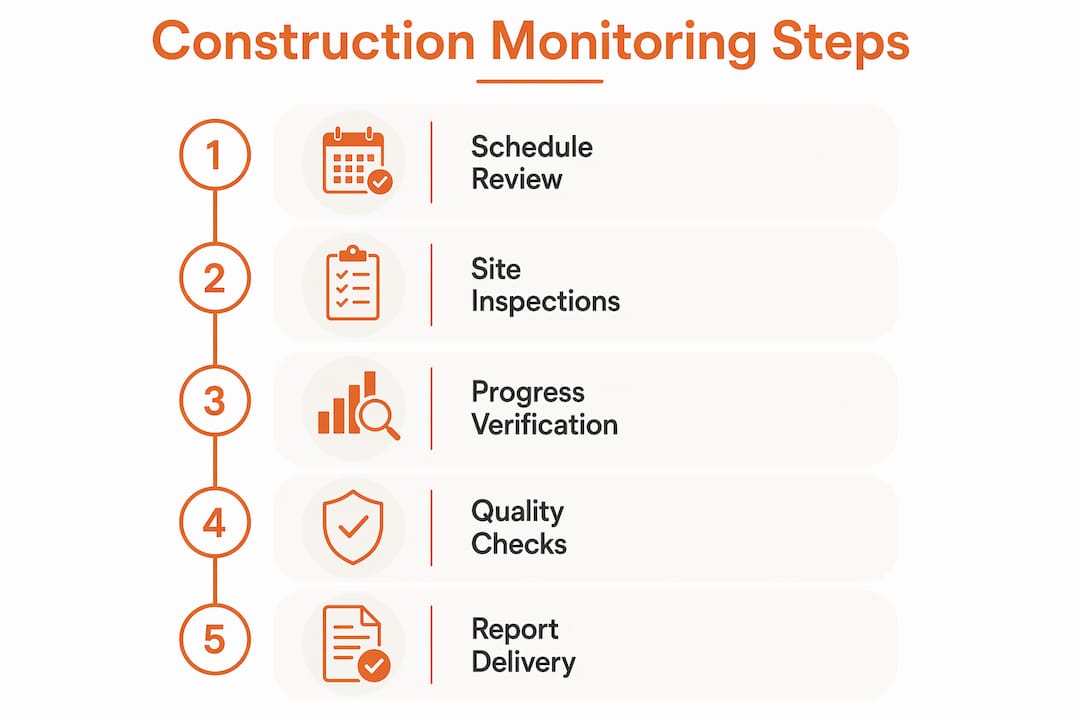
- Periodic site inspections: The monitor visits the site at defined intervals, typically aligned with draw request cycles or project milestones, to observe progress and assess workmanship quality against approved plans and specifications.
- Contract compliance verification: The monitor reviews submittals, shop drawings, and change orders to confirm that work aligns with the original contract documents and design specifications.
- Payment application review: Draw requests are validated against actual physical progress. This includes reviewing lien waivers, percentage of completion per line item, and cost-to-complete projections.
- Change order and cost tracking: The monitor evaluates whether approved changes are reflected in updated budgets and schedules, and flags unapproved deviations.
- Reporting: Monitoring reports are produced after each site visit and submitted to the client or lender. These reports must be specific and auditable, not generic status updates.
- Photo documentation: Visual evidence of conditions, progress, and defects is captured systematically to support report findings and provide a defensible record.
The distinction between monitoring, inspection, and supervision is worth clarifying. Inspection is typically a single-point-in-time activity focused on code compliance. Supervision involves daily on-site direction of workers. Monitoring is systematic and data-driven, measuring jobsite conditions continuously against the project plan and supporting corrective action through structured reporting cycles.
Pro Tip: Request that your monitoring provider use a standardized checklist tied to your project’s schedule of values. This ensures every site visit produces comparable data across draw cycles, making trend analysis and dispute resolution far easier.
How construction monitoring protects lender and investor interests
Financial stakeholders face a fundamental problem on construction projects: they are funding work they cannot directly observe. A lender releasing draw payments based solely on a contractor’s progress report is exposed to significant risk. Construction monitoring solves this by inserting an independent professional between the borrower’s claims and the lender’s decision.
The protection works on several levels:
- Independent verification: The monitor confirms that physical progress matches the draw request before funds are released. This prevents overfunding, where a lender pays for work that has not yet been completed.
- Early defect detection: Site visits identify workmanship defects, material substitutions, or deviations from approved plans before they are concealed by subsequent work. Catching a waterproofing failure before the exterior cladding goes up costs a fraction of what it costs to fix after the fact.
- Regulatory and permit compliance: The monitor tracks whether required inspections have been completed and permits are current, reducing the lender’s exposure to regulatory risk.
- Cost-to-complete analysis: Beyond verifying what has been built, the monitor assesses whether the remaining budget is sufficient to complete the project. This is critical for lenders managing construction loan exposure.
- Auditable reporting: Monitoring reports must be specific, including line-item percentage completion and condition documentation, to credibly support lender decisions and protect investment.
“Monitoring acts as independent due diligence, protecting lenders from biased borrower data by validating physical progress and budget compliance.” — Eddisons
The value of monitoring depends entirely on the monitor’s independence from both the developer and the contractor. A monitoring firm with financial ties to either party cannot produce objective reports. This is why reputable lenders specify that the monitoring firm must have no prior relationship with the project team. Independence is not a preference. It is the foundation of the service’s credibility.
How does construction monitoring compare to project management?
Construction professionals often ask whether monitoring duplicates the work of a project manager or site supervisor. It does not. The three roles serve different functions and answer to different clients.
| Role | Primary function | Reports to | On-site frequency |
|---|---|---|---|
| Construction monitor | Independent verification of progress, quality, and budget compliance | Lender or investor | Periodic (draw cycles or milestones) |
| Project manager | Coordinates and directs project execution | Owner or developer | Regular to continuous |
| Site supervisor | Manages daily work and on-site problem-solving | Contractor | Daily |
The monitor’s value comes precisely from not being embedded in the project team. A project manager has a vested interest in the project’s success and may downplay issues to maintain relationships or protect schedules. The monitor has no such conflict. Their obligation is to report what they observe, accurately and completely, to the party funding the work.
This separation also means the monitor does not give instructions to contractors or resolve site problems. If the monitor identifies a defect, they report it to the client. The client then directs the project manager or contractor to address it. This chain of communication preserves the monitor’s objectivity and creates a clear paper trail for dispute resolution.
Pro Tip: When selecting a monitoring provider, ask directly about their independence protocols. Specifically, ask whether they have performed any prior work for the developer or general contractor on this project. A credible firm will have a written conflict-of-interest policy and will disclose any prior relationships without hesitation.
Practical benefits of construction monitoring for project teams
Beyond protecting lenders, construction monitoring delivers measurable benefits for project managers and contractors who understand how to work with it effectively.

Improved project visibility is the most immediate benefit. Consistent data capture and review cycles create measurable feedback loops that accelerate decision-making. When monitoring reports are produced on a regular cadence, project managers gain an external benchmark for their own progress tracking.
Risk management improves because issues are identified at the earliest possible stage. A monitor who visits the site at each draw cycle will catch a structural deviation or a subcontractor falling behind schedule before it compounds into a schedule delay or a cost overrun. Small issues do not snowball into big problems when there is a systematic process for catching them early.
Budget control tightens when draw requests are subject to independent verification. Contractors who know their payment applications will be reviewed against physical progress have a strong incentive to keep their documentation accurate and their cost tracking current. This discipline benefits the entire project team, not just the lender.
Regulatory compliance is easier to maintain when a monitor is tracking permit status and required inspections as part of their reporting scope. For projects in jurisdictions with complex permitting requirements, this oversight reduces the risk of stop-work orders or failed inspections.
For project managers integrating monitoring into their workflows, the most effective approach is to treat the monitor as a resource rather than an auditor. Share your schedule of values, your updated project schedule, and your change order log before each site visit. The monitor’s report will be more accurate, and any issues they identify will be easier to address with full context already in place. You can explore construction oversight services that align monitoring with broader project management practices for a more integrated approach.
Key takeaways
Construction monitoring service is the independent verification function that protects lenders, investors, and project owners by confirming that physical progress, quality, and budget compliance match what contractors report.
| Point | Details |
|---|---|
| Definition of the service | An independent professional verifies quality, schedule, and budget compliance on behalf of lenders or investors. |
| Core activities | Site inspections, payment application review, change order tracking, and auditable reporting tied to draw cycles. |
| Independence is non-negotiable | The monitor must have no financial ties to the developer or contractor to produce credible, objective reports. |
| Not a replacement for management | Monitoring complements project management and supervision but serves a different client with a different mandate. |
| Practical benefit for PMs | Treating the monitor as a resource rather than an auditor improves report accuracy and accelerates issue resolution. |
Why the independence question is the one most teams get wrong
I have worked alongside monitoring engagements on projects ranging from mid-rise residential to large commercial builds, and the single most consistent failure point is not documentation or reporting frequency. It is the independence question. Teams select a monitoring firm based on price or familiarity, and then discover mid-project that the firm has a prior relationship with the GC or the developer. At that point, every report the firm has produced is compromised in the eyes of the lender.
The industry talks about independence as a principle, but in practice it is treated as a checkbox. A firm signs a conflict-of-interest declaration and everyone moves on. What actually matters is whether the monitor has the professional standing and the contractual protection to report a serious defect or a budget shortfall without fear of losing future work from the developer. That kind of independence is structural, not just procedural.
Technology is changing this dynamic in useful ways. Remote monitoring tools, photo documentation platforms, and digital checklists create an evidence trail that is harder to manipulate than a narrative report. When a monitor’s findings are backed by timestamped photos and georeferenced data, the report becomes genuinely auditable. That is the direction the industry is moving, and project managers who understand this will be better positioned to select monitoring providers who meet that standard.
My advice: before you engage a monitoring firm, ask to see a sample report from a completed project. If it contains line-item percentage completion, condition-specific photo documentation, and a cost-to-complete analysis, you are looking at a firm that takes the role seriously. If it reads like a general progress update, keep looking.
— Rowena
How Rconstructionsolutions supports your monitoring and oversight needs

Rconstructionsolutions brings over 30 years of hands-on construction experience to the oversight challenges that project managers and contractors face every day. Whether you are implementing a monitoring program for the first time or refining an existing process, the team at Rconstructionsolutions provides construction consulting services tailored to your project type, scale, and stakeholder requirements. From documentation frameworks to draw cycle reporting structures, the focus is on giving you the tools and processes that produce defensible, auditable results. If you are a construction manager looking to integrate monitoring into your project workflow, the support for construction managers page outlines exactly how that engagement works in practice.
FAQ
What does a construction monitor do on site?
A construction monitor conducts periodic site inspections to verify physical progress, workmanship quality, and compliance with contract documents. They do not direct workers or manage the project. Their role is to observe, document, and report findings to the lender or investor funding the work.
How is construction monitoring different from a building inspection?
A building inspection is a single-point-in-time code compliance check performed by a municipal authority or third-party inspector. Construction monitoring is an ongoing, systematic process tied to funding milestones that covers quality, budget, schedule, and contract compliance across the full project lifecycle.
Who pays for construction monitoring services?
The cost of construction monitoring is typically paid by the borrower or developer as a condition of the construction loan. Lenders require the service to protect their financial exposure, and the fee is usually included in the project’s soft costs budget.
How often does a construction monitor visit the site?
Site visit frequency is determined by the project’s draw cycle or milestone schedule. Most monitoring engagements involve visits at each draw request, which may occur monthly or at defined completion percentages. Monitoring runs on a funding milestone cadence, not daily supervision.
What makes a construction monitoring report credible?
A credible monitoring report includes line-item percentage completion, condition-specific photo documentation, lien waiver verification, and a cost-to-complete analysis. Generic status updates without this specificity do not provide the evidentiary standard lenders need to make defensible draw release decisions.