
Hiring a Construction Project Manager: Risk Mitigation Guide | R. Construction Solutions
The single most effective way to protect yourself when hiring a construction project manager is to combine a defined role with a weighted interview scorecard, two-stage interviews, verified references, and a documented offer before anyone sets foot on your project. That process, done in the right order, protects your schedule, your budget, and your legal exposure simultaneously.
Your hiring protection checklist:
- Define the role first. Write a scope-of-authority brief before you post the job. Include change-order limits, reporting lines, and 4–6 measurable KPIs.
- Use a weighted scorecard. Score every candidate on 8 defined competencies with assigned weights to ensure consistent, evidence-based evaluation and eliminate gut-feel bias.
- Run a two-stage interview. A 20–30 minute phone screen for knockouts, then a 45–90 minute scenario-based interview or a paid working test for senior roles.
- Verify references with specific questions. Ask for budgets, schedule variances, and EMR figures. Vague answers are a red flag, not a minor concern.
- Run background and credential checks. Confirm OSHA 30-hour cards, licenses, and driving records before the offer goes out.
- Document the offer in writing. Include probation terms, scope of authority, performance milestones, and termination conditions.
- Onboard with a 30/60/90-day plan. Set KPIs, schedule check-ins, and confirm software access before day one.
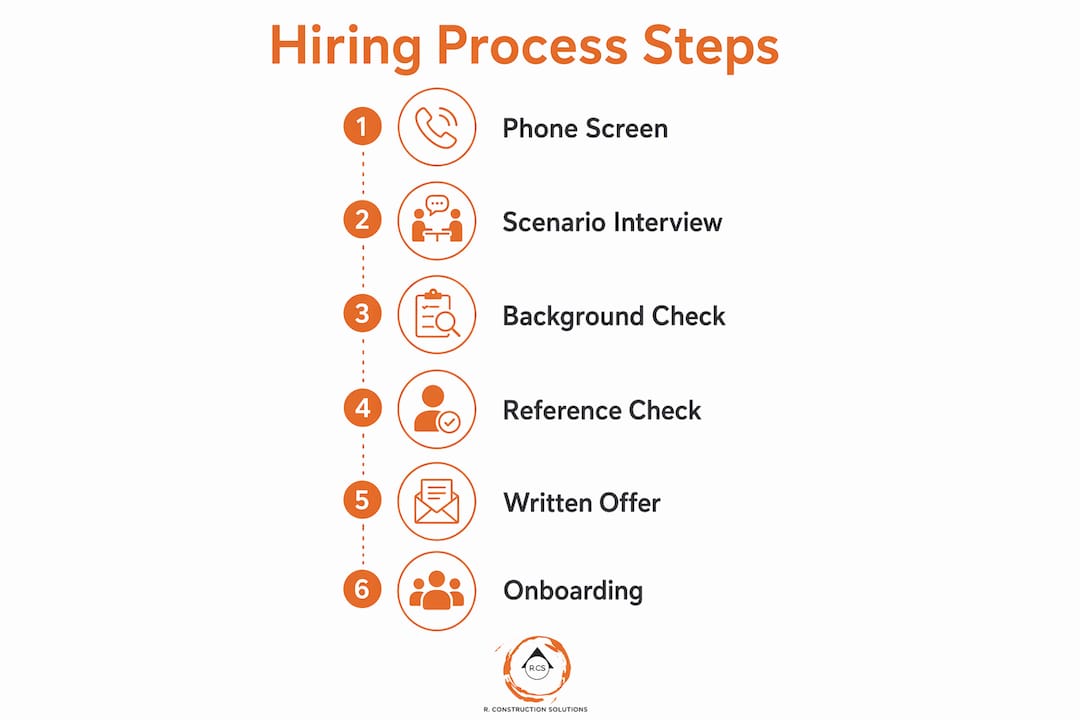
One-line hiring timeline: Phone screen → scenario interview or working test → references and background check → written offer → structured 30/60/90 onboarding.
Typical PM hires take several weeks from first contact to mobilization. Start your pipeline well before you need the role filled.

Table of Contents
- How do you define the PM role before you post the job?
- What technical skills and credentials should a construction PM have?
- How do you vet project manager candidates without relying on gut feel?
- How do you check references and verify a PM’s claims?
- What should your offer letter and contract include to protect your business?
- What does a strong 30/60/90-day onboarding plan look like?
- Templates, scorecards, and legal guardrails for compliant construction hiring
- Key Takeaways
- What most owners get wrong when hiring a construction PM
- Reduce your hiring risk with R Construction Solutions LLC
How do you define the PM role before you post the job?
Skipping this step is where most owners create their own problems. A vague job post attracts vague candidates, and a vague candidate becomes a vague employee who makes decisions you never authorized.
Before you write a single interview question, document three things: what the PM owns, what they cannot do without your approval, and how you will measure their performance during the initial onboarding period. That clarity shapes every downstream decision, from the job post to the offer letter.
PM vs. superintendent: get the seat right. A project manager owns budget, schedule, subcontractor contracts, owner communication, and change-order discipline. A superintendent owns daily field operations, crew coordination, and quality control. These are different seats. Hiring a superintendent-type into a PM role, or vice versa, is one of the most common hiring mistakes in construction. If you need both functions, define both seats before you hire either one. A related guide on construction firm organizational structure can help you map reporting lines clearly.
Authority limits to define in writing:
- Change-order approval threshold (e.g., set a dollar limit under which the PM can approve changes, with anything above requiring owner sign-off)
- Subcontractor direction authority (can direct scope, cannot execute new subcontracts without owner approval)
- Purchase authority (materials, rentals, incidentals up to a defined dollar limit)
- Reporting line (reports directly to owner, principal, or VP of operations)
Role brief template (copy into your job post):
Title: Project Manager | Reports to: [Owner/VP Operations] | Authority: Manages budget up to $[X], approves change orders up to $[X], directs subcontractors within contracted scope | Deliverables: Weekly schedule updates, monthly cost-to-complete forecast, RFI log, safety incident report | KPIs: Schedule variance ≤5%, cost forecast accuracy within 3%, RFIs closed within 5 business days, zero recordable safety incidents, owner satisfaction score ≥4/5
First-90-day KPIs to include in the offer:
- Schedule variance (target: within 5% of baseline)
- Cost-to-complete accuracy (target: within 3% of budget)
- RFI closure rate (target: closed within 5 business days)
- Safety incidents (target: zero recordable)
- Owner/client satisfaction (target: 4 out of 5 or higher on a structured check-in)
What technical skills and credentials should a construction PM have?
Not every credential signals the same thing. Some are gates; others are conversation starters. Knowing the difference saves you from filtering out strong candidates on paper while letting weak ones through on charm.
Technical skills that are non-negotiable
Budget control and cost forecasting, schedule development and recovery, subcontractor coordination and scope management, and change-order discipline are the four core competencies that separate a PM from a glorified administrator. A candidate who cannot speak to specific dollar amounts managed, schedule recovery strategies executed, or change-order disputes resolved has not actually done the job at the level you need.
Safety credentials: beyond the card
OSHA 30-hour is the expected baseline for any supervisory PM role. But the card alone tells you nothing about day-to-day safety leadership. Ask candidates to describe how they ran a safety program, not just that they attended a training. Probe for toolbox talk frequency, incident investigation experience, and how they handled a subcontractor safety violation. The Experience Modification Rate is your most powerful verification tool here: an EMR below 1.0 indicates better-than-average safety performance, while a rate at or above 1.2 commonly disqualifies subcontractors from prequalification on commercial and public projects. Ask candidates what their last employer’s EMR was. If they cannot answer, that tells you something.
Certifications: screening signal, not a gate
| Credential | What It Signals | How to Weight It |
|---|---|---|
| OSHA 30-Hour | Supervisory safety baseline | Required for most PM roles |
| PMP (PMI) | Process discipline, structured PM methodology | Positive signal; verify with scenario questions |
| CCM (Certified Construction Manager) | Construction-specific management depth | Strong signal for senior roles |
| PMI-CP | Construction-focused PMI credential | Emerging credential; weight alongside experience |
| Procore Certified | Platform fluency | Useful for firms running Procore |
| Primavera P6 | Scheduling depth for large or complex projects | Required if your projects use P6 scheduling |
Certifications confirm training. Outcomes confirm performance. Weight both, but never let a credential substitute for verified results.
Software familiarity that actually matters
Procore and Buildertrend are the two most common platforms in residential and commercial construction at the growth-stage firm level. Primavera P6 matters for larger, schedule-intensive projects. Ask candidates to describe a specific workflow they managed in the platform, not just whether they have used it. A candidate who can walk you through how they set up a cost ledger in Procore or built a baseline schedule in P6 is demonstrably more valuable than one who checks the box.
How do you vet project manager candidates without relying on gut feel?
Structured, scenario-based interviews are the most reliable way to separate confident talkers from effective doers. The process below is repeatable, defensible, and designed to produce comparable scores across candidates.
Stage 1: Phone screen (20–30 minutes)
Use this call to knock out candidates who do not meet baseline requirements. Keep it tight and consistent across every candidate.
Knockout questions for the phone screen:
- Are you available to start by [date]? Is travel to [location/region] workable for you?
- Do you hold a current OSHA 30-hour card?
- What project management software have you used in the last two years?
- What is the largest project budget you have managed end-to-end?
- Are you authorized to work in the United States?
Anyone who clears these moves to Stage 2. Anyone who does not is a polite no.
Stage 2: Scenario-based interview (45–90 minutes)
This is where you find out how candidates think. Give them a real-world scenario with embedded problems and ask them to walk you through their response. For senior roles, a paid working test of 1–2 hours, where you provide a project summary with embedded schedule and budget issues and ask for a written recovery plan, is worth the investment.
Sample scenario questions:
- “You are three weeks into a project and your concrete subcontractor is running 10 days behind. Walk me through exactly what you do.”
- “You receive a change-order request from a subcontractor for $45,000 in additional scope. The owner has not approved it. What happens next?”
- “Your cost-to-complete forecast shows you are 8% over budget at the 40% completion mark. How do you communicate that to the owner and what is your recovery plan?”
Weighted interview scorecard
Structured scorecards with weighted competencies reduce biased, gut-feel hiring and force evidence-based comparisons across candidates. Score each competency 1–5, multiply by the weight, and total the columns.
| Competency | Weight | Score (1–5) | Weighted Score |
|---|---|---|---|
| Budget management | 20% | ||
| Schedule recovery | 20% | ||
| Safety ownership | 15% | ||
| Subcontractor coordination | 15% | ||
| Communication | 10% | ||
| Technical tools (Procore/P6) | 8% | ||
| Problem-solving under pressure | 7% | ||
| Culture fit | 5% |
Pro Tip: Demand numbers when candidates describe past projects. “I managed a large commercial project” is not evidence. “I managed a $4.2M tenant improvement, recovered a 14-day schedule slip in week six, and closed out 3% under budget” is. Vague answers are the highest-signal red flag in any PM interview.
How do you check references and verify a PM’s claims?
Mission-critical PM roles warrant 5–6 reference checks when the stakes are high. For most growth-stage firms, three strong references, asked the right questions, will tell you what you need to know.
Three references to request:
- A direct supervisor or owner from a project the candidate managed end-to-end
- A subcontractor or trade partner the candidate coordinated directly
- An owner’s representative or client the candidate reported to
Four consistent questions to ask every referee:
- What was the total project budget, and how did the project finish relative to that budget?
- What was the original schedule, and what was the actual completion date?
- How did the candidate handle a significant problem or dispute on the project?
- Would you hire this person again, and in what capacity?
The consistency matters. Ask the same four questions to every referee so you can compare answers directly. If a candidate’s claimed $6M project budget comes back as “I think it was around $2M” from the supervisor, you have a material discrepancy worth investigating before the offer goes out.
Background and credential verification checklist:
- Confirm OSHA 30-hour card (request the card number and verify with OSHA’s training provider records)
- Verify any state contractor licenses or certifications claimed on the resume
- Run a driving record check if the role involves site travel in a company vehicle
- Ask directly about the candidate’s last employer’s EMR and verify it against public prequalification records where available
- Conduct a criminal background check consistent with your state’s ban-the-box laws and applied uniformly across all candidates for the same role
Red flags to watch for:
- References who cannot name specific budgets, schedules, or outcomes
- No subcontractor reference available (a PM who cannot produce one has not managed subcontractors)
- Unexplained gaps in employment or vague descriptions of role transitions
- An inability to name the EMR of any employer they have worked for in a supervisory capacity
- References who hesitate when asked “Would you hire this person again?”
Use third-party verification services for background checks and document every result before the offer is signed. Failing to verify safety credentials and documentation exposes your firm to increased insurance and bonding costs, and creates liability if an incident occurs on a project the PM is managing.
What should your offer letter and contract include to protect your business?
The offer letter is your first legal protection. The employment contract or independent contractor agreement is your second. Neither should be an afterthought.
Employee vs. independent contractor: classify correctly
Misclassifying a PM as an independent contractor when the working relationship meets the legal definition of employment is a costly and avoidable mistake. The IRS and most state labor agencies use behavioral control, financial control, and the type of relationship as the three-factor test. If you direct how, when, and where the PM works, provide their tools, and the relationship is ongoing rather than project-specific, the classification is almost certainly employment. Confirm classification with a qualified employment attorney before the offer goes out. This is a risk note, not legal advice.
Offer letter checklist
- Start date and job location
- Compensation structure (salary, bonus triggers, overtime classification)
- Probation period (typically 60–90 days) with explicit performance expectations
- Benefits and PTO
- Travel expectations and reimbursement policy
- Conditions tied to the offer (background check, drug screen, license verification)
- Sign-off requirement before the start date
A clear, well-documented offer letter sets expectations and reduces future disputes. Every condition should be in writing before the candidate’s first day.
Contract clauses that protect your margin and schedule
- Scope of authority: Define exactly what the PM can commit to on your behalf without prior approval.
- Change-order approval process: Require written owner approval above a defined dollar threshold. No verbal authorizations.
- Performance milestones: Tie compensation or bonus to measurable outcomes (schedule adherence, cost-to-complete accuracy).
- Holdbacks and retainage: For contractor engagements, structure milestone payments with a holdback released at project closeout.
- Termination for cause: Define specific, objective triggers (safety incident, budget overrun beyond a defined threshold, failure to meet KPIs after a documented improvement period).
- Dispute resolution: Specify mediation before arbitration, and arbitration before litigation. Name the governing jurisdiction.
Insurance and bonding expectations
Require a certificate of insurance from any PM engaged as an independent contractor, and confirm minimum limits before site access. For subcontractors the PM manages, require COI verification as part of the PM’s onboarding responsibilities. General liability, workers’ compensation, and professional liability coverage are the three minimums to confirm. Document every certificate in the personnel or vendor file.
Negotiation tips: Structure milestone payments rather than front-loading compensation. Use performance holdbacks tied to schedule and budget outcomes. For contractor engagements, retainage of 5–10% held until project closeout is a standard protection that aligns the PM’s financial interest with yours.
What does a strong 30/60/90-day onboarding plan look like?
Onboarding is where the hire either becomes productive or starts costing you money. A structured plan with clear milestones reduces turnover risk and gets the PM contributing faster.
30-day priorities:
- Complete site visits for all active projects
- Gain full access to Procore or Buildertrend, cost ledger, and schedule baseline
- Meet all active subcontractors and key vendors
- Review the safety program, incident log, and any open RFIs
- Shadow the owner or outgoing PM on at least two owner/client meetings
60-day milestones:
- Own the weekly schedule update and cost-to-complete forecast independently
- Close all inherited open RFIs or document a resolution plan for each
- Conduct at least one subcontractor coordination meeting without owner involvement
- Submit first independent cost forecast with variance explanation
90-day review criteria:
- Schedule variance within target (≤5% of baseline)
- Cost forecast accuracy within 3% of budget
- Zero unresolved safety incidents
- Owner/client satisfaction check-in completed and scored
- Decision point: continue, coach with a documented improvement plan, or part ways
Tool and system setup checklist (complete before day one):
- Procore or Buildertrend login and project access provisioned
- Cost ledger access and chart of accounts reviewed
- Schedule baseline imported and shared
- Email, phone, and communication platform access confirmed
- Safety program documents and site-specific hazard assessments shared
Pre-schedule check-ins at the 30, 60, and 90-day marks. Do not wait for problems to surface. A 30-minute structured check-in at each milestone, using the KPIs above as the agenda, gives you early warning and creates a documented record if performance issues develop.
Templates, scorecards, and legal guardrails for compliant construction hiring
The tools below are designed to make your hiring process repeatable, defensible, and legally sound. Use them as starting templates and adapt them to your firm’s specific roles and jurisdictions.
Scorecard template: 8 competencies
The scorecard from the vetting section applies here as your master template. Weight the competencies to match your project type. A firm running large commercial projects should weight schedule recovery and subcontractor coordination more heavily. A residential remodeler may weight communication and culture fit higher. The weights are yours to set; the discipline of scoring evidence, not impressions, is non-negotiable.
What counts as verifiable proof in a reference check or interview:
- Budget: A specific dollar figure the candidate can name and a referee can confirm
- Schedule: Original duration, actual completion date, and the candidate’s role in any recovery
- Safety: EMR figure, incident rate, and specific safety program responsibilities
- Subcontractor management: Names of trades coordinated, scope of authority, and any dispute resolution examples
Offer letter and onboarding document checklist
Keep these in every personnel file:
- Signed offer letter with all conditions noted
- Background check authorization and results
- Credential verification records (OSHA card, licenses, COI)
- Signed job description with authority limits
- 30/60/90 onboarding plan with signatures at each review
- Performance improvement plan documentation (if applicable)
Legal interviewing guardrails
Avoid these questions entirely: salary history (prohibited in many U.S. states), age or date of birth, health status or disability, marital or family status, national origin or citizenship (you may ask about work authorization), and religion. Phrase physical or functional requirements as job-related criteria: “This role requires the ability to access active construction sites, which may involve uneven terrain and ladder access” rather than “Are you physically able to do this job?” Consistency across all candidates for the same role is your strongest legal protection. Apply every screening step, including background checks and drug screens, uniformly. For a broader view of compliant interviewing practices, review your state’s current salary history ban status and any local anti-discrimination ordinances before your next hire.
Key Takeaways
A bad PM hire costs you more than a salary. It costs you schedule, margin, client relationships, and sometimes your license. Protect your business by running a defined, evidence-based process every time.
| Point | Details |
|---|---|
| Define the role before posting | Write a scope-of-authority brief with KPIs, authority limits, and reporting lines before the job goes live. |
| Use a weighted scorecard | Score all candidates on 8 competencies with assigned weights to eliminate gut-feel bias. |
| Verify references with specific questions | Ask for budgets, schedule outcomes, and EMR figures; vague answers are a disqualifying red flag. |
| Document the offer and contract | Include probation terms, change-order authority, performance milestones, and dispute resolution in writing. |
| R Construction Solutions LLC | Provides hiring process setup, scorecard design, candidate sourcing, and 30/60/90 onboarding support for contractors. |
What most owners get wrong when hiring a construction PM
The most common mistake is not a bad interview question. It is skipping the process entirely and hiring on rapport. An owner meets a candidate who speaks confidently, has a firm handshake, and knows the right terminology. The reference check gets abbreviated to one phone call with a friend of a friend. The offer letter is a two-paragraph email. Six months later, the project is 12% over budget, three subcontractors are threatening to walk, and the owner is back to managing the job themselves.
The second most common mistake is under-documenting authority. A PM who does not have a written change-order threshold will make decisions at whatever level feels comfortable to them. That is not malicious; it is what happens when expectations are not set in writing. Small issues snowball into big problems when authority limits live only in someone’s head.
The fix for both is the same: build the process before you need it. A weighted scorecard takes about two hours to create. A reference-check script takes 30 minutes. An offer letter template, reviewed once by an employment attorney, protects you on every hire after that. The paid working test for senior roles, where you give a candidate a project summary with embedded problems and ask for a written recovery plan, is the single best predictor of on-the-job performance I have seen in construction hiring. It costs you a few hundred dollars and saves you from a six-figure mistake.
One more thing: do not automatically disqualify candidates with project-based or seasonal employment patterns. Construction careers often look like job-hopping on paper. The question is whether the moves were strategic and project-driven or a pattern of exits under pressure. Ask directly. The answer, and how the candidate frames it, tells you more than the resume does.
Reduce your hiring risk with R Construction Solutions LLC
Hiring a construction project manager without a structured process is one of the highest-risk decisions a growth-stage contractor makes. R Construction Solutions LLC gives you a faster, more defensible path to the right hire.

The firm’s construction recruiting and hiring support covers the full process: role definition and scope-of-authority documentation, weighted scorecard creation, candidate sourcing from a construction-specific network, reference and background verification, and structured 30/60/90 onboarding programs. Engagements are fixed-fee or retainer-based, scoped to what your firm actually needs rather than a one-size package. Rowena Tulacz brings 30+ years of construction operations and business development experience to every engagement, which means the process you get is built for how construction businesses actually work.
If you are preparing to hire a PM, or you have a hire in progress and want a second set of eyes on your process, book a consulting call with R Construction Solutions LLC to get started.
Authoritative sources and further reading
The sources below back the key claims in this guide and are worth bookmarking for your own hiring documentation:
- Structured interviews guide | PIN — The practitioner rationale for weighted scorecards and how to score evidence rather than impressions. Use this when building your competency weights.
- Construction PM Interview Questions: Guide | FirstHR — Two-stage interview structure and scenario question frameworks. Reference this when writing your phone-screen script and Stage 2 questions.
- Common Hiring Mistakes | iRecruit — Data on hiring timelines (8–16 weeks) and the most frequent process failures. Use this to justify starting your pipeline 3–6 months out.
- Mission-Critical Hiring Mistakes | iRecruit — The case for 5–6 reference checks on high-stakes roles and the cost of rushing a hire.
- How to Hire a Construction PM | StartupKit — OSHA 30-hour baseline guidance, EMR explanation (1.0 baseline; 1.2 often disqualifies), and insurance/bonding verification requirements.
- Lead, Hire, and Fire | Holmes Murphy — Employment risk reduction in construction: offer letter best practices, classification risks, and termination documentation. Bookmark this for your HR compliance file.
- Salary History Ban Guidance | HRDive — Current state-by-state salary history ban status and compliant interviewing practices. Check this before your next hire to confirm your state’s requirements.
- Spotting Red Flags in Construction Hiring | Skiles Group — Practical red-flag checklist covering work history concerns, attitude signals, and cultural fit indicators from a construction industry perspective.