
Construction Company Valuation Explained: Methods & Strategies | R. Construction Solutions
Construction company valuation is the process of determining the fair market value of a contracting business based on its financial performance, assets, market position, and industry-specific risk factors. If you’re planning a sale, bringing in a partner, refinancing, or simply want to know what your business is worth, understanding how that number is built gives you real negotiating power.
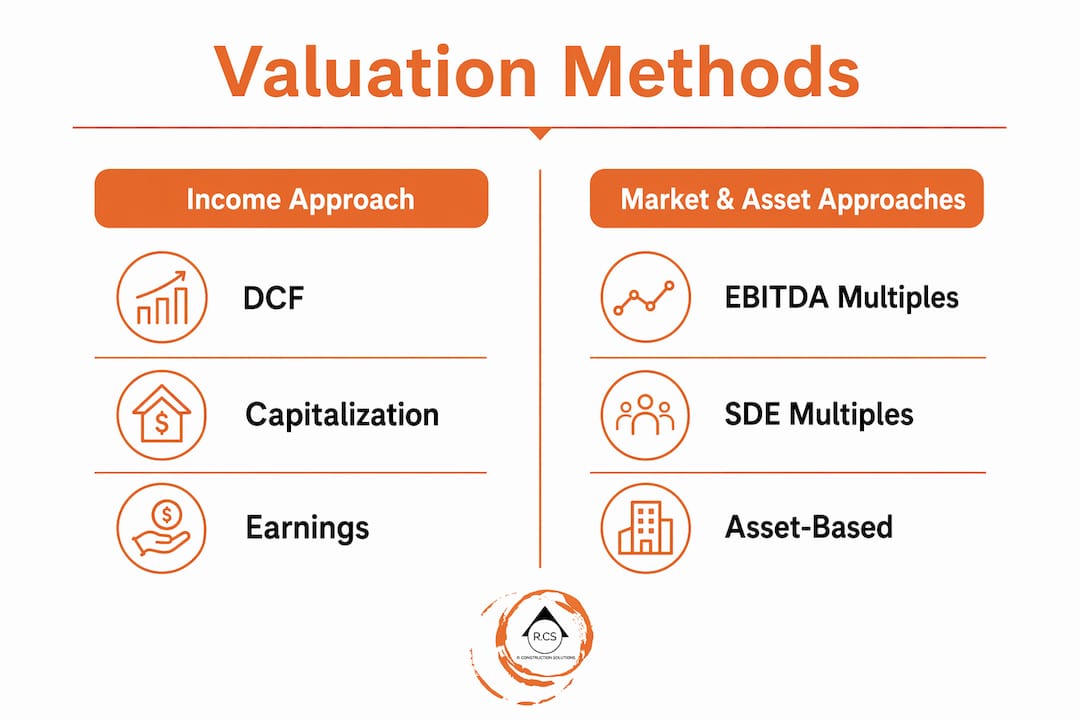
Three primary approaches drive most construction valuations:
- Income approach (discounted cash flow or capitalization of earnings): projects future cash flows and discounts them to present value; best suited to established contractors with predictable backlog and stable EBITDA margins.
- Market/multiples approach (EBITDA or SDE multiples): benchmarks your business against comparable private transactions; the most common method for small to mid-market contractors.
- Asset-based approach (net asset value or liquidation): anchors value in equipment, working capital, and tangible assets; most relevant for heavy civil firms, equipment-intensive trades, or distressed situations.
As a quick rule of thumb: owner-operated residential GCs and small specialty trades are typically valued on a seller’s discretionary earnings (SDE) multiple, while commercial contractors and mid-market platforms are valued on EBITDA. The asset approach becomes the floor when earnings are thin or the business is equipment-heavy.
Pro Tip: Buyers prize margin consistency above almost everything else. A contractor with five years of stable 12% gross margins will command a higher multiple than a faster-growing firm whose margins swing by 8 points year to year. Build predictability before you build revenue.
Table of Contents
- Why does valuation matter for construction owners?
- What are the core construction valuation methods?
- What financial metrics do buyers and appraisers actually use?
- Which construction-specific factors move your multiple up or down?
- How do appraisers normalize construction financials?
- What are typical valuation multiples for construction companies?
- What happens during a valuation engagement?
- How can you increase your company’s value before a sale?
- Worked example: valuing a hypothetical $4M contractor
- When should you hire a valuation professional?
- Key Takeaways
- What owners rarely hear about construction valuation
- Ready to prepare your business for valuation?
- Useful sources and further reading
Why does valuation matter for construction owners?
Most owners think about valuation once, right before a sale. That’s the wrong time. A defensible, current valuation shapes decisions across the entire life of a business, and the cost of getting it wrong shows up in real dollars.
Primary situations where an accurate valuation is non-negotiable:
- Exit planning and sale: Misaligned expectations between owner and buyer are the single most common reason deals collapse. Knowing your number before you go to market lets you negotiate from fact, not hope.
- Merger or recapitalization: Whether you’re selling a minority stake or merging with a larger platform, valuation determines your equity position and earnout structure.
- SBA or bank financing: Lenders use business value to set loan-to-value ratios. An under-documented valuation can shrink your borrowing capacity or kill a deal entirely.
- Bonding and surety: Surety underwriters review financial health closely. A well-documented valuation supports higher single and aggregate bonding limits.
- Partnership disputes and buyouts: Without an agreed valuation methodology, partner disputes become expensive litigation. A standing appraisal policy prevents that.
- Estate and tax planning: Gift and estate tax filings require defensible fair market value; the IRS scrutinizes construction business valuations closely.
Consider two scenarios: a contractor preparing for an SBA-financed buyer versus one selling to a strategic consolidator. The SBA buyer is constrained by lender guidelines and deal structure; the strategic buyer is paying for synergies, bonding capacity, and backlog. The same business can be worth materially different amounts depending on who is across the table and how the deal is structured. Knowing your valuation in advance lets you choose the right buyer type, not just the first one who calls.
What are the core construction valuation methods?
Income approach: DCF and capitalization of earnings
The income approach values a business by projecting the cash it will generate and discounting those flows back to today’s dollars. For construction firms, this means normalizing historical earnings, building a forward projection anchored in backlog and pipeline, and applying a discount rate that reflects the risk profile of the business.
Two variants apply to contractors:
- Discounted cash flow (DCF): Projects cash flows for a defined period (typically 5 years) plus a terminal value, then discounts everything at a weighted average cost of capital. Best for contractors with multi-year contracts, predictable backlog, and stable margins.
- Capitalization of earnings: Divides a single normalized earnings figure by a capitalization rate. Simpler and more common for smaller firms with steady, repeatable earnings.
Construction-specific complications: retainage receivables, WIP timing differences, and cyclical revenue all distort reported earnings. An appraiser using the income approach must normalize for these before projecting forward. A backlog of signed contracts with funded purchase orders is a genuine asset here; a backlog of verbal commitments is not.
Market/multiples approach: EBITDA and SDE multiples
This is the most widely used method for small to mid-market contractors. The appraiser identifies comparable private transactions from databases such as DealStats or BizComps, adjusts for size and comparability, and derives a multiple range. That multiple is applied to your normalized EBITDA or SDE to produce an enterprise value.
Illustrative worked example (multiples approach):
- Reported revenue: $4,000,000
- Reported EBITDA: $320,000
- Owner compensation adjustment (above-market): +$80,000
- Nonrecurring legal expense: +$25,000
- Related-party rent adjustment: +$15,000
- Normalized EBITDA: $440,000
- Applied multiple (specialty trade, stable margins, moderate concentration): 4.0x
- Enterprise value: $1,760,000
- Less net debt (equipment loans minus cash): ($120,000)
- Implied equity value: $1,640,000
This example uses illustrative assumptions. Actual multiples depend on trade, size, risk profile, and market conditions at the time of the transaction.
Asset-based approach: when equipment and net assets drive value
For heavy civil contractors, excavating firms, and equipment-intensive specialty trades, the asset-based approach can produce a value that exceeds the earnings-based result. The appraiser calculates net asset value: fair market value of all assets (equipment, real estate, receivables, WIP) minus all liabilities. During periods of equipment price inflation, the fair market value of a well-maintained fleet can significantly exceed depreciated book value.
This approach also sets the floor in distressed situations. If a buyer can acquire the assets for less than replacement cost, they have little incentive to pay an earnings premium.
Pros and cons by method for construction-specific realities:
| Method | Best For | Key Strength | Key Limitation |
|---|---|---|---|
| Income (DCF/Cap) | Established contractors, multi-year contracts | Captures future earning power | Sensitive to backlog quality and discount rate assumptions |
| Market/Multiples | Most small to mid-market contractors | Market-tested, buyer-familiar | Comparable data can be thin for niche trades |
| Asset-Based | Heavy civil, equipment fleets, distressed | Anchors value in tangible assets | Ignores going-concern earnings premium |
What financial metrics do buyers and appraisers actually use?
Buyers and appraisers work from a specific set of metrics. Knowing these formulas lets you read a valuation report critically and spot where the assumptions favor or hurt you.
Core definitions and formulas:
- Revenue: Total contract billings recognized in the period. For contractors using percentage-of-completion, this is not the same as cash collected.
- Cost of goods sold (COGS): Direct job costs: labor, materials, subcontractors, equipment costs allocated to projects.
- Gross profit: Revenue minus COGS. The most honest signal of field-level profitability.
- Gross margin: Gross profit divided by revenue, expressed as a percentage.
- EBITDA: Earnings before interest, taxes, depreciation, and amortization. The standard earnings base for mid-market transactions.
- Normalized EBITDA: EBITDA adjusted for owner compensation, related-party transactions, nonrecurring items, and WIP corrections. This is the number buyers actually pay a multiple on.
- SDE (seller’s discretionary earnings): Normalized EBITDA plus one owner’s full compensation and benefits. Used for owner-operated businesses where the buyer will replace the owner’s role.
Backlog: quality over quantity
Backlog is the total value of work under signed contract that has not yet been completed. But raw backlog size is less important than backlog quality. Backlog quality matters more than backlog size: a diversified, profitable backlog with signed contracts and good margins is worth far more than a larger backlog of thin-margin or single-client projects. Appraisers will ask for job-level detail, not just a total number.
Qualified backlog means: signed contracts or executed purchase orders, funded by the owner, with a notice to proceed (NTP) issued or imminent. Verbal commitments and letters of intent don’t count.
Working capital and WIP
Working capital (current assets minus current liabilities) tells a buyer whether the business can fund its own operations. WIP schedules reveal whether the company is overbilling (collecting cash ahead of earning it) or underbilling (earning revenue it hasn’t collected yet). WIP schedules are often the most revealing documents in a construction valuation; inaccurate WIP can materially misstate economic earnings.

Gross profit per employee is a forward-looking operational signal that buyers and lenders read closely. According to KBScpa, this metric indicates whether a firm can generate sustainable returns with a lean workforce, which directly speaks to scalability. A contractor generating $80,000 in gross profit per employee looks very different to a buyer than one generating $35,000, even at the same revenue level.
Buyers weight margin stability, bonding capacity, and backlog quality most heavily. Owners often focus on top-line revenue growth. That gap in perspective is where most valuation negotiations get contentious.
Which construction-specific factors move your multiple up or down?
Risk profile is the single largest driver of valuation multiples in construction. Geographic concentration, customer concentration, and trade-specific barriers to entry materially change what a buyer will pay. Here’s how each factor plays out:
- Bonding capacity: Strong surety relationships and high single/aggregate limits signal financial health to buyers. Bonding capacity can be worth nearly a full turn of EBITDA in some transactions, and inability to transfer surety capacity is a material deal breaker for many buyers.
- Experience modification rate (EMR): An EMR above 1.0 raises buyer concern about safety culture, insurance costs, and project eligibility. An EMR below 0.85 is a genuine competitive advantage.
- Customer concentration: If one client represents more than 20–25% of revenue, buyers apply a risk discount. Losing that client post-close is a real scenario they price in.
- Owner dependency: When the owner holds all key relationships, manages all estimating, and is the face of the business, buyers see a significant transition risk. This is often underreported in seller narratives but is a quantifiable factor in discount rate and multiple selection.
- Contract type: Fixed-price contracts carry more risk than cost-plus or GMP contracts. A backlog heavy in fixed-price work during a period of material cost volatility is a red flag.
- Equipment age and utilization: Aging, poorly maintained equipment increases capital expenditure risk for a buyer. Well-documented maintenance records and recent appraisals support value.
- Geographic concentration: A contractor working exclusively in one metro or region is more exposed to local economic cycles than one with a diversified footprint.
- Seasonality: Businesses with sharp seasonal revenue swings require more working capital and carry higher cash flow risk, which buyers factor into their offer.
Pro Tip: The fastest risk reductions are often the simplest: diversify your client list before you go to market, document your EMR improvement trend, and get a current equipment appraisal. Each one removes a specific objection a buyer will raise.
How do appraisers normalize construction financials?
Normalization is the process of adjusting reported financial statements to reflect the true economic earnings of the business, stripped of owner-specific decisions, one-time events, and accounting choices that don’t reflect ongoing operations. Most construction companies have several adjustments that materially change the earnings base.
Common normalization adjustments:
| Adjustment Category | Typical Direction | Example |
|---|---|---|
| Owner compensation | Add back excess above market | Owner’s compensation above-market amount added back |
| Related-party rent | Add back above-market rent | Owner’s LLC rent adjustment added back |
| Nonrecurring legal expense | Add back | Nonrecurring legal expense adjustment |
| Equipment lease capitalization | Adjust | Operating lease reclassified to reflect true debt and depreciation |
| WIP over/underbilling correction | Adjust earnings | Overbilling of $120K reversed to normalize revenue recognition |
| Family member compensation | Add back excess | Related-party compensation adjustment |
Document checklist appraisers will request:
- Three to five years of federal tax returns (business and personal)
- Three to five years of compiled or reviewed financial statements
- Job-level WIP schedules for the most recent 2–3 years
- Signed backlog contracts with NTP documentation
- Current bonding letter from surety (single and aggregate limits)
- Insurance certificates and EMR history (3–5 years)
- Equipment list with year, make, model, and estimated fair market value
- Accounts receivable aging report
- Related-party agreements (leases, management fees, loans)
- Key employee agreements and org chart
Preparing this document set before an appraiser arrives cuts weeks off the engagement timeline and signals to buyers that the business is well-managed. A contractor business assessment can help you identify gaps in your documentation before the formal process begins.
What are typical valuation multiples for construction companies?
Multiples in construction are derived from private transaction databases and, for larger firms, public company comparables adjusted for size. The challenge is that construction M&A data is thinner than in other industries, so comparability matters enormously. A roofing contractor and a mechanical contractor are both “construction,” but they trade at very different multiples.
Typical multiple ranges by tier and trade:
| Business Type | Valuation Base | Typical Multiple Range | Key Rationale |
|---|---|---|---|
| Owner-op residential GC | SDE | 2.0x | High owner dependency, cyclical demand, limited barriers |
| Specialty trade contractor | EBITDA | 4.0x | Trade licensing, recurring service mix, bonding capacity |
| Mid-market commercial GC | EBITDA | 4.0x | Management depth, diversified backlog, bonding |
| National/regional platform | EBITDA | 5.0x | Geographic scale, recurring revenue, M&A synergies |
What moves a multiple up or down:
- Recurring revenue or service contract mix (up)
- Strong, transferable bonding capacity (up)
- Margin consistency over 3–5 years (up)
- Low customer concentration (up)
- Experienced management team that doesn’t depend on the owner (up)
- Geographic diversification (up)
- High owner dependency (down)
- EMR above 1.0 (down)
- Thin or single-client backlog (down)
- Aging equipment with deferred maintenance (down)
Is a business worth “3x profit”? It depends entirely on which profit figure you’re multiplying. Three times SDE on a small owner-op GC is a reasonable starting point. Three times EBITDA on a mid-market specialty contractor is well below market. The multiple and the earnings base must be matched to the buyer type and business size. A 1.0x improvement in your EBITDA multiple can add roughly 28% to enterprise value without any change in revenue, which is why operational improvements that expand multiples are worth prioritizing over short-term revenue chasing.
What happens during a valuation engagement?
Here’s the typical sequence from engagement letter to final report, with realistic timelines:
- Scoping and engagement letter (Week 1): The appraiser defines the standard of value (fair market value, investment value), the purpose of the valuation, and the scope of work. Fee and timeline are agreed in writing.
- Data request and document assembly (Weeks 2–4): The appraiser sends a document request list. This is where owner preparation pays off. Gaps in WIP schedules or missing tax returns extend this phase significantly.
- Financial analysis and normalization (Weeks 3–5): The appraiser normalizes earnings, reviews WIP, analyzes backlog quality, and assesses risk factors. For companies with union contracts, multi-state licensing, or federal contracting compliance requirements, this phase takes longer.
- Draft report and Q&A (Weeks 5–7): A draft report is delivered for factual review. This is not a negotiation of the conclusion; it’s a check for factual errors in the inputs.
- Final report delivery (Week 7–10): The final certified report is issued. For litigation or SBA purposes, the appraiser may need to defend the report, which adds cost and timeline.
What drives a longer engagement:
- Complex WIP with multiple percentage-of-completion jobs
- Union contracts requiring benefit analysis
- Multi-state licensing and compliance review
- Federal contracting work (FAR/DFARS compliance, set-aside history)
- Equipment fleet requiring independent appraisal
- Litigation support or expert testimony requirements
Typical fee ranges: Professional valuations for construction businesses generally run $7,500–$25,000 depending on company complexity, equipment fleet size, and engagement scope. Litigation support and expert testimony work sits at the higher end. A preliminary or limited-scope opinion of value costs less but carries less weight with buyers and lenders.
Owner prep checklist to reduce timeline:
- Assemble tax returns and financials for the past 3–5 years before the engagement starts
- Prepare a current, job-level WIP schedule
- Pull your bonding letter and EMR history
- Create an equipment list with fair market value estimates
- Document all related-party transactions in writing
How can you increase your company’s value before a sale?
The most effective value-building work happens 12–24 months before you go to market. Here’s a time-phased roadmap:
0–6 months: Quick wins
- Clean up your WIP schedule and job costing. Inaccurate WIP is the first thing an appraiser flags, and it’s fixable. Improving your construction estimating process directly tightens your margin reporting.
- Diversify your client base. If one client is above 20% of revenue, actively pursue new accounts. Even modest diversification reduces the concentration discount.
- Pull your EMR history and address any open safety issues. A downward EMR trend is a positive signal; document it.
- Get a current equipment appraisal. Know what your fleet is worth at fair market value, not book value.
6–12 months: Operational changes
- Build management depth. Hire or develop a project manager, estimator, or operations manager who can run the business without daily owner involvement. Reducing owner dependency is one of the highest-leverage moves you can make before a sale.
- Formalize your surety relationship. Work with your bonding agent to increase your single and aggregate limits. Document the relationship and ensure it is transferable.
- Standardize your estimating and bid process. Buyers want to see a repeatable system, not one that lives in the owner’s head. Use an estimating checklist to document your process.
- Shift contract mix toward cost-plus or GMP where possible to reduce fixed-price risk exposure.
12–24 months: Strategic investments for multiple expansion
- Pursue recurring revenue: service agreements, maintenance contracts, or preferred vendor relationships that generate predictable annual revenue.
- Expand geographic footprint deliberately. Adding a second market reduces regional concentration risk.
- Invest in financial reporting quality. Move from cash-basis to accrual accounting if you haven’t. Buyers and lenders require it, and it typically reveals more value than cash-basis statements show.
- Use a growth planning checklist to prioritize investments that directly improve the metrics buyers care about.
KPIs to track your progress:
- Gross profit per employee (target: improving trend, ideally $65,000+)
- Backlog coverage in months (target: 3–6 months of revenue)
- Customer concentration % (target: no single client above 20%)
- EMR (target: below 1.0, trending down)
Pro Tip: Companies that operate without daily owner involvement command stronger valuations. Start delegating client relationships and estimating decisions at least 18 months before any planned transaction.
Worked example: valuing a hypothetical $4M contractor
This example walks through the full mechanics so you can follow the math and spot questionable assumptions in any report you receive.
Input data
| Item | Value |
|---|---|
| Annual revenue | $4,000,000 |
| Reported EBITDA | $320,000 |
| Nonrecurring legal expense | $25,000 |
| Bonding capacity (single/aggregate) | $3M / $8M |
| Net debt (equipment loans minus cash) | $95,000 |

Normalization
| Adjustment | Amount |
|---|---|
| Reported EBITDA | $320,000 |
| Add: nonrecurring legal | +$25,000 |
| Normalized EBITDA | $345,000 |
(The correct normalized EBITDA, adding only the $25,000 to the $320,000, is $345,000.)
Valuation
This contractor is a specialty trade firm with stable margins, an EMR below 1.0, solid bonding, and a diversified backlog. Based on the multiple ranges discussed earlier, a 4.5x EBITDA multiple is reasonable.
- Normalized EBITDA: $345,000
- Applied multiple: 4.5x
- Enterprise value: $1,552,500
- Less net debt: ($95,000)
- Implied equity value: $1,457,500
Sensitivity analysis
Small changes in assumptions produce meaningful swings in value. Here’s what a one-turn change in multiple or a 10% change in normalized EBITDA does to this example:
| Scenario | Normalized EBITDA | Multiple | Enterprise Value |
|---|---|---|---|
| Base case | $345,000 | 4.5x | $1,552,500 |
| Multiple drops to 4.0x | $345,000 | 4.0x | $1,380,000 |
| Multiple rises to 5.0x | $345,000 | 5.0x | $1,725,000 |
| EBITDA down 10% | $310,500 | 4.5x | $1,397,250 |
| EBITDA up 10% | $379,500 | 4.5x | $1,707,750 |
A one-turn drop in multiple costs this owner roughly $172,500 in enterprise value. That’s the financial case for investing in the operational improvements that expand multiples before going to market.
When should you hire a valuation professional?
Not every situation requires a full certified appraisal. But several do, and trying to navigate them without the right expert is a costly mistake.
Situations that require professional help:
- Planned sale or recapitalization (any size)
- SBA 7(a) or 504 loan requiring a business valuation
- Partner buyout or shareholder dispute
- Estate planning, gift tax filings, or ownership transfer
- Significant owner succession planning with bonding transfer
- Litigation involving business damages or lost profits
- Federal contracting compliance reviews involving business value
Types of professionals and what each delivers:
- Certified business appraiser (CBA) or accredited senior appraiser (ASA): Produces a defensible, standards-compliant valuation report. Required for SBA financing, estate/gift tax, and litigation.
- CPA with construction forensic experience: Normalizes complex WIP, analyzes job costing, and can serve as an expert witness. Essential when WIP disputes or revenue recognition issues are in play.
- M&A advisor or business broker: Helps position the business for sale, identify buyers, and manage the deal process. Not a substitute for a certified appraiser but a critical partner in a transaction.
- Surety/bonding consultant: Advises on bonding transfer strategy and helps structure the transaction to preserve surety relationships. Often overlooked until it’s too late.
Interview questions to ask an appraiser before hiring:
- How many construction company valuations have you completed in the past three years?
- Can you share a sample report structure (redacted)?
- How do you normalize WIP and handle percentage-of-completion adjustments?
- What databases do you use for comparable transactions?
- What is your timeline and fee structure for this engagement?
- Have you provided expert testimony in construction valuation disputes?
- Can you provide references from construction clients?
When evaluating consulting proposals for valuation-related advisory, a structured proposal evaluation process helps you compare credentials and scope objectively.
Due diligence readiness checklist (what you can do before the expert arrives):
- Organize 3–5 years of tax returns and financial statements
- Prepare a current job-level WIP schedule
- Compile signed backlog contracts with NTP documentation
- Obtain a current bonding letter
- Pull EMR history and safety records
- Create an equipment list with estimated fair market values
- Document all related-party transactions
For owners exploring construction financing options alongside a valuation, a construction loan guide can help you understand how lenders use business value in underwriting decisions.
Key Takeaways
A construction company’s value is determined by normalized earnings, the multiple buyers will pay for those earnings, and the risk factors that move that multiple up or down.
| Point | Details |
|---|---|
| Match method to business type | Owner-ops use SDE multiples (2.0x); specialty trades use EBITDA multiples (4.0x); asset-heavy firms may use asset-based approach. |
| Normalize before you value | Adjust owner compensation, related-party costs, nonrecurring items, and WIP before applying any multiple. |
| Top three value drivers | Margin consistency, transferable bonding capacity, and backlog quality move multiples more than revenue growth. |
| A 1-turn multiple gain adds ~28% | Operational improvements that expand your EBITDA multiple by 1.0x add roughly 28% to enterprise value without increasing revenue. |
| R Construction Solutions LLC | Helps contractors clean WIP, improve estimating, build management depth, and prepare financially for valuation or sale. |
What owners rarely hear about construction valuation
Most valuation guides focus on the math. The math matters, but the assumptions behind the math are where deals are won or lost.
Here’s what I’ve observed across 30+ years of operations and business development advisory in the construction industry: owners consistently overestimate the value of their revenue and underestimate the value of their systems. A $6 million contractor with clean WIP, documented estimating processes, a management team that doesn’t need the owner in every meeting, and a transferable surety relationship will sell for more than a $10 million contractor held together by the owner’s relationships and institutional memory.
Three rules of thumb I apply when advising clients preparing for a valuation or sale:
Margin consistency beats top-line growth for buyers. A buyer acquiring your business is buying future cash flows, not past revenue. Five years of 14% gross margins with low variance is worth more than five years of 18% average margins that swung between 8% and 28%. Volatility is risk, and risk compresses multiples.
Bonding transfers are worth a turn. If your surety relationship is personal to you and cannot be transferred to a new owner, buyers will price that risk into their offer. Work with your bonding agent 18–24 months before any planned transaction to structure a transferable relationship. That single step can be worth a full turn of EBITDA in the final negotiation.
Build estimating depth before you sell. Buyers want to see that your estimating process produces consistent margins across project types and estimators. If your best estimates come from one person (often the owner), that’s a concentration risk. Documenting and distributing your estimating methodology is one of the highest-return pre-sale investments you can make.
The owners who get the best outcomes in a sale are the ones who started preparing two years before they needed to. Valuation is not a number you discover at the end. It’s a number you build.
Ready to prepare your business for valuation?
Knowing your construction company’s worth is one thing. Building toward a number that reflects what your business is actually capable of is where the real work happens.

R Construction Solutions LLC works directly with construction contractors on the operational and financial groundwork that valuation requires: WIP cleanup and job costing discipline, estimating process improvement, backlog qualification, bonding advisory, management depth development, and pre-sale readiness planning. These aren’t generic consulting services. They’re the specific fixes that move multiples and reduce buyer friction in a real transaction.
If you’re planning a sale, a financing event, or simply want a clear picture of where your business stands, the right starting point is a structured advisory conversation. Bring your last two years of financials, your current WIP schedule, and your bonding letter. That’s enough to identify the gaps and build a realistic plan.
Schedule a consulting engagement with R Construction Solutions LLC and get a direct, practical assessment of where your business stands and what it will take to get it where you want it.
Useful sources and further reading
The following sources were used in preparing this guide and are recommended for owners who want to go deeper on specific topics:
- Factors Affecting the Value of Construction Companies (BerryDunn): Best for understanding how risk factors (customer concentration, geographic concentration, trade barriers) affect multiples. A practitioner-level reference.
- Financial Metrics for Construction Business Valuations (KBScpa): Covers gross profit per employee, EBITDA normalization, and the metrics buyers weight most heavily. Useful for owners building their financial reporting.
- Commercial Construction Valuation (Mark S. Gottlieb, MSGCPA): Detailed treatment of bonding capacity as a value driver and owner dependency as a quantifiable risk. Recommended reading before any transaction.
- What Buyers Look for in Construction Companies (Katzabosch): Practical buyer-perspective analysis of WIP schedules, backlog quality, and due diligence priorities.
- Construction Business Valuation (CT Acquisitions): Tiered multiple ranges by trade and business size, with transaction context.
- How to Value a Construction Company (ExitValue.ai): Accessible overview of margin consistency as a valuation driver, with practical owner guidance.
- Comprehensive Construction Business Valuation (K38 Consulting): Explains the leverage effect of multiple expansion and why operational improvements often outperform revenue growth in building value.
- Contractor Business Assessment Explained (R Construction Solutions LLC): Internal resource covering the document checklist and business health assessment process owners should complete before a formal valuation engagement.
- Construction Loan for Business: 2026 Owner’s Guide (JurisLedger): Partner resource on construction financing options and how lenders use business value in underwriting. Relevant for owners preparing for SBA or bank financing alongside a valuation.
- R Construction Solutions LLC Consulting Services: Service landing page for owners ready to begin valuation preparation, WIP cleanup, estimating improvement, or pre-sale advisory.
This article is general information for educational purposes and does not constitute financial, legal, or professional appraisal advice. Confirm current valuation standards and tax implications with a qualified appraiser, CPA, or attorney for your specific situation.