The Role of Risk Management in Construction Operations
Risk management in construction operations is the structured process of identifying, assessing, and controlling risks that threaten project success across cost, schedule, safety, and quality dimensions. Construction projects face an unusually wide range of threats, from subcontractor failures and material shortages to regulatory violations and weather delays. Without a formal system to address these threats, small issues snowball into budget overruns, missed deadlines, and serious injuries. The role of risk management in construction operations goes far beyond paperwork. It is an active, ongoing discipline that runs from preconstruction through project closeout, protecting your margins and your crew at every phase.
What are the key components of construction risk management?
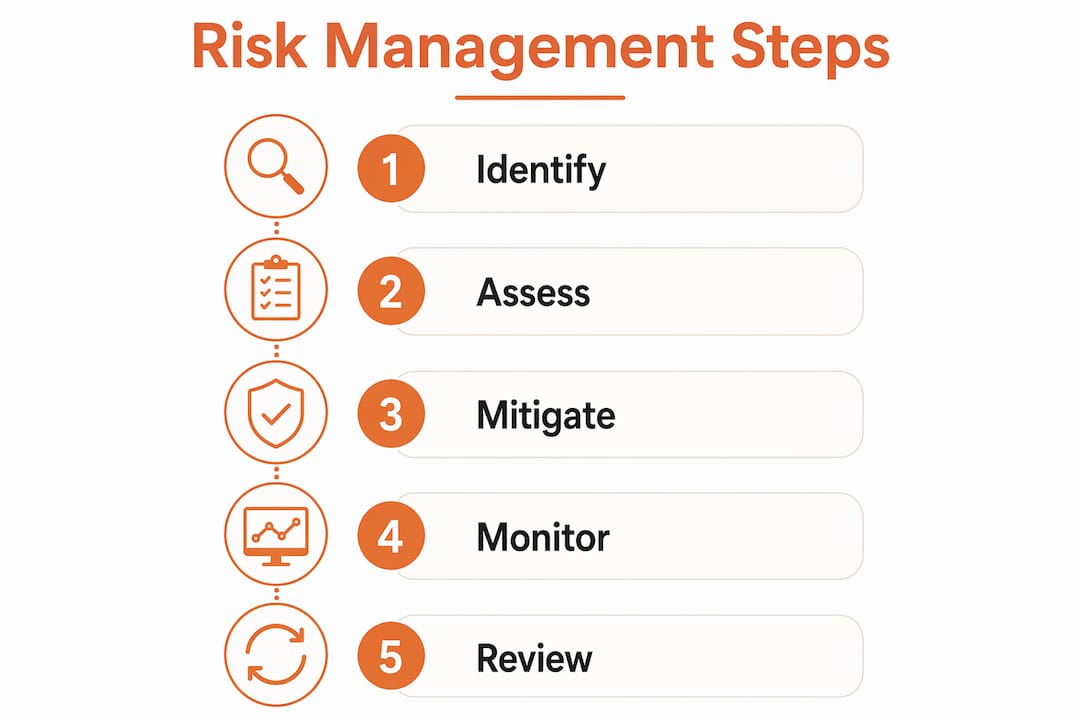
Effective construction risk management follows a four-step cycle: identify, assess, mitigate, and monitor. Each step builds on the last, and skipping any one of them leaves your project exposed.
The four core steps are:
-
Risk identification. Catalog every potential threat before work begins. Group risks by category: financial, schedule, safety, contractual, and environmental. AACE International 62R-11 sets the industry standard for structured risk identification and categorization in construction projects. That framework gives your team a consistent starting point rather than relying on memory or past experience alone.
-
Risk assessment. Score each identified risk using a probability-severity matrix, commonly a 5x5 grid. Assign a likelihood score and an impact score, then multiply them to get a priority rating. Inconsistent matrix scoring, often based on gut feel, causes poorly resourced safety and mitigation programs. Standardized scoring removes that subjectivity and forces honest conversations about real exposure.
-
Risk mitigation planning. For every high-priority risk, define a specific response. Assign a named individual, set a hard deadline, and document both in your risk register. Assigning a named owner with a deadline for each identified hazard is the single most effective step in preventing mitigation failure.
-
Risk monitoring and updating. Review and update the risk register at defined intervals and whenever site conditions change significantly. A risk register that goes untouched after week one is not a risk management tool. It is a liability.
Pro Tip: Separate your safety hazard assessments from your broader project risk assessments. Failing to distinguish between the two results in incomplete protection. Safety assessments focus on immediate physical dangers; project assessments cover financial, schedule, and contractual exposure.
One more critical point: trigger-based reassessments protect you when conditions shift unexpectedly. Define in advance what events, such as a subcontractor default or a two-week weather delay, will automatically trigger a full risk review. That discipline keeps your risk process connected to reality.
How does risk management integrate into daily construction operations?
The biggest failure in construction risk management is treating it as a one-time exercise. Paper-based static risk assessments cannot adapt to changing site conditions. Real-time digital updates are what make risk management actually effective on a live project.

Embedding risk management into daily operations means connecting it to the workflows your team already uses. Daily reports, toolbox talks, and field observations all generate risk data. The question is whether that data feeds back into your risk register or disappears into a folder.
Practical ways to integrate risk management into daily operations:
- Assign a risk owner for every open item before work on that phase begins. No owner means no accountability.
- Use digital field tools to log new hazards and update existing ones in real time. Supervisors and frontline workers should both have access.
- Review the top five open risks at every weekly project meeting. This keeps the register alive and signals to the team that risk management is a priority, not a formality.
- Connect your project contingency planning directly to your risk register. When a risk escalates, the contingency response should already be defined.
- Use daily reports as a feedback loop. If a foreman flags a new hazard, it should appear in the risk register within 24 hours.
Treating risk management as a checkbox undermines its value. When it is integrated practically into workflows, it becomes a proactive decision tool that helps you catch problems before they cost money or hurt someone.
Pro Tip: Assign a dedicated risk review slot in your weekly project meeting agenda. Even 10 minutes of structured review keeps the register current and reinforces a culture of accountability across the project team.
The role of an operations manager in this process is critical. Operations managers translate site-level observations into register updates and escalate emerging risks to project leadership before they become claims.
What governance structures support construction risk management?
Risk management does not live only on the job site. It requires organizational governance to function at scale. Risk management is now a central business function requiring clear governance and designated risk managers who link strategy to site operations. That means your board or senior leadership must define the firm’s risk appetite and set the tone for how risk is handled across all projects.
Governance structures that support effective risk management include:
- A defined risk appetite statement. Leadership must decide how much risk the firm is willing to accept on a given project type before the bid goes out.
- A designated risk manager or risk champion. This person translates strategic risk policy into site-level procedures and ensures accountability flows in both directions.
- Compliance with legal requirements. Employers with five or more employees must create and regularly update written risk assessments under standard safety regulations. This is not optional.
- Enterprise Risk Management (ERM) or ISO 31000 alignment. These frameworks connect project-level risks to firm-wide financial and operational exposure, giving leadership a complete picture.
“Risk management integrated across an organization’s functions enables governance that connects strategy to operations. Without that connection, site-level risk controls operate in isolation, and firm-wide exposure goes unmanaged.”
Internal audit functions play a supporting role here. Regular audits of risk registers, mitigation logs, and ownership records reveal where the process is breaking down before a project does. Embedding contract compliance practices into your governance structure further reduces legal and financial exposure on public and commercial work.
What risk mitigation strategies do construction teams prioritize?
Every identified risk needs a response. Construction teams use four standard response strategies, and choosing the right one depends on the risk’s probability and severity score.
| Response Strategy | When to Use It | Example |
|---|---|---|
| Avoid | High probability, high impact | Redesign a scope element that creates unacceptable safety exposure |
| Transfer | High impact, manageable probability | Shift financial risk to a subcontractor or insurer through contract terms |
| Mitigate | Moderate probability or impact | Add inspections, training, or redundant processes to reduce likelihood |
| Accept | Low probability and low impact | Document and monitor without active intervention |
Calibrated risk matrices drive this prioritization. A risk rated 20 out of 25 on a 5x5 matrix demands an avoid or transfer response. A risk rated 4 out of 25 can be accepted with monitoring. The matrix only works when scoring is consistent across the team.
Schedule quality monitoring through metrics like the Schedule Performance Index (SPI) is one of the most underused mitigation tools in construction. SPI below 1.0 signals that the project is behind schedule. That signal should trigger an automatic risk review, not just a schedule update meeting.
Pro Tip: Build trigger thresholds directly into your risk register. Define in writing that an SPI below 0.85 or a cost variance exceeding 5% automatically activates a mandatory risk review. Thresholds remove the guesswork and the politics from escalation decisions.
Contingency planning is the financial side of mitigation. Every risk register should map high-severity risks to a specific contingency line in the budget. When the risk materializes, the response is funded and ready. For a deeper look at how construction firms structure financial risk buffers, the relationship between contingency and risk management is direct and quantifiable. Understanding key construction risk factors from an insurance and operational perspective also helps teams build more complete mitigation plans.
Key Takeaways
Effective risk management in construction operations requires structured identification, consistent scoring, named ownership, and real-time updates to protect cost, schedule, safety, and quality outcomes across every project phase.
| Point | Details |
|---|---|
| Start with a structured framework | Use AACE 62R-11 or equivalent standards to categorize and score risks consistently from day one. |
| Assign named owners with deadlines | Every open risk item needs a specific person and a hard deadline to prevent mitigation failure. |
| Update risk registers in real time | Static, paper-based registers cannot reflect changing site conditions; digital tools are required. |
| Separate safety and project risk assessments | Safety hazard assessments and project risk assessments serve different purposes and both are required. |
| Connect risk management to governance | Firm-wide risk appetite, legal compliance, and ERM frameworks keep site-level controls aligned with strategy. |
Risk management is a leadership discipline, not a paperwork exercise
I have worked with construction firms that had beautifully formatted risk registers and zero mitigation activity. The register existed to satisfy a contract requirement. Nobody owned the items. Nobody updated them. And when a subcontractor defaulted mid-project, the team scrambled because the response plan was never built.
The firms that manage risk well share one trait: leadership treats it as a real operational responsibility. The project manager reviews the register weekly. The superintendent flags new hazards the same day they appear. The owner has defined what risks the firm will and will not accept before the contract is signed.
What I find most telling is the ownership question. Ask any project manager to name the person responsible for the top three open risks on their current project. If they cannot answer in 10 seconds, the risk management process is not working. Named ownership with a deadline is the single most reliable predictor of whether a risk gets resolved or becomes a claim.
Digital tools matter, but they are not the solution on their own. I have seen firms adopt field management platforms and still produce static risk data because nobody built the habit of updating records daily. The tool only works when the workflow is designed around it. Process improvement in construction starts with the workflow, not the software.
The firms that scale successfully, from $5 million to $50 million in revenue, are the ones that build risk management into their operational DNA early. They do not wait for a costly incident to take it seriously.
— Rowena
How Rconstructionsolutions supports your risk management process
Construction risk management works best when it is built into your firm’s daily operations from the ground up, not added as an afterthought after a project goes sideways.
Rconstructionsolutions brings over 30 years of hands-on construction experience to help contractors build risk management processes that actually work in the field. The consulting team works directly with project managers and operations leaders to design risk identification workflows, accountability structures, and digital tracking systems tailored to your firm’s size and project types. Whether you run residential builds or large commercial contracts, the goal is the same: fewer surprises, better margins, and safer job sites. Visit the construction consulting services page to learn how Rconstructionsolutions can help your team build a risk process that protects every project.
FAQ
What is the role of risk management in construction operations?
Risk management in construction operations is the systematic process of identifying, assessing, and controlling threats to project cost, schedule, safety, and quality. It runs continuously from preconstruction through closeout and requires named ownership and regular updates to be effective.
What are the most common construction risk factors?
The most common construction risk factors include subcontractor failures, budget overruns, schedule delays, safety incidents, and contractual disputes. Financial and schedule risks are closely linked, meaning a delay in one area typically triggers cost exposure in another.
How do construction teams prioritize risk responses?
Construction teams use a probability-severity matrix, typically a 5x5 grid, to score and rank risks. High-scoring risks receive avoid or transfer responses, while lower-scoring risks may be accepted with monitoring and documented in the risk register.
Are written risk assessments legally required on construction sites?
Employers with five or more employees must produce and maintain written risk assessments under standard safety regulations. These assessments must be updated regularly to reflect current site conditions and any new hazards identified during the project.
What is the difference between a safety hazard assessment and a project risk assessment?
A safety hazard assessment focuses on immediate physical dangers to workers on site. A project risk assessment covers broader financial, schedule, and contractual risks that affect overall project success. Both are required and serve different but complementary purposes.

