
Why General Contractors Carry Project Contingency
Project contingency is a reserved budget line that general contractors hold to absorb unexpected costs within the defined construction scope, keeping projects on schedule without emergency owner approvals or unplanned capital injections. Every experienced contractor knows that no estimate is perfect. Coordination errors, hidden site conditions, and material price swings are not exceptions in construction. They are the rule. Understanding why a general contractor carries project contingency, and how to manage it correctly, separates contractors who protect their margins from those who bleed them on every job.
Why general contractors carry project contingency
Contractor contingency is defined as a budget reserve held by the general contractor to cover latent, unforeseen risks within the agreed construction scope. It is not a profit buffer. It is not a slush fund. Its sole purpose is to keep the project moving when reality diverges from the estimate.
The distinction between contractor contingency and owner contingency matters enormously. Contractor contingency covers latent risks like coordination errors, minor quantity adjustments, and hidden site conditions. Owner contingency, by contrast, covers scope changes, design revisions, and program additions. Mixing the two creates disputes, audit failures, and damaged owner relationships.
GC contingency typically ranges from 2% to 5% of total work cost inside a Guaranteed Maximum Price (GMP) contract. Owner contingency runs higher, from 5% to 15% of hard costs, depending on project complexity and design completeness. These are not arbitrary numbers. They reflect decades of industry loss data and risk modeling across commercial and residential project types.

Carrying the right contingency level gives you financial control without sacrificing scope. When an unforeseen condition surfaces, you draw from the reserve, document the use, and keep the crew working. Without it, you face a choice between absorbing the loss or triggering a change order process that stalls the job.
How project contingency addresses common unforeseen construction risks
Construction projects fail budgets for predictable reasons. The risks that drain contractor contingency are not random. They cluster around a consistent set of categories.
Common contingency expenses that contractor reserves cover include:
- Coordination errors between trades, such as mechanical and structural conflicts discovered during installation
- Minor quantity changes where field measurements differ from design drawings
- Material price fluctuations on commodities like steel, lumber, and copper that shift between bid and procurement
- Latent site conditions such as unexpected soil bearing capacity, buried utilities, or concealed structural deficiencies
- Subcontractor productivity shortfalls that require additional supervision or schedule recovery measures
Each of these is a contractor-controlled risk. None of them require owner authorization to resolve, provided the contingency clause is properly drafted. Contractor contingency is exclusively for latent construction risks, not for profit recovery or poor estimating. That distinction is the foundation of good contingency governance.
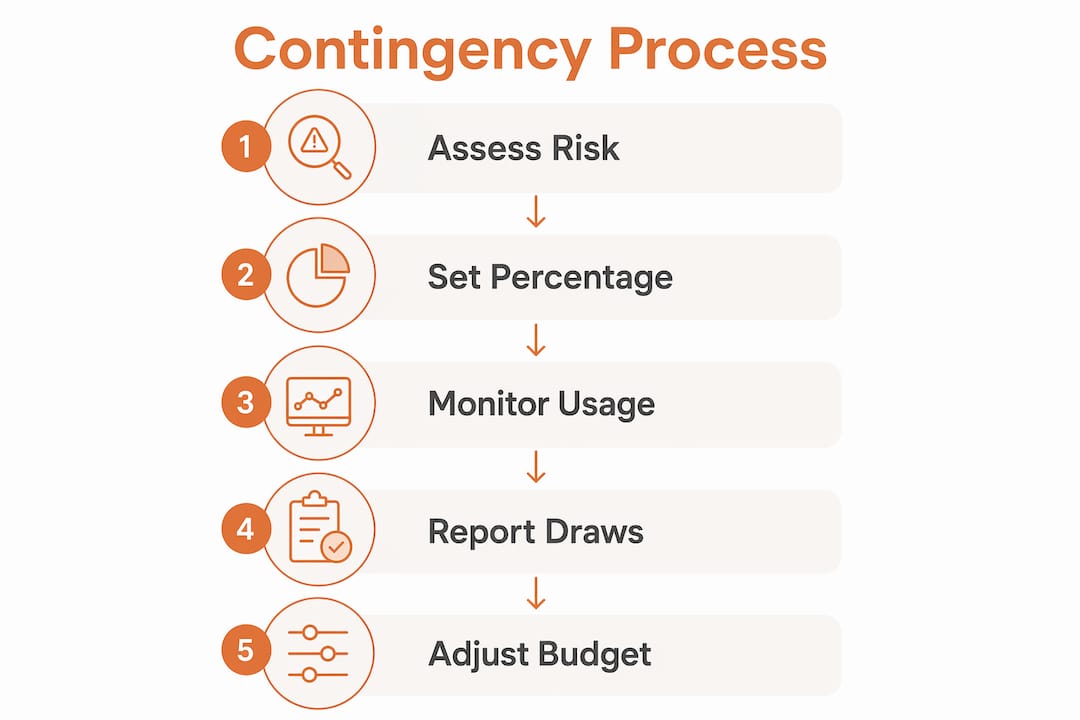
Risk profile drives the percentage you set. Low-risk projects warrant 3–5% contingency, mid-risk projects 5–8%, and high-risk projects 8–12%. Renovation work with concealed conditions can justify up to 25%. That range reflects the reality that a ground-up commercial build on a clean site carries far less uncertainty than a historic renovation with unknown structural conditions behind every wall.
Pro Tip: When estimating contingency for renovation work, walk the site with your superintendent before finalizing the number. What you see in person will reveal risks that drawings never capture.
Contingency does not cover scope changes. If the owner adds a floor, changes the facade material, or expands the program, that cost belongs in a change order, not in your contingency reserve. Blurring that line is one of the most common and costly mistakes contractors make.
Industry best practices and standards for setting contractor contingency
Setting the right contingency percentage requires more than guessing. It requires a structured risk assessment tied to project type, design completeness, and contract structure.
| Project risk profile | Contingency range | Typical scenario |
|---|---|---|
| Low risk | 3–5% | Ground-up commercial, complete design documents |
| Mid risk | 5–8% | Occupied renovation, partial design completion |
| High risk | 8–12% | Complex MEP coordination, phased construction |
| Concealed conditions | Up to 25% | Historic renovation, unknown subsurface conditions |
GMP contracts are the most common vehicle for contractor contingency in commercial construction. The GMP structure caps the owner’s exposure and places the contractor in the position of managing cost risk within a defined ceiling. Inside that ceiling, the contractor contingency fund operates as the first line of defense against cost overruns.
A well-drafted contingency clause defines permissible uses and restricts draws to contractor-controlled risks. The owner cannot access these funds. That protection only exists if the clause is specific. Vague language like “unforeseen conditions” without defined parameters invites disputes.
Lenders have their own requirements. Construction lenders view depleted contingency as a major red flag that threatens collateral value. Many loan agreements require lender approval before contingency funds can be reallocated. Lenders require fully funded contingency reserves before loan closing. That means your contingency sizing affects not just your budget but your client’s financing.
Pro Tip: Review your contingency clause with legal counsel at contract formation, not after a dispute arises. The language you negotiate upfront determines how much protection you actually have.
Transparency with stakeholders builds trust. Reporting contingency draws in your monthly owner reports, with clear documentation of the triggering event and the amount used, demonstrates financial discipline. Owners and lenders notice. That discipline also protects you during audits and project closeout.
Common mistakes in managing contractor contingency
Contingency mismanagement is one of the fastest ways to damage a project’s financial health and your reputation with owners and lenders. The mistakes are well-documented and largely avoidable.
- Using contingency as a profit supplement. Drawing contingency to cover estimating errors or low-margin subcontracts violates the fund’s purpose and exposes you to audit findings and owner disputes.
- Failing to separate contractor and owner contingency. When these funds are commingled in reporting, owners assume they have access to both. Separating contractor contingency from owner contingency aligns financial governance and prevents costly misunderstandings.
- Neglecting documentation. Every contingency draw needs a paper trail. The triggering event, the amount, the approval, and the resolution must be recorded. Without documentation, you cannot defend the draw during closeout or litigation.
- Over-allocating contingency. Over-allocating contingency inflates bids unnecessarily, reducing your competitiveness in project awards. Padding the contingency to feel safe costs you work.
- Misaligning bid exclusions with contingency scope. Failure to harmonize bid exclusions and contingency funds causes contractors to absorb costs for work outside the GMP scope. That is money you never planned to spend.
The consequences of these mistakes compound quickly. Depleted contingency triggers lender red flags. Undocumented draws invite owner disputes. Poor risk assessment leads to cost overruns that erode profit on every job. Reviewing your common contractor business mistakes before contract execution is a practical first step toward avoiding these traps.
Practical strategies for effective contingency governance and deployment
Knowing why you carry contingency is only half the answer. How you govern and deploy it determines whether it actually protects you. These steps give you a repeatable process.
-
Set a discretionary draw threshold. A discretionary threshold of $50,000 for contingency draws without owner approval keeps projects moving during fast-paced construction phases. Negotiate this threshold at contract formation so it is contractually protected.
-
Define the approval process in writing. Every draw above the threshold should require a written request, a description of the triggering event, and a designated approver. This process protects you and gives owners confidence that funds are controlled.
-
Align contingency with bid exclusions. Contractors must align bid exclusions explicitly with contingency budget items to avoid absorbing costs for work outside the GMP scope. Review your exclusions list against your contingency categories before signing the contract.
-
Integrate contingency tracking into contract administration. Track draws in your project management system with the same rigor you apply to subcontract commitments. Monthly reporting should show the opening balance, draws to date, and remaining reserve.
-
Plan for unspent contingency at closeout. Unspent contingency should be returned or reallocated, not treated as extra profit. Misusing unspent funds leads to owner dissatisfaction and lost future bids. A clear closeout protocol for contingency builds long-term owner trust.
Connecting your contingency governance to your broader process improvement in construction reduces the frequency of draws in the first place. Better coordination, tighter scheduling, and proactive subcontractor management all lower the risk events that trigger contingency use.
Key takeaways
General contractors carry project contingency because construction risk is real, predictable in category, and manageable with the right financial structure and governance discipline.
| Point | Details |
|---|---|
| Contingency is not profit | Contractor contingency covers latent risks only; misuse triggers disputes and audit findings. |
| Percentage reflects risk | Set 3–5% for low-risk projects and up to 25% for concealed-condition renovations based on project complexity. |
| Clause language is critical | A well-drafted contingency clause defines permitted uses and prevents owner access to contractor funds. |
| Lenders watch the reserve | Depleted contingency signals financial distress to lenders and can jeopardize project financing. |
| Governance protects everyone | Documented draws, discretionary thresholds, and closeout protocols build owner trust and protect your margins. |
What 30 years of contingency disputes taught me
I have reviewed hundreds of contracts where the contingency clause was an afterthought. A single vague sentence buried in the GMP exhibit. No defined uses. No draw process. No threshold. And every single time, that vagueness became the center of a dispute by month four.
The contractors who avoid those disputes do one thing differently. They negotiate the contingency clause with the same attention they give the payment terms. They define what the fund covers, what it does not cover, who approves draws, and what happens to unspent funds at closeout. That conversation happens before the contract is signed, not after the first cost event surfaces.
The other pattern I see consistently is contractors who set contingency based on gut feel rather than risk assessment. They pick 5% because that is what they always do. But a ground-up steel frame building and a gut renovation of a 1920s warehouse are not the same risk profile. The number has to match the job.
Proactive contingency governance is not bureaucracy. It is the difference between finishing a project with your margin intact and explaining to an owner why you need more money. Get the clause right at the start. Track every draw. Return what you do not use. That discipline compounds over time into a reputation that wins you better projects.
— Rowena
How Rconstructionsolutions supports contractor contingency planning
Managing contingency well requires more than knowing the percentages. It requires contract knowledge, risk assessment skills, and a governance process that holds up under scrutiny.

Rconstructionsolutions brings over 30 years of hands-on construction experience to contractors who want to get this right. Their construction consulting services cover contingency planning, contract governance, and risk management for both residential and commercial contractors. The team works directly with you to build contingency frameworks that match your project types and risk profiles. Contractors can also access practical templates and budgeting tools through The Sandbox, a resource hub built specifically for contractors who want proven systems without starting from scratch.
FAQ
What is contractor contingency in a GMP contract?
Contractor contingency in a GMP contract is a reserved budget line the general contractor controls to cover unforeseen costs within the agreed scope. GC contingency typically ranges from 2% to 5% of total work cost and cannot be accessed by the owner.
What are common contingency expenses for general contractors?
Common contingency expenses include coordination errors between trades, minor quantity changes, material price fluctuations, latent site conditions, and subcontractor productivity shortfalls. These are contractor-controlled risks that arise within the defined project scope.
How is contractor contingency different from owner contingency?
Contractor contingency covers latent construction risks within the scope. Owner contingency covers scope changes, design revisions, and program additions. Commingling the two creates disputes and audit failures.
How much contingency should a general contractor carry?
Risk profile drives the percentage: low-risk projects warrant 3–5%, mid-risk 5–8%, high-risk 8–12%, and renovation work with concealed conditions up to 25%. The number must match the specific project’s uncertainty level.
What happens to unspent contractor contingency at project closeout?
Unspent contingency should be returned or reallocated according to the contract terms, not retained as additional profit. Returning unspent funds builds owner trust and protects your standing for future project awards.