
Public Construction Contract Compliance: 2026 Expert Guide | R. Construction Solutions
Public construction contract compliance is defined as the full adherence to every legal, procedural, and contract-specific obligation required on publicly funded construction projects. This covers everything from bid submission documents and Davis-Bacon Act wage certifications to subcontractor flow-down requirements and final lien waivers. For contractors working on public works, non-compliance is not a minor administrative issue. It triggers bid disqualification, financial penalties, retainage withholding, and even debarment. Understanding what is public construction contract compliance, and how it applies at every project phase, is the foundation of a defensible and profitable public works operation.
What is public construction contract compliance at bid submission?
Public construction contract compliance begins before a single shovel breaks ground. The bid submission phase carries the highest disqualification risk, and most contractors lose work not because they underbid, but because their paperwork is incomplete.
Public bid compliance requires fulfilling legal and documentation requirements that cover wage rates, non-collusion statements, and subcontractor listings. Missing any one of these documents typically results in automatic disqualification, regardless of bid price. The standard documents required at submission include:
- Non-collusion affidavit. This certifies that your bid was prepared independently, without coordination with competing bidders.
- Davis-Bacon wage rate certification. Federal contracts over $2,000 must meet Davis-Bacon Act wage rates, and your bid must include certified payroll documentation commitments.
- Subcontractor listing. Most public agencies require you to name subcontractors at bid time, often with their license numbers and scope of work.
- Bid bond. A surety bond, typically 5%–10% of the bid amount, guarantees you will execute the contract if awarded.
- Insurance certificates. Proof of general liability, workers’ compensation, and any project-specific coverage required by the owner.
- MBE/WBE/DBE participation forms. Federal and state funded projects often mandate minority and disadvantaged business participation goals. Contractors pursuing WBE, MBE, and DBE certifications should have these documents prepared well in advance.
Reading the contract alone is not enough. Contractors must interpret Division 01 specifications and align contract requirements against regulatory regimes such as Davis-Bacon, OSHA, and applicable environmental statutes during the bidding stage. Skipping this step is where small issues snowball into disqualification or costly change orders later.
Pro Tip: Schedule a bid compliance review at least five business days before the submission deadline. Assign one person to own the checklist, and have a second person verify every document independently. This two-step check catches errors that cost you the contract.

How do compliance requirements extend during project execution?
Winning the bid is only the beginning. Execution-phase compliance is where most contractors face their biggest exposure, because the obligations multiply once work starts.
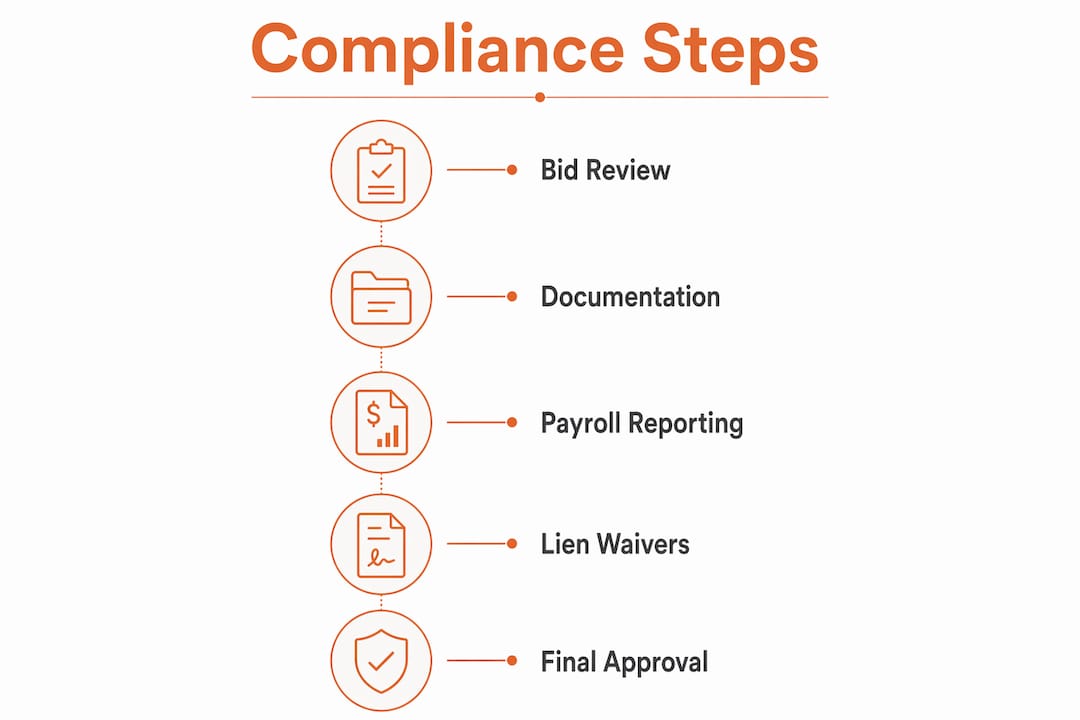
Subcontractor compliance varies project by project and must be traced back to the prime contract clauses to avoid disputes. What your subcontractor did on a previous public job is irrelevant. Each project has its own flow-down requirements, and you are responsible for enforcing them. Failure to treat compliance as project-specific creates risks including retainage withholding, mechanic’s liens, and indemnity claims.
Key execution-phase compliance obligations include:
- Certified payroll submissions. Weekly certified payroll reports are mandatory on Davis-Bacon covered projects. Late or inaccurate submissions trigger agency audits.
- OCIP/CCIP coordination. Owner-controlled and contractor-controlled insurance programs require specific endorsements and enrollment steps. Missing an enrollment deadline can void coverage. Contractors managing insurance program coordination benefit from a dedicated tracking system.
- Change order documentation. Every scope change on a public contract must be formally documented and approved before work proceeds. Verbal approvals do not protect you.
- Safety compliance logs. OSHA recordkeeping requirements apply to all federal and most state public projects. Toolbox talks, incident reports, and inspection records must be current.
- Subcontractor insurance tracking. You must verify that every subcontractor maintains required coverage throughout the project, not just at the start.
AIA G706 forms, the contractor’s affidavit and final lien waiver, frequently bottleneck project closeout. No final payment or release of retention occurs without unconditional lien waivers and completed insurance documentation from every subcontractor. General contractors who track this in real time avoid the last-minute scramble that delays final billing by weeks or months.
The table below outlines the most common execution-phase compliance documents and their timing:
| Document | Trigger | Consequence of missing |
|---|---|---|
| Certified payroll report | Weekly, Davis-Bacon projects | Agency audit, payment suspension |
| Subcontractor lien waiver | Each payment application | Retention withheld, payment blocked |
| AIA G706 final affidavit | Project closeout | Final payment blocked |
| OCIP/CCIP enrollment | Pre-mobilization | Coverage void, liability exposure |
| OSHA incident report | Within 24 hours of incident | Federal citation, stop-work order |
Pro Tip: Build a compliance tracker specific to each public project, not a generic company-wide template. Map every document requirement directly to the prime contract clause that demands it. This makes dispute resolution faster and protects your payment rights.
What are the key legal frameworks shaping public works contract regulations?
Public works contract regulations draw from multiple legal layers. Federal, state, and international frameworks all shape what contractors must do, and they do not always align neatly.
The Davis-Bacon Act sets the floor for wage compliance on federal construction contracts. The Occupational Safety and Health Act (OSHA) governs site safety standards. Environmental statutes such as the Clean Water Act and Clean Air Act apply when projects disturb soil, waterways, or generate emissions. State prevailing wage laws often set higher thresholds than federal minimums, so contractors must apply whichever standard is stricter.
For contractors operating in or bidding on internationally funded projects, the regulatory picture expands further. Under the 2007 EU Remedies Directive, a mandatory 10-day standstill period follows contract award decisions, giving unsuccessful bidders time to challenge the outcome before the contract is signed. This transparency requirement reflects the EU’s broader procurement principle that public procurement must prioritize equal treatment, transparency, and best value, not just the lowest price. The Most Economically Advantageous Tender (MEAT) criteria incorporate quality, environmental impact, social factors, lifecycle cost, and innovation.
The UK Procurement Act 2023, effective for contracts procured on or after april 1, 2026, introduces new transparency obligations. Contracting authorities must publish payment information for any payment over £30,000 including VAT on a quarterly basis. This applies to public contracts commenced under the new regime and signals a broader global shift toward payment transparency in public construction.
The distinction between federally funded and locally funded projects matters significantly. Federal projects trigger Davis-Bacon, Buy American provisions, and federal OSHA standards automatically. State or municipal projects may follow state prevailing wage laws and local procurement codes instead. Contractors bidding across jurisdictions need a clear map of which regulatory regime applies to each contract. A solid construction compliance management guide can help contractors build that map before they bid.
Who is responsible for compliance on public construction projects?
Compliance responsibility on public construction projects is shared, but the distribution is not equal. General contractors carry the heaviest burden because they are the prime contract holder.
Clear role definitions between agencies and contractors prevent oversight gaps that lead to underperformance. Separate roles for monitoring performance and processing payments prevent scope creep and accountability lapses. When these roles blur, compliance failures go undetected until they become financial disputes.
The typical accountability structure looks like this:
- Public agency. Sets contract requirements, monitors performance, reviews certified payrolls, and approves change orders. The agency does not manage day-to-day site compliance.
- General contractor. Owns all prime contract obligations. Responsible for flowing down requirements to subcontractors, maintaining documentation, and submitting compliance reports.
- Subcontractors. Responsible for their own workers’ certifications, insurance, and lien waivers. But the general contractor is accountable to the owner if a subcontractor fails.
- Compliance or project manager. The internal role that tracks documentation deadlines, coordinates insurance, and flags gaps before they become violations.
Shared accountability between agencies and contractors requires clear upfront role definitions and communication. Contractors who wait for the agency to flag a compliance gap have already lost time and credibility. The most effective approach is to treat compliance as a proactive function, not a reactive one. Firms that build compliance into their operating model keep their legal and financial positions defensible throughout the project lifecycle.
Key Takeaways
Public construction contract compliance requires proactive documentation management, project-specific subcontractor oversight, and alignment with federal, state, and international regulatory frameworks at every project phase.
| Point | Details |
|---|---|
| Bid compliance starts early | Submit non-collusion statements, Davis-Bacon certifications, and subcontractor lists on time to avoid disqualification. |
| Execution compliance is project-specific | Trace every subcontractor requirement back to the prime contract clause that demands it. |
| Legal frameworks stack | Federal, state, and international rules apply simultaneously; always apply the stricter standard. |
| Role clarity prevents gaps | Define agency and contractor responsibilities upfront to avoid accountability lapses during execution. |
| Closeout compliance is a payment gate | AIA G706 lien waivers and insurance documentation from all subcontractors must be complete before final payment releases. |
What I’ve learned about compliance after 30 years in the field
Most contractors treat compliance as a checklist they pull out when an auditor shows up. That approach costs them money every single time.
The contractors I’ve seen thrive on public work treat compliance the same way they treat scheduling: it runs in the background, continuously, with a dedicated owner and a clear process. They do not wait for the agency to ask for a certified payroll report. They submit it before the deadline, every week, without being asked. That posture alone separates the contractors who get repeat public work from those who struggle to get past the prequalification stage.
What surprises most contractors is how much of their compliance exposure lives in their subcontractor relationships. You can have perfect internal documentation and still face retainage withholding because one subcontractor failed to submit a lien waiver. The prime contract does not care whose fault it was. You signed it, and you are responsible. The fix is not more paperwork. It is a system that tracks every subcontractor’s compliance status in real time, tied directly to your payment application process.
The regulatory environment is also shifting faster than most contractors realize. The UK Procurement Act 2023 changes effective in 2026 signal a global trend toward greater payment transparency and public accountability. Even contractors who only work domestically will feel this pressure as state and municipal agencies adopt similar reporting requirements. Building compliance capability now, before it becomes mandatory, is the move that protects your business long term.
— Rowena
How Rconstructionsolutions helps contractors stay compliant
Public construction contract compliance is complex, but it does not have to be a source of constant stress. Rconstructionsolutions brings over 30 years of hands-on construction experience to help contractors build compliance into their daily operations, not just their closeout checklists.

Whether you need help structuring your bid compliance process, managing subcontractor documentation, or understanding how new public works contract regulations affect your projects, Rconstructionsolutions offers tailored consulting services built specifically for contractors. Electrical contractors can access specialized compliance support designed for the unique demands of public electrical work. Contractors looking for ready-to-use tools and templates can visit The Sandbox for practical resources that support compliance at every project phase. Contact Rconstructionsolutions to build a compliance process that protects your contracts and your bottom line.
FAQ
What is public construction contract compliance?
Public construction contract compliance is the full adherence to all legal, procedural, and contractual obligations on publicly funded construction projects. It covers bid documentation, wage laws, subcontractor requirements, safety standards, and project closeout documentation.
What documents are required for public bid compliance?
Required documents typically include a non-collusion affidavit, Davis-Bacon wage rate certification for contracts over $2,000, subcontractor listings, bid bonds, insurance certificates, and any applicable MBE/WBE/DBE participation forms.
How does the Davis-Bacon Act affect construction contract compliance?
The Davis-Bacon Act requires contractors on federal construction contracts over $2,000 to pay workers the locally prevailing wage rates and submit weekly certified payroll reports. Non-compliance triggers agency audits and can result in payment suspension.
Who is responsible for subcontractor compliance on public projects?
The general contractor is responsible for ensuring all subcontractors meet prime contract compliance requirements, even though subcontractors carry their own obligations. Failure by a subcontractor to submit lien waivers or maintain insurance can block the general contractor’s final payment.
What happens if a contractor misses a compliance requirement on a public project?
Consequences range from bid disqualification and retainage withholding to mechanic’s liens, indemnity claims, and debarment from future public work. Missing documentation at closeout, such as AIA G706 lien waivers, directly blocks final payment release.