
Construction Contingency Budgets: A Guide for Project Managers | R. Construction Solutions
A construction contingency budget is a designated financial reserve within the overall project budget, set aside to cover unforeseen costs and risks that arise during construction. Industry standards place this reserve at 5% to 10% of total project cost for most builds, with complex or high-risk projects reaching 15–25%. Understanding what is construction contingency budget explained correctly separates projects that finish on budget from those that spiral into cost overruns. Approximately 90% of construction projects experience cost overruns, and incomplete budget structures are a leading cause. A well-sized contingency fund is not a luxury. It is a financial control mechanism every project manager needs from day one.
What is a construction contingency budget and why does it matter?
A construction contingency budget is a controlled reserve, not a general spending account. The industry term most professionals use is “cost contingency,” and it covers what AACE International’s Cost Engineering Terminology calls known-unknown risks. These are risks you know could happen but cannot price exactly at the time of estimating.
Two categories define how contingency works in practice. The first is contingency reserves, which cover known unknowns within the defined project scope. The second is management reserves, which cover unknown unknowns and are held by project sponsors or owners, not the project team. Treating these as the same fund is one of the most common and costly mistakes in construction finance.
Contractor contingency and owner contingency also serve different purposes. A contractor’s contingency protects against production risks: labor shortages, material price swings, or subcontractor defaults. An owner’s contingency covers scope changes, design revisions, or permit delays that fall outside the contractor’s control. Both must appear as separate line items in any well-structured budget.
- Known unknowns (contingency reserves): Soil conditions that may require additional excavation, weather delays in exposed regions, or minor design gaps identified late in the process.
- Unknown unknowns (management reserves): Regulatory changes mid-project, discovery of buried utilities not shown on drawings, or force majeure events.
- Contractor contingency: Covers production and execution risk within the contractor’s scope.
- Owner contingency: Covers scope evolution, design changes, and external factors the owner controls.
Pro Tip: Never pool contractor and owner contingency into one line item. Separate accounts give each party clear accountability and prevent one side from quietly drawing on the other’s reserve.
How to calculate and allocate a contingency budget effectively
Calculating contingency starts with project complexity, not habit. A flat percentage applied without analysis is the weakest method available, yet it remains the most common approach on job sites.
The three most reliable methods are:
- Percentage of total project cost. Use 5–10% for well-defined projects with complete drawings and known site conditions. Increase to 15–25% for projects with significant unknowns, phased designs, or difficult sites.
- Expected Value method. Assign a probability and a cost impact to each identified risk, then multiply and sum the results. For example, a 60% chance of a $100,000 cost increase plus a 30% chance of a $50,000 increase produces a calculated contingency need of $75,000. This method ties your reserve directly to real risk data.
- Line-item risk analysis. Review each major cost category and assign a contingency percentage based on its specific uncertainty. Structural work on a new build may need only 5%, while mechanical rough-in on a pre-1980 renovation may need 20%.
| Project type | Recommended contingency range | Primary risk driver |
|---|---|---|
| New commercial build, complete design | 5–10% | Market pricing, weather |
| Tenant improvement, occupied building | 8–12% | Coordination, phasing |
| Renovation, pre-1980 structure | 10–20%+ | Hidden hazards, code compliance |
| Complex infrastructure or phased project | 15–25% | Design gaps, site unknowns |
Renovations of pre-1980 buildings frequently require contingency above 10% because of hidden hazards like asbestos and lead paint. A flat 10% applied to these projects is not conservative. It is inadequate.

Design completeness also drives contingency size. A project at 30% design completion carries far more uncertainty than one at 90%. Adjust your reserve downward as drawings are finalized and site conditions are confirmed.
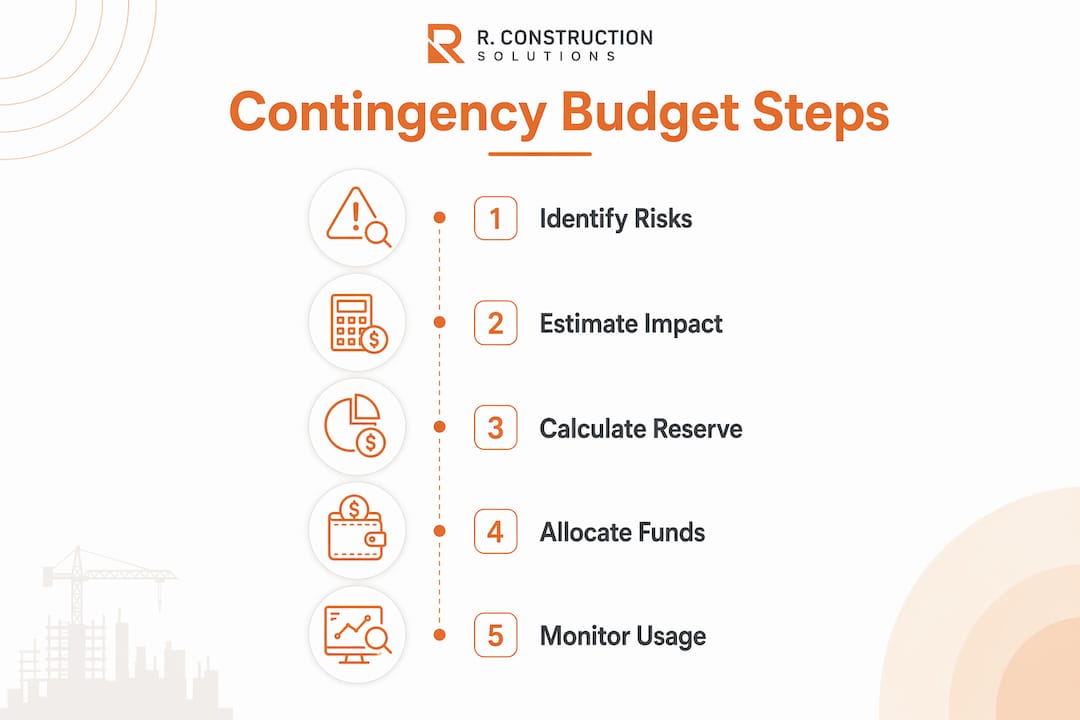
Pro Tip: Apply the Expected Value method to your top five identified risks before defaulting to a percentage. Even a rough probability estimate produces a more defensible contingency number than a gut-feel percentage.
What are the most common mistakes with contingency budgets?
Misusing contingency as a slush fund is the single most destructive habit in construction project cost management. When project managers pull from contingency to cover scope additions, poor estimating, or value engineering failures, the reserve disappears before a real risk event occurs.
Experts caution that treating contingency as a fudge factor to hide affordability gaps destroys budget transparency and creates a false picture of project health. A well-structured budget separates target budget from expected outturn so stakeholders always see the true financial position.
The most frequent errors project managers make include:
- Failing to update contingency after change orders. Every approved change order that adds scope should reduce the contingency balance by the risk that change eliminates, or increase it if new risks are introduced.
- Setting a universal flat percentage. A 10% contingency on a straightforward warehouse build and a 10% contingency on a hospital renovation are not equivalent decisions. Context determines the right number.
- Ignoring lender requirements. Construction lenders treat contingency as restricted collateral and require consent before any reallocation. Failing to manage this transparently can stall loan draws and trigger personal guarantees.
- Double counting reserves. When contractor contingency and owner contingency overlap in scope, you pay for the same risk twice. Clear scope boundaries prevent this.
- Skipping documentation. Unapproved contingency use leads to funds disappearing without accountability, leaving the project exposed when a real risk event hits.
Poor budget structure and risk misclassification cause more cost overruns than genuinely unforeseeable events. That means most overruns are preventable with better planning upfront.
How do you manage and draw down contingency funds during construction?
Managing contingency during construction requires process discipline, not just good intentions. The reserve must function as a controlled asset with formal rules for access and tracking.
- Require documented change orders for every draw. Contingency should only be drawn down after a documented trigger event occurs. No trigger, no draw. This rule protects the reserve from casual spending and keeps the project team accountable.
- Track the contingency balance in real time. Reconcile contingency against approved draws at every project meeting. A balance updated weekly catches problems before they compound. Pair this with your construction estimating process to maintain a consistent financial picture from bid to closeout.
- Set deployment triggers in advance. Define the specific conditions that authorize a contingency draw before construction starts. Examples include a subcontractor default, a confirmed soil condition change, or a permit revision that adds cost. Trigger events documented in tier-1 infrastructure projects show that pre-defined criteria reduce disputes and speed up approvals.
- Communicate contingency status to all stakeholders. Owners, lenders, and project sponsors need regular updates on the contingency balance. Surprises at project closeout damage relationships and can trigger lender intervention.
- Account for contingency in lender draws. Lenders require consent before contingency is reallocated. Build this approval step into your draw schedule so it does not delay funding.
Pro Tip: Create a contingency log as a standalone document, separate from the main budget. List every draw, the trigger event, the approval date, and the remaining balance. This log becomes your audit trail if a lender or owner questions how funds were used.
Contingency is reactive financial protection. Mitigation plans are proactive strategies to avoid risks. Both are necessary, and neither replaces the other. A project with strong mitigation planning still needs a funded contingency reserve because not every risk can be avoided.
Key Takeaways
A properly sized and managed contingency reserve is the most reliable tool for keeping construction projects financially stable through unpredictable conditions.
| Point | Details |
|---|---|
| Standard contingency range | Budget 5–10% for defined projects; increase to 15–25% for complex or high-risk builds. |
| Know your contingency types | Separate contractor contingency, owner contingency, and management reserves into distinct line items. |
| Use the Expected Value method | Calculate contingency from real risk probabilities, not habit or gut feel. |
| Document every draw | Require a formal change order and trigger event before any contingency funds are released. |
| Lender rules are non-negotiable | Treat contingency as restricted collateral and get lender consent before any reallocation. |
Why contingency budgeting is a mindset, not a math problem
The contractors I see struggle most with contingency are not bad at math. They are operating with the wrong mental model. They treat the contingency line as a buffer to make the budget look acceptable to an owner, not as a financial instrument they will actually manage.
The shift that changes outcomes is treating contingency as a controlled asset from the first day of estimating. That means sizing it to real risk data, separating it from management reserves, and building the approval process before construction starts. When a risk event hits at week eight of a 40-week project, you do not want to be figuring out the rules for the first time.
The other thing I have observed is that project managers underestimate how much lender scrutiny affects contingency management. Lender requirements for contingency transparency are strict, and poor management creates real financial exposure for project managers personally. That is not a theoretical risk. It is a documented pattern in construction finance disputes.
The distinction between contingency and management reserves also matters more than most teams realize. When those two funds blur together, accountability disappears. The project team spends the owner’s reserve, the owner assumes the contractor’s reserve is intact, and nobody catches the gap until the project is underwater. Clear separation is not bureaucracy. It is financial control.
Contingency budgeting done well reflects how seriously a project team takes risk. It signals to owners, lenders, and subcontractors that the project is managed by professionals who plan for reality, not just best-case scenarios. That reputation compounds over time and directly affects the quality of work and partners you attract.
— Rowena
How Rconstructionsolutions supports better contingency planning
Rconstructionsolutions brings over 30 years of hands-on construction experience to the specific challenge of budget planning and risk management. Contractors who work with the team gain structured guidance on sizing contingency reserves, separating risk categories, and building the approval processes that keep funds protected throughout a project.

Whether you manage residential builds or large commercial projects, the construction consulting services at Rconstructionsolutions are built around your specific project profile, not generic templates. The team has helped mid-sized firms scale from $5 million to $50 million in revenue by fixing the financial planning gaps that hold growth back. Contingency budgeting is one of the most common and most fixable gaps. Contact Rconstructionsolutions to get a plan that fits your projects and your risk profile.
FAQ
What is a construction contingency budget?
A construction contingency budget is a financial reserve within the total project budget set aside to cover unforeseen costs and risks. Industry standards recommend 5–10% for most projects, with higher percentages for complex or high-risk builds.
How is contingency different from a management reserve?
Contingency covers known-unknown risks within the project scope, while management reserves cover unknown-unknown risks held by project sponsors. AACE International’s Cost Engineering Terminology defines these as distinct budget components.
What percentage should a contingency budget be?
Most projects use 5–10% of total project cost as a contingency budget. Renovations of pre-1980 buildings or projects with incomplete designs often require 15–25% to account for hidden conditions and scope uncertainty.
Can contingency funds be used for any project expense?
Contingency funds must only be used for documented risk events, not routine expenses or scope additions. Every draw requires a formal change order and an approved trigger event to maintain budget integrity.
What happens if contingency is mismanaged with a lender?
Construction lenders treat contingency as restricted collateral and require consent before reallocation. Poor contingency management can stall loan draws and trigger personal guarantees for project managers.