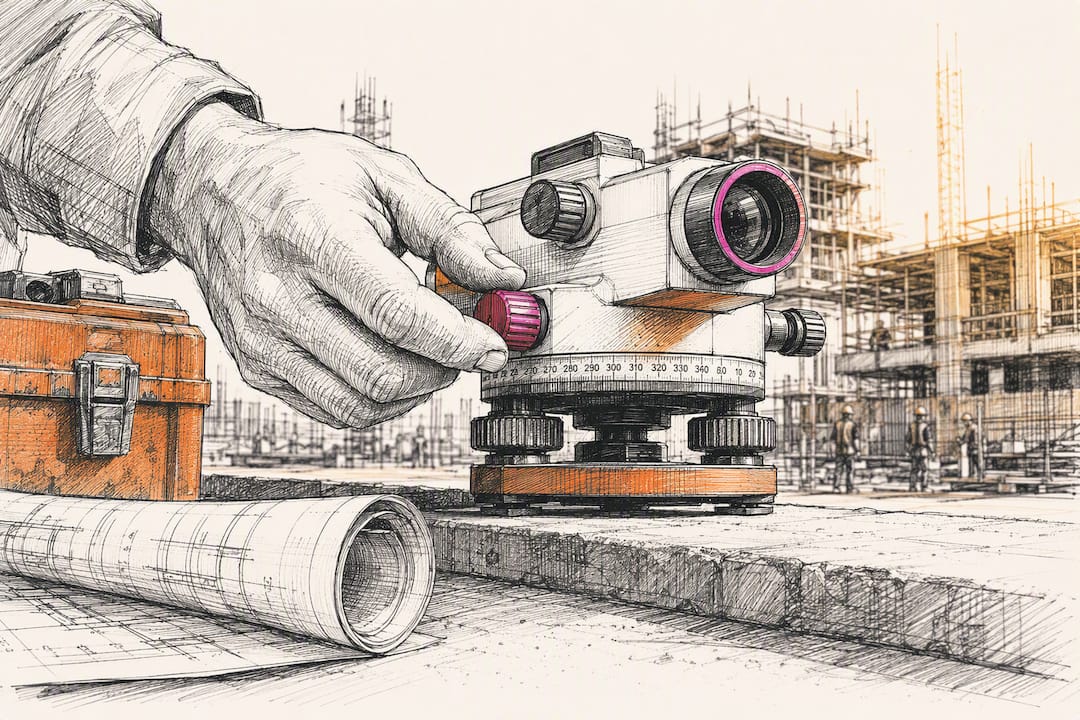
Cut Rework in One Quarter: QA vs QC Playbook for Construction Managers
Quality assurance is the preventive, process-focused system that makes defects unlikely before work starts. Quality control is the inspection and testing layer that verifies whether finished work actually met the requirements. QA and QC in construction depend on each other, but most contractors overinvest in catching mistakes and underinvest in preventing them. Prioritize building out your QA processes first, keep QC rigorous as your verification backstop, and you’ll spend far less time and money on rework.
TL;DR:
- Building a strong QA program focuses on defining procedures, responsibilities, and acceptance criteria before work begins to prevent defects more effectively.
- QC field activities generate critical records such as inspection reports, NCRs, and punch lists, which must be backed by managers with explicit authority to act.
- Digital tools like mobile checklists, photo logs, and integrated test result routing significantly reduce paperwork and improve data accuracy and traceability.
- Common rework causes include out-of-date drawings, poor submittal reviews, sequencing errors, scope gaps, and unqualified crews, each requiring specific QA controls.
- Prioritizing scheduled hold points and granting QC managers authority to stop work creates a foundation for meaningful quality management and reduces costly errors.
Table of Contents
- Quality Assurance vs Quality Control in Construction: The Core Difference
- What Quality Assurance Looks Like on a Construction Project
- What Quality Control Looks Like in the Field
- Building a QC Plan and Inspection & Test Plan That Actually Gets Used
- Digital Tools That Actually Reduce QA/QC Paperwork
- The Root Causes of Rework and the QA Controls That Stop Them
- A Quarterly Action Plan to Strengthen QA/QC
- Industry Standards Shaping QA/QC Requirements
- Who Owns QA and QC on a Construction Project
- Connecting QA/QC to Safety and Environmental Compliance
- Training and Certification for QA/QC Staff
- Running Quality Audits That Drive Real Improvement
- A Field-Ready Perspective on Cutting Rework
- Sources
Quality Assurance vs Quality Control in Construction: The Core Difference
QA and QC serve different goals on the same timeline. Quality assurance is prevention: it defines the procedures, training, and acceptance criteria that make defects unlikely before a crew ever picks up a tool. Quality control is detection: it verifies, through inspection and testing, whether the finished work actually meets those criteria. QA happens upstream, owned by project leadership and the quality manager. QC happens downstream, owned by inspectors and lab technicians at the point of installation.
Consider a concrete pour. QA is the pre-pour submittal review, the approved mix design, and the certified testing lab lined up weeks in advance. QC is the technician pulling slump tests and cylinders on pour day. Miss the QA step and QC becomes your only line of defense, which is a losing bet on a fast-moving job.
- QA: Prevention, procedures, and training, owned before work begins
- QC: Inspection, testing, and verification, owned during and after work
- Shared goal: A defensible record showing the work meets spec, as QA and QC explainers consistently frame it
What Quality Assurance Looks Like on a Construction Project
A functioning QA program lives inside a Project Quality Plan (PQP) or Quality Management Plan (QMP), and it needs more than a cover page. The plan should spell out project scope, an organizational chart showing who owns quality decisions, written responsibilities for each role, standard procedures for common tasks, training requirements, and a schedule for internal audits.
QA also sets the acceptance criteria QC will later test against, and it defines how often testing happens, at what tolerances, and using which standards. On projects with subcontractors, QA flows those same requirements downstream: subs need documented competence, and their crews need the same procedures your own team follows, enabled by commercial subcontractor management tools that streamline coordination and compliance.
- Defined scope, org chart, and named responsibilities
- Written procedures for repeatable tasks (formwork, welding, waterproofing)
- Training records showing crews are qualified for the work assigned
- Audit schedule to catch process drift before it becomes a defect
- Subcontractor flow-down requirements and competence documentation
Many owners and federal contracts require a QMP before mobilization, and private owners increasingly expect an equivalent package at closeout.
Pro Tip: Write your acceptance criteria into the QA plan before bidding subcontractor scopes. Subs who know the testing tolerances upfront price the work more accurately and argue less at inspection time.
What Quality Control Looks Like in the Field
QC is where the paperwork meets the concrete, literally. Field QC generates a steady stream of records: daily inspection reports, standard test report forms, nonconformance reports (NCRs) when work fails to meet spec, and punch lists as the project nears completion.
Authority matters here more than most contractors realize. The QC Manager needs written authority, including the power to stop or suspend affected work, or the role becomes advisory rather than operational. A QC Manager without that authority in writing is a common and expensive gap.
- Inspection reports logged daily, tied to specific locations and activities
- Standard Test Report Forms for material sampling and lab results
- NCRs documenting nonconforming work and the corrective action taken
- Punch lists tracking outstanding items to closeout
Hold points are where QC earns its keep: pre-pour inspection before concrete covers rebar, pre-cover inspection before drywall hides mechanical rough-in, and functional testing before systems get commissioned. Skip a hold point under schedule pressure and you’ve traded a five-minute inspection for a demolition-and-redo cycle.
Building a QC Plan and Inspection & Test Plan That Actually Gets Used
An Inspection & Test Plan (ITP) is the standard control document tying specific activities to specific verification steps, and it works best when it’s sized to the job rather than copied from a template built for a different scope.
- Start with a project drawings list. Reference the exact drawing set the ITP verifies against, so revisions don’t create silent gaps.
- Attach material source sampling and testing forms. Name the lab, the standard (AASHTO or ASTM reference), and the sampling frequency for each material.
- Include Standard Test Report Forms and inspection report templates. The NETTCP/FHWA model QC plan uses a ten-section structure with these as core appendices, and it explicitly recommends scaling detail to project size and complexity rather than using one template for everything.
- Set retention rules tied to your exposure. A common practice retains quality records for the statute of repose in your jurisdiction plus three years, since complete documentation is a contractor’s primary defense in disputes.
A thin ITP on a complex materials scope creates blind spots. A bloated one on a simple scope just slows the crew down.
Digital Tools That Actually Reduce QA/QC Paperwork
The tool categories that move the needle are unglamorous: mobile field apps for digital checklists and forms, document control systems that keep drawing revisions synced across the team, photo logs tied to location and date, and lab integrations that route test results straight into the project record instead of a filing cabinet.
RFIs linked directly to drawings prevent the same question from getting asked five times by five different subs, and they put the answer in front of every field user simultaneously, which cuts down on the duplicated errors that come from stale information. When evaluating a platform, prioritize offline capability for jobsites with weak connectivity, a clean audit trail for every form submission, and the ability to export a full compliance package without manually reassembling PDFs.
- Mobile forms and checklists usable offline
- Document control with automatic revision tracking
- Photo logs tagged by location and date
- Lab integrations that route results into the project record
- Exportable compliance packages for closeout and audits
Pro Tip: If your current system requires someone to manually compile inspection records before a closeout submission, that’s a sign your document control setup is working against you, not for you.
The Root Causes of Rework and the QA Controls That Stop Them
Most rework traces back to a handful of repeat offenders, and each one has a specific QA fix rather than a general “be more careful” fix.
- Out-of-date drawings on-site: Fix with document control that pushes revisions automatically and flags superseded sets.
- Poor or rushed submittal reviews: Fix with submittal gates that block procurement until QA sign-off is logged.
- Sequencing errors between trades: Fix with sequencing reviews built into weekly coordination meetings, not left to verbal handoffs.
- Ambiguous specs or scope gaps: Fix with RFI workflows that resolve questions before, not after, installation.
- Unqualified crews on specialized work: Fix with training records checked against task assignments before mobilization.
Guidance from contractor quality programs consistently frames the fix as getting work right the first time through planning and forward-looking quality meetings rather than treating quality reviews as a defects checklist after the fact. Track rework hours by cause monthly and feed the pattern into a lessons-learned review every quarter.
A Quarterly Action Plan to Strengthen QA/QC
You don’t need a year-long overhaul to see results. A focused quarter can shift how your project handles quality.
- Appoint a QA lead with real authority, distinct from the QC Manager, so prevention and verification don’t collapse into one overworked role.
- Define hold points explicitly for every major scope, in writing, before the schedule locks.
- Standardize your forms across projects so inspectors and subs aren’t relearning a new template every job.
- Schedule pre-cover inspections as calendar events, not as a task someone remembers to request.
- Integrate QC checkpoints into the master schedule as formal milestones. Scheduling inspections as milestones prevents them from getting bypassed when the schedule slips, which is exactly when quality controls matter most.
- Track three metrics monthly: rework hours, open NCRs, and inspection backlog. If any of the three trends upward for two consecutive months, that’s your signal to intervene before it shows up in the budget report.
Contractors who treat resources like the Construction Company Growth Planning Checklist for 2026 as a companion to their QA rollout tend to align ownership and accountability faster than teams building the org chart from scratch.
Industry Standards Shaping QA/QC Requirements
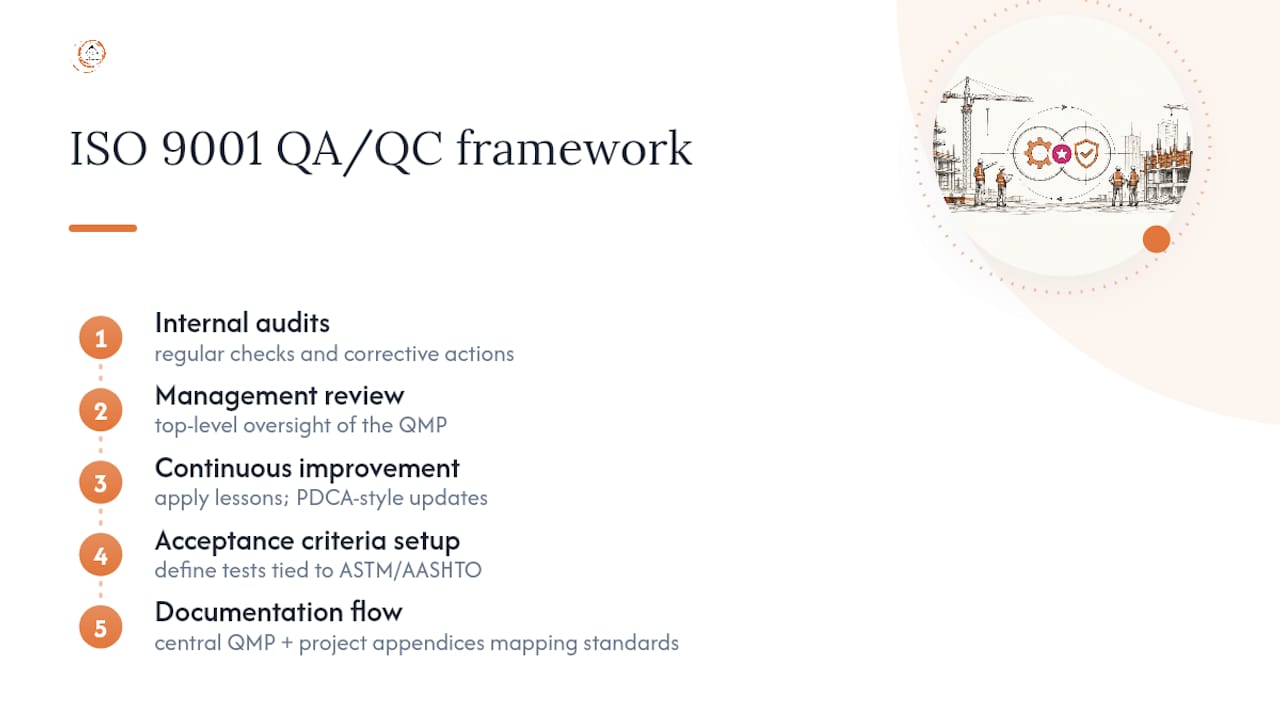
Most contractors won’t pursue full ISO 9001 certification, but the standard’s structure, internal audits, management review, and continuous improvement, shows up in how serious QMPs get built even without formal certification. ISO 9001’s framework gives project teams a proven skeleton for organizing quality documentation, and pulling from it saves you from reinventing a quality management structure from zero.
Materials-heavy scopes like earthwork lean on ASTM and AASHTO standards to define exactly how sampling and testing get done. A model QC plan ties specific tests to specific standards, for example, referencing the correct ASTM method for compaction testing rather than leaving the lab to guess at intent, and keeps those specifics in project appendices rather than buried in the main plan where they’re easy to overlook during revisions.
Federal and many state-funded projects add their own layer. Contracts governed by FAR and DFARS often require a submitted QMP before mobilization, and agencies increasingly expect documentation that maps directly to referenced standards rather than generic quality language. Contractors bidding public work should treat compliance requirements as part of the QA plan itself, not a separate compliance exercise handled after award.
None of these standards are optional window dressing. They’re the reference points inspectors, auditors, and dispute arbitrators use to judge whether your documentation holds up, and a QMP that ignores them is harder to defend when a disagreement over workmanship reaches a claim.
Who Owns QA and QC on a Construction Project
Clear ownership is what separates a QA/QC program that works from one that exists only on paper. The QA Manager or Quality Manager owns the Project Quality Plan itself: writing procedures, setting acceptance criteria, scheduling audits, and making sure subcontractors receive the same requirements as the prime contractor’s own crews.
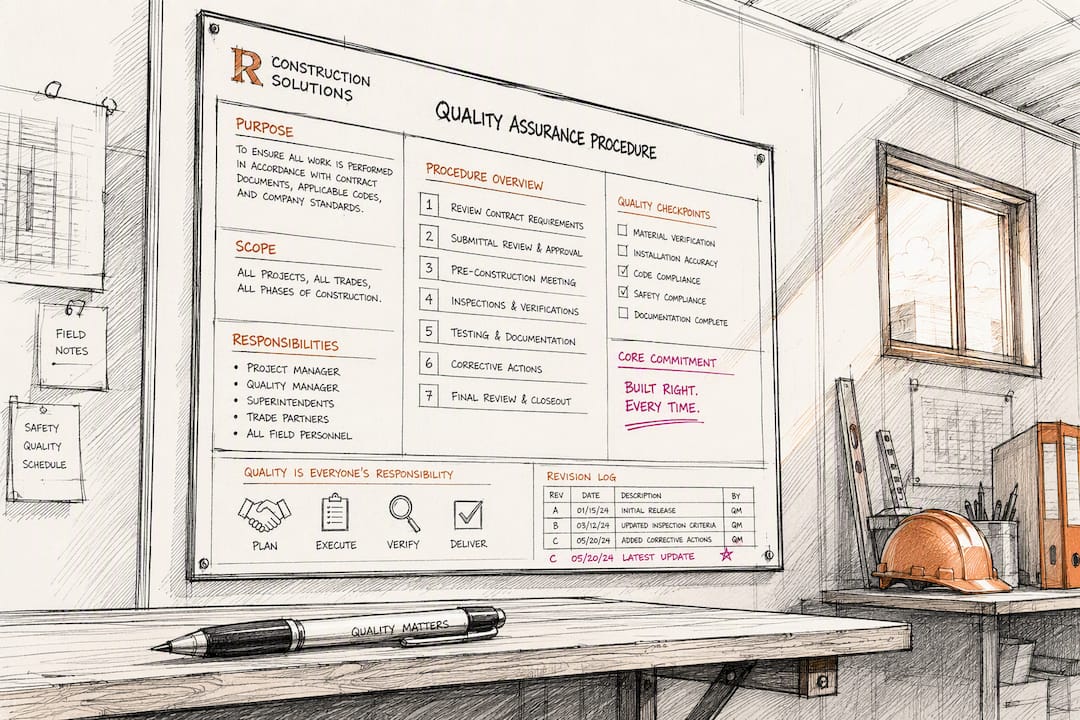
The QC Manager owns field verification, and needs explicit written authority to inspect, test, reject nonconforming work, and suspend affected activities when necessary. Without that authority documented in the QMP, a QC Manager becomes an observer rather than a gatekeeper, and that gap tends to surface at the worst possible moment, mid-pour, with a superintendent pushing to keep the schedule moving.
Qualified lab technicians perform the actual testing, whether that’s concrete cylinder breaks, soil compaction tests, or weld inspections, and their certifications need to match the standards referenced in the ITP. Superintendents and project managers sit at the intersection: they don’t own QA/QC directly, but they’re the ones who either protect hold points on the schedule or let them slide.
Subcontractors carry their own QA/QC responsibility too, and the prime contractor’s QMP should flow requirements down explicitly rather than assuming subs will infer them. A sub who doesn’t know the testing tolerance for their scope will price it wrong and argue about it later. Clear role definitions, written into the plan rather than assumed, are what let a project function when the original QA lead is out sick during a critical inspection window.
Connecting QA/QC to Safety and Environmental Compliance
Quality, safety, and environmental compliance overlap more than most quality plans acknowledge. A structural inspection that catches under-strength concrete isn’t just a quality finding, it’s a safety finding, and treating them as separate tracks means the same nonconformance gets documented twice by two different teams that may never compare notes.
The practical fix is procedural: build cross-references into your NCR forms so a quality failure that carries safety implications automatically triggers the safety team’s review, and vice versa. Environmental compliance follows the same logic. Erosion control inspections, stormwater pollution prevention plan (SWPPP) checks, and material handling records for hazardous substances all generate documentation that looks a lot like a QC inspection report, timestamped, location-tagged, tied to a corrective action if something’s out of spec.
Contractors managing Cal/OSHA requirements alongside quality documentation benefit from a single audit calendar rather than three separate ones running on different clocks. When your QA lead, safety officer, and environmental compliance contact are checking the same schedule, hold points don’t get missed because one team assumed another team already covered it. This integration matters most on federal and public works projects, where a documented QMS gap in one discipline can jeopardize compliance findings across all three.
Training and Certification for QA/QC Staff
QA/QC personnel need certifications that match the work they’re verifying, and generic “quality training” doesn’t substitute for standard-specific credentials. Lab technicians running concrete or soil tests typically need certification tied to the specific ASTM or AASHTO test method they’re performing, not a blanket lab certificate. Weld inspectors need credentials matched to the applicable welding code for the project’s structural scope.
Beyond technical certifications, QC Managers benefit from documented training on the specific QMP they’re enforcing, since a generalist quality credential doesn’t tell a superintendent whether that person understands this project’s hold points and acceptance criteria. Training records belong in the QA plan itself, not in a separate HR file, because auditors and owners will ask to see that the person who signed off on an inspection was actually qualified to do it.
Ongoing training matters as much as initial certification. Standards get revised, project specs change between phases, and a QC Manager trained on last year’s spec sheet can sign off on work that no longer meets current requirements. Building a recurring training review into your quarterly audit schedule closes that gap before it becomes a nonconformance nobody can explain.
Running Quality Audits That Drive Real Improvement
Internal audits work when they’re structured to find process gaps, not just to check a compliance box. A useful audit schedule reviews whether procedures documented in the QMP are actually being followed in the field, not whether the QMP document itself looks complete on paper.
Structure audits around the same forward-looking framing that works for quality meetings generally: what’s coming up in the next phase, what risks that phase carries, and what needs to change now to avoid a repeat of last month’s NCRs. That approach surfaces problems while there’s still time to fix the process, rather than after the defect has already been built into the work.
Feed audit findings into a lessons-learned log reviewed at least quarterly, and track recurring findings by category, drawings, submittals, sequencing, so the pattern becomes visible instead of scattered across dozens of individual NCRs. A contractor with a documented process for closing the loop on audit findings, updating procedures, retraining crews, revising checklists, builds a defensible record that a one-time compliance certificate never will. Continuous improvement in QA/QC isn’t a separate initiative; it’s what a functioning audit cycle produces automatically when someone actually reads the findings.
A Field-Ready Perspective on Cutting Rework
The industry treats QA/QC as a compliance obligation, something you document to satisfy an owner or pass an audit. That framing gets the priority backwards. The QA/QC programs that actually reduce rework treat quality as a scheduling discipline first and a paperwork discipline second.
Here’s what the evidence in this guide actually supports: contractors who integrate hold points into the master schedule, as formal milestones rather than informal reminders, protect their quality process under the exact conditions that usually destroy it: schedule pressure. Conventional advice tells contractors to “improve documentation.” The more useful advice is to protect the calendar slots where documentation gets generated in the first place.
If you’re prioritizing one thing this quarter, don’t start with a bigger binder. Start by giving your QC Manager written authority to hold work, and put your inspection hold points on the same schedule your superintendent uses to run the job. Everything else, the forms, the software, the training records, works better once that foundation exists. Consulting support that helps draft or audit a Project Quality Plan, of the kind R Construction Solutions LLC provides, tends to matter most exactly at this stage, before the plan gets built around the wrong priorities. Contractors evaluating outside help should read through questions worth asking a construction consultant before signing an engagement.
— Rowena Tulacz
If your QA/QC program still runs on scattered spreadsheets and a QC Manager without documented authority, that gap will show up in your next dispute or your next audit, whichever comes first. R Construction Solutions LLC works directly with contracting firms to draft Project Quality Plans, roll out the digital workflows that keep inspection records defensible, and train the staff who’ll actually run the program day to day. Explore R Construction Solutions LLC’s construction consulting services to scope what a QA/QC overhaul would look like on your next project.
Sources
- FHWA — Model QC Plan / Earthwork example
- ISO — ISO 9001 quality management
- Construction Quality - Guidance for Contractors (CQIC)
- Fieldwire — QA vs QC in construction (digital workflow examples)
Recommended
- From Chaos to Coordination: Process Improvement for Construction
- Build an Estimating Checklist for General Contractor Projects
- How Process Improvement Drives Success in Construction: Practical Steps for Contractors
- Implement Lean Construction Management Practices That Work
Running the job and the business at the same time? One short email a week — change orders, billing, job costing, scheduling. Free, no pitch. Subscribe.
Free and unconditional. No call required, no obligation, unsubscribe anytime.