Implement Lean Construction Management Practices That Work
Lean construction management is defined as a production management philosophy that applies manufacturing efficiency principles to construction projects, with the goal of maximizing value and eliminating waste at every phase. When you implement lean construction management practices correctly, the results are measurable: productivity increases 24–50% and costs drop 16–25%, while Percent Plan Complete (PPC) climbs from a typical 35–50% up to 65–85%. Those numbers represent real money and real schedule reliability on your projects. The Lean Construction Institute has championed this approach for decades, and the evidence base keeps growing. This guide gives you the tools, the preparation steps, and the execution roadmap to make lean work on your projects.
What are the essential lean construction management tools?
Lean construction is not a single tool. It is a system of interlocking methods that, together, change how work flows through a project. Understanding each tool’s role helps you apply them in the right sequence.
- Last Planner System (LPS). The most widely used lean tool, LPS shifts scheduling authority to the people doing the work. Foremen and trade supervisors commit to weekly work plans based on what is actually ready to execute, not what a Gantt chart says should happen. The result is higher PPC and measurably less rework.
- Pull planning. Rather than pushing tasks forward from a start date, pull planning works backward from a milestone. Teams identify constraints and sequence work so each trade pulls the next one into position. This prevents the classic “hurry up and wait” cycle that kills productivity on most sites.
- Value Stream Mapping (VSM). VSM is a visual diagram of every step in a process, from design through closeout. It exposes non-value-adding steps, such as redundant inspections, unnecessary material moves, and approval bottlenecks, so you can target them directly.
- 5S methodology. 5S improves jobsite safety and saves time almost immediately by standardizing how tools, materials, and work areas are organized. The five steps are Sort, Set in Order, Shine, Standardize, and Sustain. A clean, organized site is not just aesthetically better. It reduces motion waste and prevents small delays from compounding into schedule slippage.
- Kaizen. Kaizen means continuous improvement through small, frequent changes. On a construction project, this looks like weekly retrospectives where crews identify one thing that slowed them down and agree on a fix before the next cycle begins.
These tools are most effective when treated as a production management system, not a menu of options to pick from selectively.
Pro Tip: Start with the Last Planner System before introducing VSM or 5S. LPS builds the collaborative habits your team needs to make the other tools stick.
| Tool | Primary function | Best applied when |
|---|---|---|
| Last Planner System | Weekly commitment planning | Throughout construction phase |
| Pull planning | Milestone-based sequencing | Phase kickoff and look-ahead windows |
| Value Stream Mapping | Waste identification | Pre-construction and phase transitions |
| 5S | Site organization | Site setup and ongoing maintenance |
| Kaizen | Continuous improvement cycles | Weekly throughout project lifecycle |
How to prepare your team and organization for lean implementation
The biggest reason lean construction fails is not a lack of tools. It is a lack of preparation. Before you run your first pull planning session, your organization needs to be ready for the cultural shift that lean demands.
Leadership commitment is the non-negotiable starting point. Leaders must actively lead kaizen events and collaborative planning sessions, not just authorize them from a distance. When a project executive shows up to a pull planning session and participates, it signals to every trade partner that this process is real. When they skip it, the message is equally clear.

Building lean champions on your team accelerates adoption. A lean champion is a project manager, superintendent, or senior foreman who has been trained in lean methods and takes ownership of facilitating the process on site. They run the weekly work plan meetings, track PPC, and coach crews through the 5S setup. You do not need one on every project immediately, but you need at least one to get started.
Training is where most firms underinvest. Common barriers include poor training and lack of leadership initiative, and these two problems reinforce each other. A structured training program covering LPS, pull planning, and PPC tracking gives your team the vocabulary and confidence to participate. Without it, lean sessions feel like extra meetings with no clear purpose.
Early trade partner involvement is equally critical. Lean construction works because it is collaborative. Bringing subcontractors into the planning process from the start, rather than handing them a schedule and expecting compliance, builds the trust that makes weekly commitments meaningful. Empowering trade foremen to influence planning and execution is one of the highest-return moves you can make.
- Secure visible leadership sponsorship before the first session
- Identify and train at least one lean champion per project
- Run a lean orientation for all trade partners at project kickoff
- Establish a clear PPC tracking process from week one
- Create a feedback loop where crews can raise constraints without blame
Pro Tip: Frame lean to your trades as “we want your input on the schedule” rather than “we’re changing how we work.” The first framing invites participation. The second triggers resistance.
Step-by-step process to implement lean construction management practices on your project
A clear execution sequence prevents lean from becoming a one-time workshop that fades after the first month.
-
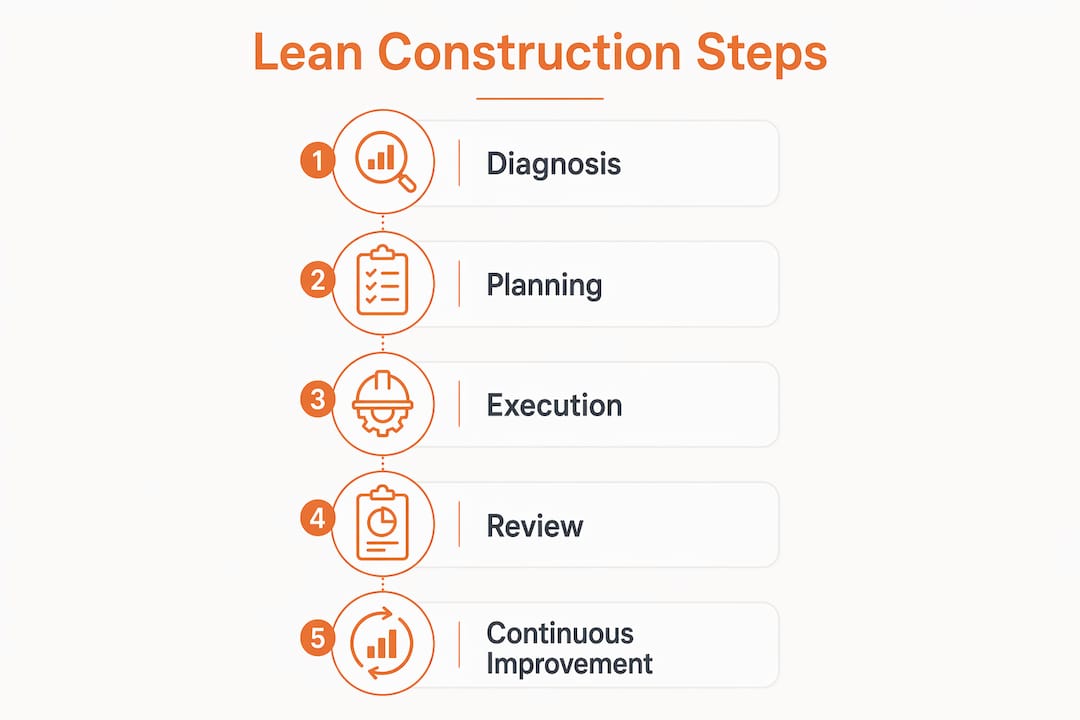
Run a lean maturity health check. Before anything else, assess where your project or organization currently stands. Map your existing workflows, identify the top five sources of waste, and document your current PPC baseline. This gives you a starting point to measure against.
-
Set up collaborative planning sessions. Schedule your first phase pull planning session with all lead trade foremen and the project superintendent. Work backward from the phase completion milestone. Identify constraints, assign owners, and build a three-to-six-week look-ahead. Commit to weekly work plan meetings from that point forward.
-
Deploy visual management tools. Physical planning boards in the site trailer or a dedicated Obeya room (a shared visual control room) keep the plan visible and the team aligned. Digital boards work, but physical boards in a shared space create a daily touchpoint that digital tools alone do not replicate. Digital solutions integrated with lean methods add transparency and foresight when layered on top of these physical practices, not as a replacement for them.
-
Track PPC weekly and act on the data. PPC is your lean health metric. Calculate it every week by dividing completed commitments by total commitments made. When PPC drops, run a root cause analysis in the next weekly meeting. Do not let a low PPC week pass without a documented reason and a corrective action.
-
Run kaizen events at phase transitions. At the end of each major phase, hold a structured retrospective. What worked? What slowed the team down? What would you do differently? Document the answers.
-
Build a lean playbook and scale. A lean playbook documenting project lessons and standardizing tool use is the mechanism that takes lean from a single project experiment to a firm-wide capability. Capture your pull planning templates, PPC tracking sheets, and kaizen event formats. Use them on the next project without starting from scratch.
| Implementation phase | Key activity | Success metric |
|---|---|---|
| Diagnosis | Waste mapping and PPC baseline | Baseline PPC documented |
| Planning setup | Phase pull planning session | Look-ahead plan completed |
| Execution | Weekly work plans and PPC tracking | PPC above 65% within 8 weeks |
| Improvement | Kaizen events at phase transitions | Lessons captured and applied |
| Scaling | Lean playbook creation | Playbook used on next project |
For additional context on aligning your processes before going lean, the guide on process improvement for construction covers the coordination groundwork that makes lean adoption faster.
What challenges will you face when implementing lean construction?
Lean construction implementation runs into predictable obstacles. Knowing them in advance lets you address them before they derail your effort.
The most common pitfall is treating lean as better scheduling. Viewing lean as merely better scheduling misses the cultural changes required, including giving trade foremen real authority in weekly work planning sessions. If your pull planning sessions are just a project manager presenting a revised schedule to subcontractors, you are not doing lean. You are doing a more elaborate version of what you already do.
Digital tool misalignment creates a second layer of friction. Many firms invest in field management apps and then try to bolt lean practices on top of them. When the digital workflow does not match the lean planning process, teams default to the tool they know and abandon the lean process. The fix is to select or configure your digital tools to support lean workflows, not the other way around.
Adversarial communication patterns actively undermine lean. Replacing RFI-based communication with collaborative issue management systems prevents the blame-and-document cycle that fractures team trust. When a constraint surfaces in a weekly work plan meeting, the response should be “how do we solve this together,” not “get it in writing.”
Lean construction fails most often not because the tools are wrong, but because leadership treats it as a project management upgrade rather than an organizational commitment. The firms that sustain lean gains are the ones where senior leaders show up, ask questions, and hold themselves accountable to the same improvement standards they set for their crews.
Proactive risk management during the design phase also reduces the waste that lean has to address later. The approach outlined at MOSAIC Eco-construction Solutions shows how early-stage risk identification aligns directly with lean’s waste-prevention goals.
Key takeaways
Lean construction management delivers its greatest results when applied as a complete production system, not as a collection of individual tools.
| Point | Details |
|---|---|
| Productivity and cost gains are proven | Lean construction drives 24–50% productivity gains and 16–25% cost reductions on documented projects. |
| LPS is the foundation | Start with the Last Planner System to build collaborative planning habits before adding other lean tools. |
| Leadership presence is non-negotiable | Leaders must participate in kaizen events and planning sessions, not just approve them from a distance. |
| PPC is your weekly health check | Track Percent Plan Complete every week and act on root causes when it drops below 65%. |
| Playbooks enable scaling | Document lessons and templates from pilot projects so lean practices transfer to every subsequent project. |
Why lean construction is really a leadership test
I have worked with construction firms that had every lean tool in place: pull planning boards, weekly PPC tracking, 5S-organized sites. And some of them still saw lean fade out within six months. The tools were not the problem. Leadership engagement was.
What I have found is that lean construction is less a methodology question and more a leadership question. The firms that sustain it are the ones where the project executive walks the site, asks the foreman what is blocking their crew this week, and then actually removes that constraint before the next meeting. That behavior, repeated consistently, tells every person on the project that lean is real and that their input matters.
The other thing I push hard on is the lean playbook. Most firms treat pilot projects as experiments and then start from scratch on the next job. That is a waste of the most valuable asset you built: the specific, documented knowledge of what worked on your projects, with your crews, in your market. A lean playbook does not have to be a 100-page manual. It can be a set of templates, a one-page PPC tracking sheet, and a pull planning facilitation guide. The point is that it exists and gets used.
Lean also changes who has a voice in planning. Trade foremen who have spent years executing schedules they had no hand in building will tell you things about workflow constraints that no project manager sitting in a trailer can see. Giving them a seat at the pull planning table is not just good lean practice. It is good management.
— Rowena
Rconstructionsolutions supports your lean construction adoption
Lean construction delivers real results, but getting the implementation right requires more than reading a guide.

Rconstructionsolutions brings over 30 years of hands-on construction operations experience to firms that want to move from reactive project management to disciplined, lean-driven execution. The construction consulting services cover lean readiness assessments, pull planning facilitation, PPC tracking setup, and lean champion training, all tailored to your firm’s size and project type. For contractors who want practical tools to get started immediately, The Sandbox offers templates, planning tools, and resources built specifically for construction teams. Whether you are running a $5 million residential operation or scaling toward $50 million in commercial work, the right lean foundation changes your trajectory.
FAQ
What is lean construction management?
Lean construction management is a production management philosophy that applies waste-reduction and value-maximization principles to construction projects. It uses tools like the Last Planner System, pull planning, and 5S to improve workflow, reduce costs, and increase schedule reliability.
What is Percent Plan Complete (PPC) and why does it matter?
PPC measures the percentage of weekly work plan commitments that a crew actually completes. It is the primary lean health metric, with high-performing lean projects typically achieving PPC of 65–85% compared to a baseline of 35–50%.
How long does it take to see results from lean construction?
Most projects see measurable PPC improvements within six to eight weeks of consistent Last Planner System use. Broader cost and productivity gains typically become visible at the phase or project level, usually within three to six months of sustained implementation.
What is the biggest mistake firms make when starting lean?
The most common mistake is treating lean as a scheduling upgrade rather than a cultural shift. Lean requires leadership participation, trade foreman involvement in planning, and a commitment to acting on weekly feedback, not just running better meetings.
Do you need special software to implement lean construction?
No. The core lean tools, including pull planning boards, PPC tracking sheets, and 5S checklists, can be implemented with physical boards and simple spreadsheets. Digital tools add value when they are configured to support lean workflows, but they are not a prerequisite for getting started.

