
Industry Experience and Consulting Value for Contractors
Industry experience is the single factor that separates a consultant who delivers real results from one who delivers a report. The global management consulting market is valued at over $490 billion with a 5.6% annual growth rate as of 2026. That growth reflects rising demand, but it also means more generic firms competing for your budget. For construction contractors and managers, the role of industry experience in consulting value is not abstract. It determines whether a consultant can walk your jobsite, read your schedule, and spot the bottleneck before the next progress meeting.
How does industry experience shape consulting value in construction?
Industry experience in consulting is defined as direct, hands-on knowledge of a sector’s operations, compliance requirements, and project dynamics that a consultant brings before the engagement begins. In construction, that means understanding subcontractor coordination, lien waivers, bonding requirements, and the real cost of a two-week schedule slip.
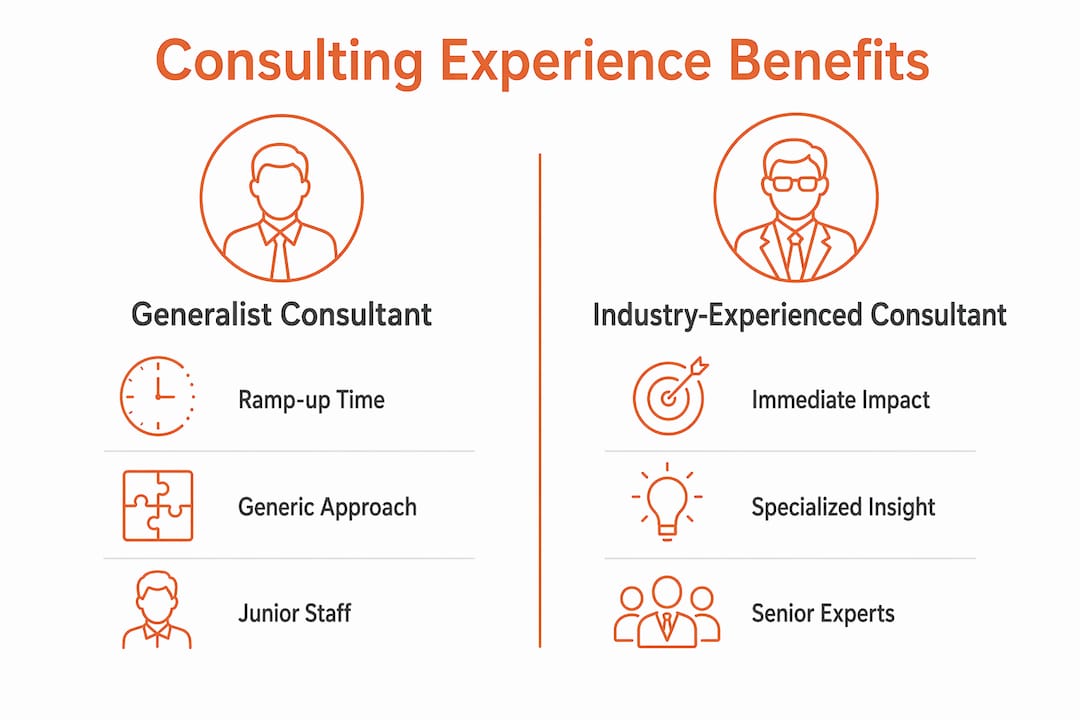
Consultants with deep industry knowledge eliminate the ramp-up period and understand unique sector operational levers immediately. That is a critical distinction. A generalist consultant spends the first weeks learning what a superintendent does. An experienced construction consultant already knows, so they start solving problems on day one.

The average corporate hiring process in the U.S. takes over 23 days, while consulting teams can be deployed within days. For a contractor managing tight project timelines, that speed difference is not a convenience. It is a competitive advantage.
Pro Tip: When evaluating a consultant, ask them to describe a specific workflow problem they solved in your trade. Vague answers signal a generalist. Specific answers about scheduling conflicts, crew productivity, or material procurement signal someone who has been on the ground.
How does experience accelerate consulting effectiveness vs. generic consulting?
The primary differentiator between generalist and specialist consultants is the ramp-up period. Specialists largely eliminate it because they already know the terrain.
| Factor | Generalist consultant | Industry-experienced consultant |
|---|---|---|
| Ramp-up time | Weeks to months | Days or none |
| Problem identification | Broad discovery process | Targeted diagnostic from day one |
| Compliance awareness | Requires briefing | Already understands local codes and bonding |
| Recommendation quality | High-level frameworks | Operational blueprints specific to your trade |
| Client trust | Must be earned over time | Built on shared language and experience |
Specialized consultants use optimized diagnostic mechanisms to identify inefficiencies quickly, reducing months-long discovery to days. For a mid-sized general contractor running multiple projects, that speed translates directly into faster decisions and fewer costly delays.
Generalist consulting firms typically deploy junior associates with limited real-world executive experience for implementation. Specialized industry consultants provide hands-on operational blueprints instead. That difference shows up in the quality of the output you receive and in whether your team can actually act on it.
Pro Tip: Ask any consulting firm you are evaluating to show you a sample deliverable from a construction engagement. A one-page operational blueprint beats a 60-slide deck every time.
What specific benefits does construction industry experience bring to consulting?
Organizations adopting management consultant recommendations see approximately 10% productivity improvements alongside gains in product quality and inventory management. That figure comes from a World Bank and Stanford cross-industry study. In construction, a 10% productivity gain on a $10 million project is $1 million in recovered capacity.
The benefits of consulting experience go beyond productivity numbers. Here is what industry-experienced consultants deliver that generalists cannot:
- Faster trust. Consultants with industry experience foster trust and shared understanding with clients, which makes implementing tough changes far easier. When a consultant has managed a crew or negotiated a subcontract, your foremen listen differently.
- Nuanced recommendations. A consultant who understands shift patterns, material lead times, and crew fatigue gives you advice you can actually use. Generic advice about “improving workflow” means nothing without that context.
- Compliance fluency. Construction involves OSHA regulations, local building codes, bonding requirements, and contract law. An experienced consultant flags compliance gaps before they become project shutdowns.
- Supply chain insight. Understanding how material delays cascade into schedule overruns requires direct experience. Industry-experienced consultants build that awareness into their recommendations from the start.
- Change adoption. Your team is more likely to accept process changes from someone who has worked in the field. Resistance drops when the consultant speaks the same language as your project managers.
Specialized industry consulting delivers clear, operational blueprints over broad, high-level presentations from generalist firms. That is the difference between a recommendation your team can execute Monday morning and one that sits in a binder.
Pro Tip: Before signing a consulting agreement, ask for references from contractors in your specific trade. A consultant who has worked with electrical contractors may not understand the operational dynamics of a home builder.
How do consulting skills transfer when backed by construction experience?
Consulting value stems from the consultant’s ability to frame ambiguous problems, communicate tradeoffs, and take rapid ownership. Those skills are universal. What changes is how effectively they apply when the consultant also knows your industry.
Here is how core consulting skills translate differently in construction-experienced engagements:
- Problem framing. A consultant without construction experience frames a scheduling problem as a resource allocation issue. An experienced consultant frames it as a subcontractor sequencing problem caused by a specific trade dependency. The second framing leads to a faster, more targeted fix.
- Executive communication. Communicating tradeoffs to a construction firm owner requires understanding job costing, bonding capacity, and cash flow cycles. A consultant who knows these concepts speaks your language at the ownership level.
- Ownership of deliverables. Ex-McKinsey consultants bring structured problem framing, clear executive communication, and rapid ownership language. When that structured approach is combined with construction sector knowledge, the consultant does not just hand off a report. They stay accountable for implementation outcomes.
- Structured analysis. Consulting engagements add the most value when they build structured analyses and recommendations rather than just providing access to experience. Industry knowledge makes those analyses grounded in operational reality, not theory.
The result is a consultant who can walk into your weekly project meeting, understand what is being discussed, and contribute a recommendation that your team can act on before the meeting ends.
What risks arise when your consultant lacks construction experience?
Hiring a consultant without relevant construction experience creates predictable problems. Consultants lacking micro-vertical fluency often fail in specialized sectors like construction because they miss operational bottlenecks that experienced practitioners spot immediately.
The risks are specific and costly:
- Missed compliance gaps. A consultant unfamiliar with Davis-Bacon wage requirements or local prevailing wage laws can expose your firm to significant legal liability.
- Delayed value. Long onboarding and discovery phases push the timeline for any real improvement. By the time a generalist understands your operations, your project may already be over budget.
- Non-actionable outputs. Generic recommendations about “improving communication” or “adopting best practices” do not help a project manager dealing with a concrete pour delay. You need specific, executable steps.
- Team resistance. Your field staff and project managers will not respect advice from someone who has never managed a crew, read a set of drawings, or dealt with a failed inspection.
- Misaligned solutions. A consultant who recommends a software tool built for manufacturing will create more problems than it solves when applied to a construction workflow.
Evaluating a consulting firm on industry track record before signing is the most direct way to avoid these outcomes. Ask for case studies from construction engagements, not general business transformations. The answers will tell you everything you need to know.
Key takeaways
Industry-experienced consultants deliver faster results, higher trust, and more practical recommendations than generalists because they eliminate the ramp-up period and understand construction’s operational realities from day one.
| Point | Details |
|---|---|
| Ramp-up elimination | Experienced consultants start solving problems immediately, not after weeks of discovery. |
| Measurable productivity gains | Specialized consulting produces approximately 10% productivity improvements per World Bank and Stanford research. |
| Trust and adoption | Shared industry background reduces team resistance and accelerates change implementation. |
| Compliance and risk awareness | Construction-experienced consultants identify compliance gaps before they become project shutdowns. |
| Actionable outputs | Industry knowledge converts generic frameworks into specific, executable operational blueprints. |
What I’ve learned about picking the right consultant for construction firms
After working alongside contractors at every scale, from small residential builders to commercial firms managing $50 million in annual revenue, I have seen the same mistake repeated. Firms hire consultants based on brand name or price, not on whether that consultant has ever managed a subcontractor dispute or read a critical path schedule.
The uncomfortable truth is that a polished presentation from a large generalist firm often signals exactly the wrong thing. It means the firm has invested in selling, not in knowing your business. The consultants who create the most lasting change in construction firms are the ones who ask about your bonding capacity on the first call, not your “strategic vision.”
I also think the “Expertise Paradox” is real and underappreciated. Deep industry experts sometimes struggle to package their knowledge into a framework your team can follow. The best construction consultants I have seen combine field experience with the ability to design that experience into a clear, repeatable process. That combination is rare, and it is worth paying for.
My recommendation is to treat consultant selection the same way you treat hiring a project manager. Check their references in your specific trade. Ask what they would do in the first 30 days. If they cannot answer that question with specifics, they are not ready to work in your business.
— Rowena
Work with consultants who already know construction
Rconstructionsolutions brings over 30 years of direct construction industry experience to every engagement. The team works with electrical contractors, mechanical contractors, and home builders across the country, delivering recommendations that your team can act on immediately. Rconstructionsolutions has helped mid-sized firms grow from $5 million to $50 million in revenue by applying hands-on operational knowledge, not generic frameworks. If you are ready to work with consultants who understand your business before the first meeting, explore the construction consulting services Rconstructionsolutions offers and reach out for a tailored engagement.
FAQ
What is the role of industry experience in consulting value?
Industry experience defines how quickly and accurately a consultant can identify problems and recommend solutions. Consultants with direct construction experience eliminate the ramp-up period and deliver operational recommendations from day one.
Why does industry knowledge matter more than consulting brand?
Consulting brand signals process capability, but industry knowledge determines whether recommendations fit your actual operations. A consultant who understands construction workflows, compliance requirements, and project dynamics produces more useful outputs than a well-branded generalist.
How do I evaluate a consultant’s construction experience?
Ask for case studies from your specific trade and request references from contractors at a similar revenue scale. Strong candidates will describe specific operational problems they solved, not general business transformations.
What productivity gains can construction firms expect from specialized consulting?
Research from a World Bank and Stanford study shows organizations that adopt management consultant recommendations see approximately 10% productivity improvements. Specialized construction consulting produces gains in scheduling efficiency, crew productivity, and supply chain management.
What are the biggest risks of hiring a generalist consultant for construction?
Generalist consultants miss compliance gaps, produce non-actionable recommendations, and face resistance from field staff who do not trust advice from someone without construction experience. The result is delayed value and wasted budget.