
What Is a Scalable Construction Business Model?
What a scalable construction business model actually means
A scalable construction business model lets you increase project volume without a matching increase in chaos, margin erosion, or owner burnout. The shift happens when you move from relying on individual heroics to running repeatable, predictable systems that hold up whether you’re running three jobs or thirty.
Most contractors build businesses that grow. Far fewer build businesses that scale. The difference is structural:
- Growth adds more projects, more revenue, and usually more stress.
- Scaling adds more projects while improving efficiency, margin, and control.
- A scalable model depends on documented processes, defined roles, and data visibility, not on any one person knowing everything.
- The business can function, and profit, without the owner at the center of every decision.
Think of it as the difference between a business that runs because of you and one that runs with you. The first caps out when your bandwidth does. The second keeps growing.
Table of Contents
- Growth vs. scaling: why the distinction matters for your bottom line
- Business model innovations that enable construction business scalability
- Operational best practices for building a scalable construction business
- How to implement a scalable construction business model step by step
- What scaling looks like in practice
- Funding and investment considerations for scaling
- Workforce management and training during scaling
- Key Takeaways
- R Construction Solutions LLC helps contractors build businesses that scale
Growth vs. scaling: why the distinction matters for your bottom line
True scaling means doing more work with greater efficiency, measured by KPIs like gross margin per project, not just top-line revenue. Chasing volume without that efficiency focus is where contractors get into trouble.
The risks of confusing growth for scaling are real:
- Margin erosion happens when you win more work but your estimating, change order management, and job costing can’t keep pace.
- Owner burnout follows when every decision still runs through you, even as the workload doubles.
- Cash flow crises emerge because construction projects are capital-intensive before they generate income, and more jobs means more capital tied up simultaneously.
- Quality slippage occurs when your field teams are stretched and there’s no system to catch problems early.
Revenue going up while profit per job goes down is a warning sign, not a win. The contractors who build lasting businesses track gross margin by project and by project manager, not just total revenue at month-end.
Business model innovations that enable construction business scalability
The construction industry has moved well beyond the traditional general contractor model. Three business model archetypes now define how growth-oriented firms approach scalability:
- Vertical integration: One firm owns design, engineering, manufacturing, logistics, and assembly. Full control over quality and cost, but high capital requirements and limited flexibility when the pipeline softens.
- Digital system integrator: The firm acts as a platform and coordination hub, orchestrating specialist manufacturers and logistics partners through digital tools rather than owning production assets. Capital-light and geographically flexible, though dependent on strong partner governance.
- Spin-off factory model: An established contractor creates a dedicated offsite unit as a separate business, routing suitable projects through it while the parent continues traditional delivery. Lower market risk, but cultural friction between the two operating modes is common.
Beyond these archetypes, elementized construction offers a compelling platform approach. It focuses on standardized families of building elements, panels, frames, MEP racks, and facade components, with aligned tolerances and a parametric grid. The result is an element platform that serves multiple building types across regions, comparable to how automotive manufacturers use vehicle platforms across model lines. Revenue streams diversify beyond turn-key delivery into software licenses, engineering services, maintenance contracts, and reuse fees.
Pro Tip: Asset-light models like the digital system integrator approach let growing contractors expand into new markets without building a factory in every region. If geographic expansion is your goal, this model deserves serious consideration before committing capital to physical infrastructure.

Operational best practices for building a scalable construction business
Systems, roles, and meeting rhythms are the operational backbone of any construction business that successfully scales. Without them, small issues snowball into big problems fast.
- Delegate before you hit capacity. Delegate 70% of operational tasks before reaching $3 million in revenue. Owners who control every decision become the bottleneck that prevents growth.
- Define roles with clarity. Every person needs a defined seat: what outcomes they own, what tasks they’re responsible for, and where their authority ends. No gray areas.
- Build your org chart for where you’re going. At $5 million and above, your operations manager runs the leadership team, project managers own jobs from contract to closeout, and superintendents report to PMs, not directly to you.
- Track 5–7 KPIs weekly with clear targets and color-coded status. Revenue backlog, gross profit percentage by PM, accounts receivable aging, and bid-to-award rate are the numbers that tell you whether the business is healthy before problems become crises.
- Run a disciplined weekly leadership meeting. A 90-minute agenda covering scorecard review, Rock status, headlines, to-dos, and an issues list creates the rhythm that lets you step back from daily operations without losing control.
- Document your core processes. Estimating, project handoffs, change order management, and client communication all need written workflows. Documented processes let you delegate with confidence and onboard new hires in days rather than months.
- Hire ahead of demand. Bring on new team members at 70–80% capacity, not 100%. Hiring when you’re already maxed out means you’re too busy to train properly, and undertrained hires in key roles cost more than the delay.
The role of an operations manager is often the first leadership seat that transforms how a construction firm operates at scale. Getting that hire right, and defining the role clearly before you post the job, changes everything.
How to implement a scalable construction business model step by step
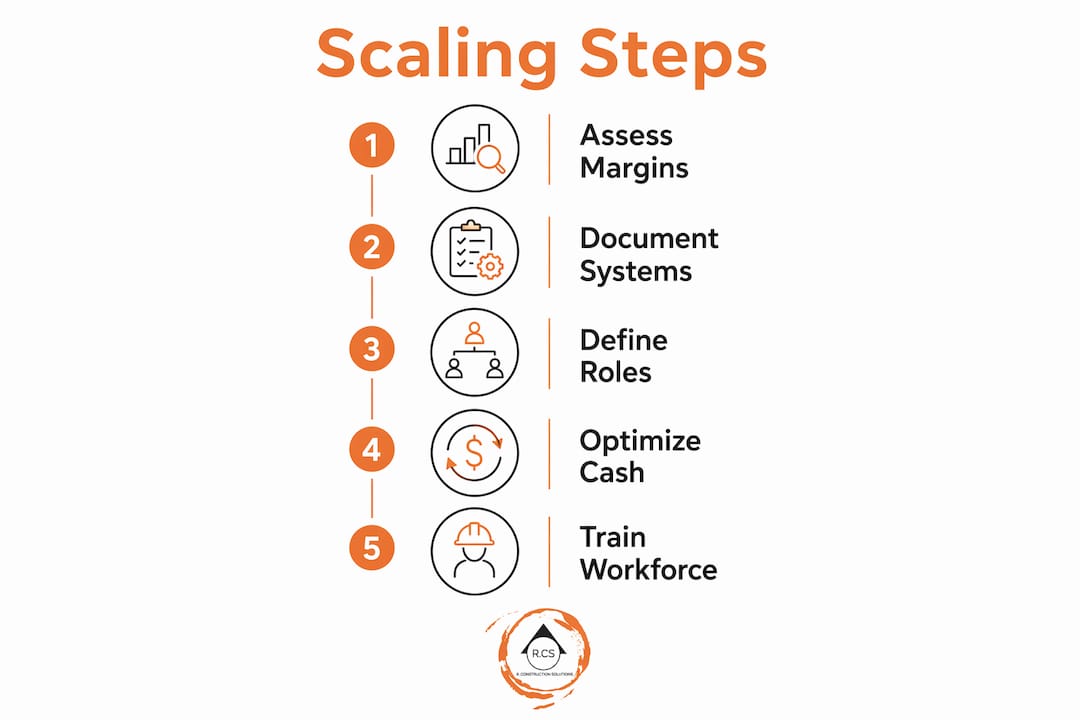
Building scalability into your operations is a phased process, not a single event. Here’s a practical sequence:
- Draw your current org chart honestly. Then draw the org chart you need at your next revenue target. The gap between those two pictures is your roadmap.
- Establish 5–7 weekly metrics with targets. Start tracking gross margin per project, revenue backlog, and accounts receivable aging. Review them every week, even if it’s just you and one other person at first.
- Launch your weekly leadership meeting. Keep the agenda tight. Use the issues list to resolve problems with clear owners and deadlines, not just to discuss them.
- Define roles with written accountabilities. Every leadership seat needs documented outcomes and responsibilities before you fill it.
- Document your estimating and project management processes. Write down what you actually do, then teach it to someone else. This is how you remove yourself as the single point of failure.
- Implement digital tools that give you operational visibility. Platforms like Procore and Buildertrend centralize scheduling, job costing, and field reporting so leadership can see where every job stands without calling the superintendent.
- Build your cash runway. Maintain a 90-day cash runway and hold working capital equal to at least 20% of projected annual revenue. Construction cash cycles are long, and running thin on capital while scaling is a fast path to a liquidity crisis.
- Hire proactively, not reactively. Plan your workforce growth by quarter. Know which roles you’ll need before the work demands them.
- Review your growth planning checklist regularly. Scalability isn’t a destination. It’s a discipline you practice every quarter.
Pro Tip: Pull your last 12 months of project gross margins and rank every job. Identify your three lowest-margin clients and calculate what your financials would look like if you replaced that volume with work at your top-quartile margin rate. That exercise alone often reveals a growth strategy that requires no new hires and no new software.
What scaling looks like in practice
The contractors who cross the $5 million threshold share a common pattern. They stopped running every job personally and built a management layer before they needed it. They documented their estimating process so a second person could execute it consistently. They tracked gross margin by project manager, which let them coach underperformers and reward top performers with more responsibility.
A general contractor scaling from $2 million to $6 million typically goes through three visible transitions: the owner moves from running jobs to managing project managers, the estimating function shifts from a single person to a documented process with dedicated ownership, and the back office formalizes with structured accounts payable, accounts receivable, and compliance tracking. Each transition feels uncomfortable. Each one is also what makes the next revenue tier possible.
The sustainable growth strategies that work in practice are rarely glamorous. They’re about consistency: the same estimating logic on every bid, the same project handoff checklist on every job, the same weekly scorecard reviewed every Monday morning.
Funding and investment considerations for scaling
Cash flow kills more profitable construction companies than bad estimating does. The timing mismatch between when you spend and when you get paid is the defining financial challenge of scaling a contracting business.
Retainage, a portion of contract value withheld until project completion, can represent a significant amount of capital tied up for extended periods on large commercial jobs. Running multiple jobs of that size simultaneously without adequate working capital isn’t a growth strategy. It’s a countdown to a liquidity problem.
A practical benchmark involves maintaining a cash runway of several months and sufficient working capital relative to projected revenue to avoid liquidity issues. Surety bonds typically require demonstrating 10–15% of contract value in liquid or near-liquid assets, so companies that can’t bond larger public and commercial projects have effectively capped their own growth ceiling below the tier where the best margin opportunities concentrate.
An operational efficiency checklist can help you identify where cash is leaking before you go looking for outside capital. Fix the internal inefficiencies first. Outside funding amplifies what’s already there, good or bad.
Workforce management and training during scaling
Your people strategy is as important as your financial strategy when scaling. The two most common workforce mistakes are hiring too late and onboarding too fast.
Hire team members before reaching full capacity to ensure adequate training and transition. That bandwidth gap is what allows you to train new hires properly, catch problems early, and avoid the quality compromises that come from throwing someone into a role before they’re ready.
Training during a growth phase works best when it’s built into your documented processes. When your project handoff checklist, change order workflow, and client communication protocols are written down, a new project manager can become productive in days rather than months. The company’s knowledge lives in the system, not in any one person’s head.
Proactive workforce planning means knowing which roles you’ll need six months from now, not six weeks. At the $3 million to $5 million range, the critical hires are typically a project manager with full job ownership, a field superintendent who reports to that PM, and an office administrator who handles accounts payable, accounts receivable, and compliance documentation. Getting those three seats filled and functioning before you need them is what separates contractors who scale smoothly from those who grow into chaos.
Key Takeaways
A scalable construction business model requires documented systems, defined leadership roles, and disciplined financial management to grow project volume without losing margin or control.
| Point | Details |
|---|---|
| Scaling vs. growth | Scaling means more projects with greater efficiency; growth alone often erodes margin and burns out owners. |
| Delegation threshold | Delegate 70% of operational tasks before hitting $3 million in revenue to avoid becoming the bottleneck. |
| Cash runway target | Maintain a 90-day cash runway and working capital equal to at least 20% of projected annual revenue. |
| Workforce hiring rule | Hire new team members at 70–80% capacity to allow proper training before demand peaks. |
| R Construction Solutions LLC | Provides construction business consulting, process improvement, and operational advisory to help contractors build scalable, profitable operations. |
R Construction Solutions LLC helps contractors build businesses that scale
Scaling a construction business is a systems problem, not a willpower problem. If your revenue is growing but your margins are shrinking and your calendar is full of fires, the issue isn’t effort. It’s structure.
R Construction Solutions LLC, founded by Rowena Tulacz with 30+ years of operations and business development experience in the construction industry, works directly with growth-stage contractors doing $1 million to $10 million in annual revenue. The firm delivers construction consulting services covering process improvement, workflow documentation, estimating support, leadership role definition, and KPI tracking, everything covered in this article, applied to your specific business. No generic playbooks. No corporate detachment. Every engagement is built around a signed engagement letter and delivered by a team that has worked inside the construction industry for decades. If you’re ready to move from operational chaos to organized, profitable growth, contact R Construction Solutions LLC at rconstructionsolutions.com to get started.

