
How to Build a Sustainable Construction Growth Plan: Expert Guide | R. Construction Solutions
A sustainable construction business growth plan is a living operational document that aligns your revenue targets, workforce capacity, financial assumptions, and client delivery systems into a single, executable strategy. The construction sector recorded ten consecutive months of growth as of May 2026, with a 48% year-over-year increase in ideated investment across all verticals. That growth creates real opportunity, but it also exposes firms without a structured plan to overextension, margin erosion, and workforce strain. For small to mid-sized contractors, the ability to create a sustainable construction business growth plan is the difference between scaling profitably and simply getting busier.
What foundational elements must a sustainable construction growth plan include?
A growth plan without measurable goals is just a wish list. The first step is setting specific, time-bound targets across three categories: revenue, gross margin percentage, and safety KPIs like your Experience Modification Rate (EMR). A firm targeting $15 million in annual revenue needs to know what gross margin percentage sustains that number, how many crews it requires, and what contract mix supports consistent cash flow. Without those anchors, every decision becomes reactive.
Define your service scope and geographic focus. Trying to serve every trade in every market dilutes your estimating accuracy and stretches your project management capacity. Decide which services you deliver best, which contract types (lump sum, GMP, cost-plus) fit your risk tolerance, and which geographic radius your crews can cover without excessive mobilization costs. This clarity directly improves bid quality and win rates.

Operational capacity assessment is the step most firms skip. You need an honest count of your crew sizes, subcontractor relationships, equipment availability, and project management bandwidth. Construction business plans must integrate workflow descriptions from lead to closeout, including roles, safety processes, and capacity constraints to be operationally effective. A plan that ignores capacity will generate commitments your team cannot fulfill.
Here is a framework for the core components of a grounded growth plan:
| Component | What to define |
|---|---|
| Revenue and margin targets | Annual revenue goal, gross margin %, and net profit floor |
| Service and geographic scope | Trade specialization, contract types, and service radius |
| Operational capacity | Crew count, subcontractor bench, equipment, and PM bandwidth |
| Financial assumptions | Payment terms, contract sizes, payroll timing, and overhead rate |
| Safety and compliance | EMR target, incident reporting cadence, and training schedule |
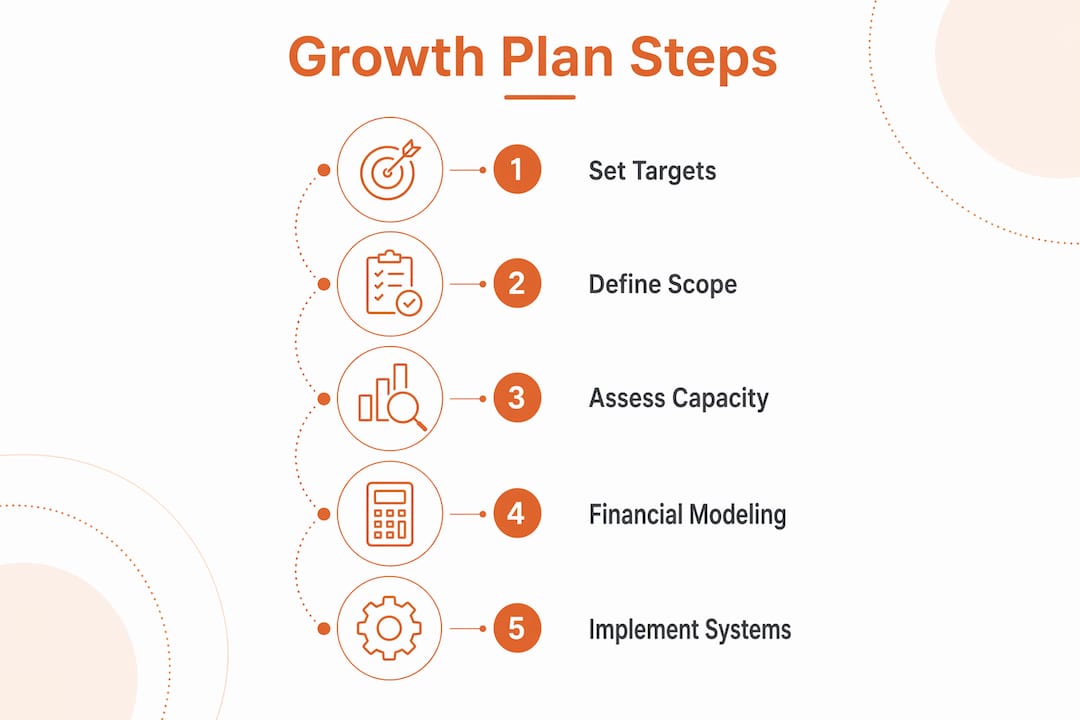
Pro Tip: Set your margin target before you set your revenue target. A firm doing $10 million at 22% gross margin outperforms one doing $14 million at 12%. Volume without margin is a cash flow trap.
Your financial assumptions section must include payment terms by contract type, average contract size, and payroll timing. Construction wages rose 5.0% from May 2025 to May 2026, with average hourly earnings at $38.97. That wage pressure must be baked into every estimate and every financial model you build going forward.
How to implement client-centric systems that drive sustainable growth
The firms that scale consistently do not compete on price alone. They compete on the client experience they deliver from first contact through project closeout. Shifting to a client-centric operating model means designing every internal process around what the client sees, hears, and feels at each touchpoint. That shift is what separates contractors who win repeat business and referrals from those who constantly chase new leads.
Here is a practical sequence for building client-centric systems into your operations:
- Map every client touchpoint. From the first inquiry call to the final punch list walkthrough, document what happens, who owns it, and how long it takes. Gaps in this map are where client relationships break down.
- Implement a client portal or project communication platform. Tools like Procore, Buildertrend, or CoConstruct give clients real-time visibility into schedules, budgets, and change orders. Clients who feel informed are far less likely to dispute invoices or withhold referrals.
- Automate repetitive workflow steps. Proposal generation, lien waiver collection, and subcontractor onboarding are all candidates for automation. Time saved on administration goes directly into project execution and business development.
- Manage safety as a financial lever, not just a compliance requirement. Maintaining an EMR below 0.8 improves access to public contracts and lowers insurance costs. A single serious injury can increase overhead by up to $150,000 annually and spike your EMR by 0.3 to 0.5 points, which can disqualify your firm from certain contracts entirely.
- Hire strategically based on bottlenecks, not headcount targets. Identify where your operation slows down first. If estimating is the constraint, hire an estimator or invest in remote estimating services before adding field crews.
Pro Tip: Safety investments can reduce incident rates by 15 to 25% within 12 months through formal reporting and training programs. That reduction translates directly into lower insurance premiums and better contract access.
Data center construction is driving high-growth categories, with starts up 380% year-to-date in 2026. Without that segment, nonresidential growth forecasts shift from 1.5% growth to nearly 9% contraction. Firms with client-centric systems and clean safety records are best positioned to access these high-value, fast-moving projects.
How to build driver-based financial models for planning
A driver-based financial model connects your operational inputs directly to your financial outputs. Instead of static spreadsheets that go stale the moment a project delays, driver-based models update cash flow projections automatically when you change a variable like contract size, payment terms, or crew count. This is the standard that effective construction business plans use to support fast, confident decision-making.
Your model must incorporate gross margin percentage by project type, payroll timing, subcontractor payment schedules, and average contract size. Layer in payment terms by client segment, because a 60-day net term on a $2 million contract creates a very different cash position than a 30-day net term on the same job. Scenario planning is not optional. Build at least three scenarios: base case, pipeline delay, and cost overrun. Each scenario should show you the cash floor and the point at which you need a line of credit.
| Model input | Why it matters |
|---|---|
| Gross margin % by project type | Reveals which work actually funds growth |
| Payroll timing vs. billing cycle | Identifies cash gaps before they become crises |
| Contract size and payment terms | Drives working capital requirements |
| Pipeline probability weighting | Prevents over-hiring ahead of uncertain revenue |
Maintain a rolling 12 to 24 month cash flow view and update it monthly. Labor productivity in construction is roughly 10% below 2019 levels, which means fixed-price contracts carry hidden margin risk if your estimates assume pre-2019 productivity rates. Adjust your labor cost assumptions accordingly, or you will consistently underbid and underperform on margin.
What sustainable construction strategies enhance resilience and market positioning?
Sustainable construction strategies are no longer a niche differentiator. They are a baseline expectation from an increasing number of public and private clients, and they carry direct financial benefits for firms that integrate them into their operations.
The EPA recommends focusing beyond recycling to optimize building size and materials for true sustainability, starting with source reduction and designing for adaptability and deconstruction to permanently reduce life-cycle material demand. For contractors, this translates into practical decisions on every project.
Key strategies that build both resilience and market positioning include:
- Source reduction in material planning. Right-sizing specifications and reducing waste at the design stage lowers material costs and disposal fees. This is a direct margin improvement, not just an environmental benefit.
- Energy and water efficiency specifications. Clients in the commercial and institutional sectors increasingly require LEED or ENERGY STAR compliance. Firms that can deliver these specifications without subcontracting the expertise command better margins and stronger repeat business.
- Positioning for high-growth segments. Data centers, healthcare facilities, and advanced manufacturing plants are the fastest-growing nonresidential categories in 2026. Each requires specialized knowledge of power infrastructure, mechanical systems, and phased construction. Building that capability now creates a durable competitive position.
- Safety culture as a market differentiator. Firms with EMRs below 0.8 qualify for more public contracts, carry lower insurance costs, and attract better subcontractors. Safety is a risk-management imperative that directly affects which projects you can bid and win.
- Integrated technology adoption. Successful firms shift from isolated technology adoption to integrated capabilities aligned with new delivery models to protect margins. That means connecting your estimating, scheduling, and financial reporting tools rather than running them as separate systems.
Understanding your bonding capacity is also a sustainability factor. Firms that manage their bonding capacity proactively can pursue larger contracts without the last-minute scramble that strains relationships with surety providers.
How to monitor performance and iterate for continuous sustainable growth
A growth plan that is not reviewed regularly is not a plan. It is a document. Building a review cadence into your operations is what converts strategy into results.
- Weekly reviews. Track project-level metrics: schedule variance, labor hours versus budget, and open change orders. Weekly reviews catch small issues before they compound into margin losses.
- Monthly reviews. Analyze bid-to-win rate, gross margin by project type, and cash position against your rolling forecast. If your bid-to-win rate drops below your baseline, investigate whether the issue is pricing, scope definition, or competitor behavior.
- Quarterly reviews. Conduct a full margin audit across all active and recently closed projects. Compare actual margins to estimated margins and identify the root cause of any variance greater than 3%. Adjust your estimating assumptions before the next bid cycle.
- Annual reviews. Reassess your service scope, geographic focus, and capacity plan against the prior year’s performance data. Use this review to set the following year’s targets and update your financial model assumptions.
Leadership development through structured weekly practices like project debriefs can boost team productivity by 20% within two quarters. On a $5 million revenue base, that productivity gain equals $1 million in additional output capacity without adding headcount. Build debrief sessions into your weekly rhythm and treat them as non-negotiable. You can also grow market share more effectively when your team is consistently learning from completed work rather than repeating the same mistakes across projects.
Key takeaways
A sustainable construction business growth plan succeeds when it connects measurable goals, client-centric operations, driver-based financial modeling, and a consistent performance review cadence into one integrated system.
| Point | Details |
|---|---|
| Set margin targets first | Define gross margin percentage before revenue goals to avoid high-volume, low-profit traps. |
| Build driver-based financial models | Update cash flow projections dynamically using real inputs like payroll timing and contract size. |
| Manage safety as a growth lever | An EMR below 0.8 unlocks better contracts, lower insurance costs, and stronger subcontractor access. |
| Adopt sustainable construction practices | Source reduction and energy efficiency specifications improve margins and expand your client base. |
| Review performance on a fixed cadence | Weekly, monthly, and quarterly reviews convert your plan from a document into a decision-making tool. |
What I’ve learned about growth that most plans get wrong
After working with contractors across residential and commercial sectors, the pattern I see most often is firms that confuse revenue growth with business growth. They add crews, take on more projects, and watch their cash position get worse, not better. The problem is almost always margin discipline, or the lack of it.
The contractors who scale successfully from $5 million to $20 million and beyond do three things consistently. They know their numbers at the project level, not just the company level. They compete on the quality of their client experience, not just their bid price. And they treat safety as a financial strategy, not a compliance checkbox.
The other shift I find most underestimated is leadership development. You cannot scale a construction business on the owner’s capacity alone. When you invest in structured debriefs, clear accountability systems, and defined career paths for your project managers and field supervisors, you build the internal capacity that makes growth sustainable. Without that, every new project just adds pressure to the same bottleneck.
The firms that struggle are usually the ones waiting for the market to slow down before they fix their systems. The firms that win are the ones who use a strong market to build the processes that will carry them through the next downturn.
— Rowena
How Rconstructionsolutions helps you build a growth plan that works
Rconstructionsolutions brings over 30 years of hands-on construction operations experience to every engagement. The team works directly with small to mid-sized contractors to build growth plans grounded in real operational data, not generic templates.
Whether you are a general contractor targeting your first $20 million or a specialty contractor looking to protect margins while scaling, Rconstructionsolutions provides the construction consulting services and tools to get there. From AI-driven estimating support to financial modeling and workflow design, every service is built around your specific operation. Explore the contractor tools and templates in The Sandbox to start building your plan today, or connect directly with the team to discuss a tailored consulting engagement.
FAQ
What is a sustainable construction business growth plan?
A sustainable construction business growth plan is a documented strategy that aligns revenue targets, operational capacity, financial modeling, and client delivery systems to support profitable, long-term expansion. It functions as a living document updated regularly as market conditions and project data change.
How do I set realistic revenue targets for my construction firm?
Start with your gross margin percentage and work backward from your net profit goal. Factor in current crew capacity, average contract size, and your bid-to-win rate to determine a revenue target your operation can actually support.
Why does safety management affect business growth in construction?
Maintaining an EMR below 0.8 qualifies your firm for more public contracts and reduces insurance costs. A single serious injury can add up to $150,000 in annual overhead and disqualify you from high-value project opportunities.
What financial model should a construction business use for planning?
A driver-based financial model is the standard for construction planning. It connects operational inputs like payroll timing, contract size, and payment terms directly to cash flow projections, allowing you to run scenario analyses and make faster decisions.
How often should I review my construction business growth plan?
Review project-level KPIs weekly, financial performance monthly, and conduct a full margin audit quarterly. An annual review should reset your targets and update your financial model assumptions based on the prior year’s actual performance data.