
Construction Business Strategic Planning: A Guide for Contractors | R. Construction Solutions
Construction business strategic planning is the process of defining where your firm competes, how it wins work, and what capabilities it must build to stay profitable over time. Unlike a project schedule or a quarterly budget, a strategic plan sets the direction for every major business decision your company makes. It shapes your bid strategy, your hiring, your risk tolerance, and the technology you invest in. Done right, it turns your firm from a reactive order-taker into a business that controls its own growth.
What is construction business strategic planning, and why does it matter?
Strategic planning in construction involves three core decisions: where to compete, how to win, and what capabilities to develop for sustained profitability. Those three questions sound simple. The answers are not.
“Where to compete” means choosing your market segments and client types. A general contractor that chases every project type across every geography spreads itself thin and wins on price alone. A firm that focuses on healthcare renovation or industrial tenant improvement builds a reputation, a network, and a pricing premium. That focus is a strategic choice, not an accident.
“How to win” means identifying your real differentiators. Speed of delivery, safety culture, self-perform capability, or technology-driven estimating accuracy are all legitimate competitive advantages. Vague claims like “quality work” are not. Your differentiator must show up in your proposals, your staffing model, and your client conversations.

“What capabilities to build” means investing ahead of the work you want. If you plan to pursue design-build projects, you need estimators who can work from concept drawings and project managers who understand design coordination. The importance of construction planning at the business level is that it forces these investment decisions before the opportunity arrives, not after you’ve already lost the bid.
What essential components make up construction business strategic planning?
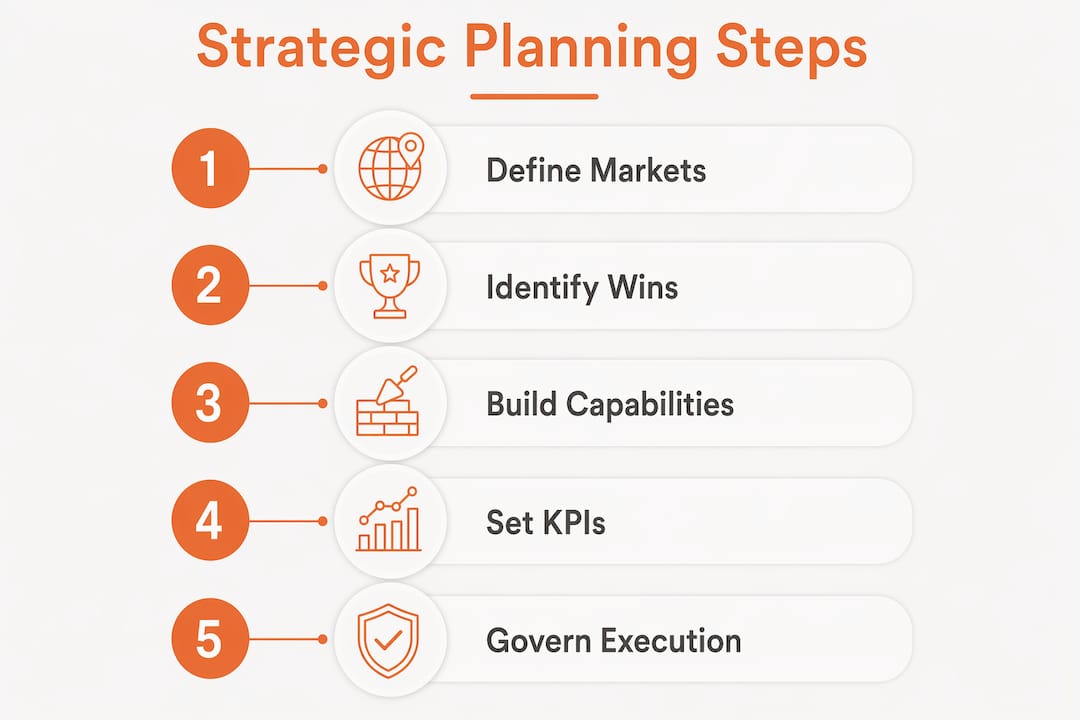
A complete strategic plan for a construction firm covers five interconnected areas. Each one connects directly to daily operational decisions.
- Market selection: Which project types, client categories, and geographic markets will you pursue? Choosing two or three segments and excelling in them beats chasing everything.
- Competitive advantage: What makes your firm the right choice over competitors? Safety record, self-perform trades, speed, or technology integration are all defensible positions.
- Capability building: What workforce skills, equipment, and technology does your target market require? Gaps here become bid losses and project failures.
- Measurable targets: Win rate, backlog mix, labor utilization, and safety incident rates are the metrics that tell you whether your strategy is working. Without them, your plan is a slogan.
- Risk posture: Which contract types and delivery methods match your firm’s risk tolerance? A firm that signs lump-sum contracts without the estimating depth to support them is taking on risk it cannot price.
Pro Tip: Set your KPIs before you write your strategy narrative. If you cannot define a measurable outcome for a goal, the goal is not specific enough to execute.
Construction business strategies that skip any of these five components tend to produce plans that look good in a binder and change nothing in the field. The construction estimating process is one area where strategy and operations intersect directly. A firm that decides to compete on price accuracy must invest in estimating tools and talent. That is a strategic commitment, not just an operational tweak.
How does strategic planning differ from project planning, and how do they connect?
Construction leaders often confuse strategic business planning with project planning. They are different in scope and purpose, but they must connect.
| Dimension | Strategic business planning | Construction project planning |
|---|---|---|
| Time horizon | 3–5 years | Project duration |
| Primary focus | Firm direction, market position, capabilities | Schedule, resources, budget, safety |
| Key decisions | Which markets, how to win, what to build | Sequencing, procurement, risk controls |
| Owner | Executive leadership | Project manager, superintendent |
| Success metrics | Win rate, margin, backlog growth | On-time delivery, cost variance, safety incidents |
Construction project planning sequences resources, timelines, budgets, and safety protocols to execute what the business has already decided to pursue. Strategic planning decides what to pursue in the first place. The connection between the two is where most firms lose alignment.
Construction project strategic alignment means your project selection reflects your strategic targets. If your strategy calls for growing your healthcare portfolio, your business development team should be qualifying healthcare clients, and your project managers should be building healthcare-specific execution experience. When those two tracks run separately, you win work that does not fit your capabilities and lose work that does.
A practical example: a mid-sized mechanical contractor decides strategically to self-perform sheet metal fabrication. That decision changes hiring, equipment investment, shop space, and bid strategy simultaneously. Project planning then executes within that framework. Without the strategic decision made first, the project team has no framework to work within.
Why is execution readiness and governance crucial in construction strategic planning?
A strategic plan that sits in a document and never drives a decision is worse than no plan at all. It creates false confidence. Execution readiness requires translating every strategic goal into specific, trackable initiatives with clear owners and deadlines.
Governance is the mechanism that keeps strategy alive between annual planning sessions. Without it, rapid execution dynamics devolve into slow claims processing and reactive decision-making. Here is how to build governance into your planning process:
- Assign decision rights. Every strategic initiative needs one owner who is accountable for progress. Shared ownership produces no ownership.
- Set milestone reviews. Monthly or quarterly check-ins against KPIs keep the plan from drifting. Review win rate, backlog composition, and labor utilization at minimum.
- Define escalation paths. When a project or bid decision conflicts with the strategic plan, who decides? Unclear escalation paths produce inconsistent decisions.
- Use leading and lagging indicators. Leading and lagging metrics together tell you whether you are on track before results arrive. Proposal volume is a leading indicator. Win rate is a lagging one.
- Decompose goals into steps. Vague goals like “grow revenue” fail because no one knows what action to take on Monday morning. Break every goal into specific initiatives with measurable milestones.
Pro Tip: Run a 90-day sprint review alongside your annual plan. Quarterly sprints keep teams focused and give you a structured moment to adapt without abandoning the long-term direction.
Strategic governance mechanisms reduce scope creep and project delays by clearly defining decision rights and review stages. That is not bureaucracy. It is the difference between a plan that executes and one that expires.
How can construction leaders tailor planning to firm size and experience?
Construction firms’ strategic planning approach correlates directly with organizational size, type, and experience. Copying a Fortune 500 planning template into a 12-person subcontracting firm produces paperwork, not results.
Here is how to calibrate your approach:
- Small firms (under $5 million revenue): Focus on two or three highest-return market segments. Keep the plan short, written, and reviewed quarterly. Prioritize cash flow visibility and capacity-aware bidding above all else. Winning a project you cannot staff is worse than losing it.
- Mid-sized firms ($5 million to $50 million): Formalize the process with department-level input. Estimating, operations, and finance should each contribute targets. Introduce structured KPI tracking and a governance calendar.
- Larger or more experienced firms: Broaden participation to include field leadership and key subcontractors. Use scenario planning to stress-test assumptions about labor markets, material costs, and client pipeline.
Capacity-aware bidding deserves special attention regardless of firm size. Aligning project selection with available supervision, trade partners, equipment, and cash flow prevents the most common strategic failure in construction: winning unprofitable work. Treating capacity as a marketing problem rather than a strategic constraint is a fast path to overextension.
Small firms especially benefit from an ongoing, adaptable planning process focused on highest-return efforts. The formality of the process matters less than the consistency of the practice. A firm that reviews its strategy every 90 days and adjusts outperforms one that writes a five-year plan and files it.
Alignment from strategic planning cascades beyond leadership to all levels, clarifying the “why” behind decisions and accelerating execution. When your field superintendent understands why the firm is pursuing healthcare work, they make better daily decisions about client relationships and quality standards.
Key takeaways
Construction business strategic planning works when it translates firm-level goals into measurable targets, capacity-aware project selection, and governance structures that hold teams accountable every quarter.
| Point | Details |
|---|---|
| Define where and how to compete | Choose specific market segments and differentiators before writing any other part of your plan. |
| Set measurable KPIs | Track win rate, backlog mix, and labor utilization to know whether your strategy is working. |
| Separate strategy from project planning | Strategic planning sets direction; project planning executes within it. Both must connect. |
| Build governance into the plan | Assign decision rights, set milestone reviews, and define escalation paths to keep strategy alive. |
| Tailor planning to your firm size | Small firms need adaptability; larger firms need structured participation and scenario planning. |
Why I think most construction firms plan too late and too vaguely
Most construction leaders I work with are not short on ambition. They are short on specificity. They write goals like “grow the business” or “improve our reputation” and then wonder why nothing changes six months later. The problem is not effort. It is that strategic planning isn’t optional anymore, and treating it as a once-a-year exercise produces once-a-year results.
The firms that grow consistently do one thing differently: they make strategy operational. Every bid decision, every hire, every subcontractor relationship gets filtered through a clear strategic lens. That lens only exists if you have built it deliberately. A contractor who decides to compete in the data center market cannot just start bidding data center projects. They need to hire people who know the work, build relationships with the right trade partners, and adjust their bonding and insurance accordingly. That is strategy showing up in operations.
The other pattern I see constantly is capacity mismatch. A firm wins a $12 million project while already running three projects at the edge of its supervision capacity. Small issues snowball into big problems: schedule slips, quality failures, client relationships damaged. Process improvement in construction starts with knowing your limits and building your plan around them, not around the revenue you wish you had.
My honest advice: write a one-page strategic plan before you write anything else. Define your market, your differentiator, your three KPIs, and your capacity ceiling. Review it every 90 days. That discipline alone puts you ahead of most firms in your market.
— Rowena
How Rconstructionsolutions helps construction firms build plans that execute
Rconstructionsolutions works directly with residential and commercial contractors to build strategic plans that translate into real operational decisions, not binder documents.

With over 30 years of hands-on construction experience, the Rconstructionsolutions team helps firms define their market position, set measurable KPIs, and build governance structures that hold through project cycles. Mid-sized firms scaling from $5 million to $50 million have used this approach to grow revenue while keeping operations under control. The Sandbox resource hub provides practical tools and templates that support both strategic and operational planning. For firms ready to move from reactive to deliberate, Rconstructionsolutions construction consulting services offer the structured guidance to get there.
FAQ
What is construction business strategic planning?
Construction business strategic planning is the process of deciding where your firm competes, how it wins work, and what capabilities it builds to stay profitable. It produces measurable targets and operational decisions that guide bidding, staffing, risk management, and technology investment.
How does strategic planning differ from project planning?
Strategic planning sets long-term business direction and market position. Project planning sequences resources, schedules, and budgets to execute specific projects within that direction.
What KPIs should a construction firm track in its strategic plan?
Win rate, backlog mix, labor utilization, and safety incident rates are the core metrics. Each one signals whether your strategy is producing the results you planned for.
How should small construction firms approach strategic planning?
Small firms benefit most from a short, written plan reviewed every quarter. Focus on two or three market segments, track cash flow closely, and align every bid decision with available supervision capacity.
Why does governance matter in construction strategic planning?
Without governance, strategic goals drift and accountability disappears. Defined decision rights, milestone reviews, and escalation paths keep the plan active and prevent scope creep from derailing execution.