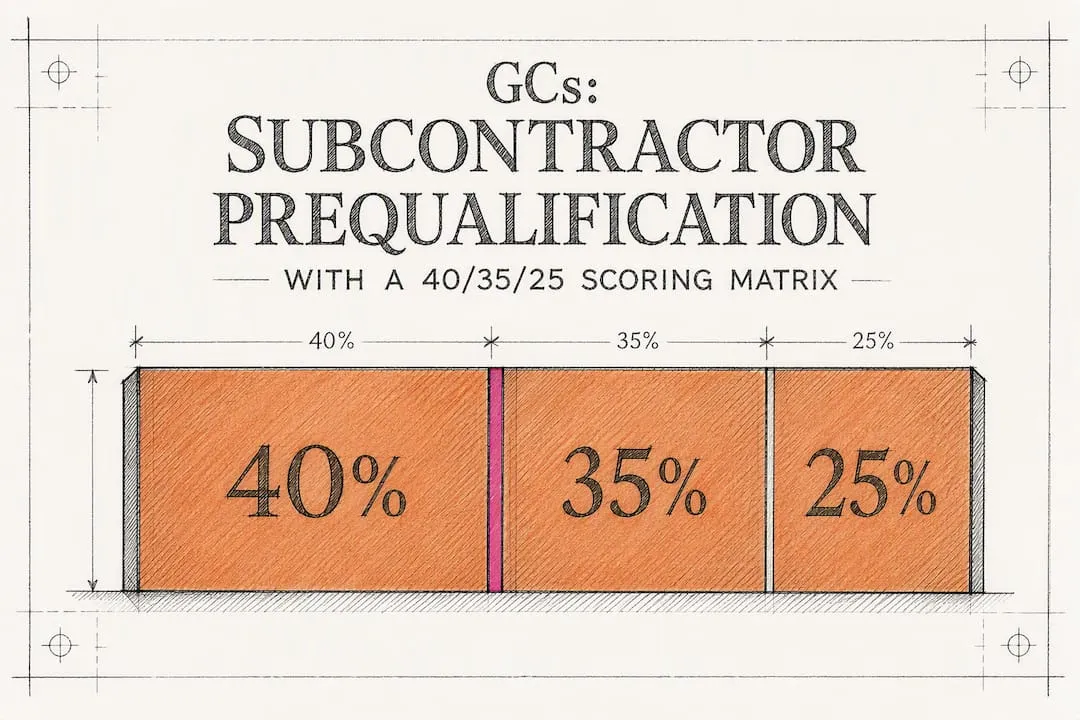
GCs: Subcontractor Prequalification with a 40/35/25 Scoring Matrix
Subcontractor prequalification is the process of verifying a trade contractor’s financial strength, safety record, and reputation before letting them bid or before awarding work. The baseline every general contractor should run is an annual requalification cycle built on three pillars: capacity, capital, and character. Start by pulling the documentation checklist below, then run submissions through the scoring matrix to decide who bids, who gets awarded, and at what dollar ceiling.
TL;DR:
- Scoring should focus on capacity, capital, and character, with thresholds set for key metrics like bonding limits, EMR, and reference quality.
- Verification must include direct confirmation of bonding, licensing, safety records, and reference checks, with any red flags prompting immediate requalification.
- Payment controls like retainage, joint checks, and strict verification of banking details help mitigate risk on conditional subcontractor awards.
- Full requalification is recommended annually, with immediate review triggered by safety incidents, lien filings, ownership changes, or workload shifts.
- Prequalification records should be centralized in accessible systems that automate renewals, maintain audit trails, and tie directly into payment and project workflows.
Table of Contents
- What Documents Belong in a Subcontractor Prequalification Checklist?
- How Do You Score and Tier Subcontractor Prequalification Submissions?
- What Verification Steps Confirm a Subcontractor’s Submitted Documents?
- Which Payment Controls Reduce Risk on Conditional Subcontractor Awards
- How Often Should You Requalify Subcontractors?
- Where Should Prequalification Records Live?
- Practitioner Tips for Common Prequalification Failures
- Assessing Dispute History and Litigation Risk Beyond the Paper Trail
- Handling Sensitive Subcontractor Data Securely
- Fitting Prequalification Into Your Bid Package Workflow
- A Program Is Only as Good as the Decisions It Forces You to Make
- How R Construction Solutions LLC Builds Prequalification Programs That Stick
- Sources
What Documents Belong in a Subcontractor Prequalification Checklist?
A prequalification packet only works if it is consistent. If every project manager asks for something different, you end up with incomplete files and no way to compare one trade contractor against another. Standardize the request and file the same set every time.
The core packet should include:
- A completed prequalification questionnaire and a signed W-9 for vendor setup and tax reporting.
- Certificates of insurance (COIs) showing required limits, additional insured status, and primary/noncontributory wording where your contracts demand it.
- A surety or bonding letter stating single-job and aggregate bonding capacity, ideally with the surety’s AM Best rating noted for larger awards.
- Two to three years of financial statements or CPA-prepared summaries, plus a current interim snapshot if the last fiscal year-end is more than six months old.
- OSHA 300/300A logs and EMR history, a written safety program, and DART/TRIR figures if the subcontractor tracks them.
- State and trade license numbers, a list of recently completed projects, three owner or GC references, a bank reference, and a line-of-credit letter.
Trade contractors resist paperwork when it feels arbitrary. A standardized preQ form distributed the same way to every bidder removes that friction and gives you an apples-to-apples file for scoring.
How Do You Score and Tier Subcontractor Prequalification Submissions?
Collecting documents is only half the job. Without a scoring method, every packet just sits in a folder and nobody makes a defensible decision. CFMA’s prequalification framework organizes evaluation around three Cs: capacity, capital, and character, each scored against defined thresholds rather than a simple pass or fail checkbox.
A workable weighting looks like this:
- Capacity (40%): current workload, available crews, and equipment relative to your bid package.
- Capital (35%): financial statements, bonding capacity, and liquidity ratios.
- Character (25%): safety record, reference calls, litigation history, and communication quality.
Set numeric thresholds so reviewers aren’t guessing. Common benchmarks include limits on EMR, current ratio, and working capital relative to anticipated award values, adjusted to project context without fixed numeric thresholds.
Pro Tip: Document every conditional approval in writing, including the exact monitoring trigger that would move a Tier 2 sub back to full review. A verbal understanding disappears the moment there’s a dispute.
What Verification Steps Confirm a Subcontractor’s Submitted Documents?
A packet full of paper means nothing if nobody checks it against reality. Verification is where prequalification earns its credibility.
- Call the surety directly. Confirm single-job and aggregate bonding limits, how long the relationship has run, and current outstanding workload.
- Validate banking details before any payment relationship begins, and confirm the bank reference independently rather than trusting a number on letterhead.
- Search state contractor license boards and public OSHA inspection records, and request sample safety documentation to compare against what was submitted.
- Check county lien records and court dockets in jurisdictions where the subcontractor has worked recently.
- Run reference calls with a script, not a casual chat. Ask specifically about payment behavior, schedule adherence, and how the sub communicates when problems arise.
AGC’s guidance on preventing sub default stresses that effective review is project-specific: a trade contractor fine for a small residential job may be a poor fit for a complex commercial package with tight sequencing. Any surety refusal to confirm bonding capacity, an unexplained lien, or a licensing lapse should trigger an off-cycle full requalification before the sub bids again.
Which Payment Controls Reduce Risk on Conditional Subcontractor Awards
Even a Tier 2 subcontractor can be the right choice on a given package, provided you attach controls that cap your exposure. Retainage, waiver-gated payment releases, and joint checks for critical material suppliers provide leverage without excluding qualified subcontractors. Payment controls should be connected to approval tiers, with additional safeguards applied to conditionally approved subs, such as increased retainage or joint checks, and conditional release of payments based on lien waiver documentation.
- Validate every bank account with a two-step verification call before the first payment, not after.
Pro Tip: Vendor-fraud attempts often mimic a legitimate banking-change email. Confirm any change in payment details by phone, using a number you already have on file, not the number listed in the request.
Industry guidance on vetting subcontractors for payment risk makes the same point: the tier decision only matters if it actually shapes how and when money moves.
How Often Should You Requalify Subcontractors?
Prequalification is a living record, not a one-time gate. Run a full requalification annually, and set reminders 30 to 60 days before expiration so nothing lapses mid-project.
Certain events should force an immediate off-cycle review, regardless of where a sub sits in the annual cycle:
- A recordable safety incident or a new OSHA citation.
- A new lien filing or civil judgment against the subcontractor.
- A change in ownership or key management departure.
- A large new award that materially changes the sub’s current workload capacity.
- Any change in banking details submitted for payment.
Full annual requalification means refreshing every document in the original packet. A lighter renewal touch, updated COI, current EMR, and an interim financial snapshot, can bridge the gap between full cycles if nothing material has changed.
Where Should Prequalification Records Live?
A prequalification file that only lives in one estimator’s inbox is a liability. The record needs to be visible to accounts payable and project teams alike, because the tier decision should directly govern what payment controls apply.
Most firms house the active record in either a vendor master module inside their ERP or inside a dedicated prequalification portal that feeds into their project management platform, tools like Procore are common examples of systems built to carry that data through to contract setup and payment. Whichever platform you use, it needs to expose four things automatically:
- Expiration dates with automated renewal reminders.
- A consistent file-naming standard so old and current COIs don’t get confused.
- An audit trail showing who approved what tier and when.
- A direct link between the approved tier and the payment controls applied in AP.
Firms managing subcontractor coordination on active projects, as outlined in BRCKS’s guidance on managing subcontractors, find that the biggest breakdowns happen when prequalification data and day-to-day project communication live in separate systems that never talk to each other.
Practitioner Tips for Common Prequalification Failures
The programs that break down usually fail on judgment calls, not paperwork. Accept a conditional approval only when you can name the specific metric that would pull it back for review, not a vague “we’ll keep an eye on it.”
When you present requirements to subs, frame it as a standard process every bidder goes through, not a personal audit. That framing preserves the relationship while still getting you complete files.
The fastest administrative fix for most programs: enforce a single file-naming convention, automate COI expiration alerts, and hard-tie your scoring output to award ceilings so nobody can informally override a Tier 2 cap.
Assessing Dispute History and Litigation Risk Beyond the Paper Trail
Financial statements and safety logs tell you where a subcontractor stands today. They tell you almost nothing about how that sub behaves when a job goes sideways, and that is exactly when risk shows up on your project.
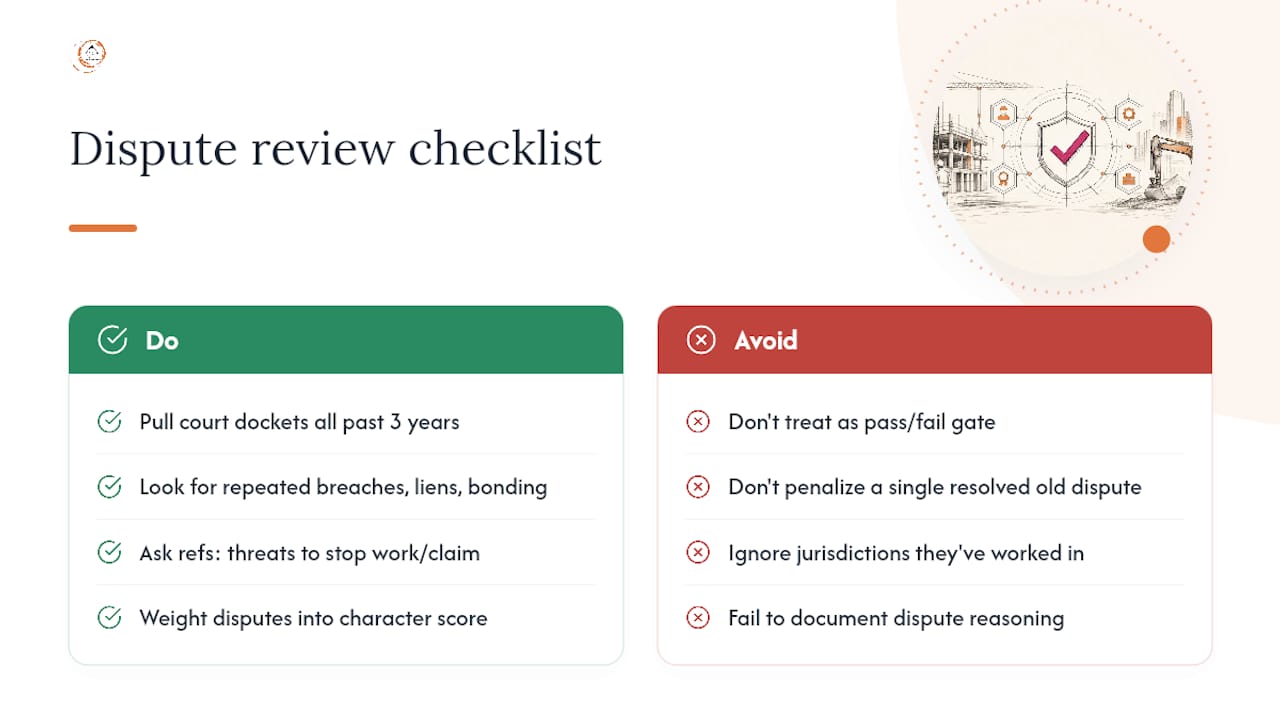
Litigation and dispute history deserve their own line item in your review, separate from the standard document checklist. A subcontractor with a clean balance sheet but a pattern of walking off jobs mid-dispute, or filing liens as a negotiating tactic rather than a last resort, carries a risk that no financial ratio captures. Pull county court dockets in every jurisdiction where the sub has worked in the past three years, not just where they’re currently licensed. Look specifically for patterns: repeated breach-of-contract claims, mechanic’s lien filings against multiple GCs, or bonding claims paid out by their surety.
Ask reference contacts a direct question you won’t find in any questionnaire: “Did this subcontractor ever threaten to stop work or file a claim during a disagreement, and how was it resolved?” The answer tells you more about character than any credit score.
Weight this signal into your character score rather than treating it as a separate pass or fail gate. A single old dispute with a clear resolution shouldn’t sink an otherwise strong sub. A pattern across multiple projects should. Document your reasoning either way, because this is the category most likely to get challenged if a decision is ever questioned later.
Handling Sensitive Subcontractor Data Securely
Prequalification packets carry financial statements, bank account numbers, tax identification numbers, and insurance details, exactly the kind of data that makes a breach expensive and a compliance failure embarrassing.
Store completed packets in a system with role-based access, not a shared drive open to the whole company. Estimators need to see scoring outcomes and tier status; they rarely need to see raw bank statements or full financial detail. Limit that visibility to whoever owns vendor setup and AP.
Set a retention policy and stick to it. Financial documents and bank references from expired or declined subcontractors should be purged on a schedule, not left indefinitely in a folder nobody audits. Encrypt data at rest wherever your platform supports it, and never accept banking changes or sensitive updates over unsecured email without a verification call.
Build the same discipline into how you request information in the first place. A short, project-specific request, as recommended in Autodesk’s prequalification guidance, reduces how much sensitive data you’re collecting and storing in the first place, since you’re only asking for what a given package actually requires. Less collected data means less exposure if something ever goes wrong on your end.
Fitting Prequalification Into Your Bid Package Workflow
Prequalification only pays off when it’s built into the bid process, not bolted on as an afterthought after a sub is already halfway through a job. The sequence should run in a specific order, every time.
Start by defining your criteria and tiers before the bid package goes out, not after submissions land on your desk. Distribute the standardized preQ form alongside the invitation to bid, so subcontractors know upfront that qualification and pricing are evaluated together. Review and verify submissions on a set turnaround, ideally within five to seven business days, so you’re not holding up the schedule while paperwork sits in a queue. Score and assign a tier before you compare pricing, so a low bid from a Tier 3 sub doesn’t quietly win on price alone. Maintain the record with the annual renewal cycle already built in, so the file is current the next time that sub bids on your work.
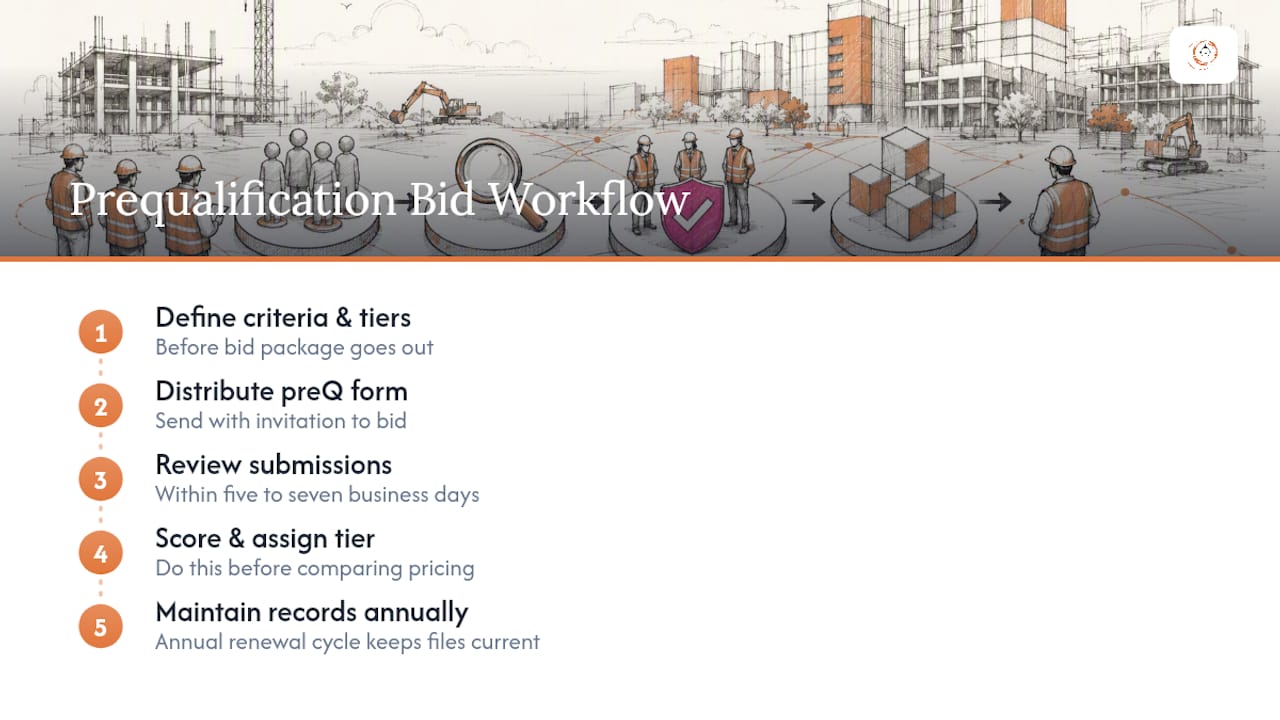
That sequence, drawn from the step-by-step prequalification process most preconstruction teams converge on, keeps qualification from becoming a bottleneck. It also means your award decision reflects both price and risk, which is the entire point of running prequalification in the first place. Firms working toward public-sector awards face an added layer of documentation requirements worth reviewing separately in a compliant public-sector bid submission.
A Program Is Only as Good as the Decisions It Forces You to Make
Most contractors don’t fail at prequalification because they lack a checklist. They fail because nobody’s willing to enforce the tier a subcontractor actually earns when the schedule is tight and the low bid looks tempting. A scoring matrix only has value if it overrides your gut instinct on the days your gut instinct is wrong.
The programs I’ve seen work best treat prequalification as an operational system with teeth, not a compliance exercise that gets filed and forgotten. That means the tier decision has to physically limit what AP will pay and what a PM can commit to, not just live as a note in a file somewhere.
R Construction Solutions LLC works with growth-stage contractors to build exactly that kind of system: defensible, tied to real payment controls, and light enough that your team will actually keep it running past the first busy season. As an advisor with more than three decades in construction operations and business development, I’ve watched too many well-intentioned prequalification programs collapse under their own paperwork within a year of launch.

— Rowena Tulacz
How R Construction Solutions LLC Builds Prequalification Programs That Stick
A checklist template is easy to find. Getting your project managers and AP team to actually use it, consistently, months after launch, is the harder problem, and it’s the one most contractors never solve on their own.
R Construction Solutions LLC designs and implements the entire system: the scoring matrix weighted to your typical award sizes, the document intake process your estimators will actually follow, and the ERP or vendor-master integration that pushes tier decisions into AP so payment controls enforce themselves instead of relying on someone remembering. We also support the process side, standardizing how requests go out to subs so you get complete files back the first time instead of chasing paperwork for three weeks. If your current program lives in a spreadsheet nobody trusts, or doesn’t exist at all, start with a review of your construction consulting services and we’ll map out what a working version looks like for your revenue size and award volume.
Sources
- CFMA — Subcontractor review and prequalification: a primer
- AGC — Preventing sub default: best practices
- IRS — Form W-9 (Request for Taxpayer Identification Number and Certification)
- MeltPlan — How to prequalify subcontractors: step-by-step
Recommended
- General Contractor Estimating Best Practices 2026
- Project Manager Hiring Criteria That Actually Predict Performance
- Contractor Business Assessment Explained for Contractors
- How to Protect Yourself Hiring a Construction Project Manager
Running the job and the business at the same time? One short email a week — change orders, billing, job costing, scheduling. Free, no pitch. Subscribe.
Free and unconditional. No call required, no obligation, unsubscribe anytime.