
How to Submit a Compliant Public Sector Construction Bid
To submit a compliant public sector construction bid, your package must exactly match every form, certification, bond, pricing document, and submission method the solicitation specifies, with each item mapped to its regulatory citation under 2 CFR pt. 200 (§200.318–§200.320). One missing signature or unacknowledged addendum is enough to eliminate an otherwise competitive offer.
Pre-submission compliance checklist:
- Active SAM.gov registration with valid UEI and matching legal business name
- Bid bond (typically 20% of bid price, capped at $3 million for federal work) and proof of required insurance
- Signed bid form with no conditional language or qualifications
- All required certifications: debarment, non-collusion, Buy American, and applicable wage determinations
- Acknowledgment of every issued addendum on the bid form
- Cost or price analysis documentation for contracts above $150,000
- Time-stamped submission confirmation, uploaded at least one hour before the deadline
Follow the solicitation to the letter, document your cost/price analysis, and submit early. The public works contract market exceeds $400 billion annually, and the contractors who win consistently are the ones who treat compliance as the first filter, not an afterthought.
Key Takeaways
A compliant public sector construction bid requires active SAM registration, complete certifications, a documented cost/price analysis above $150,000, and a time-stamped submission delivered at least one hour before the deadline.
| Point | Details |
|---|---|
| SAM registration is a hard requirement | Registration must be active at award, not just at submission; new registrations take 7–10 business days. |
| Addenda acknowledgment is non-negotiable | Every issued addendum must be acknowledged on the bid form or the bid is non-responsive. |
| Cost/price analysis above $150,000 | Document direct costs, overhead, profit, and attach subcontractor quotes and wage determinations. |
| Submit at least one hour early | FAR 15.208 treats late submissions as non-responsive; portal latency is the contractor’s risk, not the agency’s. |
| R Construction Solutions LLC bid support | Fixed-fee bid review and retainer compliance programs cover solicitation analysis, 2 CFR pt. 200 mapping, and submission coordination. |
Table of Contents
- What do you need to qualify before submitting a public bid?
- How do you extract compliance requirements from a solicitation?
- Building a bid package mapped to 2 CFR pt. 200 and FAR
- How should you price and document your bid for procurement reviewers?
- What are the submission mechanics for sealed and electronic bids?
- What records do you need to keep after submitting a bid?
- What compliance mistakes lead to automatic bid rejection?
- What does effective bid compliance actually look like in practice?
- R Construction Solutions LLC supports compliant bid preparation
- Sources
What do you need to qualify before submitting a public bid?
Eligibility failures are the most preventable form of rejection. Before you price a single line item, confirm these prerequisites are in order.
- SAM.gov registration: Your registration must be active at the time of award, not just at submission. New registrations take roughly 7–10 business days and require annual renewal. Set a calendar reminder 60 days before your expiration date.
- UEI and legal name match: The Unique Entity Identifier, legal business name, and TIN on your bid must match SAM exactly. Discrepancies trigger eligibility flags.
- Licenses and prequalification: Confirm required trade licenses for the project’s jurisdiction. Many agencies maintain plan-holder lists; verify you are registered before the bid opening. For a full licensing requirements checklist by jurisdiction, review the firm’s published resource.
- Bonding: Federal guidance references a bid guarantee of at least 20% of the bid price, capped at $3 million, where applicable. Performance and payment bonds are typically required at award. Confirm your surety’s capacity before you commit to a project size.
- Debarment status: Run a SAM.gov exclusion check on your firm, key principals, and any named subcontractors. A debarred sub can disqualify your entire package.
Pro Tip: Start this eligibility checklist 30–45 days before the bid letting date. Bonding capacity, license renewals, and SAM updates all take time you will not have the week before submission.
How do you extract compliance requirements from a solicitation?
Reading the solicitation is not a skim job. Here is a structured method to pull every binding requirement before you write a single word of your response.
- Identify the contract type. Determine whether the agency is using an Invitation for Bids (IFB/ITB) or a Request for Proposals (RFP). Sealed bidding awards to the lowest responsive, responsible bidder. Competitive proposals evaluate on stated criteria and allow negotiation. The distinction controls your entire response strategy.
- List every required form and attachment. Federal construction contracts above the simplified acquisition threshold commonly require SF 1442 and TIN disclosure. State and local solicitations have their own standard forms. Write down every form number and attachment label.
- Map certifications and affidavits. Note every required certification: debarment, non-collusion, Buy American, Iran Contracting Act (where applicable), and any agency-specific affidavits.
- Record wage determinations. Identify the applicable Davis-Bacon wage determination number and confirm it matches the project’s county and trade classifications.
- Track addenda and Q&A deadlines. Log the question submission deadline, expected addenda release dates, and the final acknowledgment requirement. Every addendum must be acknowledged on the bid form.
- Confirm submission method and labeling. Note whether submission is through an electronic portal or sealed envelope. For hard-copy submissions, local instructions to bidders commonly require double-sealed envelopes with specific labeling, bid guaranty amounts, and qualification statements.
Never add conditional language or qualifications to your bid. If a contract term is unacceptable, raise it through the formal Q&A process before the deadline and rely on an official addendum. A qualification inserted into your bid form is automatic grounds for rejection.
Building a bid package mapped to 2 CFR pt. 200 and FAR
Every item in your bid packet has a regulatory home. Knowing that mapping is what separates a compliant construction proposal from one that gets returned.
Regulatory mapping for key packet items:
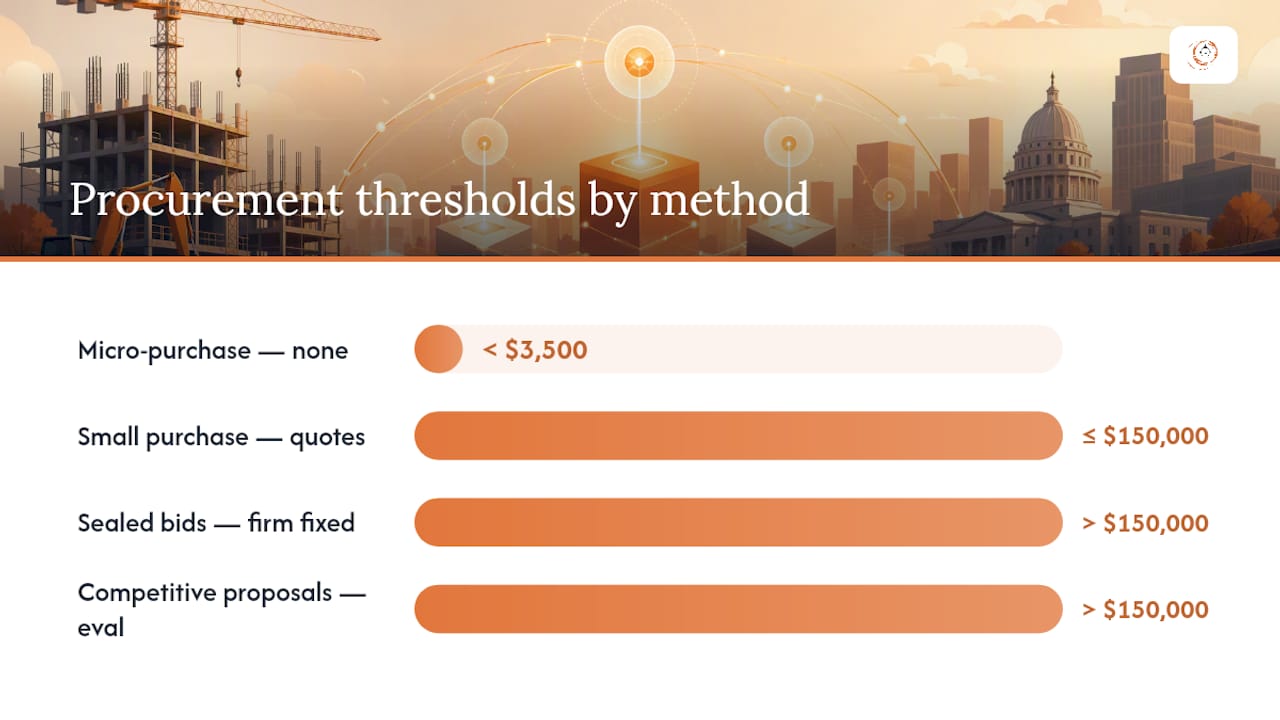
- Competition and procurement method (§200.320): Confirm the agency’s selected method (micro-purchase under ~$3,500; small purchase up to ~$150,000; sealed bids or competitive proposals above that) matches the solicitation type.
- Procurement documentation (§200.318(i)): The agency must document method rationale, selection/rejection reasons, and basis for contract price. Your packet should make that documentation easy to produce.
- Contractor responsibility (§200.318(h)): Agencies must verify you are a responsible contractor. Provide licenses, bonding, past performance references, and financial capacity evidence proactively.
- Required certifications: Debarment and suspension certification, non-collusion affidavit, Buy American certification, TIN disclosure, and Davis-Bacon wage compliance certification where federal funding applies.
- Bid guarantee: For applicable federal contracts, a bid bond of at least 20% of the bid price (capped at $3 million) per LegalClarity’s bid documentation guidance.
Procurement threshold reference:
| Procurement Method | Approximate Threshold | Typical Requirement |
|---|---|---|
| Micro-purchase | Under ~$3,500 | No competition required |
| Small purchase | Up to ~$150,000 | Price or rate quotes from multiple sources |
| Sealed bids | Above ~$150,000 | Public advertising, firm fixed price, lowest responsive bidder |
| Competitive proposals | Above ~$150,000 | Evaluation criteria, negotiation allowed |
Value engineering clauses are encouraged for construction contracts of sufficient size as a mechanism to seek cost reductions when procurement rules allow. If the solicitation includes one, address it explicitly in your proposal.
How should you price and document your bid for procurement reviewers?
Pricing is not just arithmetic. For contracts above $150,000, you must document a cost or price analysis that demonstrates your price is fair and reasonable.
What a compliant cost/price analysis includes:
- Direct costs broken out by labor, materials, equipment, and subcontractor quotes
- Overhead allocation method and rate
- Profit documented as a separate, negotiated element when there is no price competition
- Source documents attached: subcontractor quotes, supplier bids, equipment rental rates, and applicable wage determinations
Present your price breakdown so a reviewer can verify the arithmetic without calling you. Units, quantities, unit prices, and extensions should be in a clear schedule of values. Avoid percentage-of-cost contract structures; they are prohibited under federal procurement rules.
For federally funded projects, attach your pricing worksheets and subcontractor quotes as supporting documentation. If you need help building a pricing team capable of producing this level of documentation, the construction estimator hiring checklist is a practical starting point.
What are the submission mechanics for sealed and electronic bids?
Procedure controls responsiveness just as much as content does.
- Confirm the submission method. Electronic portals and sealed envelopes have different rules. Never mix them up.
- Label hard-copy envelopes correctly. Include project name, bid number, opening date and time, and your firm’s name exactly as the solicitation requires.
- Upload portal submissions at least one hour early. FAR 15.208 treats late submissions as non-responsive except in very narrow, government-controlled exceptions. Portal latency, file size limits, and browser timeouts are your problem, not the agency’s.
- Save your submission confirmation. Screenshot or download the time-stamped portal receipt. For hard copy, get a dated, signed receipt from the receiving office.
- Verify addenda acknowledgments on the bid form. This is the single most common reason a complete, competitive bid gets rejected.
Pro Tip: Use checklist-driven bid management tools to validate your document set before upload, but always follow up with a human review of signatures and math. Automated validation catches missing files; it does not catch an unsigned certification or a transposed number.
For a deeper look at electronic submission workflows and bid automation best practices, the firm’s published guide covers portal-specific validation steps.
What records do you need to keep after submitting a bid?
Audit readiness starts at bid submission, not after award. Per §200.318(i), agencies must maintain procurement records covering method rationale, selection or rejection justification, and basis for contract price. As the contractor, your parallel file supports your position in any audit, protest, or dispute.

Recommended retention items:
| Document | Retention Trigger | Why It Matters |
|---|---|---|
| Solicitation and all addenda | Bid submission | Proves the requirements you responded to |
| Bid package as submitted | Bid submission | Baseline for responsiveness disputes |
| Cost/price analysis worksheets | Contract award | Supports price reasonableness documentation |
| Subcontractor and supplier quotes | Contract award | Backs up your pricing source documents |
| Bonding and insurance certificates | Award through project close | Required for performance and payment bond claims |
| Davis-Bacon payroll records | Each pay period | Federal funding compliance; subject to audit |
| Bid opening documentation | Bid opening | Confirms timely receipt and public opening |
Tie each retained file to the solicitation clause that requires it. Maintain digital backups in a named project folder, and log who verified each document and when. For a full overview of government contract award procedures including debriefings and protest timelines, that resource covers the post-award side in detail.
What compliance mistakes lead to automatic bid rejection?
The most common disqualifiers are not complex regulatory failures. They are procedural oversights that a pre-submission checklist would catch every time.
- Missing or unacknowledged addenda: If the agency issued three addenda and your bid form acknowledges two, your bid is non-responsive. Period.
- Unsigned forms or certifications: A certification with no signature is not a certification. Check every signature line, including the non-collusion affidavit and debarment certification.
- Wrong wage determination: Using an outdated or wrong-county wage determination is an immediate compliance failure on federally funded work.
- Missing bid bond or insufficient bond amount: A bid guarantee below the required percentage or from an unlisted surety disqualifies the submission.
- Math errors in the schedule of values: A unit price that does not multiply to the extension, or a subtotal that does not add up, raises questions about your entire pricing methodology.
- Expired or inactive SAM registration at award: Your registration must be active when the contract is awarded, not just when you submitted.
- Prohibited contract types: Cost-plus-percentage-of-cost structures are prohibited. Time-and-materials contracts are allowable only when no other type is suitable, and they require a ceiling price and agency oversight.
The single most reliable pre-submission check: print your bid form, walk every line against the solicitation’s required forms list, and have a second person verify signatures and addenda acknowledgments independently. Most rejections happen on items that were in the package but not completed correctly, not on items that were forgotten entirely.
What does effective bid compliance actually look like in practice?
Most contractors treat compliance as a checklist they run through at the end. That sequencing is backwards, and it costs them bids they should have won.
The right workflow starts with a responsiveness review before pricing begins. Confirm SAM status, bonding capacity, and licensing on day one. Map every required form and certification to a responsible owner on your team before the estimate is half-built.
Pricing competitiveness matters, but a non-responsive bid at any price is a loss. Verify responsiveness first, then sharpen your numbers.
Rowena Tulacz brings 30+ years of operations and business development experience in the construction industry, with specific expertise in federal contracting compliance including FAR, DFARS, and Cal/OSHA requirements. R Construction Solutions LLC supports contractors through solicitation review, compliance mapping to 2 CFR pt. 200, cost/price analysis documentation, and submission coordination across the full public sector bidding process.
R Construction Solutions LLC supports compliant bid preparation
Winning a public sector contract starts with a bid that survives the responsiveness review. R Construction Solutions LLC delivers fixed-fee bid review and ongoing retainer support that covers solicitation analysis, compliance mapping to 2 CFR pt. 200 and applicable FAR clauses, cost/price analysis documentation, bond and insurance verification, and submission coordination.

Contractors working with R Construction Solutions LLC get a structured review process that flags missing certifications, incorrect wage determinations, and addenda gaps before they become rejection notices. The firm’s federal procurement consulting practice is built on more than three decades of operations and advisory experience in the construction industry, serving general contractors, subcontractors, and specialty trades firms across the United States.
For contractors who want to build their own compliance program, The Sandbox offers templates and checklists to accelerate bid preparation. For a full review of your next bid package or to set up an ongoing compliance retainer, visit R Construction Solutions LLC’s consulting services page and request an initial consultation.
Sources
Use these sources to verify rules, download forms, and confirm thresholds before each submission.
- FAR 15.208 — Late submissions, modifications, and withdrawals of proposals
- How to Win Public Works Contracts: $400B Bidding Guide | Buildermuse
- Bid Docs: Key Components, Requirements, and Protests - LegalClarity
Save links and downloaded templates to a named project folder in your document control system. An auditor who asks for your solicitation file should be able to find every document within minutes, not hours.