
Government Contract Awards: A Contractor’s Guide to Winning | R. Construction Solutions
Government contract awards are the formal decisions by federal agencies to allocate funds to a winning contractor after a structured, multi-stage procurement process governed by the Federal Acquisition Regulation (FAR). Understanding how government contract awards work is the difference between submitting a compliant proposal and actually winning one. The process runs through five defined phases, involves registration in SAM.gov, and scores proposals against criteria set by a Source Selection Authority. Contractors who treat this as a one-time submission exercise consistently lose to those who engage the full procurement lifecycle from the start.
What are the main phases of the government contract award process?
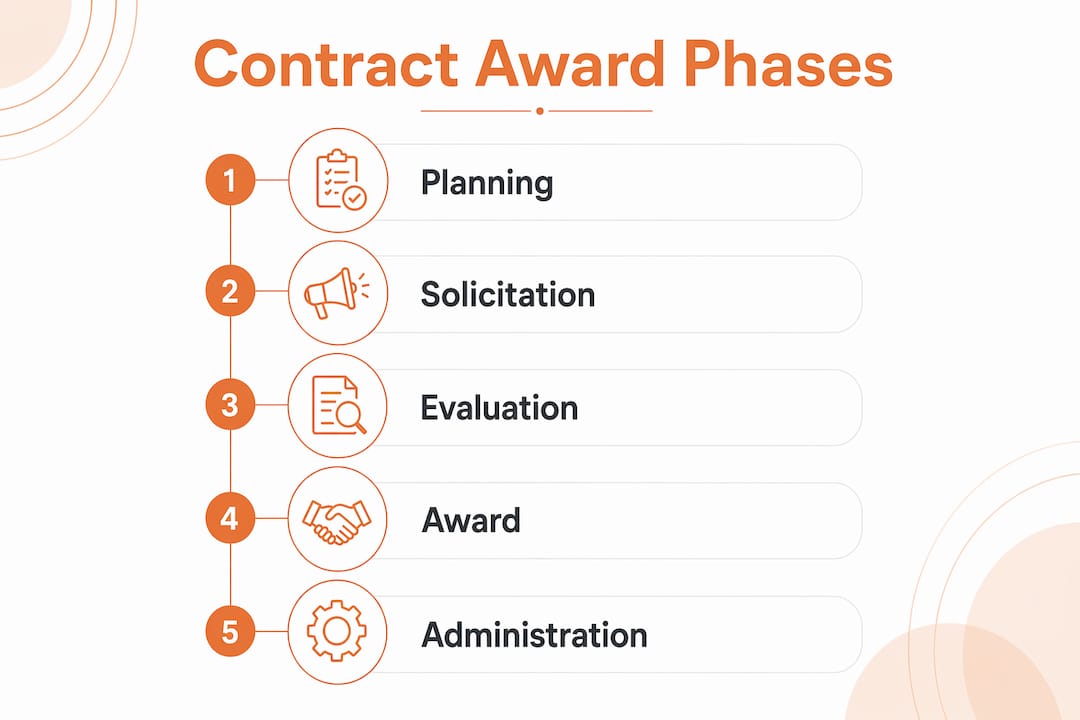
The federal contract lifecycle spans 6 to 24 months across five phases: planning, solicitation, evaluation, award, and administration. Each phase has a defined purpose and a typical timeline that contractors must account for when building their government procurement strategy.
Phase timelines at a glance:
| Phase | Typical Duration | Key Activity |
|---|---|---|
| Planning | 6–18 months | Budget approval, market research, requirements definition |
| Solicitation | 1–3 months | RFP/RFQ/IFB published, Q&A period open |
| Evaluation | 1–4 months | Proposals scored by evaluation team |
| Award | ~1 month | Contract signed, notifications issued |
| Administration | 1–10+ years | Performance, payments, modifications |
The planning phase is where most contractors are invisible. Agencies define requirements, conduct market research, and set evaluation criteria long before a solicitation appears publicly. Contractors who show up only at the solicitation phase are already behind.
Registration in SAM.gov is mandatory for any federal award above $10,000. The registration process takes 5–10 business days and requires annual renewal. A lapsed registration can delay payments and disqualify a proposal outright, so treat it as a standing operational task, not a one-time checkbox.

Solicitation windows are tight. Response times range from 7–30 days for RFQs, 30–60 days for RFPs, and 10–21 days for IDIQ task orders. Competitive acquisitions above $25,000 must be published on SAM.gov, which is your primary source for active opportunities.
How does the government evaluate proposals and select contract winners?
Two evaluation methods dominate federal procurement: Lowest Price Technically Acceptable (LPTA) and Best Value. Choosing the wrong proposal strategy for the wrong method is one of the most common and costly mistakes contractors make.
LPTA awards the contract to the lowest-priced proposal that meets the minimum technical requirements. Best Value weighs technical approach, past performance, and price together to select the proposal offering the greatest overall benefit. Under Best Value, the Source Selection Authority must formally document the rationale for choosing a higher-priced offeror over a cheaper one.
| Factor | LPTA | Best Value |
|---|---|---|
| Price weight | Dominant | One of several factors |
| Technical approach | Pass/fail threshold | Scored and differentiated |
| Past performance | Minimal | Heavily weighted |
| Proposal strategy | Compete on cost | Compete on quality and value |
Past performance is the factor contractors underestimate most. CPARS ratings are reviewed before evaluators read technical volumes in Best Value acquisitions. A poor CPARS record suppresses your score before the agency reads a single page of your proposal. Build strong past performance on smaller contracts and subcontracting work before pursuing large prime awards.
Pro Tip: In a Best Value acquisition, do not write a generic technical approach. Evaluators score differentiation. Show specifically how your methods, team, and resources produce a better outcome than the minimum requirement.
The evaluation team scores proposals against criteria published in the solicitation. Knowing the evaluation method before you write a single word shapes every section of your response, from pricing to the technical narrative.
What strategic steps improve your chances before and during solicitation?
Winning contractors engage actively across all procurement stages, not only at the solicitation phase. The steps below reflect what separates consistent winners from one-time bidders.
-
Register and maintain SAM.gov. Keep your registration current year-round. A lapsed account at the wrong moment ends your bid before it starts.
-
Respond to Sources Sought notices and RFIs. These pre-solicitation tools let agencies gauge market interest and capability. Your response can directly influence how requirements are written. Contractors who respond to Sources Sought notices shape evaluation criteria before the solicitation is finalized.
-
Attend industry days. These events give you direct access to contracting officers and program managers. Use them to understand priorities, ask clarifying questions, and make your firm known before competition begins.
-
Ask strategic questions during the Q&A window. Well-crafted questions during the solicitation Q&A period clarify ambiguous requirements and can result in solicitation amendments that benefit your approach. Every question and answer is shared with all offerors, so phrase yours to surface information that strengthens your position.
-
Track and acknowledge every amendment. Missing a solicitation amendment renders your proposal nonresponsive. Non-acknowledgment is an automatic disqualification. Set up alerts and review every amendment the moment it posts.
-
Submit at least 24 hours early. Portal instability near deadlines is common. Late submissions are automatically rejected with no exceptions. Build submission time into your proposal schedule as a hard deadline, not a soft target.
Pro Tip: Get on the right contract vehicles before solicitations are issued. Agencies often buy from approved vendor pools without a new open competition. Being on the right vehicle means you compete in a smaller pool with a faster path to award.
Contractors who leverage certifications such as WBE, MBE, or DBE status gain additional positioning advantages, particularly on set-aside contracts and subcontracting opportunities tied to large prime awards.
What happens after a contract is awarded?
Contract award is not the finish line. It is the start of the administration phase, which can run from one year to over a decade depending on the contract type. How you perform during this phase directly determines your ability to win future work.
Key post-award activities every contractor must manage:
- Award notification and signing. The agency issues a notice of award. Review the contract document carefully before signing. Confirm scope, period of performance, and payment terms match the solicitation.
- Contract administration. A Contracting Officer’s Representative (COR) monitors your performance. Maintain open communication with the COR and document all deliverables and milestones.
- Payment timelines. Federal agencies are required to pay within 30 days of a proper invoice under the Prompt Payment Act. Delayed payments often result from invoice errors, so submit clean, complete invoices every time.
- CPARS ratings. Your performance is recorded in CPARS throughout the contract. These ratings follow you into every future bid. Treat each contract as a reference that either opens or closes the next door.
- Request debriefings when you lose. Debriefings are underutilized but highly valuable. Losing vendors can request a formal debrief within prescribed timeframes to receive specific feedback on their proposal scores. Most contractors skip this step and repeat the same mistakes on the next bid.
The construction consulting engagement process mirrors government contract administration in many ways. Contractors who already manage structured project delivery adapt faster to federal performance requirements.
Key Takeaways
Winning government contracts requires active engagement across every phase of the procurement lifecycle, from SAM.gov registration through post-award performance and debriefing.
| Point | Details |
|---|---|
| Register early in SAM.gov | Registration takes 5–10 business days and must be renewed annually to stay eligible. |
| Know your evaluation method | LPTA rewards lowest price; Best Value rewards quality, past performance, and price together. |
| Engage before solicitation | Respond to Sources Sought notices and attend industry days to shape requirements early. |
| Acknowledge every amendment | Missing a solicitation amendment disqualifies your proposal automatically. |
| Request debriefings after losses | Formal debriefings provide scored feedback that directly improves future proposals. |
What I’ve learned after watching contractors win and lose the same bids
The contractors I see win consistently share one habit: they treat government procurement as a relationship-driven process, not a paperwork exercise. They are in front of contracting officers at industry days. They respond to Sources Sought notices even when they are not sure they will bid. They ask questions during Q&A that reveal how the agency is actually thinking about the problem.
The contractors who lose consistently do the opposite. They find the solicitation on SAM.gov the week it drops, scramble to write a proposal, and submit at 11:58 PM on the due date. Then they wonder why they keep losing to the same firms.
Past performance is the piece that surprises most contractors. I have seen technically superior proposals lose because the offeror had one poor CPARS rating from three years ago. Evaluators in Best Value acquisitions see that rating before they read your technical volume. Build your past performance record deliberately. Take subcontracting work. Win smaller contracts. Get strong CPARS ratings before you chase the large awards.
The other mistake I see constantly is ignoring debriefings. You are entitled to feedback when you lose. Use it. The agency will tell you exactly where your proposal fell short. That information is worth more than any proposal-writing guide.
Government contracting rewards preparation and persistence. The firms that evaluate proposals carefully and build their process around the full procurement cycle win more than they lose. The ones who treat it as a lottery do not last long in this market.
— Rowena
How Rconstructionsolutions supports contractors in government work
Navigating the government contracting process takes more than reading the FAR. It takes hands-on experience with proposal preparation, registration compliance, and contract administration across real projects.
Rconstructionsolutions brings over 30 years of construction industry experience to contractors pursuing federal and public sector work. The team provides direct support through SAM.gov registration, proposal strategy, and post-award performance management. Contractors working with Rconstructionsolutions have scaled from $5 million to $50 million in revenue by building the systems and track record that government agencies reward. For contractors ready to compete seriously for public sector contracts, the construction consulting services page outlines exactly how the firm supports each stage of the award process. You can also learn more about winning government contracts from additional expert resources aligned with this approach.
FAQ
What is a government contract award?
A government contract award is the official agency decision to allocate contract funds to a selected contractor after evaluating proposals against published criteria. The award is governed by the Federal Acquisition Regulation (FAR) and documented by the Source Selection Authority.
How long does the government contracting process take?
The full contract lifecycle spans 6 to 24 months from planning through award. The administration phase can extend from one year to over a decade depending on the contract type and scope.
What is the difference between LPTA and Best Value?
LPTA awards the contract to the lowest-priced proposal that meets minimum technical requirements. Best Value selects the proposal offering the greatest overall benefit by weighing technical approach, past performance, and price together.
Do I need SAM.gov registration to bid on federal contracts?
Yes. SAM.gov registration is mandatory for any federal award above $10,000. Registration takes 5–10 business days and must be renewed annually. A lapsed registration can delay payments and disqualify active proposals.
What should I do after losing a government contract bid?
Request a formal debriefing from the contracting agency within the prescribed timeframe. Debriefings provide scored feedback on exactly where your proposal fell short, giving you specific information to improve your next submission.