
Project Manager Hiring Criteria That Actually Predict Performance
Five criteria separate a project manager who protects your margin from one who erodes it: OSHA 30 completion with real safety ownership, project-type and delivery-method fit, documented budget and schedule ownership with numbers attached, working fluency in your project management software, and references that confirm all of it. If a candidate is missing more than one of these, keep looking.
The tactical move this week: build a weighted scorecard and run a scenario-based technical interview before you make an offer to anyone. That single step, more than any resume line, is what separates a hire that survives your fastest-moving project from one that quietly derails it.
Rowena Tulacz, founder of R Construction Solutions LLC, has spent over three decades on the operations and business development side of construction and built this framework from what actually predicts a good hire versus a costly one.
Key Takeaways
Growth-stage contractors reduce hiring risk most effectively by replacing resume screening with a weighted scorecard, scenario-based interviews, and direct verification of budget, schedule, and safety claims.
| Point | Details |
|---|---|
| Set five non-negotiables | Require OSHA 30 completion, project-type fit, budget ownership evidence, software fluency, and verifiable references before any interview. |
| Use a weighted scorecard | Score candidates across project-fit, budget control, schedule recovery, safety, subcontractor management, and cultural fit. |
| Verify, don’t assume | Request change-order logs, baseline-versus-actual schedules, and closeout checklists to confirm claimed results. |
| Source ahead of the pipeline | Start active sourcing once a pursuit crosses roughly 50% win probability, not after contract award. |
| Protect the hire post-offer | Move fast on offers and run a structured 30-60-90 day onboarding plan to secure first-year retention. |
| Get expert hiring support | R Construction Solutions LLC builds scorecards, sourcing plans, and onboarding systems for growth-stage contractors. |
Table of Contents
- What Are the Must-Have Project Manager Hiring Criteria?
- How Do You Screen Candidates With a Structured Interview Process?
- Why Verification Matters More Than the Resume
- When Should You Start Sourcing a Construction Project Manager?
- What Compensation and Onboarding Approach Protects Your Hire?
- How R Construction Solutions LLC Helps You Hire Better Project Managers
- How Do You Assess Leadership and Communication Skills?
- Do PMP or PRINCE2 Certifications Matter for Construction Hires?
- How Do You Test Risk Management Capabilities?
- How Do You Test Problem-Solving Under Pressure?
- How Do You Evaluate Past Budget Management and Financial Acumen?
- Start With a Diagnostic, Not a Job Posting
- The Hiring Mistakes I See Most Often
- Sources
What Are the Must-Have Project Manager Hiring Criteria?
A construction project manager owns three things: schedule, budget, and safety. The Occupational Outlook Handbook frames the role as planning, scheduling, budgeting, and supervising construction activities, and while many postings ask for a bachelor’s degree, verified field experience and on-the-job performance carry more predictive weight for a growth-stage contractor than the diploma does. Your job before you post the role is deciding which accountabilities matter most for your typical project mix, then screening against that, not a generic template.
Start by separating must-haves from nice-to-haves.
- OSHA 30 completion. This is treated as the standard safety baseline for supervisory and project manager roles in U.S. construction, and a candidate without it is starting behind.
- Project-type and delivery-method match. A PM who has only run hard-bid work will struggle on a design-build job, and that experience often doesn’t transfer quickly.
- Evidence of budget ownership. Not “managed a $5 million project” but specific numbers: original budget, final cost, and why the variance happened.
- Software fluency. Working knowledge of Procore, Buildertrend, or Primavera P6, whichever your firm runs.
- Owner and subcontractor references who will confirm the above.
Ask every candidate for a one-page project portfolio before the first interview: project name, contract value, delivery method, role, schedule variance, budget variance, and one reference contact per project. Verify the schedule and budget numbers against whatever documentation the candidate can produce. A portfolio that’s vague on numbers is itself a signal.
How Do You Screen Candidates With a Structured Interview Process?
Gut-feel hiring misses more than it catches. A three-stage structured process, run against a weighted scorecard, surfaces the difference between someone who talks well and someone who actually recovers a slipping schedule.
Stage one is a 30-minute phone screen, usually owned by an office manager or HR lead, filtering for the non-negotiables: OSHA 30, project-type fit, and basic availability.
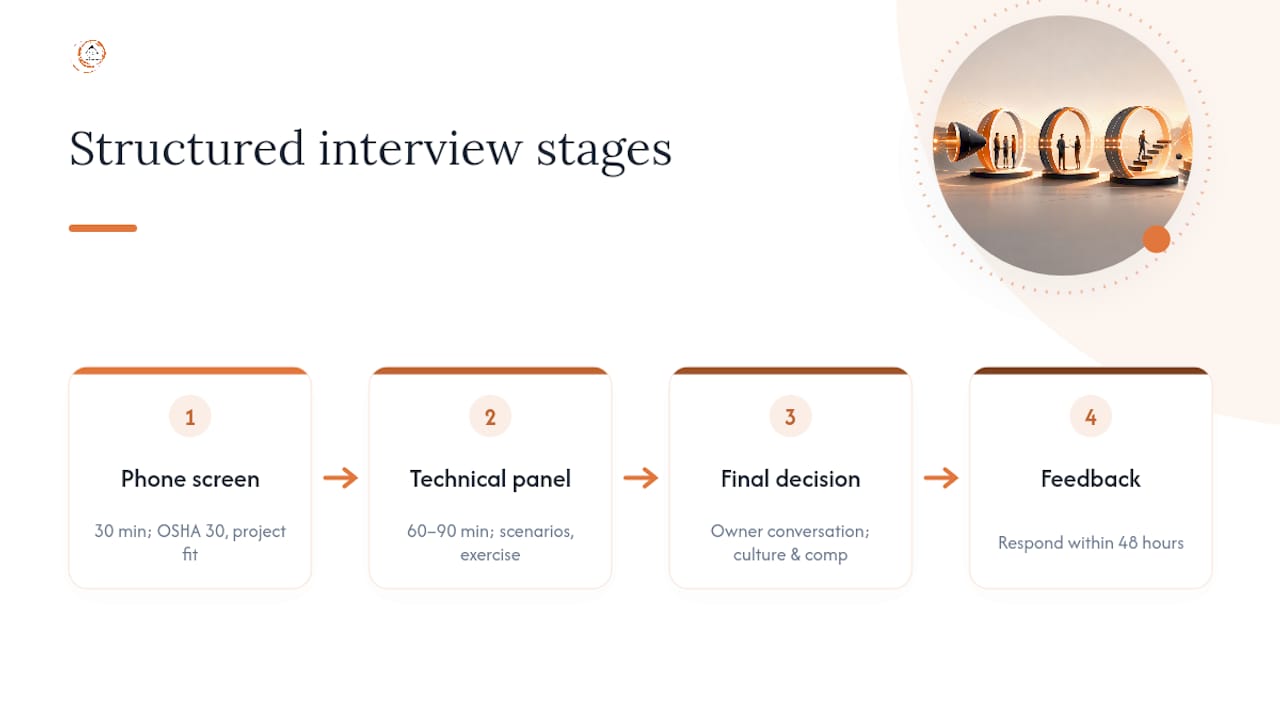
Stage two is a 60-to-90-minute technical panel with your ops lead or senior estimator, built around scenario questions and a short technical exercise.
Stage three is a final decision-maker conversation, typically the owner or president, focused on cultural fit and compensation alignment.
A sample weighted scorecard:
Scenario questions should demand specifics, not theory. Ask: “Walk me through a project where the schedule slipped by three weeks. What caused it, what did you do in the first 48 hours, and what was the final variance?” A strong answer names the trade that caused the delay, the recovery decision made, and the actual days recouped. A weak answer stays abstract.
Pair this with a short technical test: a 15-minute cost-variance exercise where the candidate reviews a sample change-order log and explains what they’d flag. This is one of the recommended verification practices for separating candidates who understand budget mechanics from those who just manage a spreadsheet.
Pro Tip: Cap each stage at 48 hours before your team gives feedback. Strong PM candidates are usually fielding two or three offers at once, and a slow process loses them to a competitor who decided faster.
Why Verification Matters More Than the Resume
A resume tells you what a candidate claims. Verification tells you what actually happened. This is where most growth-stage firms skip a step, and it’s the step that catches the gap between a polished interview and real field performance.
Experience Modification Rate, or EMR, is a company-level safety metric, but a candidate who has actually owned safety on a project can speak to it fluently: what their prior company’s EMR was, what drove it up or down, and what they personally did about incident rates on their jobs. Vague answers here are a flag, not a disqualifier, but a flag worth probing further alongside a check of OSHA recordables on any project they claim to have run.
Reference checks should target three people per candidate: the project owner, one subcontractor, and one superintendent who worked under them. Ask each the same three questions: how did they handle a schedule slip, how did they process change orders, and would they rehire this person for a similar project.
Request specific documents before the offer stage:
- Change-order log from a recent project
- Baseline schedule versus actual schedule
- Project closeout checklist
- Subcontractor performance notes
Our related guide on protecting yourself when hiring a construction project manager walks through this verification sequence in more detail.
When Should You Start Sourcing a Construction Project Manager?
The most common hiring mistake growth-stage firms make isn’t a bad interview. It’s starting the search too late, after a project is already awarded and the mobilization clock is running.
Tie sourcing to your bid pipeline, not your award date. Bringing a senior PM in before mobilization lets them influence design coordination and procurement decisions instead of inheriting someone else’s choices.
Prioritize three channels: internal referrals from current PMs and superintendents, a construction-focused recruiter for mission-critical roles like MEP coordination or commissioning, and direct outreach to passive candidates at firms doing similar work.
Build a rolling 12-to-24 month talent map organized by your recurring project types. When a specific sector or delivery method keeps showing up in your pipeline, you should already know two or three names who fit before the bid is even submitted.
Pro Tip: Review your talent map every quarter alongside your pipeline forecast. If a sector is heating up and your map is empty, that’s your signal to call a recruiter now, not after the award.
Our strategic planning guide for contractors covers how to fold this talent mapping into broader workforce planning.
What Compensation and Onboarding Approach Protects Your Hire?
Losing a strong candidate over a slow offer is one of the most avoidable mistakes in construction hiring, and losing a good hire in month three because onboarding was an afterthought is nearly as common.
Benchmark pay before you post the role, not after you’ve fallen for a candidate. Base salary is the anchor, but bonus structure tied to project completion, per diem for travel projects, and vehicle or mileage support are what separate a competitive offer from one that gets countered elsewhere.
- Decide your offer-decision owner in advance, typically the owner or president for a growth-stage firm, so there’s no internal delay after the final interview.
- Target a 48-to-72 hour decision window from final interview to offer.
- Present the offer verbally first, then follow with written details within 24 hours.
Once they’re hired, protect the investment with a structured 30-60-90 day plan:
- Days 1 to 30: Shadow an active project, meet key subcontractors, and get access to Procore or Buildertrend.
- Days 31 to 60: Take partial ownership of one project’s schedule and budget reporting.
- Days 61 to 90: Full ownership of a project, with a formal check-in against performance expectations.
A documented onboarding plan like this is consistently linked to better first-year retention across construction hiring guides.
How R Construction Solutions LLC Helps You Hire Better Project Managers
Building the systems above from scratch, while running live projects, is exactly where most growth-stage firms lose momentum. R Construction Solutions LLC was built to close that gap for contractors doing between $1 million and $10 million in annual revenue.
The firm’s services map directly to what this guide covers:
- Role definition workshops that translate your project mix into a specific PM job description
- Custom scorecard development weighted to your delivery methods and sector
- Construction-focused recruiting and sourcing for project managers, superintendents, and estimators
- 30-60-90 onboarding design tailored to your company’s systems
- Implementation support for Procore, Buildertrend, and other project management platforms
Rowena Tulacz brings 30-plus years of construction operations and business development experience experience to every engagement, with direct expertise in job costing, workflow design, and PM system rollout. The construction consulting services page outlines how engagements are structured for firms that need this built now rather than pieced together over another hiring cycle.
How Do You Assess Leadership and Communication Skills?
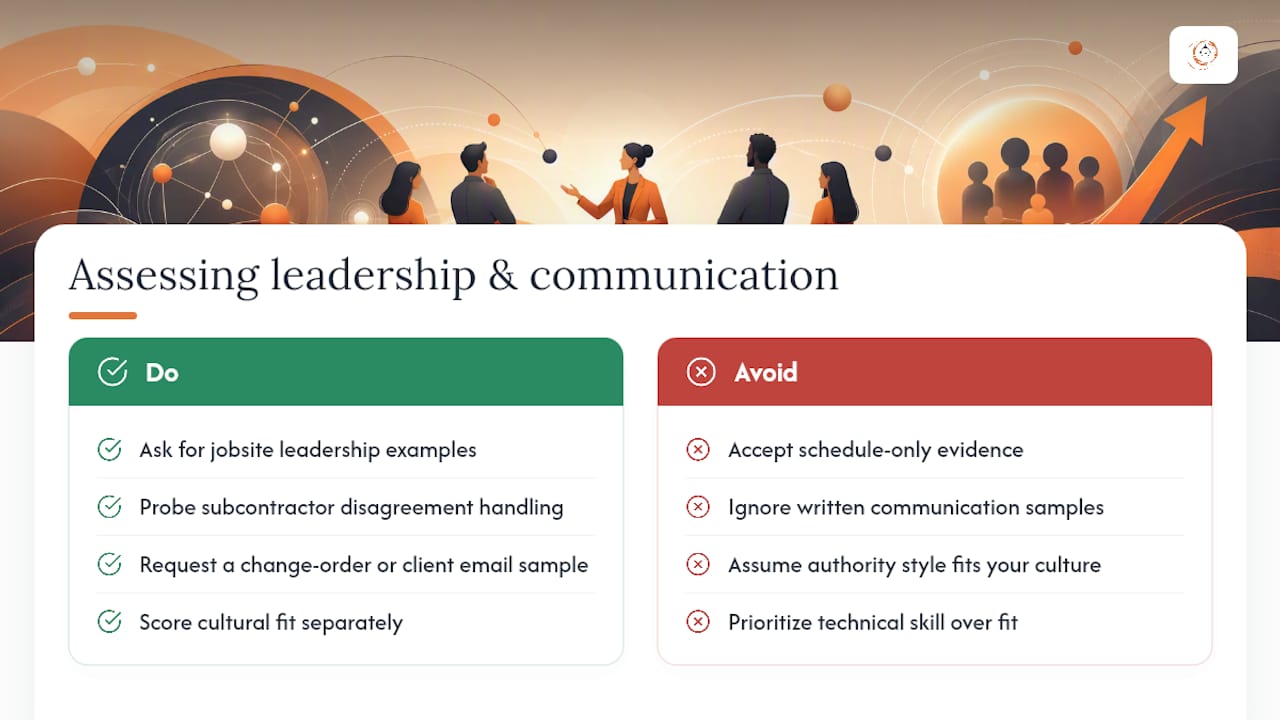
Technical competence gets a project manager through the estimate review. Leadership and communication are what get a project through the inevitable moment when a subcontractor misses a deadline or a client demands an explanation for a change order.
Look for evidence of how a candidate has led a jobsite team, not just managed a schedule. Ask how they’ve handled a disagreement with a superintendent over sequencing, or how they’ve communicated bad news, a cost overrun or a delay, to an owner. The skills most associated with strong field performance include flexible planning under pressure and the emotional intelligence to manage friction between trades without it becoming a project-level problem.
A useful probe during the technical panel: “Tell me about a time a subcontractor pushed back on your direction. What did you say, and what happened next?” Listen for whether the candidate describes a collaborative resolution or simply asserts authority. Both styles can work depending on your company culture, but you want to know which one you’re getting before the offer, not during the first site conflict.
Communication style matters just as much in writing as in person. Ask for a sample of a change-order notice or a client update email the candidate has written. A PM who documents clearly protects you legally and keeps owners calmer during disputes. One who writes vague, defensive updates creates friction that eventually lands on your desk.
Cultural fit deserves its own line on the scorecard, separate from communication skill. A technically excellent PM who clashes with your existing team’s working style, whether that’s your pace of decision-making or your tolerance for informal problem-solving, will cost you more in friction than a slightly less polished hire who fits how your company actually operates.
Do PMP or PRINCE2 Certifications Matter for Construction Hires?
Certifications like PMP and PRINCE2 signal that a candidate understands formal project management frameworks, but in construction hiring, they’re a supporting data point, not a deciding one. Neither certification tests field-specific knowledge like OSHA compliance, subcontractor sequencing, or change-order mechanics on an actual jobsite.
Treat a PMP or similar credential the way you’d treat a strong reference letter: it adds confidence, but it doesn’t replace verified project experience. A candidate with a PMP and no documented track record of running a comparable project should still go through the same scorecard and reference process as everyone else.
Education requirements deserve the same nuance. The Occupational Outlook Handbook notes many construction manager roles list a bachelor’s degree as a preference, often in construction management or engineering, but plenty of the strongest PMs in the industry came up through estimating, superintending, or the trades themselves and built their project management skill on the job.
For a growth-stage firm, the practical approach is to weight formal credentials lightly on your scorecard, somewhere in the range of the “nice-to-have” column rather than the must-have list, and let project-type fit, budget ownership, and safety record carry the real weight. A candidate with fifteen years running commercial tenant improvements and no certification is very often a stronger hire than one with a fresh PMP and no comparable field history.
How Do You Test Risk Management Capabilities?
Risk management in construction rarely looks like a formal risk register. It looks like a PM noticing a long-lead equipment order is running behind and adjusting the schedule three weeks before anyone else would have caught it.
Ask candidates to walk through a project where they identified a risk before it became a problem. A strong answer names the specific trigger, whether it was a supplier delay, a permitting bottleneck, or a design conflict, and describes the concrete step taken to mitigate it. Weak answers describe risk in the abstract, without a real example attached.
A useful scenario question: “You’re two months into a project and your structural steel supplier tells you their delivery is slipping six weeks. Walk me through what you do in the next 48 hours.” Listen for sequencing logic: does the candidate talk about resequencing other trades, negotiating with the supplier, or notifying the owner early? A candidate who jumps straight to blame, rather than a plan, is showing you how they’ll handle the next surprise on your project.
Risk ownership also shows up in how a candidate discusses contingency. Ask how they’ve used a project’s contingency budget in the past and what triggered drawing on it. Our breakdown of how construction contingency budgets work is a useful internal reference if you want to sharpen this line of questioning before the interview.
Reference checks should confirm this directly. Ask the project owner: “Did this PM flag problems early, or did issues tend to surface late?” That single question often reveals more about risk management than anything in the interview itself.
How Do You Test Problem-Solving Under Pressure?
The best way to test problem-solving isn’t to ask a candidate whether they’re good at it. It’s to hand them a real, unresolved scenario and watch how they think through it live.
During the technical panel, present a short case: a concrete pour is scheduled for tomorrow, but the inspector just failed the rebar placement on a walkthrough. What does the candidate do in the next four hours? A strong response moves through a clear sequence: contact the structural engineer, assess whether a partial fix is possible before the pour window closes, and communicate the delay risk to the owner immediately rather than waiting to see if it resolves itself.
Watch for candidates who ask clarifying questions before answering. That instinct, gathering the missing information before committing to a decision, is often a better signal than a fast, confident answer that skips steps. Construction problems rarely come with complete information, and a PM who defaults to asking “what do we know and what don’t we know yet” tends to make fewer costly assumptions on your actual jobsite.
Decision-making speed matters too, but only in combination with judgment. Ask about a decision the candidate made that turned out to be wrong, and how they corrected course. Candidates who can’t name a mistake, or who deflect blame entirely, are often the ones who repeat the same error on your project instead of catching it early.
How Do You Evaluate Past Budget Management and Financial Acumen?
Budget talk during an interview is cheap. Budget verification is where you find out whether a candidate actually understands cost control or just managed to stay employed on projects that happened to come in on target.
Ask for the specific numbers on their two or three largest projects: original contract value, final cost, and the primary driver of any variance. A candidate who can rattle off exact figures and explain a variance in terms of a specific change order, a material price swing, or a subcontractor default is showing you real fluency. One who says “it came in close to budget” without specifics hasn’t demonstrated financial acumen at all.
The cost-variance exercise described earlier in the screening process is your best tool here. Hand the candidate a sample change-order log and ask them to identify which entries look like scope creep versus legitimate owner-directed changes. Financially sharp PMs spot the difference quickly, because that distinction is exactly what protects your margin on a real job.
Reference checks should confirm the pattern. Ask the project owner directly: “Did change orders get processed promptly and accurately, or did they pile up and create disputes at closeout?” A PM with strong financial habits keeps that log current throughout the project, not reconstructed under pressure during the final walk-through.
Start With a Diagnostic, Not a Job Posting
Posting a job listing before you’ve defined the role clearly is how most growth-stage firms end up interviewing candidates who look right on paper and fall apart on the first difficult jobsite decision.
R Construction Solutions LLC works with contractors to build the hiring infrastructure this guide describes, starting with a short diagnostic call to map your project types, review your current job description, and identify where your screening process is leaking good candidates or letting weak ones through. From there, we build a weighted scorecard specific to your delivery methods, connect you with sourcing channels suited to your mission-critical roles, and design a 30-60-90 onboarding plan that protects the hire once it’s made.
Every engagement runs on a signed engagement letter with clear scope and timeline, delivered by a team grounded in decades of real construction operations and business development experience rather than generic HR consulting. If your last PM hire didn’t work out, or you’re staffing up for a pipeline that’s about to get busier, visit the construction consulting services page and book a diagnostic call to get the scorecard and sourcing plan started this month.
The Hiring Mistakes I See Most Often
The single most expensive mistake I see growth-stage firms make is hiring on schedule pressure instead of fit. A project starts soon, a resume looks decent, and the scorecard gets skipped entirely.
One habit fixes most of this: require the one-page project portfolio before the first interview, every time, no exceptions. It filters out unqualified candidates in minutes and gives your technical panel real numbers to interrogate instead of vague claims. Firms that adopt this consistently report shorter time-to-fill and noticeably better first-year retention, because the mismatch gets caught in screening rather than six months into a live project.
If your current process doesn’t include a scorecard, it’s worth a conversation before your next posting goes live.
— Rowena Tulacz
Sources
- Is OSHA 10 or 30 Hour Training Mandatory?
- Construction managers - Occupational Outlook Handbook | BLS
- Choose the right construction project management methodology
- How to hire a construction project manager (StartupKit)