
Small Business Set-Aside Contracts: A Guide for Contractors | R. Construction Solutions
Small business set-aside contracts reserve federal acquisitions exclusively for eligible small businesses, and the single most important rule that triggers them is the Rule of Two: a contracting officer must set aside any acquisition above the micro-purchase threshold when there is a reasonable expectation that at least two responsible small businesses will submit offers and award can be made at a fair and reasonable price. That rule, codified in FAR Subpart 19.5, is not discretionary once both conditions are met. The statutory authority behind it is the Small Business Act’s mandate that a “fair proportion” of federal contract dollars go to small businesses, administered by the U.S. Small Business Administration (SBA) and tracked through the Federal Procurement Data System (FPDS).
Three immediate practical implications follow from that framework:
- Who can bid: Only firms that self-certify as small under the applicable NAICS code in SAM.gov may submit offers on a set-aside solicitation.
- When it is mandatory: Any acquisition between the micro-purchase threshold and the simplified acquisition threshold is automatically reserved for small businesses; above the SAT, the Rule of Two applies, per FAR Subpart 19.5.
- Where documentation lives: Contracting officers must record their market research and Rule of Two analysis in the contract file, and award data flows into FPDS for government-wide goal reporting.
The government-wide small-business procurement goal is 23% of eligible federal contract dollars. Set-aside contracts are the primary mechanism agencies use to reach it.
Pro Tip: If you are a contracting officer, document your Rule of Two analysis the moment you complete market research — not after the solicitation issues. Retroactive documentation is the single most common audit finding in set-aside files.
Table of Contents
- What is the legal basis for small business set-aside contracts?
- What types of set-asides exist and what dollar thresholds apply?
- How do socioeconomic program set-asides work?
- What steps must a contracting officer follow to implement a set-aside?
- What are the nonmanufacturer rule and subcontracting limits?
- How does a small business qualify and stay eligible for set-aside work?
- What is the measurable impact of set-aside programs on federal procurement?
- What compliance issues and protests should you watch for?
- How can construction contractors pursue and win set-aside work?
- Where can you find set-aside opportunities and free help?
- Key Takeaways
- Why set-aside contracts are a growth lever, not just a compliance exercise
- How R Construction Solutions LLC helps contractors win set-aside work
- Authoritative sources and further reading
What is the legal basis for small business set-aside contracts?
The role of small business set-aside contracts traces directly to Section 15 of the Small Business Act (15 U.S.C. § 644), which directs federal agencies to award a “fair proportion” of contracts and subcontracts to small businesses. Congress reinforced that mandate through the Competition in Contracting Act (CICA), which generally requires full and open competition but carves out an explicit exception for set-asides under the Small Business Act. The two statutes work together: CICA permits restricting competition when doing so advances a statutory goal, and the Small Business Act supplies that goal.
FAR Part 19 translates the statutory mandate into operational rules. FAR Subpart 19.5 is the core operative section, covering total set-asides, partial set-asides, reserves, and the Rule of Two. The specific clauses contracting officers cite most often in file documentation are:
- FAR 19.502-2: — Mandatory total set-aside for acquisitions between $10,000 and $250,000; Rule of Two trigger above the SAT.
The SBA plays three distinct roles in this framework. First, it administers size standards under 13 C.F.R. Part 121, which define “small” for each NAICS code. Second, it runs the certification and verification programs for socioeconomic set-asides (8(a), HUBZone, SDVOSB, WOSB). Third, it adjudicates size and status protests when a competitor or contracting officer challenges a firm’s eligibility after award.
The Congressional Research Service’s overview of small business contracting documents how this statutory and regulatory architecture has evolved since the Small Business Act’s passage in 1953, with each major amendment expanding program coverage or tightening enforcement. Understanding that history helps contracting officers interpret ambiguous regulatory language by reference to congressional intent.
What types of set-asides exist and what dollar thresholds apply?
Set-aside contracts come in four operational categories, each suited to different acquisition structures.
- Total set-aside: — The entire acquisition is restricted to small businesses. This is the default when the Rule of Two is satisfied.
- Class set-aside: — A blanket determination that all future acquisitions of a specific type within an agency will be set aside, eliminating the need for individual Rule of Two analyses.
Dollar thresholds and required actions
| Threshold | Dollar Range | Required Action |
|---|---|---|
| Micro-purchase | Up to $10,000 | No set-aside required; purchase card use typical |
| Mandatory small-business set-aside | $10,001 to $250,000 | Automatic set-aside; no Rule of Two analysis needed |
| Rule of Two zone | Above $250,000 (SAT) | Contracting officer must apply Rule of Two |
| Sole-source (8(a)) | Up to $4.5M (services) / $7.5M (manufacturing) | SBA acceptance required; no competition needed |
| Sole-source (HUBZone, SDVOSB, WOSB) | Up to $4.5M (services) / $7.5M (manufacturing) | Statutory conditions must be met |
These thresholds come directly from FAR Subpart 19.5 and SBA program regulations. Contracting officers should verify current figures in the eCFR because they are periodically adjusted by the FAR Council.
How do socioeconomic program set-asides work?
Before defaulting to a general small-business set-aside for any acquisition above the SAT, contracting officers must consider whether a socioeconomic program set-aside is appropriate. The SBA’s set-aside procurement guidance is explicit on this sequencing, though it does not establish a strict preference order among the four programs themselves.
Program eligibility and documentation requirements
- 8(a) Business Development Program: — Firms must be SBA-certified as 8(a) participants (owned and controlled by socially and economically disadvantaged individuals). SBA acceptance of the requirement is needed before award. Sole-source authority applies up to $4.5M for services and $7.5M for manufacturing/construction.
When sole-source authority applies
A contracting officer may award a sole-source contract to a socioeconomic program participant when:
- Subpart 19.5 - Small Business Total Set-Asides, Partial Set-Asides, and Reserves
- Set-aside procurement | U.S. Small Business Administration
- Part 19 - Small Business Programs | Acquisition.GOV
- Congressional Research Service (CRS) report R45576
- fpds.gov
- sam.gov
- What Is a Set-Aside Contract? The Definitive Guide to Federal Set-Asides (2026) | Fed-Spend
- An Overview of Small Business Contracting
For 8(a) contracts specifically, SBA acceptance of the requirement is a prerequisite, not a formality. SBA can decline to accept a requirement into the 8(a) program, which returns the contracting officer to the general Rule of Two analysis.
Firms pursuing socioeconomic program set-asides should review the certification pathways and how they connect to contract awards through the certification-to-contract process. Maintaining active certification and keeping SAM.gov representations current are non-negotiable prerequisites for competing in these pools.
What steps must a contracting officer follow to implement a set-aside?
Implementing a set-aside correctly requires a documented sequence of decisions. Skipping any step creates protest vulnerability.
Step-by-step contracting officer checklist
- Determine the acquisition value — and identify whether it falls in the mandatory set-aside range ($10,001–$250,000) or requires a Rule of Two analysis (above $250,000).
- Conduct market research — using SAM.gov searches, FPDS historical award data, industry days, and requests for information. The research must be sufficient to support a “reasonable expectation” finding.
Withdrawal and modification procedures
A contracting officer may withdraw or modify a set-aside when market research reveals that the Rule of Two conditions are no longer met. Required steps include:
- Documenting the updated market research findings that support withdrawal.
- Notifying the agency’s Small Business Specialist (SBS) and, where applicable, the SBA’s Procurement Center Representative (PCR).
- Amending the solicitation or canceling and reissuing under a different competition strategy.
- Retaining all documentation in the contract file for audit purposes.
Contracting officers must document their Rule of Two analysis in the contract file — this documentation is central to defending a set-aside decision and to justifying any withdrawal or modification, per FAR Subpart 19.5.
What are the nonmanufacturer rule and subcontracting limits?
These two requirements define how much work a small-business prime must actually perform on a set-aside contract. Violating either can result in contract termination, debarment, or False Claims Act liability.
Subcontracting limits by contract type
| Contract Type | Minimum Work Prime Must Perform |
|---|---|
| Services (labor hours) | At least half of the cost of contract performance incurred for personnel |
| Supplies (non-manufacturer) | At least half of the contract value (excluding materials) |
| General construction | At least 15% of the cost of contract performance with its own employees |
| Specialty construction (trades) | At least 25% of the cost of contract performance with its own employees |

These percentages come from SBA set-aside procurement guidance. Construction contractors should pay close attention to the distinction between general and specialty construction, because the 15% threshold for general construction is significantly lower than most contractors expect.
The nonmanufacturer rule and waivers
For supply contracts, a small-business prime that does not manufacture the product must supply the product of a domestic small-business manufacturer. SBA can waive this rule when no small-business manufacturer exists for the product in question. The waiver process requires:
- A written request to SBA with documentation that no domestic small-business manufacturer produces the item
“Similarly situated” subcontractors
A “similarly situated entity” is a subcontractor that is itself a small business (or the applicable socioeconomic program participant) under the same NAICS code as the prime. Work performed by a similarly situated subcontractor counts toward the prime’s performance percentage. This is a significant compliance tool: a small general contractor can bring in a similarly situated small electrical subcontractor, and that subcontractor’s labor counts toward the prime’s 15% minimum.
Pro Tip: Document your similarly situated subcontractor analysis before contract award, not after. Identify each subcontractor’s SAM.gov registration, NAICS code, and size status in writing. If a protest or audit hits, that contemporaneous record is your primary defense.
How does a small business qualify and stay eligible for set-aside work?
Eligibility for set-aside contracts depends on three overlapping requirements: size, registration, and (for socioeconomic programs) certification. Missing any one of them disqualifies a firm even if it meets the other two.
Core eligibility checklist
- NAICS code selection: — Identify the NAICS code the contracting officer will assign to the solicitation. Your size standard is determined by that code, not by your primary business activity. SBA publishes size standards in 13 C.F.R. Part 121 (employee count or average annual receipts, depending on the industry).
- SAM.gov registration: — Maintain an active registration with current representations and certifications. Size status is self-certified in SAM.gov; the burden of proof in a protest rests entirely with the contractor.
Common pitfalls and documentation best practices
- Affiliation errors: — Firms frequently miscalculate size by omitting affiliated entities. SBA’s affiliation rules under 13 C.F.R. § 121.103 are broad and cover common ownership, common management, and contractual dependence.
- Stale SAM.gov data: — Representations expire annually. A firm that grew beyond its size standard but did not update SAM.gov faces misrepresentation liability.
Self-certification vs. SBA verification
For general small-business set-asides, self-certification in SAM.gov is sufficient at bid time. For 8(a), HUBZone, SDVOSB, and WOSB/EDWOSB, SBA must formally verify and certify the firm before it can compete in those pools. The government contract awards guide covers the documentation contracting offices expect to see at award, which aligns closely with what SBA reviews in a protest.
What is the measurable impact of set-aside programs on federal procurement?
The policy rationale for set-asides is straightforward: without reserved competition, small businesses would rarely win federal contracts against large, established incumbents with lower overhead rates, larger bonding capacity, and deeper past-performance records. Set-asides correct that structural disadvantage by creating pools where only eligible small firms compete.
The government-wide small-business procurement goal is 23% of eligible federal contract dollars, set annually by the President under the Small Business Act. Individual agencies receive sub-goals for specific socioeconomic categories (small disadvantaged businesses, HUBZone firms, SDVOSBs, WOSBs). Agencies that miss their goals face increased scrutiny from SBA and Congress, which creates institutional pressure to use set-aside authority aggressively.
Federal small-business award data (FPDS)
| Metric | Source / Notes |
|---|---|
| Government-wide SB goal | 23% of eligible prime contract dollars (statutory) |
| Primary data source | FPDS — searchable by set-aside type, NAICS, agency, and fiscal year |
| CRS policy analysis | CRS R45576 — annual goal attainment and program-by-program breakdowns |
| Construction relevance | Construction NAICS codes (23xxxx series) are among the most active for set-aside awards |
FPDS is the authoritative source for actual award dollars. You can filter by “Type of Set-Aside” to see total, partial, 8(a), HUBZone, SDVOSB, and WOSB awards separately, and by NAICS to isolate construction activity. For construction contractors, this data reveals which agencies award the most set-aside construction work and at what dollar ranges, which is exactly the market intelligence you need before investing in proposal development.
The CRS overview of small business contracting documents that agencies have generally met or exceeded the 23% goal in recent fiscal years, suggesting that the set-aside system is functioning as Congress intended. For small construction firms, that means the opportunity pool is real and actively funded.
What compliance issues and protests should you watch for?
The most common compliance failures in set-aside contracting are not deliberate fraud. They are documentation gaps, affiliation miscalculations, and subcontracting limit violations that accumulate over the life of a contract.
Typical compliance failure points
- Misrepresenting size or socioeconomic status in SAM.gov (intentional or negligent).
- Subcontracting more than the permitted percentage to non-similarly-situated firms.
- Failing to document market research before issuing a set-aside solicitation.
- Awarding to a firm whose SAM.gov registration has lapsed or whose size status has changed since bid submission.
- Using the wrong NAICS code, which changes the applicable size standard.
How the protest process works
- Referral to SBA: — The contracting officer refers the protest to the SBA’s Office of Government Contracting (OGC) for size protests, or to the relevant program office for status protests.
Preventing common errors
- Conduct an affiliation analysis before every bid, not just at initial registration.
- Update SAM.gov representations immediately when your size status changes.
- Maintain a document repository with ownership records, financial statements, and certification evidence updated at least annually.
- Review subcontracting plans quarterly during contract performance to verify compliance with percentage limits.
For construction contractors, public construction contract compliance requirements layer on top of set-aside compliance, so the documentation burden is higher than in other industries. Build the compliance infrastructure before you win the contract, not after.
How can construction contractors pursue and win set-aside work?
Winning set-aside contracts in construction requires more than eligibility. It requires bid readiness, NAICS alignment, and a clear understanding of how contracting officers evaluate proposals in small-business pools.
Bid readiness checklist
- Confirm active SAM.gov registration — with current representations, correct NAICS codes, and accurate size certifications. Check expiration dates quarterly.
- Align NAICS codes to your actual work — If you perform roofing (NAICS 238160), concrete (238110), and general building construction (236220), register all three. Contracting officers assign the NAICS code that best describes the principal purpose of the acquisition.
- Review fire safety and site compliance requirements for federal construction work, including site safety rules that apply to contractor performance obligations.
Bid tips specific to construction set-asides
- Detect partial set-asides early. Read the solicitation’s Section B (contract line item numbers) carefully. If some CLINs are marked “small business set-aside” and others are not, you may be able to bid only the set-aside CLINs as a small-business prime.
- Price for the small-business pool. You are not competing against large firms with lower overhead. Price your work to reflect your actual costs, not to match a large contractor’s rate structure.
- Document minimum work performance upfront. In your technical proposal, explicitly state which scopes your own employees will perform and calculate the percentage against the applicable limit (15% for general construction, 25% for specialty). Contracting officers look for this.
- Use an estimating checklist tailored to federal solicitations, which have different cost-element requirements than commercial bids.
Team structure for small general contractors
A small general contractor winning a $2M set-aside construction contract might structure the team as follows: the prime performs site supervision, project management, and direct labor on the primary scope (satisfying the 15% minimum with its own employees), while similarly situated small subcontractors handle specialty trades. Each subcontractor’s SAM.gov registration and size status must be verified and documented before contract award.
Rowena Tulacz and the team at R Construction Solutions LLC work directly with construction contractors on exactly this kind of bid readiness, from SAM.gov registration through proposal submission and post-award compliance.
Where can you find set-aside opportunities and free help?
Finding set-aside opportunities requires knowing where to search and how to filter results for your specific market.
How to search SAM.gov for set-aside solicitations
- Go to SAM.gov and select “Contract Opportunities” from the search menu.
- Filter by “Set-Aside Type” (Total Small Business, 8(a), HUBZone, SDVOSB, WOSB, Partial, etc.).
- Add NAICS code filters to narrow results to your trade or specialty.
- Set up saved searches with email alerts so new solicitations reach you the day they post.
- Review the “Attachments” tab on each opportunity for the full solicitation package, including Section B (CLINs) and Section H (special contract requirements).
Free assistance resources
- SBA District Offices: — Every state has at least one SBA district office with staff dedicated to small-business contracting assistance. They can help with size standard questions, program eligibility, and referrals to contracting officers.
Using FPDS and SAM to validate past awards
Search FPDS by agency, NAICS code, and set-aside type to identify agencies that consistently meet their small-business goals. Agencies that regularly award set-aside construction work in your NAICS codes are your primary targets. Cross-reference with SAM.gov to find the contracting officers and small-business specialists at those agencies, then introduce your firm before a solicitation posts. Relationship-building before the solicitation is one of the highest-return activities in federal business development.
Key Takeaways
Set-aside contracts are the federal government’s primary mechanism for directing a “fair proportion” of procurement dollars to small businesses, and the Rule of Two is the mandatory trigger that contracting officers must apply above the simplified acquisition threshold.
| Point | Details |
|---|---|
| Rule of Two is mandatory | When two or more responsible small businesses are expected to bid at a fair price, a set-aside is required above $250,000. |
| Socioeconomic programs come first | For acquisitions above the SAT, contracting officers must evaluate 8(a), HUBZone, SDVOSB, and WOSB before a general set-aside. |
| Subcontracting limits are strict | General construction primes must self-perform at least 15%; specialty construction primes must self-perform at least 25%. |
| Documentation is your defense | Market research records, Rule of Two analysis, and SAM.gov size evidence must be in the contract file before award. |
| R Construction Solutions LLC | Provides federal procurement consulting, bid preparation, and SAM.gov compliance support for construction contractors pursuing set-aside work. |
Why set-aside contracts are a growth lever, not just a compliance exercise
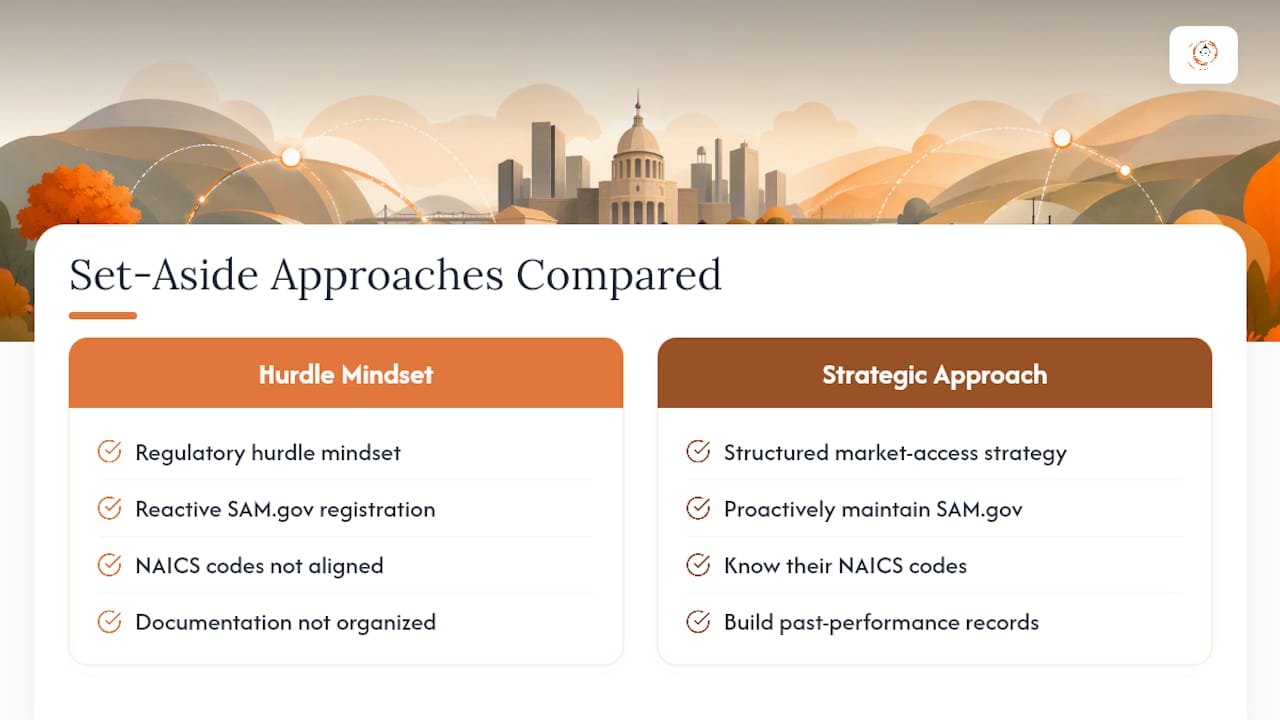
Most construction contractors approach set-aside contracting as a regulatory hurdle. That framing costs them money. The firms that grow through federal set-aside work treat it as a structured market access strategy: they know their NAICS codes, they maintain their SAM.gov registrations proactively, and they build past performance records that compound over time.
The regulatory detail in this article is not bureaucratic noise. It is the operating manual for a market that awards billions of dollars annually to small businesses, including construction contractors who know how to position themselves correctly. The 23% government-wide goal means agencies are actively looking for qualified small businesses to award work to. The contracting officers who administer these programs want to find capable small firms. The gap between opportunity and award is almost always an operational one: documentation not organized, NAICS codes not aligned, past performance not packaged.
Construction firms that invest in getting these fundamentals right before they bid consistently outperform those that try to assemble the documentation under deadline pressure. The checklist in this article is a starting point. For complex procurements, particularly those involving socioeconomic program eligibility, subcontracting plan requirements, or multi-agency vehicles, advisory support makes a measurable difference in both bid quality and award probability.
How R Construction Solutions LLC helps contractors win set-aside work
Federal set-aside contracting is one of the most structured paths to revenue growth available to small construction firms, and the difference between firms that win consistently and those that don’t usually comes down to preparation, not price. R Construction Solutions LLC delivers the operational infrastructure that makes that preparation possible.
The firm’s federal procurement consulting services are built specifically for construction contractors navigating SAM.gov registration, NAICS strategy, RFP preparation, and set-aside program eligibility. Rowena Tulacz brings more than 30 years of operations and business development experience in the construction industry, with direct expertise in FAR and DFARS compliance, bid preparation, and past performance positioning.
What R Construction Solutions LLC delivers for set-aside pursuits:
- SAM.gov registration review and NAICS code alignment
- Bid package review and federal proposal preparation support
- Subcontracting plan drafting and similarly situated subcontractor documentation
- Past performance packaging and narrative development
- Compliance checklist implementation for subcontracting limits and documentation requirements
- Training for contracting teams on set-aside procedures and file documentation
Ready to pursue set-aside work with a clear strategy and the right documentation in place? Contact R Construction Solutions LLC for a discovery conversation at rconstructionsolutions.com/construction-consulting-services.
Authoritative sources and further reading
Use these sources when documenting contracting decisions, preparing for audits, or researching program eligibility. Each serves a distinct purpose.
Regulatory and legal texts:
- FAR Part 19 — Small Business Programs: The complete regulatory text governing all small-business set-aside programs. Consult this for clause language, threshold figures, and procedural requirements. Updated continuously by the FAR Council.
- FAR Subpart 19.5 — Small Business Total Set-Asides, Partial Set-Asides, and Reserves: The operative section for total and partial set-asides, the Rule of Two, and clause insertion requirements. The primary citation for contracting officer file documentation.
SBA guidance and certification portals:
- SBA Set-Aside Procurement Guidance: Practical guidance for contracting officers on socioeconomic program priority, subcontracting limits, and the nonmanufacturer rule. Use this alongside FAR Part 19 when making program-level decisions.
- SAM.gov: Registration, representations, and certifications portal. Required for all firms competing on federal contracts. Contracting officers use it to verify size status before award. Update annually at minimum.
Data and policy analysis:
- FPDS — Federal Procurement Data System: Searchable database of all federal prime contract awards. Filter by set-aside type, NAICS code, agency, and fiscal year to quantify market opportunity and validate agency goal attainment.
- CRS Report R45576 — Small Business Contracting: Congressional Research Service analysis of the statutory basis, program history, and annual goal-setting for small-business contracting. Use for policy context and legislative history.
- CRS Overview of Small Business Contracting (EveryCRSReport): Updated CRS summary covering statutes, agency responsibilities, and recent procurement trends. Useful for briefings, training materials, and FOIA or audit responses.
- Fed-Spend: What Is a Set-Aside Contract?: Practitioner-level analysis of set-aside types, partial set-aside strategy, and award statistics. Useful for market practice context alongside the regulatory texts.
When documenting a contracting decision, cite FAR and CFR directly. When preparing for an audit or protest response, use FPDS data and SAM.gov records as contemporaneous evidence. For policy briefings or training, the CRS reports provide the statutory history and goal-attainment data that give regulatory rules their context.