
Project Commissioned: Your 30-90 Day Post-Award Playbook
When a project is commissioned, treat that moment as the contract’s official start, not a milestone to celebrate before shifting focus to the next bid. Lock the contract paperwork, verify insurance and bonds, open a job code, and put governance in place before the crew ever hits the site. The Cambridge Dictionary defines “commissioned” as work formally asked for by someone in authority, and that formal authorization triggers real obligations: notice windows, mobilization deadlines, and financial exposure that start ticking the day the award letter lands.
Your first 48 to 72 hours should include:
- Confirm the notice to proceed (NTP) or contract effective date in writing
- Verify insurance, builder’s risk coverage, and required bonds are active
- Create the job code in your accounting or ERP system immediately
- Confirm the mobilization budget with your commercial lead
- Flag every notice window (RFIs, differing site conditions) on a shared calendar
- Notify your PM, superintendent, and commercial lead, then schedule a 48-hour alignment meeting
Watch for early cost leakage in mobilization spending and long-lead orders placed before a job code exists.
Pro Tip: Open the job code before a single invoice hits your books. Startup costs charged to a general overhead account almost never make it back into project margin.
Key Takeaways
Protecting margin on a commissioned project depends on locking contract admin, assigning governance, and capturing startup costs within the first 72 hours of award.
| Point | Details |
|---|---|
| Lock contract admin early | Confirm the NTP date, insurance, and bonds before mobilization spending begins. |
| Assign governance fast | Name an executive sponsor, PM, and superintendent within 72 hours of award. |
| Capture costs immediately | Open a dedicated job code before any startup expense hits the books. |
| Document everything early | Log RFIs, differing site conditions, and notice windows the day they occur. |
| Get advisory support | R Construction Solutions LLC helps contractors build post-award governance and job-cost controls in the first 30 to 90 days. |
Table of Contents
- What Contractual and Administrative Steps Come First?
- Who Should Run the Project Once It’s Awarded?
- How Do You Mobilize a Commissioned Project on Time?
- How Do You Protect Margin from Day One?
- How Do You Prevent Claims Before They Happen?
- What Does a Complete Project Closeout Look Like?
- Which Tools Actually Speed Up a Post-Award Workflow?
- An Advisor’s View: Why the Award Moment Matters
- How R Construction Solutions LLC Supports You After Award
- Sources
What Contractual and Administrative Steps Come First?
Contract administration comes before anything else touches the ground. Confirm the contract’s effective date and any notice-to-proceed language that starts your clock for insurance, bonding, or submittal obligations, because missing that trigger date is the single most common way small contractors lose entitlement they never knew they had.
In the first 72 hours:
- Confirm builder’s risk and general liability coverage are bound and match contract exhibits.
- Secure and file performance and payment bonds with the owner or general contractor.
- Acknowledge receipt of every contract exhibit, drawing set, and specification section.
- Register the contract in your accounting and procurement systems under one job number.
In the first two weeks:
- Submit your submittal and shop-drawing log with dates tied to the baseline schedule.
- Baseline the project schedule and get it accepted by the owner’s representative.
- Log every contract notice window, including RFI deadlines and differing-site-condition notice periods, into a shared calendar visible to your PM and commercial lead.
- Confirm who signs what: submittals, pay applications, and change orders each need a named owner.
Contract type shapes how much of this risk sits with you. A lump-sum or GMP contract pushes cost risk toward the contractor, while unit-price and cost-plus arrangements shift more of it back to the owner. Know which one you signed before you plan your cash flow.
Pro Tip: Timestamp every notice-window entry with the date you received the triggering document, not the date you logged it. That distinction has decided more than one entitlement dispute.
Who Should Run the Project Once It’s Awarded?
Assign three names within 72 hours: an executive sponsor, a project manager, and a superintendent. Vague ownership at award is how small firms lose control of a job before the first load of material arrives.
- Executive sponsor: owns escalation, final change-order authority, and client relationship at the leadership level.
- Project manager: owns the schedule, budget, submittals, and RFI response times.
- Superintendent: owns field execution, safety, and daily coordination with subcontractors.
- Commercial lead: owns change-order intake and negotiates entitlement on every deviation from scope.
Run a 48-hour alignment meeting first, then settle into weekly internal huddles and biweekly client status calls. Every meeting should produce written minutes and any authorized change order needs a signature before work starts, not after. If you’re staffing up to handle a larger commissioned project, how you protect the firm when hiring a project manager matters as much as who you hire.
Pro Tip: Put your RACI chart on one page. If a deliverable has two owners listed, it has zero owners in practice.
How Do You Mobilize a Commissioned Project on Time?
Permits and long-lead procurement drive everything else, so start there before site logistics. A crew ready to work with no permit or no delivered equipment burns cash standing still.
Mobilization checklist:
- Confirm site access, temporary utilities, fencing, and signage requirements.
- Finalize your site-specific safety plan and confirm insurance endorsements match site conditions.
- Identify laydown areas and traffic control needs before subcontractors arrive.
- Order every long-lead item, HVAC equipment, specialty steel, custom fixtures, within the first 30 days.
- Hold a procurement contingency line for supply chain delays; don’t assume quoted lead times will hold.
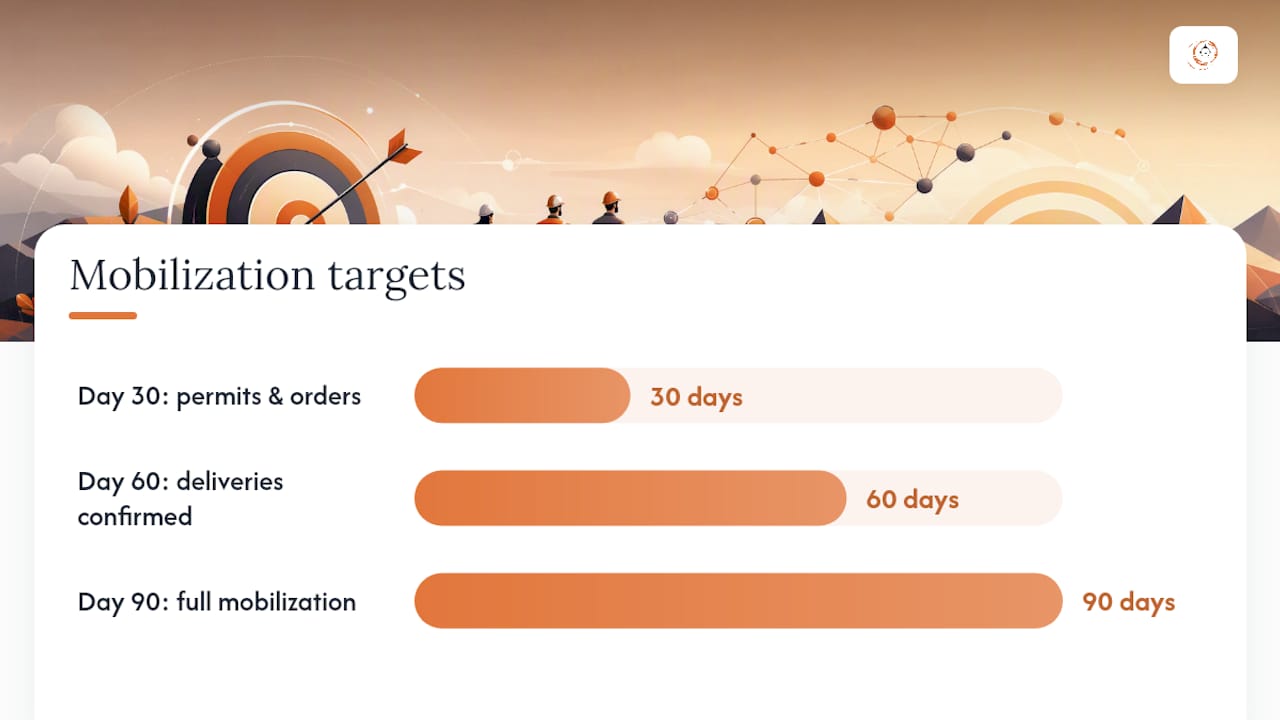
Your 30/60/90 day targets:
- By day 30: permits pulled, key subcontracts executed, long-lead orders placed.
- By day 60: major deliveries confirmed, critical-path work packages underway.
- By day 90: full field mobilization complete, all subcontractors sequenced against confirmed delivery dates.
Align subcontractor start dates with actual delivery windows. Bringing a trade crew on site before their materials arrive means paying for idle labor or, worse, demobilizing and remobilizing later at your own cost. A detailed scheduling checklist can help you build that sequencing discipline into your baseline schedule from day one.
Pro Tip: Order your longest lead-time item first, even before you’ve finalized every subcontract. A six-month delivery window doesn’t wait for your paperwork to catch up.
How Do You Protect Margin from Day One?
Set up a dedicated job code and cost buckets before any startup expense hits your books. Margin erosion on commissioned projects rarely comes from one bad decision; it comes from a hundred small costs that never got captured against the right job.
Job-cost setup steps:
- Create cost codes that mirror your estimate structure, not a generic chart of accounts.
- Map estimated costs to budget lines so variance shows up immediately.
- Enter every committed cost, subcontracts and purchase orders alike, as soon as they’re signed.
- Set a weekly or biweekly job-cost reporting cadence with your PM and commercial lead.
Small firms frequently miss this step, and delaying job code creation makes true profitability invisible until the project is nearly done, often overstating margin in early reports.
Cash-flow controls to put in place immediately:
- Forecast cash needs for the first 90 days, including mobilization reimbursements and long-lead deposits.
- Build your progress-billing schedule around actual milestone completion, not optimistic dates.
- Track retainage separately so it doesn’t distort your available cash picture.
Change-order discipline means one commercial owner negotiates entitlement, every change gets documented before work starts, and no field crew proceeds on a verbal “go ahead” alone. A minimal but enforced change-order workflow with standard submittal, costing, and signature steps stops informal scope creep before it starts.
Pro Tip: Add “standby equipment” and “mobilization reimbursement” as their own line items on your cash-flow watchlist. Both tend to hide inside general conditions until they’ve already cost you.
How Do You Prevent Claims Before They Happen?
Contemporaneous documentation preserves entitlement, so log conditions and decisions from the first day on site, not after a dispute starts brewing.
- Maintain a risk register with fields for description, owner, likelihood, impact, and mitigation status.
- Route every RFI through a rapid intake process with a defined response deadline, and tie each RFI to potential schedule or cost impact.
- Photograph differing site conditions immediately, with timestamps, and send written notice to the owner the same day.
- Keep a witness log for any verbal instruction that changes scope in the field.
If commissioning obligations, testing, startup attendance, or technical handover, aren’t clearly spelled out in your scope at award, you risk unplanned labor stretching well past substantial completion.
Pro Tip: Give field supervisors a one-page evidence checklist: photo, timestamp, written note, and RFI number. It takes two minutes and builds a claim file without slowing production.
What Does a Complete Project Closeout Look Like?
Plan closeout on day one, not in the final week, or final payment becomes a bottleneck instead of a formality.
- Assemble as-built drawings, O&M manuals, and warranty documentation as the work happens, not after.
- Track the punchlist with a named inspector, a verification step, and a documented sign-off condition.
- Collect final lien waivers and required certificates before submitting your final payment application.
- Fulfill any contract-defined handover obligations, including training and defect-remedy commitments, before calling the project complete.
Keep photos, test reports, and signed waivers organized so final payment milestones work in your favor, not against you.
Pro Tip: Use a simple folder structure, by phase and by trade, so your closeout package can go out the door in days, not weeks, when the owner asks for it.
Which Tools Actually Speed Up a Post-Award Workflow?
Automate the tasks you do most often and that carry the highest error cost: job-costing entries, change-order intake, and daily field logs.
- Accounting/ERP: the system where your job code lives and where committed costs get tracked in real time.
- Project management platforms: document control, RFI tracking, and submittal logs in one place.
- Scheduling software: ties your baseline schedule to actual field progress.
- Procurement/PO management: tracks long-lead orders against delivery commitments.
- Mobile field reporting: daily logs and photo documentation captured on site, not reconstructed later.
Automate job setup and cost capture first. Leave detailed QA sign-offs manual early on until your team trusts the new workflow.
Pro Tip: Invest first in the integration between your accounting system and your project management platform. That single connection eliminates more duplicate data entry than any other configuration change.
An Advisor’s View: Why the Award Moment Matters
The moment a project is commissioned is the exact point where a contracting firm has to stop competing and start delivering, and firms that treat it as a paperwork formality instead of an operational pivot are the ones who bleed margin in the first 90 days. Rowena Tulacz puts it directly:
“I’ve watched too many contractors win the job, then run it the same loose way they ran the bid. The award is where discipline has to start, not where it can wait.”
Pro Tip: The single fastest cultural shift you can make at award: name one commercial owner who has final say on cost and scope decisions, so nobody in the field is guessing who to call.
How R Construction Solutions LLC Supports You After Award
R Construction Solutions LLC is the advisory partner for contractors who want the first 90 days after a commissioned project locked down, not left to whoever has time to think about it between site visits. We help you stand up governance, configure job-cost systems, and build change-order workflows before startup costs start disappearing into the wrong accounts.

Our services map directly to what this playbook covers: post-award project setup, job-cost system configuration in platforms like Procore or Buildertrend, change-order workflow design, and mobilization planning engagements built around your actual contract terms, not a generic template. Whether you need a fixed-fee “post-award readiness” package or an ongoing advisory retainer, the goal is the same: protect the margin you priced into the bid.
Visit our Construction Consulting Services page to see how a post-award engagement works, and reach out to start a readiness review before your next award lands.
Sources
- EN - Section II: General Conditions of Contract — The parties’ obligations (Jus Mundi excerpt)
- commissioned adjective (WORK) — Cambridge Dictionary