
Prepare Your Business for a Consultant Engagement
A consultant engagement is a structured working relationship where an outside expert diagnoses your operational problems and delivers a defined set of solutions within an agreed timeframe. For construction business owners, knowing how to prepare your business for a consultant engagement separates firms that get measurable results from those that waste budget on vague conversations. The right preparation means defining your problem clearly, organizing your operational data, and aligning your team before the first meeting. Tools like project management software, documented workflows, and KPI dashboards give any consultant a running start. Rconstructionsolutions has seen firsthand how this upfront work determines whether an engagement drives real growth or stalls at discovery.
What are the critical prerequisites before engaging a consultant?
The single biggest mistake construction firms make is expecting consultants to discover internal processes on their own. Quality data upfront is the foundation of every high-value engagement. When you hand a consultant a clear picture of your current state, you eliminate weeks of billable discovery time and get to solutions faster.
Before your first meeting, work through this checklist:
- Define the business problem. Write a one-paragraph problem statement. “Our estimating process takes 12 hours per bid and we lose 40% of proposals” is specific. “We need help with operations” is not.
- Document your workflows. Map your core processes: estimating, scheduling, procurement, and billing. Use tools like Microsoft Visio, Lucidchart, or even a simple Word document with numbered steps.
- Pull your operational data. Gather at least 90 days of project cost reports, labor productivity records, and change order logs. If you use Procore, Buildertrend, or CoConstruct, export the relevant reports before the kickoff.
- Identify your stakeholders. Name the project owner, the internal point of contact, and any department leads who will interact with the consultant. Ambiguity about decision-making authority kills momentum.
- Set your business goals for consulting. Tie each goal to a number. “Reduce rework costs by 15% within six months” gives the consultant a target to work toward.
Pro Tip: Stage your engagement to reduce risk. Start with a limited block of hours, move to a fixed-fee project once you see results, then consider a retainer. This sequenced engagement model builds trust and protects your budget.
Assembling this information before the engagement starts is not extra work. It is the work that makes everything else faster and more precise.

How to structure your consultant kickoff meeting
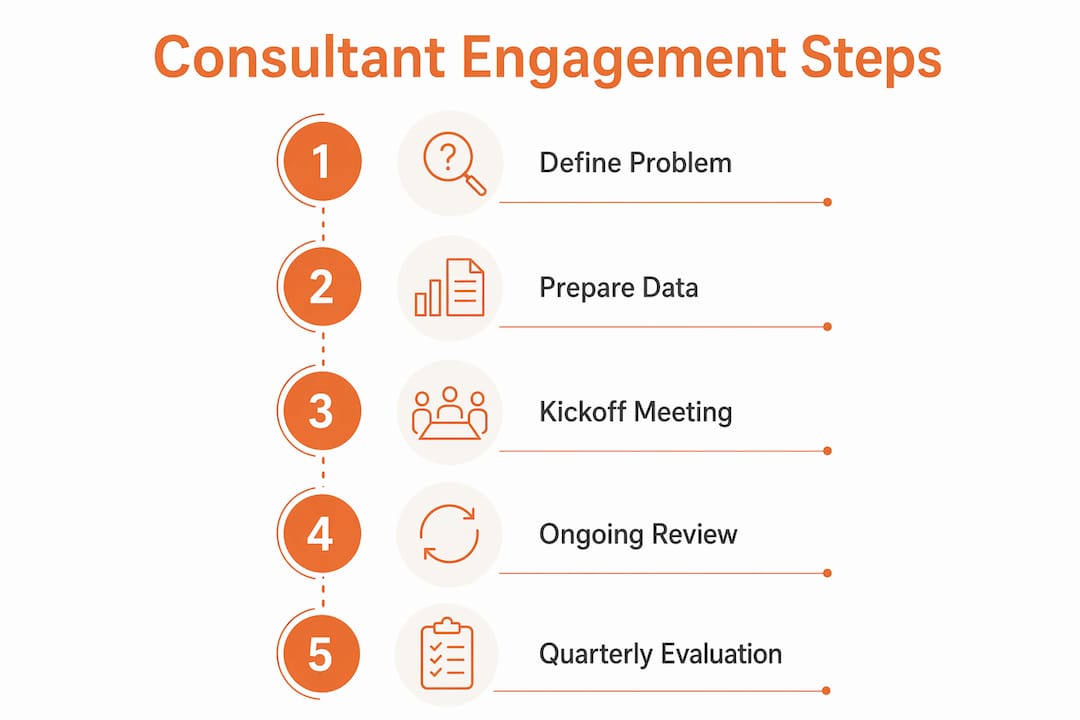
A well-run kickoff meeting sets the tone for the entire engagement. Industry best practice calls for a 60–90 minute session that covers alignment, co-created success planning, and milestone definitions. This is not a sales pitch recap. It is the moment where both sides agree on what success looks like.
Structure your kickoff in this order:
- Introductions and role clarity. Name every person in the room and define their decision-making authority. The consultant needs to know who can approve changes and who is an advisor only.
- Problem statement review. Read your written problem statement aloud. Ask the consultant to restate it in their own words. Gaps in understanding surface immediately.
- Co-create the success plan. Do not let the consultant hand you a pre-built plan. Build it together. Agree on three to five measurable outcomes and the timeline for each.
- Resource orientation. Walk the consultant through your software, your reporting tools, and your team structure. If you use Procore for project management or Sage 300 for accounting, show them where the data lives.
- Set communication norms. Agree on meeting frequency, reporting format, and response time expectations. Weekly check-ins work well for active engagements. Bi-weekly works for retainers.
- Define milestones and next steps. Close the meeting with a written list of who does what before the next session. Leave nothing verbal.
Pro Tip: Ask the consultant to send a written summary of the kickoff within 24 hours. If they cannot summarize the meeting clearly, that tells you something important about how they will communicate throughout the engagement.
The best consultants ask more questions than they answer in the early sessions. If your consultant arrives with all the answers before they have studied your business, treat that as a warning sign.
How to track progress and maintain accountability
Accountability does not happen automatically. You build it into the engagement structure from day one. Mandatory reviews every 15–20 consulting hours prevent vague conversations and keep both sides focused on outcomes rather than activity.
The most effective tracking structure for construction engagements uses three layers:
- Hourly accountability. After every 15–20 hours of consulting work, require a written report answering two questions: What changed? What decisions were made? This keeps the engagement from drifting.
- 30-day checkpoints. Review measurable outcomes against the success plan at the 30-day mark. Progress reports at 30 days increase the likelihood of a long-term partnership by 80%. That number reflects how much clarity early wins create for both sides.
- 90-day formal evaluation. Assess the full engagement against original KPIs. Document what worked, what did not, and what the next phase should address.
| Checkpoint | Frequency | Key Question |
|---|---|---|
| Hourly review | Every 15–20 hours | What changed and what was decided? |
| 30-day report | Monthly | Are measurable outcomes on track? |
| 90-day evaluation | Quarterly | Did the engagement deliver against KPIs? |
| Retainer review | Quarterly | Should scope or focus be adjusted? |
For retainer agreements, add a formal quarterly evaluation that reviews scope, budget, and relationship health. This protects you from paying for work that no longer matches your priorities. Rconstructionsolutions recommends tying every retainer renewal to documented outcomes, not just hours delivered.
Common pitfalls when engaging consultants and how to avoid them
Most failed consultant engagements share the same root causes. Knowing them in advance lets you build safeguards before they become problems.
- Skipping scope definition. A contract without defined deliverables is an open invoice. Specify what the consultant will produce, by when, and how you will measure it. Vague scope leads to scope creep and budget overruns.
- Misclassifying the relationship. Treating consultants like employees creates real tax and legal exposure. A contract alone does not protect you. The IRS and state labor boards look at behavioral control, financial control, and the type of relationship. Get legal advice before you structure the engagement.
- Skipping reference checks. Ask every consultant reference one specific question: “What did they get wrong, and how did they handle it?” That question reveals more about a consultant’s character and problem-solving ability than any success story will.
- Relying on resumes alone. Give candidates a real-world scenario from your business and ask them to walk through their analysis. Case scenario vetting exposes actual analytical skills that a polished resume cannot show. A consultant who struggles with your specific context during vetting will struggle during the engagement.
“Small issues snowball into big problems when scope is undefined. Lock down deliverables before you sign anything.”
For a deeper look at why specialists outperform generalists in construction, read why generic consultants fail construction firms. The pattern is consistent across firm sizes and project types.
Rowena’s take: slow down before you speed up
I have watched construction owners rush into consultant engagements the same way they rush a project start. They want solutions before the diagnosis is complete. That urgency is understandable. When your business is under pressure, waiting feels like losing ground.
Here is what I have learned after years of working with contractors: the firms that get the most from consulting are the ones that slow down at the front end. They spend real time writing out their problem statement. They pull their data before the first meeting. They ask hard questions during vetting instead of hiring the first consultant who sounds confident.
Effective consultants diagnose before they prescribe. They synthesize your data, ask uncomfortable questions, and build a roadmap grounded in your actual operations, not a template from a previous client. When you find a consultant who works that way, do not treat the relationship as purely transactional. The contractors I have seen scale from $5 million to $50 million did not just hire consultants. They built working relationships with people who understood their business deeply.
Culture fit matters more than most owners admit. A technically skilled consultant who communicates poorly or dismisses your team’s input will create more friction than value. Be honest about your boundaries, your communication style, and your decision-making process from day one. That transparency protects both sides and makes the work better.
When the contract ends, stay in contact. The best consulting relationships evolve into ongoing advisory partnerships. That continuity is where the real compounding value lives.
— Rowena
Ready to take the next step with Rconstructionsolutions?
Preparing for a consultant engagement is the most important investment you make before the work begins. Rconstructionsolutions brings over 30 years of hands-on construction experience to every engagement, working directly with general contractors and electrical contractors to improve workflows, reduce costs, and build the systems that support real growth.
Whether you are a mid-sized general contractor looking to scale or an electrical contractor working to tighten project delivery, Rconstructionsolutions offers specialized construction consulting built for your specific operational challenges. Services for general contractors and electrical contractors are available now. Schedule a consultation and bring the preparation work you have done in this guide to your first conversation.
Key takeaways
Preparing your construction business for a consultant engagement requires documented workflows, defined KPIs, and structured accountability checkpoints before and throughout the engagement.
| Point | Details |
|---|---|
| Define the problem first | Write a specific one-paragraph problem statement before the first consultant meeting. |
| Document workflows upfront | Provide current-state process maps so consultants skip discovery and start solving. |
| Structure the kickoff meeting | Use a 60–90 minute agenda to co-create the success plan and set communication norms. |
| Build in accountability checkpoints | Require written reports every 15–20 hours and formal reviews at 30 and 90 days. |
| Vet consultants with real scenarios | Use case-based vetting and reference questions to expose actual skills, not just credentials. |
FAQ
What does it mean to prepare your business for a consultant engagement?
Preparing your business means documenting workflows, defining measurable goals, and organizing operational data before the consultant starts. This upfront work eliminates wasted discovery time and focuses the engagement on solving real problems.
How do I structure a consultant kickoff meeting?
A structured kickoff runs 60–90 minutes and covers role introductions, a co-created success plan, resource orientation, communication norms, and defined milestones. Both sides should leave with a written list of next steps.
What is a consultant readiness checklist for construction firms?
A consultant readiness checklist includes a written problem statement, 90 days of operational data, documented process maps, named stakeholders, and measurable business goals tied to specific numbers.
How often should I review progress during a consulting engagement?
Require a written accountability report every 15–20 consulting hours, a formal 30-day checkpoint against KPIs, and a full 90-day evaluation. For retainer agreements, add a quarterly scope and relationship review.
What legal risks come with hiring a consultant?
Misclassifying a consultant as an employee creates tax and legal liability. A contract alone does not protect you. Structure the relationship carefully and consult legal counsel to confirm the engagement meets IRS and state labor board standards for independent contractor classification.