Contractors: Schedule Linked Material Procurement Workflows
A material procurement workflow is the defined sequence a company follows to identify, order, receive, and pay for the materials a project needs, with clear ownership at every handoff. Done right, it means fewer emergency buys, fewer crews standing idle waiting on delivery trucks, and materials that pass QA/QC before they ever reach a payment approval. The rest of this guide breaks that sequence into stages, controls, and a rollout plan you can put to work this quarter.
TL;DR:
- Most procurement failures stem from overlooked schedule-critical items or rushed receiving processes that can cause costly delays or disputes.
- Implementing a structured workflow with clear ownership, from requisition to payment, reduces the risk of skipping vital controls like inventory verification and three-way matching.
- Automating schedule-driven requisitions, RFQ comparison, and delivery tracking can cut procurement errors by nearly half and improve project timing.
- Linking procurement activities directly to the project schedule, especially for high-risk, long-lead items, helps prevent schedule delays and last-minute emergency purchases.
- Rolling out a phased, incremental procurement process, focusing on process standardization and schedule integration, yields better cost control and fewer material shortages.
Table of Contents
- What Are the Steps in a Material Procurement Workflow?
- Which Procurement Workflow Fits Which Material?
- What Controls Keep a Procurement Workflow From Breaking Down?
- How Much Can Automation Improve a Procurement Workflow?
- How Do You Link Procurement to the Project Schedule?
- Why Do Procurement Workflows Break Down?
- How Do You Roll Out a New Procurement Workflow?
- Why Procurement Deserves a Seat at the Strategy Table
- Get Help Building a Procurement Workflow That Holds Up Under Schedule Pressure
- Sources
- FAQ
What Are the Steps in a Material Procurement Workflow?
A construction buyout process runs through six distinct stages, and each one has a natural owner and a deadline that, if missed, tends to cascade into the next. Treat this as the skeleton of your procurement process management system, not an aspirational chart nobody follows.
- Requisition. A project engineer or superintendent identifies a material need, usually pulled from the Bill of Quantities (BoQ) or a schedule look-ahead. The SLA here should be tight, typically within a couple of days from identified need to submitted requisition, because delays at this first gate quietly eat into every downstream lead time.
- Approval. A project manager or procurement lead reviews the requisition against budget and schedule. Acceptance criteria should include a check against approved specifications and confirmation the item ties to an active schedule activity, not just a general “we’ll need this eventually” note.
- Supplier selection. For repeat materials, this pulls from an approved vendor list. For anything new or high value, it triggers an RFQ process with at least two or three competitive quotes. This stage is where material sourcing strategies either save money or quietly cost it, depending on whether buyers default to the fastest vendor or the best-fit one.
- Purchase order issuance. The PO locks in price, quantity, delivery date, and specification. It should reference the submittal package number for anything requiring shop drawings or samples, which keeps procurement lead times visible against the CPM schedule rather than tracked in a separate spreadsheet nobody checks.
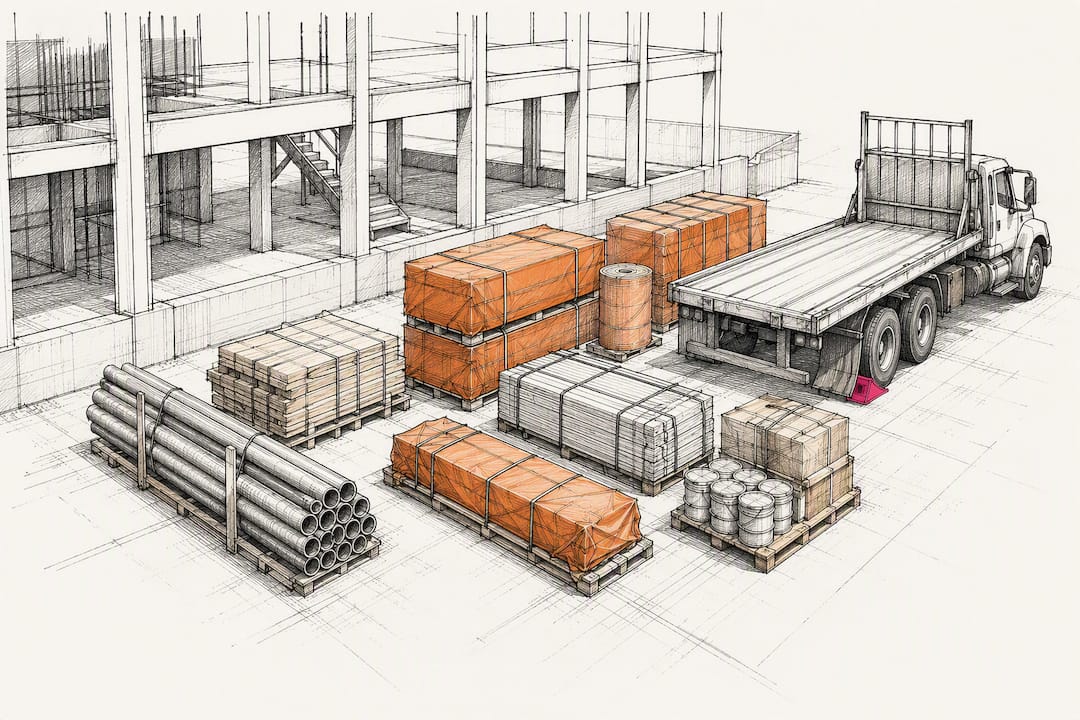
- Delivery and receiving. Materials arrive, get inspected against the PO and submittal, and get logged into inventory. This is the most commonly rushed stage, and it is where mismatched quantities, damaged goods, and wrong specifications get caught, or missed.
- Invoice and payment. Accounts payable matches the invoice against the PO and the receiving record before releasing payment. Skip this match and you are paying for materials nobody confirmed actually arrived correctly.
The gate that gets skipped most often is receiving. Crews under schedule pressure sign for a delivery without counting pallets or checking specs against the submittal, and that gap surfaces three weeks later as a change order dispute. A structured five-part framework covering input, purchasing, tracking, data management, and feedback gives smaller firms a way to formalize these gates without needing enterprise software on day one.
Which Procurement Workflow Fits Which Material?
Not every purchase deserves the same level of process. Applying a six-week strategic sourcing workflow to a box of fasteners wastes time; applying a same-day emergency workflow to a custom curtain wall system invites disaster. Match the workflow type to the risk profile of the material.
- Simple/routine workflow: Low value, short lead time, readily available from multiple suppliers. Think fasteners, standard lumber, or common PVC fittings. Use a standing approved vendor list and a low approval threshold.
- Strategic/planned workflow: High value, long lead time, or schedule critical. Custom windows, structural steel, specialty mechanical equipment, and anything requiring submittals fall here. This workflow needs early requisition, competitive bidding, and active expediting once the PO is issued.
- Emergency/reactive workflow: Unplanned need, usually from a design change, damaged material, or a missed requisition. This workflow trades cost efficiency for speed, often paying premium pricing or expedited freight to protect the schedule.
The decision criteria come down to four questions: How long is the lead time? How schedule critical is the install date? How much is at stake financially? And how much technical risk exists in the specification? A material that scores high on any two of those four belongs in the strategic lane, not the simple one.
What Controls Keep a Procurement Workflow From Breaking Down?
Every strong workflow rests on a handful of controls that catch problems before they become expensive. Skip these and you are running procurement on hope.
- Submittal priority tiers. Not every submittal deserves the same urgency. A recommended practice from AACE International calls for tying submittal priority directly to schedule float, tracking the whole procurement sequence inside the CPM network rather than as a side process.
- Approved vendor lists and scorecards. Track suppliers against on-time delivery rate, defect rate, and responsiveness. A vendor scorecard that only gets updated after a failure is not a scorecard, it is a complaint log.
- PO structure and receiving records. Every PO should specify quantity, unit price, delivery window, and reference the relevant submittal number. Goods receipt notes (GRNs) then get matched against both the PO and the invoice.
- Three-way matching. This control holds payment until the PO, the receiving record, and the invoice all agree on quantity and price, which is one of the more reliable defenses against both billing errors and outright fraud, according to Bill.
Pro Tip: Build your submittal tracker and your CPM schedule so they read off the same float numbers. If a submittal’s approval deadline and its schedule float live in two different systems, someone eventually trusts the wrong one.
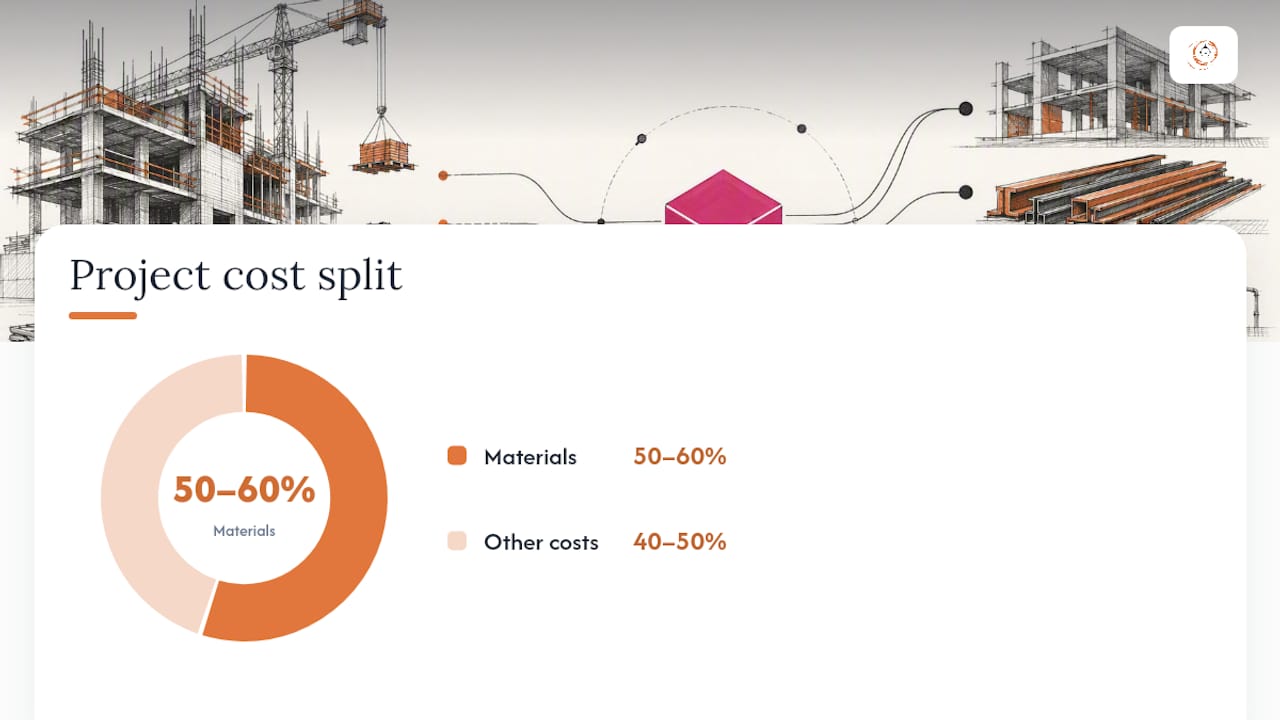
Materials typically account for 50 to 60 percent of total construction project costs, which is exactly why small process failures at the PO or receiving stage translate into outsized budget hits. QA/QC at delivery should never be optional, even under schedule pressure. Confirm quantity, inspect for damage, and verify the delivered item matches the approved submittal before signing anything, and before the invoice ever reaches accounts payable. A pre-contract and delivery verification checklist is a useful reference if your receiving process still runs on memory rather than a documented checklist.
How Much Can Automation Improve a Procurement Workflow?
Automation works best when it is applied to the parts of procurement that are repetitive and rule based, not the parts requiring judgment. Schedule-driven requisitions are the highest-value starting point: link your CPM schedule to your procurement system so that a material tied to an activity starting in six weeks automatically triggers a requisition alert instead of waiting on someone to remember.
- Schedule-driven requisitions and PO automation. Set a rule where any material tagged to a schedule activity generates a draft requisition a fixed number of days ahead of need, scaled to that item’s known lead time.
- Automated RFQ distribution and bid comparison. Send RFQs to your approved vendor pool simultaneously and pull quotes into a standard comparison format rather than juggling separate emails and PDFs.
- Delivery tracking. Automated status pings from suppliers or freight partners flag delays before they become surprises on-site.
- AP automation with three-way matching. Route invoices automatically for matching against POs and GRNs, holding exceptions for manual review instead of manual review on every single invoice.
Automating the takeoff-to-PO sequence, connecting estimating, scheduling, supplier confirmation, and delivery verification into one flow, reduces procurement errors by 30 to 45 percent in firms that have made the switch. High-performing contractors tend to automate at four distinct levels, forecasting, bidding, approval, and tracking, with schedule integration producing the largest measurable gain of the four.
Pro Tip: Automate the approval and tracking layers before you automate bidding. Bidding still benefits from human judgment on vendor relationships; approval routing and delivery tracking rarely do.
If your estimating and procurement systems still operate in isolation, an integrated estimating workflow that carries takeoff quantities straight into your requisition process is worth building before layering on more automation elsewhere.
How Do You Link Procurement to the Project Schedule?
Every material with a lead time longer than the float on its related schedule activity is a live threat to your completion date. That is not an exaggeration. Procurement needs to be built into the schedule and the BoQ starting at the design phase, because material deliveries directly affect the critical path far more often than most project teams assume until it happens to them.
Here is how R Construction Solutions LLC recommends clients set this up:
- Tag every long-lead item to its schedule activity and calculate the float. Anything with float under 10 working days gets flagged as high priority automatically.
- Set submittal priority in three tiers. High priority (low float or critical path items) gets weekly check-ins. Medium priority gets biweekly reviews. Low priority gets a standard monthly cadence.
- Build an expediting protocol for high-priority items. This includes factory acceptance testing (FAT) where applicable, fabrication progress tracking at defined milestones, and a pre-shipment QA check before the item ever leaves the vendor’s dock.
- Assign a named owner for schedule scans. Someone should review the procurement log against the live CPM schedule at least weekly, not just at monthly project meetings.
Expediting, the proactive tracking of fabrication and shipment status paired with QA/QC at receipt, is arguably the most consequential phase after a PO is issued, because this is where problems still have time to get fixed before they hit the site.
Pro Tip: Give your lowest-float, highest-risk items their own expedited administrative track, separate from routine procurement, so a single overloaded buyer never becomes the bottleneck for the item most likely to delay your project.
Why Do Procurement Workflows Break Down?
Most procurement failures are predictable, which means most are preventable if you know what to watch for.
- Reactive buying. Requisitions submitted after the need is already urgent, forcing emergency pricing and rush freight.
- Missing or late submittals. Nobody flagged the item as schedule critical, so it sat in a general queue until float ran out.
- No backup suppliers. A single vendor relationship for a critical material means one supplier problem becomes your problem.
- Receiving gaps. Deliveries signed for without a real quantity or spec check, discovered only when installation starts.
- Invoice mismatches. Payments released without confirming the PO, GRN, and invoice actually agree.
The fastest diagnostic is to trace a single failed delivery backward through all six workflow stages and identify exactly where the breakdown occurred, rather than assuming it was “a supplier problem” by default. Corrective action should target the process gap, not just the specific incident: if a submittal was missed because nobody linked it to schedule float, fix the linkage system, not just that one submittal.
How Do You Roll Out a New Procurement Workflow?
A phased rollout beats a full system overhaul, especially for a contractor still running procurement out of spreadsheets and email threads.
- Weeks 1 to 4: Standardize requisition and PO templates, formalize your approved vendor list, and build a receiving checklist every crew actually uses.
- Months 1 to 3: Connect procurement to your scheduling software and prioritize automating the approval routing and delivery tracking rules described earlier.
- Months 3 to 6: Add vendor scorecards, consolidate purchasing data across projects, and start using historical lead-time data to set smarter requisition triggers.
- Ongoing: Track cycle time, emergency purchase rate, and invoice mismatch rate monthly, and report those metrics at the same cadence as your schedule reviews.
Firms that adopt structured frameworks incrementally, rather than all at once, report meaningful reductions in order-processing time and material waste, which supports starting small and building outward instead of waiting for a perfect system.
Why Procurement Deserves a Seat at the Strategy Table
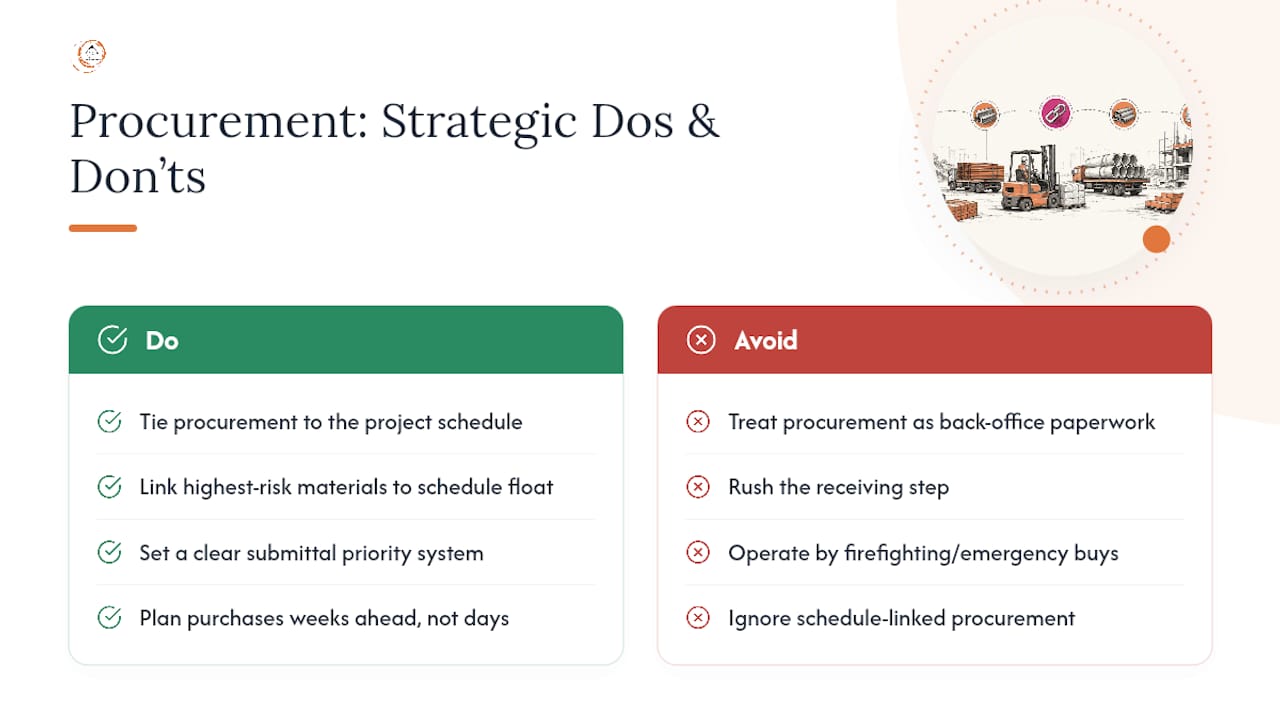
Procurement gets treated as back-office paperwork more often than it should, and that habit costs contractors real money. Across three decades of watching construction operations from the business side, I’ve seen the same pattern repeat: firms that finally tie procurement to their schedule stop firefighting and start planning purchases weeks ahead instead of days ahead.
Two things stand out from client engagements. First, the firms with the fewest emergency buys are never the biggest firms, they are the ones with the clearest submittal priority system. Second, invoice disputes almost always trace back to a receiving step that got rushed weeks earlier. If you take one step from this article, link your highest-risk materials to schedule float this month.
— Rowena Tulacz
Get Help Building a Procurement Workflow That Holds Up Under Schedule Pressure
Most contractors do not need new software first, they need a procurement process that actually connects to their schedule, their estimating, and their vendor relationships. R Construction Solutions LLC works directly with growth-stage contracting firms on exactly that gap, through process improvement and workflow optimization engagements built around the operational realities of running a mid-sized contracting business.

Clients who tighten their buyout process report faster turnaround from bid to award, fewer emergency material purchases, and estimating accuracy that holds up once a project moves into execution. If your team is managing multiple material suppliers and needs a stronger vendor framework, R Construction Solutions LLC’s support for contractors working with material suppliers covers sourcing strategy and vendor relationship structure. For firms ready to formalize estimating, scheduling, and procurement into one coordinated system, construction consulting services is the place to start. Reach out and describe where your current procurement process breaks down, and the next conversation can focus on fixing that specific gap.
Sources
For deeper technical grounding, review AACE International’s recommended practice on procurement tracking and submittal priority, and see construction consulting services for implementation support.
- Recommended practice: procurement tracking guidance — AACE International (TOC_88R-15)
- Automate construction material ordering, delivery tracking, and verification — US Tech Automations
- Material procurement optimization in construction — Appit Software (2025)
FAQ
What Is the Material Procurement Process?
It is the structured sequence a construction company uses to identify, source, order, receive, and pay for project materials, moving through requisition, approval, supplier selection, purchase order issuance, delivery and receiving, and invoice payment.
What Are the Five Stages of the Procurement Process?
Most frameworks describe five to six stages: requisition, approval, supplier selection, purchase order issuance, delivery and receiving, and invoice/payment, with some models combining the final two into one closeout stage.
How Does Procurement Connect to the Project Schedule?
Long-lead materials with float shorter than their lead time directly threaten the critical path, which is why procurement tracking should live inside the CPM schedule rather than in a separate system.
What Is Three-Way Matching in Procurement?
Three-way matching compares the purchase order, the goods receipt note, and the vendor invoice before releasing payment, catching quantity or price mismatches before money changes hands.
Can R Construction Solutions LLC Help Implement a Procurement Workflow?
Yes. R Construction Solutions LLC provides process improvement and workflow optimization consulting for contracting firms looking to formalize their procurement stages, submittal tracking, and vendor management systems.
Recommended
- How to Streamline Small Construction Project Scheduling
- Construction Workflow Optimization: A 2026 Guide for Contractors
- 9 Types of Construction Workflow Bottlenecks Killing Schedules
- From Chaos to Coordination: Process Improvement for Construction
Running the job and the business at the same time? One short email a week — change orders, billing, job costing, scheduling. Free, no pitch. Subscribe.
Free and unconditional. No call required, no obligation, unsubscribe anytime.