
Joint Venture Bids in Construction: What to Lock Down First
A joint venture makes sense when your bonding capacity, specialty mix, or local presence can’t cover a project alone. It stops making sense the moment partners start negotiating terms after the bid is already submitted. If you’re weighing joint venture construction bids teams file every year, the verdict is simple: pursue the JV only if you can check these boxes before the bid deadline, not after.
Before you submit, confirm:
- The solicitation explicitly permits joint venture bidders and specifies any required JV declaration forms.
- You have a signed term sheet, or better, a completed JV agreement, establishing the JV name-style your bid will use.
- Bonding and insurance capacity is confirmed in writing by your surety or broker.
- Every partner’s licenses and business registrations are current in the project’s jurisdiction.
- Scope split and participation percentages are documented, not just discussed.
Assign ownership now: one partner negotiates surety terms, one drives the legal document set, and one owns the bid form itself.
Key Takeaways
A joint venture bid succeeds when partners document participation, governance, and bonding terms in writing before the bid goes out, not after the award.
| Point | Details |
|---|---|
| Confirm JV eligibility first | Read the solicitation for explicit JV permission and any required declaration forms before committing pursuit resources. |
| Choose the right JV model | Conventional JVs pool profit and liability; item JVs split scope and payment by partner. |
| Negotiate clauses before bidding | Lock participation percentage, governance, capital calls, and dispute resolution in writing pre-submission. |
| Run real partner diligence | Check financials, claims history, safety record, and estimating compatibility before committing. |
| Plan the exit up front | Define buyout mechanics and bonding release procedures before a partner ever needs to leave. |
Table of Contents
- Types of Construction Joint Ventures and What They Mean for Risk
- When Does a Joint Venture Make Sense for a Bid?
- How Do You Review a Solicitation Before Pursuing a JV Bid?
- Forming the JV Entity and Registering With the State
- Which JV-Agreement Clauses Matter Most Before You Bid?
- What Due Diligence Should You Run on a Potential JV Partner?
- How Do You Prepare and Submit a Joint Venture Bid?
- Managing the Joint Venture After Award
- Handling Change Orders and Contract Amendments Within the JV
- Payment Distribution and Financial Management After Contract Award
- Exit Strategies and Dissolution Procedures
- Real-World Examples: What Separates a Successful JV Bid From a Failed One
- Where Rowena Tulacz Sees Joint Ventures Go Wrong
- Where to Go Next for Templates and Guidance
- Get Help Structuring Your Next JV Bid
- Sources
Types of Construction Joint Ventures and What They Mean for Risk
Construction JVs generally take one of two forms, and the choice shapes everything from your accounting to your bonding exposure.
A conventional (integrated) JV pools resources completely. Partners share profits, losses, and on-site management responsibility according to an agreed participation formula, and both firms are on the hook for the entire project’s performance. A line-item (item) JV works differently: partners split the contract into distinct scopes, each retaining its own profit, loss, and payment stream for the piece it performs. This structure, described in Virginia Tech’s construction contracting materials, keeps accounting cleaner but still leaves both firms named on the same bid.
The practical difference shows up fast:
- Conventional JVs require a shared bank account, combined cost coding, and joint bonding capacity, since the surety underwrites the whole project as one entity.
- Item JVs allow each partner to bond and insure its own scope, but the owner still typically treats the JV as jointly and severally liable for the full contract.
- Accounting complexity runs higher in conventional structures because every invoice, change order, and payroll entry has to be allocated by participation percentage rather than by scope.
When Does a Joint Venture Make Sense for a Bid?
A JV earns its complexity when at least one of these triggers is real, not aspirational.
Opportunity triggers:
- Your bonding limit falls short of the project size, but a partner’s combined capacity clears it.
- The scope spans disciplines you don’t carry in house (structural plus mechanical, for example).
- The owner favors bidders with local presence or a specific certification you lack.
- The project is large enough that a single-firm bid carries unacceptable balance-sheet risk.
Partner-fit criteria worth checking before you commit: bonding history, past performance on comparable work, estimating methodology, and whether your two teams can actually work side by side without friction. A partner with a compatible cost model but a thin safety record is still a risk you’re importing.
If none of these triggers apply, a straight subcontract or a teaming agreement without a formal JV entity usually gets you the same result with less legal overhead.
Pro Tip: Run the numbers on bonding capacity before you fall in love with a partner. A perfect cultural fit with insufficient surety backing still leaves you unable to bid.
How Do You Review a Solicitation Before Pursuing a JV Bid?
Before committing pursuit dollars, work through this sequence:
- Confirm JV eligibility. Read the solicitation language for explicit permission to bid as a joint venture, and collect any owner-specific JV forms. Public agencies often require a formal declaration; the Illinois Department of Transportation’s joint venture guidance requires a declaration listing participation percentages, which the agency uses to debit each partner’s bonding capacity and confirm eligibility.
- Verify licensing and registration. Check contractor licensing requirements for the project’s state, and confirm whether the JV entity itself, not just the individual partners, needs to register or foreign-qualify.
- Lock down bonding. Identify which partner’s surety will issue the bid bond and the performance and payment bonds, and get written confirmation of capacity before you spend more time on the estimate.
- Catalog disclosures and signature authority. Bid documents often specify exactly how a JV bidder must sign and what supporting disclosures (ownership structure, prior JV experience, financial statements) are required.
- Map the timeline. Note pre-bid meeting dates, statement-of-qualifications deadlines, and the final bid submission date, then work backward to when the JV agreement needs to be finalized.
Skipping step one is the most common unforced error. Teams spend weeks negotiating a JV structure only to discover the solicitation requires a single prime bidder. Our guide on public construction contract compliance covers the broader procurement rules that often sit behind these requirements.
Forming the JV Entity and Registering With the State
Two structural options dominate: an unincorporated joint venture governed purely by contract, or a project-specific LLC. The unincorporated route is faster to stand up and avoids a separate tax entity, but it offers less liability separation. A project LLC creates cleaner liability boundaries and often satisfies owner requirements more directly, though it adds filing fees and annual compliance obligations.
Either way, forming a JV entity in the United States typically means filing formation documents with the Secretary of State in the entity’s home state, and the JV will usually need to foreign-qualify in any additional state where it performs work, according to Chambers’ 2025 U.S. joint ventures practice guide. The JV agreement itself doesn’t get filed anywhere; it’s a private contract that governs how the partners actually operate.
- Entity formation can happen in days.
- Negotiating the actual JV agreement, the document that governs money, control, and risk, takes considerably longer.
Loop in your accountant early. Tax treatment, payroll setup, and how each partner reports JV income differ depending on whether you’ve formed an LLC or an unincorporated venture, and unwinding a bad choice after award is expensive. Our licensing requirements checklist is a useful companion document here.
Which JV-Agreement Clauses Matter Most Before You Bid?
The agreement is where most future disputes get prevented or created. Negotiate these clauses before the bid goes out the door, not after.
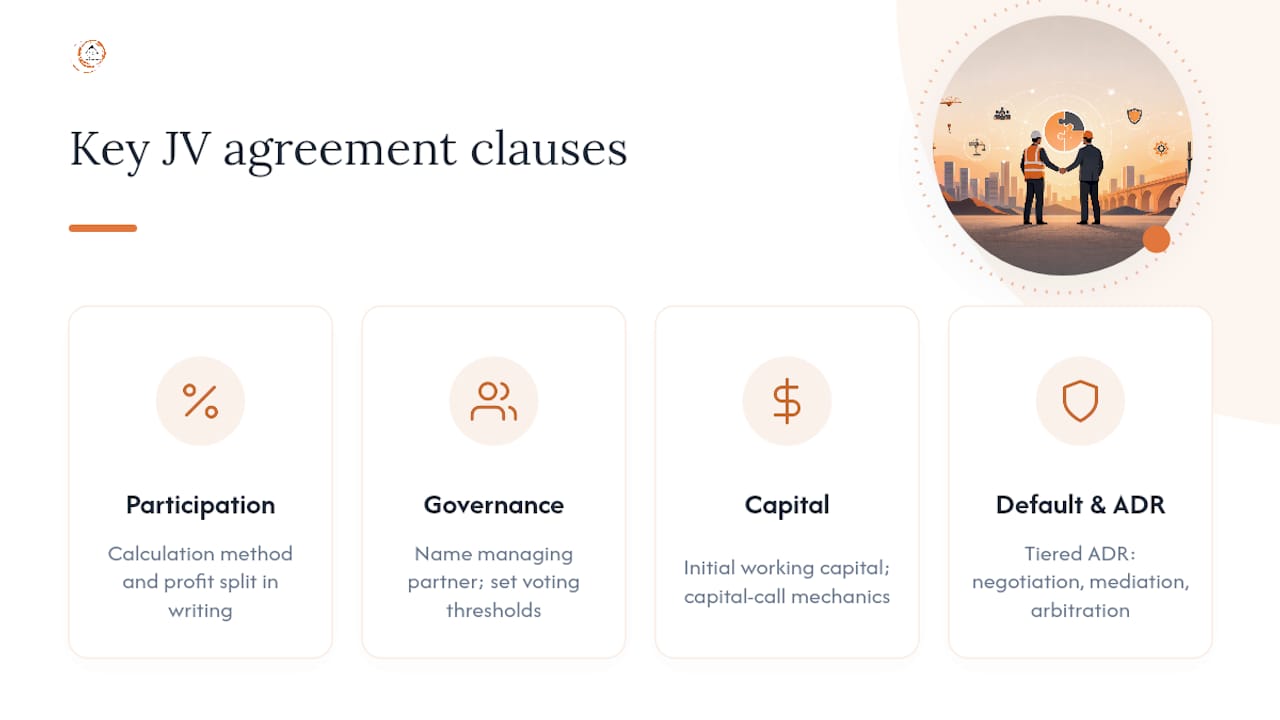
Participation percentage. This number drives profit split, capital contribution, and often bonding capacity reporting to the owner. Get the calculation method in writing, not just the final percentage.
Governance. Name a managing partner, define voting thresholds for major decisions, and specify who can approve change orders or schedule shifts without a full partner vote. Ambiguity here is the single most common source of mid-project gridlock.
Capital structure. Spell out initial working capital, the mechanics of any capital call if costs run over, and limits on distributions before the project reaches substantial completion.
Accounting and tax reporting. A joint bank account, defined invoicing rules, and a cost-allocation method that both partners’ controllers can actually reconcile against.
Bonding and insurance. Document who provides the bond, how co-surety arrangements work if both partners’ sureties participate, and what indemnity language protects each partner if the other underperforms.
Default and dispute resolution. Build in a tiered process, direct negotiation, then mediation, then arbitration, before litigation, plus clear buyout or clawback mechanics if a partner defaults.
ConsensusDocs 499, a standardized design-build joint venture agreement, covers most of these categories directly, including financing, insurance, bonding, and dispute resolution tailored to design-build work. If your structure is an LLC rather than an unincorporated JV, ConsensusDocs 299 provides the equivalent operating agreement framework, addressing ownership interests, management structure, and remedies.
Pro Tip: Draft the governance and default clauses as if the relationship will fail, because a meaningful share of JVs eventually test them. Optimistic drafting here is the expensive kind.
What Due Diligence Should You Run on a Potential JV Partner?
Treat partner selection with the same rigor you’d apply to underwriting a major subcontractor.
- Financial checks: request recent financial statements, surety references, and current backlog against burn rate.
- Claims history: ask directly about pending litigation, change-order disputes, and how the firm has historically handled payment friction with owners.
- Safety and staffing: review safety records and check whether key field managers have stayed with the firm or turned over recently.
- Estimating compatibility: compare cost models. A partner who estimates loosely on general conditions will create friction the moment the JV starts allocating shared costs.
- Reference validation: call the references directly and ask for a sample of how the firm has performed against schedule on a comparable contract, not just a testimonial.
A meaningful share of joint venture breakdowns trace back to a single root cause: partners never converted their assumptions about authority and resource contribution into documented rules, so when a real decision point hit, both sides assumed they were in charge. Our contractor business assessment guide walks through the financial side of this diligence in more depth.
How Do You Prepare and Submit a Joint Venture Bid?
Submission mechanics trip up otherwise well-prepared JVs more often than the underlying agreement does.
- Identify the bidder correctly. Use the exact JV name-style specified in your formation documents (for example, “Partner A and Partner B, a Joint Venture”), and confirm which individuals hold signature authority on behalf of the combined entity.
- Assemble bonding documentation. Get the bid bond and any required surety letters in the correct format, issued in the JV’s name where required, and confirm delivery timing against the bid deadline, not the day before.
- Attach required supporting documents. Most solicitations expect the JV agreement or a JV letter, scope-of-work exhibits showing each partner’s responsibilities, current licenses, and financial statements for both partners.
- Choose delivery method deliberately. Whether the solicitation requires electronic or paper delivery, build in time to double-check every signature block and form number against the bid documents before submission.
- Confirm receipt. Public owners in particular often require a confirmation step. Don’t assume silence means success. Our bid automation best practices guide covers workflow tools that reduce these last-mile errors.
Managing the Joint Venture After Award
Award day starts the clock on a different set of priorities. Confirm your bonds and insurance are issued in final form, get subcontracts moving, and open the JV bank account if you haven’t already, since payment delays at this stage cascade into everything downstream.
Governance needs to shift from planning mode to execution mode immediately:
- Appoint a single project manager with clear authority, even if governance remains shared at the ownership level.
- Set a reporting cadence, weekly at minimum on active jobs, so both partners see the same cost and schedule data.
- Lock change-order approval authority to specific individuals rather than leaving it open to whoever’s on-site that day.
Pro Tip: Set up an internal early-warning review, a short monthly check where both partners flag cost or schedule concerns before they become disputes. It costs an hour and prevents most of the expensive conflicts.
Cash flow controls matter just as much as field controls: agree on draw schedules and retention handling in writing during the first project meeting, not after the first disputed invoice.

Handling Change Orders and Contract Amendments Within the JV
Change orders are where JV governance gets tested in real time, and the agreement should have already answered the hard questions before the first one arrives. Who can approve a change order under a certain dollar threshold without full partner sign-off? How does the added scope or cost flow through the participation formula, does it split by the original percentage, or does the partner who caused the change absorb more of it?
Document a clear approval chain: field-level change requests go to the project manager, moderate-value changes require both partners’ sign-off, and anything that shifts the overall contract value materially triggers a formal amendment to the JV agreement itself, not just the owner contract. Keep a running log that ties every change order back to which partner’s scope it affects, since this becomes essential when reconciling final participation percentages at closeout.
Amendments to the underlying JV agreement, as opposed to the owner contract, should require unanimous written consent regardless of participation split. A 60/40 JV where the 60% partner can unilaterally amend the governing agreement isn’t really a partnership; it’s a subordination dressed up as one. Build the amendment process into the original agreement rather than negotiating it under pressure mid-project, when one partner has more leverage because the other has already committed labor and equipment to the job.
Payment Distribution and Financial Management After Contract Award
Owner payments typically flow into the joint JV bank account first, then get distributed according to the participation formula, minus any agreed reserve for shared costs like bonding premiums or joint insurance. This is where the accounting distinction between conventional and item JVs matters most in practice. Conventional JVs allocate every payment by participation percentage regardless of which partner performed the work that period; item JVs pay each partner directly for its completed scope, with the shared account handling only truly joint costs.
Retention handling needs explicit rules. If the owner withholds 5% or 10% until substantial completion, the JV agreement should specify whether that retention gets held in the joint account or tracked separately by partner, so nobody’s cash flow gets squeezed by the other partner’s retention exposure.
Set invoicing rules early: who submits the pay application to the owner, how quickly funds move from the joint account to each partner after receipt, and what happens if one partner’s subcontractor payments lag behind schedule. A partner sitting on shared funds while their own payables slip is one of the fastest ways to poison a JV relationship, even when the underlying work is going fine.
Exit Strategies and Dissolution Procedures
Every JV agreement needs a clear end date and an equally clear process for what happens if a partner needs out before that date arrives.
Early exit is the harder scenario, and it’s the one most agreements handle poorly. Build in buyout mechanics: how a departing partner’s interest gets valued, whether the remaining partner has a right of first refusal, and how ongoing liability, particularly joint-and-several bonding obligations, gets addressed if one partner leaves before the surety releases its bonds. A partner can’t simply walk away from bonding exposure by exiting the JV on paper; sureties typically require formal release or replacement backing.
Default triggers deserve their own dissolution path separate from a clean exit. If one partner fails to meet capital calls or abandons its scope, the agreement should specify remedies short of full dissolution, cure periods, remedy through the other partner stepping in and adjusting participation percentages, before either side moves to terminate.
Real-World Examples: What Separates a Successful JV Bid From a Failed One
Successful joint venture bids tend to share a common trait: the partners resolved their hardest governance questions, who has final say on major decisions, how disputes escalate, before the bid ever went out. A JV pursuing a transportation project that needed both bonding capacity beyond either firm’s individual limit and specialized structural expertise succeeded because the partners had documented their participation formula and change-order authority in a signed agreement weeks before the bid deadline, leaving the bid preparation period free for estimating rather than partner negotiation.
Failed JV bids tend to share the opposite pattern. Two firms rushed a teaming arrangement together days before a deadline, relying on a verbal understanding of scope split rather than a documented agreement. Once awarded, disagreement over who controlled subcontractor selection stalled the project for weeks, and the dispute ultimately required legal intervention to resolve, the kind of outcome that damages both firms’ standing with the owner regardless of who was technically right. The lesson holds across both scenarios: bid-stage documentation discipline predicts post-award performance far more reliably than partner reputation alone.
Where Rowena Tulacz Sees Joint Ventures Go Wrong
Most JV failures aren’t legal failures. They’re documentation failures dressed up as legal disputes. Two firms shake hands on a scope split, assume they understand each other’s authority, and skip the step of writing it down before the bid goes out.
The fix is not more legal paper. It’s earlier legal paper. Use a short term sheet to lock the core deal points, participation percentage, governance structure, capital call triggers, before you spend weeks on full agreement language. That term sheet becomes your negotiating anchor and prevents the slow drift where one partner assumes more authority than the other intended to grant.
Set up a simple internal management committee from day one, even for a two-partner JV. Bring in surety counsel the moment bonding capacity becomes a question, and involve your accountant before you pick an entity structure, not after. The firms that treat these as sequencing decisions, not afterthoughts, are the ones that make it to project closeout without a dispute.
— Rowena Tulacz
Where to Go Next for Templates and Guidance
Start with ConsensusDocs 499 for design-build JV structures and ConsensusDocs 299 for LLC-based agreements. Review your state DOT’s JV declaration requirements, modeled on Illinois DOT’s guidance, before bidding public work. For governance frameworks beyond construction, strategic partnership guidance offers useful background reading.
Get Help Structuring Your Next JV Bid
Reading a checklist is one thing. Negotiating participation percentages against a partner who has more bonding leverage than you, on a two-week deadline, is another. R Construction Solutions LLC works directly with growth-stage contractors on estimating support, bid preparation, and the operational structure behind joint venture pursuits, including how to position your firm for federal and public procurement opportunities that require this kind of partnership. If your next opportunity depends on getting the JV structure right the first time, our construction consulting services team can walk through your specific bid before you commit resources you can’t easily unwind.
Sources
- Joint ventures 2025 — USA (Chambers Practice Guides)
- 10. Joint–Venture Agreements – Construction Contracting (Virginia Tech Pressbooks)
- Joint Venture Agreement - 499 (ConsensusDocs)
- Joint Venture - Illinois Department of Transportation