
Consulting Retainers for Contractors: A 2026 Strategy Guide | R. Construction Solutions
A consulting retainer is defined as a fixed, recurring fee a client pays upfront to secure a contractor’s ongoing services or prioritized access over a set period. Understanding what does consulting retainer mean for contractors is the difference between unpredictable project income and a stable, planned revenue stream. A retainer agreement typically runs on monthly or quarterly billing cycles, with the client paying before work begins each cycle. This model differs fundamentally from hourly or project-based billing because it reserves your capacity, not just your time.
What does a consulting retainer mean for contractors?
A consulting retainer is a recurring contract with a fixed fee paid upfront, giving the client ongoing access to your services or a defined set of deliverables each billing cycle. The fee is not a deposit. It is payment for guaranteed availability, expertise, or output during that period. Unused hours may roll over to the next cycle or expire, depending on what the contract specifies. Overages, meaning work beyond the agreed scope, require separate approval and billing.

The consulting retainer definition matters most when you are moving away from one-off project bids. A retainer formalizes the ongoing relationship, sets clear expectations, and protects both sides from misunderstandings. For contractors in construction, this could mean a client pays a monthly fee for ongoing project management support, scheduling reviews, or estimating assistance. The arrangement works because both parties know exactly what is included before the cycle starts.
What types of consulting retainers exist and how do they differ?
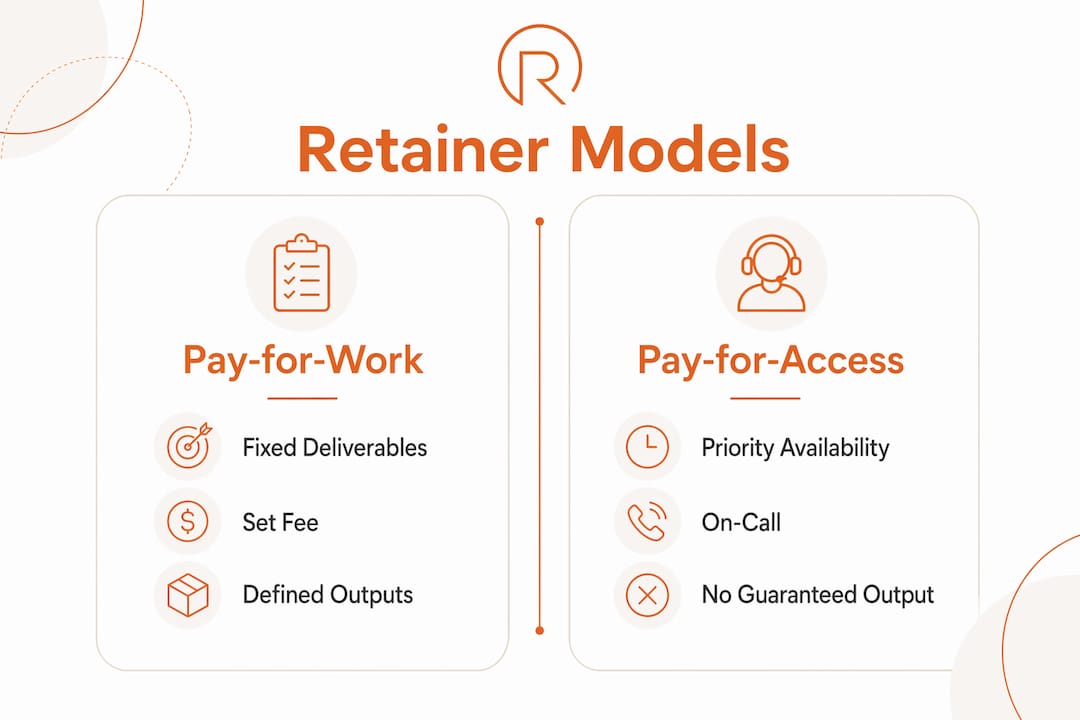
Retainers fall into two primary models, and knowing the difference protects you from agreeing to the wrong one.
Pay-for-work retainers specify fixed deliverables each period. The client pays a set fee and receives defined outputs, such as two site assessments, one scheduling update, or a monthly KPI report. The scope is concrete and measurable.
Pay-for-access retainers sell priority availability. The client pays to have you on call, but there are no guaranteed outputs. You respond to requests within an agreed timeframe, and the fee covers your reserved capacity rather than specific products.
Hybrid retainers combine both elements. A contractor might deliver one defined report per month while also remaining available for ad hoc questions up to a set number of hours.
| Retainer Type | What the Client Pays For | Key Risk |
|---|---|---|
| Pay-for-work | Fixed deliverables per cycle | Under-delivery if scope is vague |
| Pay-for-access | Priority availability, no fixed output | Over-delivery if hours are uncapped |
| Hybrid | Deliverables plus reserved availability | Scope creep across both elements |
Most contractor retainer agreements also address three operational details:
- Unused hours: Do they roll over, expire, or convert to credit?
- Overages: What is the billing rate when the client exceeds the agreed scope?
- Service levels: How quickly must you respond to requests?
Pro Tip: Always state in writing whether unused hours expire at cycle end. Rollover hours accumulate fast and can create an unmanageable backlog of client expectations.
Contractors who understand consulting services available to them are better positioned to choose the right retainer model for each client relationship.
How does a consulting retainer benefit contractors?
Retainer fees for contractors deliver four concrete advantages that project-based billing cannot match.
- Predictable cash flow. You invoice at the start of each cycle and receive payment before work begins. This removes the feast-or-famine income pattern common in construction contracting.
- Capacity planning. Knowing which clients have reserved your time lets you schedule crews, subcontractors, and your own hours with confidence. You stop overbooking and undercharging.
- Stronger client relationships. Regular, ongoing contact builds trust faster than one-off engagements. Clients who pay retainers tend to treat you as a partner rather than a vendor.
- Reduced administrative work. One recurring invoice replaces multiple project proposals, change orders, and billing disputes. The retainer model cuts the overhead of constant re-selling.
Retainers also give you a foundation for growth. Rconstructionsolutions has worked with mid-sized construction firms scaling from $5 million to $50 million, and consistent retainer income is a common factor in that trajectory. Predictable revenue lets you invest in staff, technology, and process improvements without waiting for the next project to close.
Common challenges with consulting retainers and how contractors can manage them
Retainers bring real risks if you do not manage them actively. The most common failure mode is scope creep: the client expects unlimited work for a fixed fee because the contract never defined a cap.
Here are the four most frequent problems and how to address each one:
-
Uncapped scope. Without explicit hour or deliverable limits, clients assume the retainer covers everything. Explicit caps on hours or deliverables are the single most effective way to prevent this. Write the cap into the contract before signing.
-
Vague agreements. Most retainer disputes come from unclear scope. Concrete deliverables and explicit exclusions reduce friction more than any other contract element. List what is included and, just as importantly, what is not.
-
No intake process. When clients can send requests at any time through any channel, work piles up without structure. A structured intake workflow keeps requests organized, prioritized, and within scope. Use a simple form or project management tool to log every request.
-
Untracked effort. If you do not track actual time spent against the retainer fee, you cannot tell whether the arrangement is profitable. Tracking actual effort against retainer fees informs renewal pricing and scope adjustments at the end of each cycle.
Pro Tip: Review your retainer scope every 90 days. If actual hours consistently exceed the agreed amount, adjust the fee at renewal rather than absorbing the loss.
Managing remote or distributed client relationships adds another layer of complexity. Best practices for remote construction management apply directly to retainer intake and communication workflows.
How to structure and negotiate a contractor retainer agreement effectively
A well-written contractor retainer agreement protects your income and your independence. Every agreement should cover these core elements:
- Scope of services: List specific tasks included and explicitly exclude everything else.
- Deliverables or hours: State exactly what the client receives each cycle.
- Billing cycle and advance payment: Retainer fees are billed in advance at the start of each cycle. Do not begin work until payment clears.
- Overage rates: Define the hourly or per-deliverable rate for work beyond the agreed scope.
- Unused hour policy: State whether unused time expires, rolls over, or converts to a credit.
- Notice and termination: Include a minimum notice period, typically 30 days, for either party to exit the agreement.
| Contract Element | Why It Matters |
|---|---|
| Scope and exclusions | Prevents unlimited work expectations |
| Advance billing | Protects cash flow from the first cycle |
| Overage rate | Compensates extra effort fairly |
| Unused hour policy | Avoids accumulated backlog |
| Termination clause | Gives both parties a clean exit |
One element contractors frequently overlook is independent contractor status. A retainer is not an employment contract. The IRS applies behavioral and financial control tests to determine worker classification, and the label “contractor” alone does not determine status. Maintaining contractor independence in both contract language and daily operations keeps you on the right side of IRS classification rules. That means you set your own schedule, use your own tools, and retain the right to work with other clients.
Pro Tip: Include a clause confirming your independent contractor status in every retainer agreement. One paragraph now prevents a costly misclassification dispute later.
Contractors who are new to consulting relationships benefit from reviewing questions to ask a construction consultant before drafting their first retainer.
Examples of consulting retainers in contractor and construction contexts
Retainers are not abstract finance concepts. They show up in real construction workflows every week.
- Ongoing project management support. A general contractor pays a consulting firm a monthly retainer for weekly schedule reviews, subcontractor coordination support, and monthly progress reporting. The deliverables are fixed, the billing is automatic, and both sides know what to expect.
- Specialized expertise on call. A mid-sized electrical contractor retains a compliance consultant for a set number of hours per month. The consultant answers code questions, reviews submittals, and flags regulatory changes. This is a pay-for-access model: the client buys priority availability, not a fixed output.
- Estimating and workflow support. A residential contractor retains a consulting firm for monthly estimating reviews and process audits. Rconstructionsolutions structures this type of engagement to help firms reduce bid errors and improve margin tracking over time.
- Fluctuating workload management. During peak season, a commercial contractor increases retainer hours to cover additional scheduling and procurement support. During slower months, the base retainer covers lighter advisory work. A hybrid retainer with defined base deliverables and optional add-on hours handles this well.
Contractors who want to understand how retainers fit into a broader consulting strategy can review why contractors hire outside consultants for context on when external expertise delivers the most value.
Key takeaways
A consulting retainer gives contractors predictable income and reserved capacity, but only when the agreement defines scope, caps, billing terms, and contractor independence in writing.
| Point | Details |
|---|---|
| Retainer definition | A fixed, recurring fee paid upfront for ongoing services or prioritized access each billing cycle. |
| Two core models | Pay-for-work delivers fixed outputs; pay-for-access sells reserved availability without guaranteed deliverables. |
| Scope caps are non-negotiable | Explicit hour or deliverable limits prevent clients from expecting unlimited work for a flat fee. |
| Advance billing protects cash flow | Invoice at cycle start and do not begin work until payment clears. |
| Track effort at every cycle | Comparing actual hours to retainer fees reveals whether pricing is sustainable before renewal. |
What I have learned from managing retainers in construction consulting
After years of working with contractors across residential and commercial projects, the pattern I see most often is this: contractors undervalue their time when they first set a retainer fee, then absorb the loss quietly until the relationship becomes unsustainable.
The fix is not a higher fee. The fix is better tracking. When you log actual hours against each retainer client every week, you see the margin erosion before it becomes a problem. You have real data at renewal time instead of a gut feeling.
The second lesson is about communication. Clients on retainer feel entitled to more access than the contract specifies, not because they are unreasonable, but because the boundaries were never made explicit. A short onboarding call at the start of each retainer, where you walk through the scope, the intake process, and the overage policy, prevents most disputes before they start.
The third lesson is harder to accept: not every client is a good retainer client. Some clients need the flexibility of project-based billing. Forcing a retainer structure onto a client who only needs you twice a year creates friction on both sides. The best retainer relationships are with clients who have consistent, recurring needs and who respect your time as a reserved resource.
Retainers work when both parties treat them as a partnership, not a subscription. Review the value delivered at every renewal. Adjust scope and fees when the work changes. The contractors I have seen grow the fastest are the ones who treat their retainer portfolio as a business asset, not just a billing method.
— Rowena
Rconstructionsolutions offers retainer-based consulting for contractors

Rconstructionsolutions provides construction consulting services structured as ongoing retainer engagements for both residential and commercial contractors. With over 30 years of hands-on construction experience, the team builds retainer agreements around your actual workflows, not generic templates. Contractors working with Rconstructionsolutions get defined scope, clear deliverables, and direct access to specialists in estimating, scheduling, and operational efficiency. If you are ready to replace unpredictable project income with a structured consulting arrangement that supports long-term growth, the team at Rconstructionsolutions is built for exactly that kind of work.
FAQ
What is a consulting retainer in simple terms?
A consulting retainer is a fixed fee a client pays upfront each billing cycle to secure a contractor’s ongoing services or availability. The fee is paid before work begins, and the contract defines exactly what is included.
How do retainer fees for contractors differ from hourly billing?
Retainer fees cover a set scope or reserved availability for an entire billing period, while hourly billing charges only for time actually worked. Retainers give contractors predictable income; hourly billing ties revenue directly to hours logged.
What should a contractor retainer agreement always include?
Every contractor retainer agreement should define the scope of services, deliverables or hour caps, billing cycle, overage rates, unused hour policy, and a termination notice period. Well-written agreements also specify explicit exclusions to prevent scope disputes.
Can a retainer affect a contractor’s independent contractor status?
Yes. The IRS uses behavioral and financial control tests to classify workers, and a retainer that gives the client too much control over how and when you work can trigger misclassification risk. Documenting your contractor independence in the contract and in daily practice protects your status.
How do contractors prevent scope creep on a retainer?
Set explicit hour or deliverable caps in the contract, use a structured intake process for all client requests, and track actual effort against the retainer fee every cycle. Reviewing scope at each renewal prevents small overages from becoming permanent unpaid work.