
Construction Pay Application: Get Paid Before Year-End
It is 4:45 on billing day. The office manager has the G702 open, the PM is on a site walk and not answering, and three subcontractors still have not sent their pay apps. The schedule of values in the spreadsheet no longer matches the one the architect approved, because a change order was added as a new line in one place and folded into an existing line in another. The pay app goes out a day late. Ten days later it comes back with red initials on four lines and a request for stored materials backup.
On a monthly cycle, a pay app that misses the owner's review window often slides a full month. In November and December it is worse: owners are closing their books, approvers are on vacation, and lenders want everything clean before year-end.
This guide covers the monthly construction pay application itself: what gets one approved on the first pass, what gets one kicked back, and how to set up December billing so the cash lands before the holidays.
Table of Contents
Why Construction Pay Applications Stall
Most pay apps are not rejected because the work was not done. They are rejected because the paperwork does not let the reviewer confirm it.
The most common rejection reasons
The schedule of values changed without approval. Lines were split, renamed or re-priced after the baseline was accepted.
Change orders billed before they were executed.
Percent complete that does not match the site. The reviewer walked the project last week and the drywall line says 80 percent when it looks like 50.
Stored materials without backup.
Retainage math errors, or a reduction applied that nobody approved.
Missing or wrong lien waivers.
G702 and G703 do not reconcile.
AIA's own guidance on completing the G702 lists "changing G702 totals without reconciling the supporting G703 line items" as a common mistake. Every item above is a process problem, not a construction problem, which means it can be fixed in the office.
Why a rejection costs more than the delay
Under the AIA A201 framework, the architect can certify less than the amount requested. Per AIA's instructions, the architect then initials each changed figure on the G702 and G703, attaches an explanation, and forwards the forms to the owner. Your cash forecast is now wrong, and next month starts from a number you did not choose.
Anatomy of a Clean G702 and G703
AIA describes the G702 as both the contractor's application and the architect's certificate for payment. When the architect signs, that signature "certifies to the owner that a payment in the amount indicated is due." The G703 continuation sheet breaks the contract sum into portions of the work, following your schedule of values.
The G702 summary lines
Original contract sum
Net change by change orders
Contract sum to date
Total completed and stored to date (column G on the G703)
Retainage
Total earned less retainage
Less previous certificates for payment
Current payment due
Balance to finish, including retainage
The pre-submission tie-out
The G703 tracks each line across columns: scheduled value, work completed from the previous application, this period, materials presently stored, total to date, percent complete, balance to finish, and retainage where the rate varies by line. Reviewers read across every row and down every column. AIA's tip: "use the latest finalized payment application as your starting point." Never start from a draft. Before sending, confirm:
Line 4 equals the total of column G.
Line 7 equals prior certified amounts, not prior requested amounts.
Column D on every row equals last month's approved D plus E.
Only executed change orders appear on line 2.
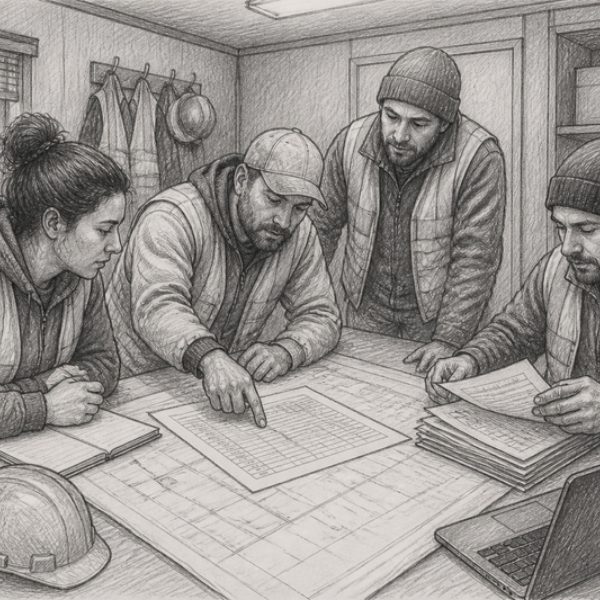
Schedule of Values, Stored Materials and Retainage
Build the schedule of values to be billed
AIA notes it does not publish a standard schedule of values form; the contractor prepares it under the general conditions. One line for "Electrical" invites arguments about percent complete. Tie lines to measurable pieces of work and, ideally, to your cost codes, so billing and job cost tell the same story. Our guide to cost code structure for construction covers that alignment.
Keep change orders as their own lines so the reviewer can still see the original scope. For how changes should move to executed paper, see our change order workflow.
Stored materials: bring the proof
Stored materials get the most scrutiny because the owner is paying for something not yet installed. Your contract controls what is allowed. As a strict benchmark, the federal clause FAR 52.232-5 lets off-site material count only if the contract specifically authorizes it and the contractor shows it has acquired title and the material will be used on that contract. Have ready:
The supplier invoice, matched to the G703 line
Dated photos of the material
For off-site storage, location, insurance and any bill of sale your contract requires
A log so stored materials move to "completed" when installed, not billed twice
Retainage: get the rate right on every line
AIA's guidance says "retainage requirements come from the contract documents" and may be affected by applicable law. Before each application, confirm the rate, which work it applies to, and whether any reduction was approved in writing.
The law is moving, too. In California, SB 61 added Civil Code section 8811, which caps retention on private works contracts entered into on or after January 1, 2026 at 5 percent of each payment and 5 percent of the contract price, with the limit flowing down to subcontracts. There are exceptions, including certain residential projects of four stories or fewer that are not mixed-use. California public works carry a similar 5 percent cap under Public Contract Code section 7201. Releasing retainage at the end of a job is its own process, covered in our closeout checklist.
Lien Waivers That Do Not Hold Up the Check
A single missing sub waiver can hold up an entire draw. California is a useful model because it uses statutory forms. The Contractors State License Board explains that a waiver is not binding unless the claimant signs and delivers it, and the form must follow "substantially" one of the four statutory forms in Civil Code sections 8132, 8134, 8136 and 8138.
Waiver type | When to use it | What it means for your pay app |
|---|---|---|
Conditional, progress | This period's payment not yet received | Send with the current pay app; effective only when payment clears |
Unconditional, progress | Prior period's payment received | Often required with the next pay app as proof money flowed through |
Conditional, final | Final payment not yet received | Part of the closeout package |
Unconditional, final | Final payment received | Signed only after the money is in hand |
A waiver routine that works
Collect conditional waivers with sub pay apps, not after yours goes out.
Track last month's unconditional waivers on the same log, by vendor and amount.
Match waiver amounts to amounts actually paid.
Never sign an unconditional waiver for money you have not received.
If waivers live in five inboxes and a shared drive, that is a document control problem. Our guide to document control in construction shows how to fix it.
Know Your Payment Clock
California private works, as an example
Owner to direct contractor: Civil Code section 8800 requires payment of an undisputed progress payment within 30 days after notice demanding payment under the contract, unless otherwise agreed in writing. In a good-faith dispute, the owner may withhold up to 150 percent of the disputed amount. Wrongful withholding carries a 2 percent per month penalty.
Contractor to subcontractor: Business and Professions Code section 7108.5 requires payment within seven days of receiving each progress payment, unless otherwise agreed in writing, with the same 150 percent dispute limit and 2 percent monthly penalty.
Federal work, as a contrast
Under FAR 52.232-27, federal construction progress payments are due 14 days after the billing office receives a proper payment request, and an improper request must be returned within seven days with the reasons. Private work follows the same lesson: the clock starts when a complete application arrives.
A Year-End Pay App Calendar
Early November
Ask every owner or owner's rep for their December cutoff in writing.
Confirm who approves while the usual reviewer is on vacation.
Push to execute every pending change order before the November pay app.
Late November
Move your sub and supplier December deadline up to match the owner's.
Walk the project with the PM and agree on percent complete line by line.
Gather stored materials backup now.
Billing week
Draft the G703 from the last approved application, then tie out the G702.
Send a pencil draft to the architect or owner's rep if they will look at one.
Attach conditional waivers and last period's unconditional waivers.
Submit early and get written confirmation of receipt.
After submission
Follow up on day three, not day twenty.
If the architect certifies a lower amount, fix your billing record so January starts clean.
What I've Seen Inside Contractor Shops
In 30+ years in construction operations, I have watched the same scene in a lot of offices. Billing day arrives and the pay app is treated like a form to fill out instead of a process that started three weeks earlier. The office manager chases the PM, the PM chases subs, and nobody has looked at the stored materials invoices.
The shops that get paid on time are the ones where the pay app has an owner, a calendar and a checklist. The PM and the office agree on percent complete before anyone types a number. Change orders are executed before they are billed. Waivers come in with sub pay apps, every month.
I have also seen what a pencil draft does. When the office sends the architect a draft a few days early and asks, "anything here you would question?", the formal application goes through clean far more often.
AI is earning a place here, too. An AI assistant can compare this month's G703 against last month's approved version, flag lines where column D does not carry forward, and check every waiver against a payment. It does not replace the PM's judgment on percent complete, but it takes the tedious tie-out off the office manager's desk at 4:45 on billing day.
Profit is earned on the project, but it is collected in the office, which is why steady billing is part of improving project profitability.
A Practical Next Step
Pull the last three pay apps on your two largest jobs. Which lines did the reviewer change, what backup was requested, and how many days passed between submission and payment? That pattern shows where your process leaks.
If you want a second set of eyes on your billing before the December crunch, schedule a free call or reach us at (408) 404-5792. To trade notes with other contractor owners and office staff, The Trailer community is open at skool.com/the-trailer-rcs.
Sources
AIA Contract Documents: Summary, G702-1992 Application and Certificate for Payment
AIA Contract Documents: How to Complete the G702 Payment Application
California CSLB: Conditional and Unconditional Waiver and Release Forms
FAR 52.232-5, Payments under Fixed-Price Construction Contracts
FAQ
What is a construction pay application?
It is the contractor's monthly request for payment based on work completed and materials stored. On AIA-based projects it usually includes the G702 summary, which doubles as the architect's certificate for payment, and the G703 continuation sheet with schedule of values lines.
Why do pay applications get rejected?
Common reasons include an unapproved schedule of values change, unexecuted change orders billed as work, percent complete that does not match the site, missing stored materials backup, retainage errors, missing lien waivers, and G702 totals that do not reconcile with the G703.
What is the difference between a conditional and unconditional lien waiver?
A conditional waiver is used before payment is received and takes effect only once payment is made. An unconditional waiver is used after payment has been received. California requires waivers to substantially follow the statutory forms in Civil Code sections 8132 through 8138.
How should contractors handle December billing?
Confirm each owner's December cutoff in writing by early November, execute pending change orders, move sub deadlines earlier, agree on percent complete with the PM before drafting, and submit early with written confirmation of receipt.
How much retainage can be withheld in California?
For private works contracts entered into on or after January 1, 2026, Civil Code section 8811 caps retention at 5 percent of each payment and of the contract price, with exceptions. Public works have a similar cap under Public Contract Code section 7201.