Contractors: 8 Phase Closeout Checklist to Release Retainage Faster
Construction closeout is the formal handover when contractual, inspection, and documentation requirements are met so the owner can occupy the building and contractors receive final payment. A successful closeout means owner acceptance, a Certificate of Occupancy where required, retainage release, and a complete turnover package the owner’s facilities team can actually use. The contractors who get paid fastest start this work weeks before the last punch item is closed, not after.
TL;DR:
- Confirm subcontractor documentation deadlines early and build in a 30-day lead time to prevent delays in final project approval.
- Accurately record the substantial completion date in writing to avoid liability issues related to warranties and legal deadlines.
- Tie the release of retainage and final payments strictly to complete, searchable documentation; incomplete packages delay cash flow.
- Organize the turnover package in a consistent digital format with clear folder structure, metadata, and file naming to facilitate owner accessibility.
- Start closeout planning at project kickoff by tracking deliverables throughout construction to reduce delays and accelerate final payment receipt.
Table of Contents
- What Are the Ordered Phases of the Construction Closeout Process?
- What Documents Are Required for Construction Closeout Sign-Off?
- What Happens at Substantial Completion, and Why Does the Date Matter?
- How Do You Run Punch Lists and Final Inspections Without Delays?
- How Do You Build and Deliver the Owner’s Turnover Package?
- What Financial Steps Release Retainage and Final Payment?
- Who Owns What During Closeout? A Responsibility Breakdown
- Why Should You Start Closeout Planning at Project Kickoff?
- Advisor Workflows and Templates You Can Adapt Now
- Why Disciplined Closeout Protects Profit and Reputation
- How R Construction Solutions LLC Supports Closeout Readiness
- Sources
What Are the Ordered Phases of the Construction Closeout Process?
Closeout is not one event. It is a sequence of eight overlapping phases, and skipping the order almost always costs you time on the back end. Procore’s breakdown of the closeout process identifies eight general activities that map closely to how experienced project managers actually run this phase in the field, and missing documentation at any step is a frequent cause of withheld final payment.
Here is the roadmap in the order it should happen:
- Pre-closeout planning. Confirm the closeout checklist, deliverable owners, and submission deadlines with the owner and architect/engineer before substantial completion is even in sight.
- Notice of Substantial Completion. The contractor requests an inspection, and the architect issues the notice once the project is usable for its intended purpose, even if minor items remain.
- Punch list generation. Owner, architect, and contractor walk the project together and document every outstanding item against the contract documents.
- Final inspections. The authority having jurisdiction (AHJ) verifies code compliance and issues sign-offs tied to occupancy.
- Commissioning and training. Building systems get tested under real operating conditions, and facilities staff receive hands-on training on equipment they will maintain.
- Turnover. The complete documentation package moves from contractor to owner in its final, organized form.
- Financial closeout. Final payment applications, lien waivers, and retainage release get processed.
- Archiving. Copies of the full closeout package get stored per contract and company retention policy.
Each phase transition has a trigger, not a calendar date. Substantial completion triggers the punch list. Punch list closure triggers final inspection requests. Final inspection approval triggers the Certificate of Occupancy, which in turn triggers the countdown on financial closeout. On a typical commercial project, that entire sequence runs anywhere from four to twelve weeks depending on project size and how early documentation collection started.
Use this sequencing checklist at your weekly closeout meetings:
- Confirm which deliverables are overdue against the original submittal schedule.
- Track punch list items by trade, with assigned closure dates.
- Verify inspection requests are scheduled, not just “pending.”
- Cross-check O&M manual delivery against the commissioning schedule, since training sessions depend on manuals being final.
- Flag any subcontractor who has not confirmed lien waiver format in writing.
The biggest scheduling mistake project managers make is treating turnover as a single week-long sprint at the end. Every phase after substantial completion runs faster when the paperwork for it started during construction, not after.
What Documents Are Required for Construction Closeout Sign-Off?
The owner and AHJ cannot formally accept a project until a defined set of deliverables lands in their hands, in a format they can actually search and store. Essential closeout deliverables include as-built drawings, operations and maintenance (O&M) manuals, equipment warranties, lien waivers, proof of final inspection, and the Certificate of Occupancy, and Yale’s facilities design standard makes clear that many institutional owners now expect this documentation in standardized digital formats, not scanned binders.
Here is the core checklist and who typically supplies each item:
- As-built drawings — general contractor, compiled from subcontractor redlines throughout construction.
- O&M manuals — equipment subcontractors and manufacturers, submitted to the GC for compilation.
- Warranties — subcontractors and suppliers, with start dates tied to substantial completion.
- Commissioning reports — commissioning agent or MEP subcontractor.
- Permits and Certificate of Occupancy — GC, coordinated with the AHJ.
- Lien waivers — every paid subcontractor and supplier, conditional then unconditional.
- Final RFIs and submittals — architect/engineer records, compiled by the GC for the project record.
On file format, the rule that matters most: every document should be a searchable, OCR-scanned PDF, not a flat image scan a facilities manager cannot search by keyword. Naming conventions should follow a consistent pattern, something like [SpecSection]_[DocumentType]_[VendorName]_[Date], organized into a folder structure that mirrors the project’s specification divisions. USC’s closeout checklist requires exactly this kind of labeling and file organization before it will accept a submission, and that standard is common across large institutional owners.
Vendors are far more responsive when a subcontractor still has retainage on the line than after they have already cashed their final check.*
Recommended lead time: give subcontractors 30 days’ notice before you need their documentation finalized, and build a hard internal deadline 15 days ahead of your own submission date to the owner, so you have room to chase stragglers.
What Happens at Substantial Completion, and Why Does the Date Matter?
The Notice or Certificate of Substantial Completion is the single most consequential document in the entire closeout process, and it is signed far too casually on too many projects. It marks the point when the project is sufficiently complete for the owner to use it for its intended purpose, and it is typically issued by the architect after a joint walkthrough with the contractor and owner.
That date does more than mark a milestone. It starts the clock on warranty periods, and in many states it also marks the beginning point courts use to calculate the statute of repose, the outer legal deadline for construction defect claims. DASNY’s contract closeout requirements treat the Notice of Substantial Completion as the formal starting point for the guarantee period, which is exactly why an inaccurate date is not a paperwork slip, it is a liability problem.
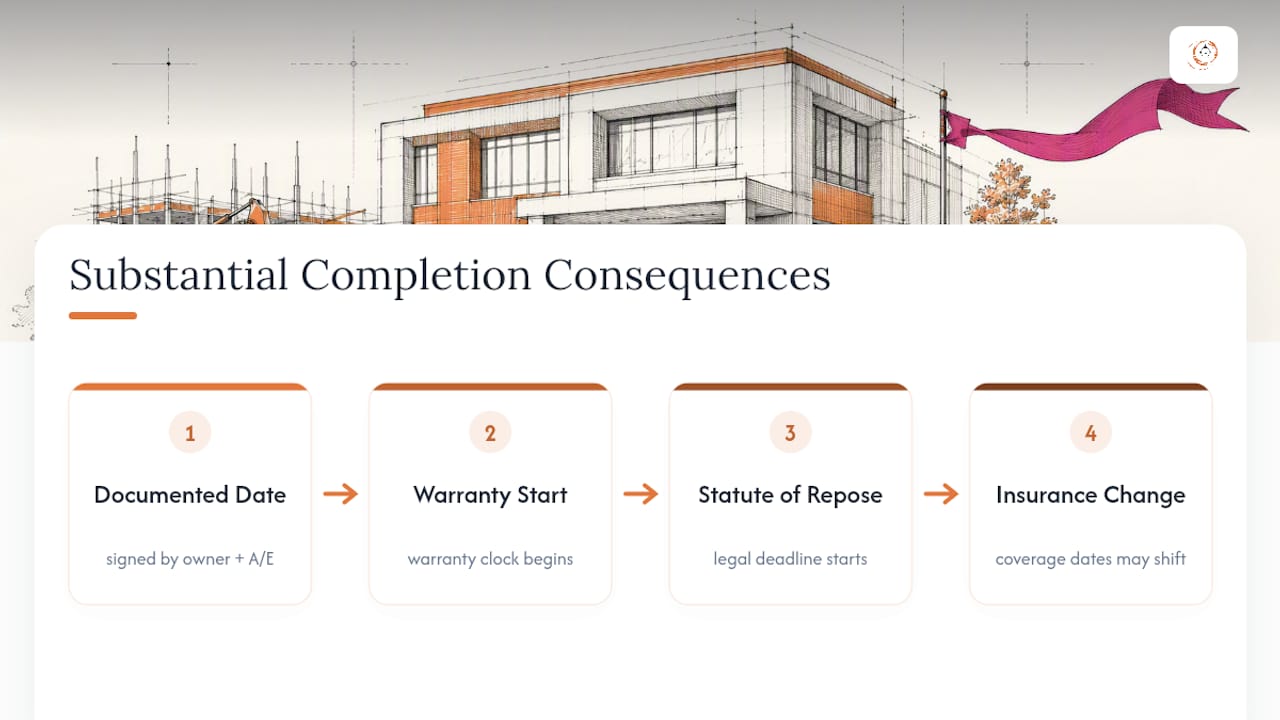
The exposure is real. Signing an AIA G704 Certificate of Substantial Completion with the wrong date, or backdating it to satisfy a schedule milestone, can shift when insurance coverage changes and when warranty obligations begin, according to AIA’s own certificate documentation. Contractors who sign an inaccurate date can find themselves on the hook for warranty claims years after they believed the clock had already run out.
Best practice here is simple and non-negotiable: document the substantial completion date in writing, get signatures from the owner and architect/engineer confirming it, and keep that record with the permanent project file. Never rely on a verbal agreement or an email thread as your record of when the clock started.
How Do You Run Punch Lists and Final Inspections Without Delays?
A punch list that does not tie back to the actual contract documents is an invitation for disputes later. Run the substantial-completion walkthrough with the owner, architect, and GC together, and document every item against the specific drawing, spec section, or submittal it violates, not a vague description like “fix paint in lobby.”
- Walk the project as a team and generate the punch list on-site, item by item, with photos attached to each entry.
- Assign every item to a specific subcontractor with a firm closure date, not a general “pending” status.
- Require photographic proof of correction before marking any item closed, and have a second party verify it.
- Submit reinspection requests to the AHJ only after your own internal verification confirms the item is genuinely resolved, since a failed reinspection resets the clock and burns goodwill with the inspector.
- Compile closure evidence into a single log that becomes part of the permanent project record.
Municipal final inspection checklists are worth reviewing before you ever schedule the AHJ visit. Austin’s building final inspection checklist shows the level of specificity inspectors bring, right down to exit signage and fire-rated door hardware, and reviewing a checklist like it before the inspector arrives catches items your own walkthrough might miss.
Pro Tip: Schedule commissioning and vendor training sessions for the same week as final inspections, not after. Facilities staff retain far more from equipment training when the systems are freshly running, and it avoids a second round of vendor site visits.
How Do You Build and Deliver the Owner’s Turnover Package?
A turnover package that owners can navigate on day one starts with a consistent folder structure, not a dump of files in whatever order they were collected. Organize by specification division, with a front-matter table of contents that maps every document to its section, so a facilities manager can find the boiler warranty without calling you six months later.
- Structure folders by CSI spec division, matching how the project manual itself is organized.
- Include a master index document at the top level listing every file and its location.
- Tag every file with minimum metadata: project name, project number, spec section, and vendor or model number where applicable.
- Apply consistent file naming across every subcontractor’s submission, even when it means reformatting what they send you.
- Deliver through a single-source platform, whether that is a cloud storage link, a project management platform export, or a hybrid of a packaged drive plus a cloud backup.
Yale’s design standard points to a real shift among institutional owners: digital-first, searchable handovers cut down dramatically on the follow-up requests that plague printed binder deliveries. If your firm still hands over binders for anything beyond a client’s explicit request, you are creating extra work for both sides. Read more on organizing digital submittals in R Construction Solutions LLC’s construction bid automation best practices.
What Financial Steps Release Retainage and Final Payment?
Retainage release is almost always tied directly to your documentation being complete, not just the physical work being done. Autodesk’s closeout guide confirms that the Certificate of Substantial Completion is frequently the contractual trigger owners use to begin the retainage release clock, so an incomplete document package delays money you have already earned.
- Retainage typically releases on a schedule tied to substantial completion or final completion, per your specific contract clause.
- Conditional lien waivers get exchanged when payment is submitted; unconditional lien waivers only after payment clears, and sequencing them backward creates real legal exposure for both sides.
- Your final payment application should bundle: final invoices, all subcontractor and supplier lien waivers, consent of surety (where a bond is involved), and the final unconditional waiver from your own firm.
Miss any one of these and the owner has legitimate grounds to hold the check, no matter how clean the physical construction work is.
Who Owns What During Closeout? A Responsibility Breakdown
Closeout gaps almost always trace back to nobody being explicitly assigned a deliverable, so ownership needs to be written down, not assumed.
- Owner: reviews and formally accepts the turnover package; authorizes final payment.
- General contractor: compiles all deliverables, coordinates subcontractor submissions, and manages the AHJ relationship.
- Subcontractors: submit O&M manuals, warranties, and as-built redlines for their own scope, on the GC’s deadline.
- Architect/engineer: issues the Notice of Substantial Completion and verifies as-built accuracy against design intent.
- AHJ: conducts final inspections and issues the Certificate of Occupancy.
When a deliverable goes unreturned, escalate in writing within 48 hours of the missed deadline, not weeks later when leverage has evaporated.
Why Should You Start Closeout Planning at Project Kickoff?
Closeout that starts at the punch list is closeout that runs late. MASTT’s project closeout research recommends starting deliverable tracking at kickoff and maintaining a living checklist throughout construction, a practice that reduces the documentation gaps that delay final payment and can pull retainage release forward by weeks.
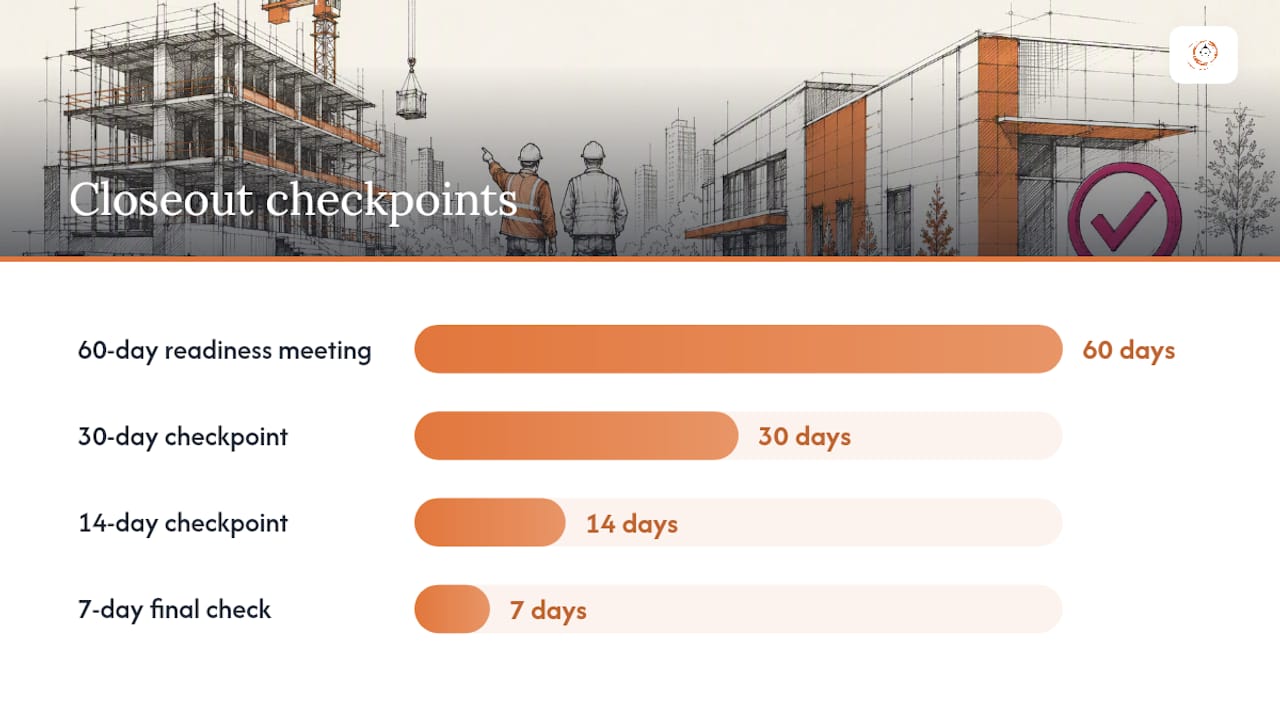
- Distribute the closeout checklist at project kickoff, not at 90% completion, and track it against 60, 30, 14, and 7-day markers before your target substantial completion date.
- Build submittal deadlines into subcontractor contracts so O&M manuals and warranties are a payment condition, not an afterthought.
- Hold a formal closeout readiness meeting 60 days before target completion. This single meeting catches missing deliverables while you still have contractual leverage to demand them.
Pro Tip: Add a “closeout status” column to your weekly OAC meeting agenda starting at the 60-day mark. Ten minutes a week beats a ten-hour scramble in the final week.
For a broader look at the handover window, see R Construction Solutions LLC’s post-award playbook, covering the first 30 to 90 days.
Advisor Workflows and Templates You Can Adapt Now
Closeout templates should scale with project size, not use a single format for every job. A small tenant improvement project needs a lighter tracking sheet than a multi-building campus job with dozens of commissioning reports.
- Small projects: one shared tracking sheet, owner and GC only, weekly updates, single-folder delivery.
- Mid-size projects: spec-division folder structure, GC-managed submittal log, biweekly OAC closeout review.
- Large/multi-building projects: dedicated closeout coordinator role, phased turnover by building or floor, commissioning agent as a formal sign-off party.
Anchor your calendar to the 60/30/14/7-day markers before target substantial completion, and confirm at each marker who still owes what. Call the subcontractor’s project manager directly at the 30-day mark, not just their office; verbal confirmation catches problems email threads miss.
Pro Tip: Standardize on one cloud platform for the entire turnover package rather than splitting delivery between email attachments, a shared drive, and a printed binder. Owners lose documents in the gaps between systems, not within one.
Why Disciplined Closeout Protects Profit and Reputation
Contractors who treat closeout as a checklist rather than an afterthought get paid faster, plain and simple. Retainage releases sooner when documentation is complete on delivery. Warranty claims drop when as-builts and O&M manuals actually match what was installed. The most common avoidable mistake I see is signing the Certificate of Substantial Completion before the punch list is even drafted, which locks in a warranty start date nobody has verified. Fix it by drafting the punch list first, confirming the date second, and signing third.
— Rowena Tulacz
How R Construction Solutions LLC Supports Closeout Readiness
R Construction Solutions LLC gives growth-stage contractors a faster path to final payment than building closeout discipline through trial and error on every project. Our advisory engagements include closeout readiness audits, template packs built around your actual contract types, and hands-on implementation support so your team stops losing weeks to missing documentation and unreturned subcontractor deliverables.

Contractors we work with typically see cleaner turnover packages, faster retainage release, and fewer post-completion warranty disputes once a repeatable closeout workflow is in place. If your firm is doing between $1 million and $10 million in annual revenue and closeout still feels like a scramble at the finish line, a structured process changes that. Visit our construction consulting services page to schedule a closeout readiness conversation and see exactly where your current workflow is losing time and money.
Sources
For legal verification, consult the AIA Certificate of Substantial Completion form directly. For practical templates, USC’s closeout checklist and municipal final inspection checklists like Austin’s offer field-tested formats worth adapting to your own projects.
- Yale Facilities design standard: Closeout procedures (Sept 2025)
- DASNY: Contract closeout requirements (2025)
- Procore: The Construction Closeout Process Explained
- Autodesk: Construction project closeout guide (2025)
Recommended
- Build an Estimating Checklist for General Contractor Projects
- Project Commissioned: Your 30-90 Day Post-Award Playbook
- How to Build a Repeat Client Base as a General Contractor
- General Contractor Estimating Best Practices 2026
Running the job and the business at the same time? One short email a week — change orders, billing, job costing, scheduling. Free, no pitch. Subscribe.
Free and unconditional. No call required, no obligation, unsubscribe anytime.