
Building a Repeat Client Base: Strategies for General Contractors | R. Construction Solutions
The most profitable thing you can do as a general contractor is not chase new leads. It is keep the clients you already have. Repeat business costs nothing to acquire, closes faster, and generates referrals that compound over time. The contractors who grow consistently do it through three deliberate systems: a structured follow-up cadence, consistent service delivery with fast quoting, and collaborative relationships that make clients feel like partners rather than project owners.
Here is the core retention framework that works:
- Immediate post-job thank-you within a short time after project completion
- a satisfaction check-in several weeks or months later to confirm quality and catch any issues early
- Maintenance reminders tied to relevant seasons linked to the work you performed (roof checks in fall, HVAC tune-ups before winter)
- Review and referral requests made at the moment of highest satisfaction, not weeks later when goodwill fades
- CRM-automated follow-ups so the system runs regardless of which team member handles the account
Pro Tip: Embed your follow-up cadence directly into your project close-out workflow inside a CRM. When the process lives in the system and not in someone’s memory, it happens every time, for every client, without exception.
How do you establish a communication cadence that retains clients?
Consistent, structured communication is the single most reliable driver of contractor client retention. Clients do not leave because the work was bad. They leave because they felt forgotten after the invoice was paid.
A practical cadence has three non-negotiable touchpoints:
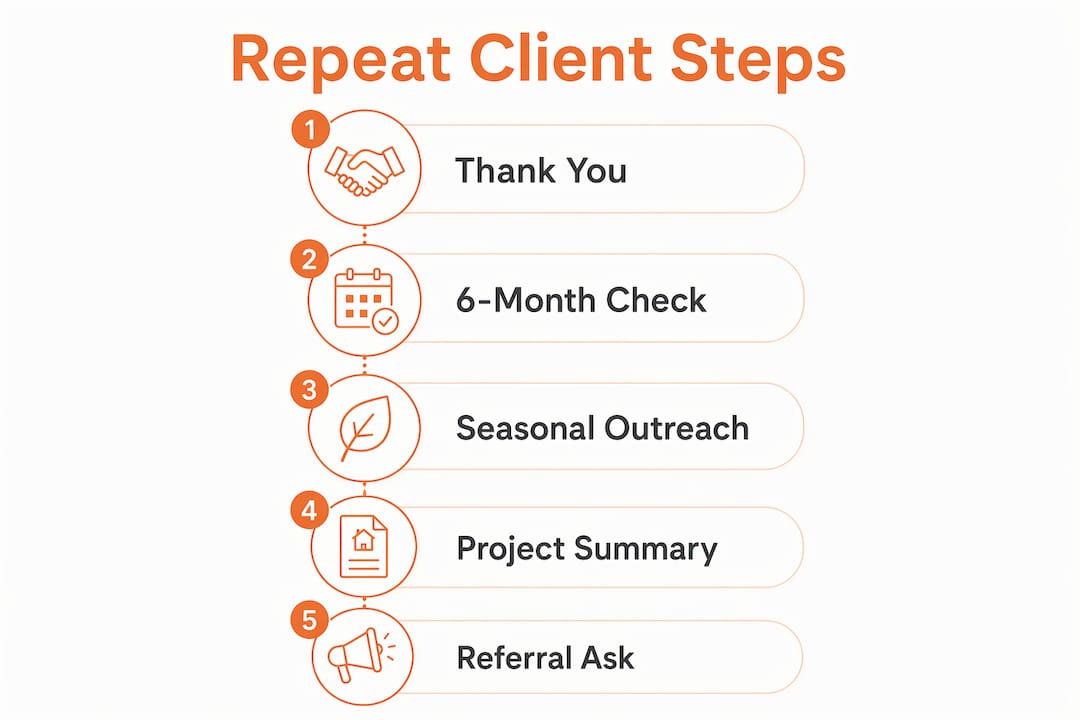
- Immediate thank-you: A call or message within 48 hours of completion confirms satisfaction and opens the door for a review request. Ask for the review at this moment, not later. Goodwill fades fast, and early review requests convert at a significantly higher rate than delayed ones.
- 6-month check-in: A brief message asking how the work is holding up. This is not a sales call. It is a trust signal that separates you from every other contractor who went silent after getting paid.
- Seasonal reminders: Tied to the specific work you did. A roofing contractor sending a pre-winter inspection offer is being useful, not pushy.
Personalization makes each touchpoint land harder. Log client preferences, communication methods, and project details in your CRM so every message references something specific. A client who gets a message that mentions their project by name feels remembered, not marketed to. CRM automation makes this cadence scalable without adding administrative burden to your team.

Does quoting speed actually affect repeat business?
Yes, and the gap is larger than most contractors expect. A returning client who receives a same-day estimate is far more likely to book again than one who waits three days. That client already trusts your work. The only variable left is responsiveness.
Service consistency matters just as much. Clients who experienced a smooth, professional project the first time have a specific expectation for the second. If the communication, crew behavior, or documentation quality drops, the relationship erodes even when the physical work is fine. Standardizing your project delivery, from pre-start communication through punch-list close-out, protects the perception you built on the first job.
Tools that support fast, accurate quoting also reduce the turnaround gap for returning clients. When templates and historical job data are already in your system, generating a competitive estimate for a familiar client takes minutes, not days.
How do you shift client conversations from price to long-term value?
The contractors who retain clients at the highest rates are not the cheapest. They are the ones clients trust as advisors, not just vendors. That shift starts during the design and planning phase, not after the contract is signed.
Getting involved early in a project, during design decisions and scope development, gives you the chance to build collaborative relationships that make issue resolution easier and change orders less contentious. When a client has been part of the decision-making process, they own the outcome alongside you.
Tactics that reinforce value beyond price:
- Document outcomes with data. After each project, provide a brief written summary of what was delivered, what was saved, and how the result aligns with what the client originally wanted. This is not a sales document. It is proof.
- Share your expertise proactively. Offer alternatives on materials, methods, or scheduling that serve the client’s goals. Clients remember contractors who gave them better options, not just the ones who executed instructions.
- Solicit testimonials immediately after project success. A specific, outcome-focused testimonial from a satisfied client is more persuasive than any marketing copy you could write.
- Ask for referrals at the right moment. Right after a successful close-out, not in a follow-up email three months later.
Proving value with data and project outcomes, rather than relying on discounts or loyalty points, is what shifts a client’s focus from your price to your results. Value communication done consistently reduces price sensitivity over time.
Pro Tip: After each project, create a one-page outcome summary using the client’s own goals as the benchmark. When the next bid conversation happens, that document does the negotiating for you.
Why does relying on one contact put your client relationship at risk?
Personnel changes happen constantly in construction and real estate. If your entire relationship with a client organization runs through one person and that person leaves, you may lose the account entirely, not because your work was poor, but because the new contact has no history with you.
Champion mapping solves this. It means deliberately identifying and nurturing relationships with multiple stakeholders inside each client organization, not just your primary contact.
Steps to build a multi-contact strategy:
- Identify all decision-makers and influencers on the client side, including project managers, finance leads, and executives who approve budgets.
- Tailor your communication to each role. A project manager wants operational updates. A CFO wants cost and schedule performance. An executive wants outcomes and strategic alignment.
- Log every contact in your CRM with their role, communication preferences, and interaction history.
- Schedule periodic executive-level check-ins separate from day-to-day project communication. These do not need to be long, but they establish a relationship that survives staff turnover.
- Use quarterly business reviews to align your work with the client’s broader goals, not just the current project’s status.
Spreading relationship depth across an organization also uncovers new opportunities. A contact in a different department may be planning a project your primary contact does not know about. Consistent multi-contact engagement is how contractors move from project vendor to preferred partner.
What the best contractors actually do differently to sustain repeat business
The gap between contractors who grow a loyal client base and those who stay stuck in the bid cycle usually comes down to one thing: systems versus intentions.
Most contractors intend to follow up. They intend to check in at six months. They intend to ask for referrals. But without a system, those intentions disappear the moment the next project starts. The contractors with the highest repeat rates have built retention into their operations the same way they build safety protocols into their job sites. It is not optional, and it does not depend on anyone remembering to do it.
At Rconstructionsolutions, the consulting work we do with mid-sized general contractors consistently reveals the same pattern. Firms that scale from project-to-project revenue to predictable, relationship-driven growth are the ones that treat client retention as an operational discipline, not a personality trait. That means CRM-based workflows, documented communication cadences, and quarterly reviews that connect your work to the client’s actual business goals, not just the project’s punch list.
The sustainable growth strategies that work in 2026 are not complicated. They are consistent. Quarterly business reviews that review ROI and align on the client’s next objectives reduce what researchers call “value drift,” the slow erosion of a client’s sense that you are delivering something worth paying for. Pairing that with AI-assisted tools for tracking client health scores, flagging at-risk accounts, and personalizing outreach at scale gives contractors the kind of visibility that used to require a dedicated account management team.
The contractors who build the most durable client bases also reflect the diversity of the industry itself. Clients across residential and commercial sectors want to work with teams that look like and understand their communities. Authentic representation in how you present your business, your crew, and your case studies builds trust before the first conversation even happens.
The bottom line: stop managing client relationships from memory. Build the system, work the system, and let the results compound. Consulting services for general contractors can accelerate that process significantly, especially for firms ready to move from reactive to predictable growth.
Key Takeaways
Repeat business for general contractors is built through consistent systems, not one-off gestures. The contractors who retain clients at the highest rates treat follow-up, quoting speed, and relationship depth as operational standards.
| Point | Details |
|---|---|
| Three-touchpoint cadence | Use an immediate thank-you, a 6-month check-in, and seasonal reminders to stay top-of-mind. |
| Same-day quoting wins | Returning clients who receive same-day estimates are significantly more likely to book again. |
| Value over discounts | Document project outcomes with data to shift client focus from price to long-term results. |
| Multi-contact mapping | Nurture relationships with multiple stakeholders per client to survive personnel changes. |
| Systems beat intentions | Embed follow-up cadences in CRM workflows so retention happens automatically, every time. |
The retention strategy most contractors overlook
The conventional advice on contractor retention focuses on communication and follow-up, and that advice is correct. But it misses the deeper structural problem: most contractors treat retention as something that happens after the project ends. The contractors who actually grow a loyal client base start retention on day one.
The moment a client signs a contract is when trust is most fragile and expectations are most malleable. How you communicate during the project, how you handle the first problem that arises, and how you document progress shapes the client’s entire perception of your firm. By the time the job is complete, the relationship is either strong enough to generate a referral or thin enough that a competitor’s faster quote will win the next project.
What I see consistently in construction consulting is that contractors underestimate how much a single, well-run quarterly business review can change a client relationship. Not a status update. A real conversation about what the client’s business goals are, how your work contributed to them, and what you can solve next. That conversation transforms you from a line item in a budget to a resource the client protects. The B2B retention research is clear on this: strategic reviews that connect contractor output to client KPIs reduce churn more reliably than any loyalty program or discount structure.
Build the relationship before you need it. The contractors who do that are the ones clients call first.