
How to Build a Commercial Construction Portfolio: A Growth Guide | R. Construction Solutions
A commercial construction portfolio is a structured collection of documented projects that proves your firm can manage complex commercial work, meet compliance standards, and deliver results clients can trust. To build a commercial construction portfolio from scratch, you need more than photos of finished buildings. You need case studies that show scope, budget control, safety records, and problem-solving. Commercial buyers effectively buy risk mitigation, not just construction work. Your portfolio is the primary tool that communicates your operational maturity before a client ever picks up the phone.
How to build a commercial construction portfolio from scratch
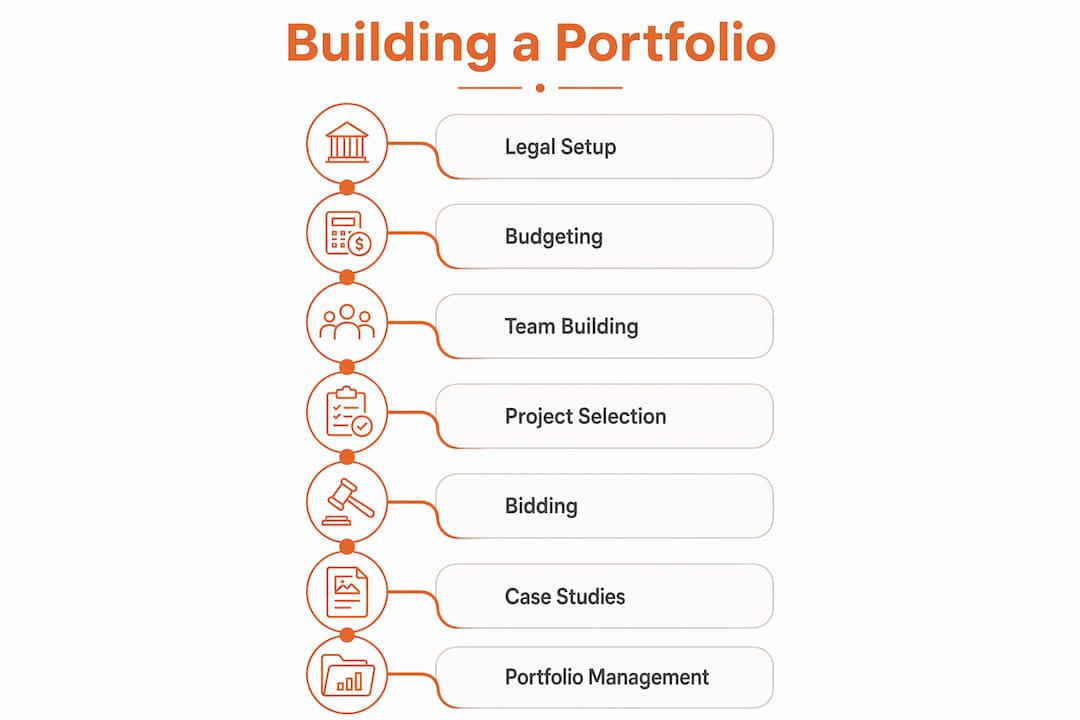
Building a credible commercial project portfolio starts with getting your business foundation right. Startup costs for U.S. commercial construction firms typically range from $150,000 to $500,000, covering licensing, insurance, staffing, and technology. That range is wide because your cost depends heavily on your trade specialty, state requirements, and whether you hire in-house or rely on subcontractors.

Licensing, insurance, and legal requirements
Your contractor’s license and general liability insurance are non-negotiable before you pursue any commercial project. Without them, you cannot submit a compliant bid, and no general contractor (GC) will add you to their approved vendor list. Most states also require workers’ compensation coverage from day one.
Beyond the basics, commercial clients expect to see certificates of insurance with specific coverage limits. A $1 million per-occurrence general liability policy is a common floor requirement. Check your state’s contractor licensing board for trade-specific requirements, since electrical, mechanical, and specialty contractors face additional layers.
Budgeting for your first year
Experts recommend a 15–20% contingency buffer on top of your projected startup costs. That buffer covers delayed payments, equipment repairs, and compliance costs you did not anticipate. Running out of cash in year one is the fastest way to stall portfolio growth before it starts.
Technology is a line item contractors often underestimate. Field management software, estimating tools, and document control systems all cost money upfront. These tools also generate the documentation records that make your portfolio credible later.
Building your team and subcontractor network
Your portfolio reflects the quality of the people who execute the work. Assemble a core team with verifiable certifications and safety training records. For specialty trades you do not self-perform, vet subcontractors carefully and document their qualifications. When a client reviews your portfolio, they are also evaluating whether your team can handle their project.
Key items to have in place before pursuing your first commercial project:
- General contractor’s license valid in your operating state
- General liability and workers’ compensation insurance with commercial-grade limits
- OSHA 30 certifications for site supervisors
- Bonding capacity to meet bid requirements on public or large private projects
- Document control system for RFIs, submittals, and daily logs
- Qualified subcontractor list with verified insurance and licensing
How to select and acquire your first commercial projects
The right first project is manageable, documentable, and commercially relevant. Focusing on projects in the $100,000–$500,000 range gives you real commercial exposure without the risk of a project that exceeds your current capacity. These smaller contracts let you build EMR logs, safety records, and compliance documentation that qualify you for larger work later.
Approaching local general contractors
Local GCs are your fastest path to a first commercial contract. Most GCs maintain approved subcontractor lists and actively look for reliable specialty trades. Call their preconstruction departments directly, bring your insurance certificates, and ask to be added to their bid lists. Showing up in person still works in this industry.
Attend local AGC (Associated General Contractors) chapter meetings and construction industry networking events. These connections often produce introductions that no online bid board can replicate. Relationships built early carry forward through your entire career.
Submitting a compliant and competitive bid
A complete bid is your first portfolio asset. GCs evaluate subcontractors partly on bid quality before they ever see your work. A sloppy or incomplete bid signals operational immaturity and gets you removed from consideration.
Follow these steps when submitting your first commercial bids:
- Read the full bid package. Review drawings, specifications, and addenda before pricing anything.
- Scope your work precisely. Define exactly what you include and exclude to avoid disputes later.
- Price with real data. Use current material costs and verified labor rates, not estimates from memory.
- Submit on time. Late bids are almost always rejected without review.
- Include all required attachments. Insurance certificates, license copies, and safety program summaries are standard requirements.
- Follow up professionally. A brief call after submission shows commitment and keeps your name in front of the GC.
Pro Tip: Ask the GC for a post-bid debrief whether you win or lose. The feedback tells you exactly what to fix before your next submission, and it builds a relationship that pays off on future bids.
Safety and schedule performance on your first projects matter more than profit margin. Clients and GCs remember contractors who hit milestones and maintain clean job sites. That reputation becomes the narrative foundation of your portfolio.
What makes a compelling project case study?
A project case study is the core unit of a credible construction portfolio. Commercial evaluators want to see operational maturity, not just finished product photos. Each case study should tell a complete story: what the project required, what obstacles appeared, how your team solved them, and what the measurable outcome was.
The anatomy of a strong case study
Every case study needs these elements to carry weight with commercial buyers:
- Project scope and location: Square footage, trade scope, and site context
- Timeline and budget: Contracted versus actual, with brief explanation of any variance
- Key constraints: Occupied spaces, phased shutdowns, zoning restrictions, or HSE requirements
- Challenges and solutions: Specific problems your team encountered and the technical decisions made
- Measurable outcomes: Safety milestones, zero-incident records, LEED or BREEAM certifications, or schedule recovery metrics
- Client testimonial: A direct quote tied to this specific project, not a generic endorsement
High-gloss photos without problem-solution narratives reduce portfolio credibility with commercial evaluators. Including technical documents like RFI logs and risk registers signals systemized delivery and builds evaluator confidence.
Weak case study vs. strong case study
| Element | Weak approach | Strong approach |
|---|---|---|
| Project description | “Office renovation, 5,000 sq ft” | “Phased occupied office renovation, 5,000 sq ft, zero operational downtime” |
| Challenge section | Missing | Describes specific constraint and technical solution |
| Visuals | Before/after photos only | Photos with annotated progress milestones |
| Outcomes | “Completed on time” | “Delivered 3 days ahead of schedule, zero recordable incidents” |
| Documentation | None | RFI log summary, safety record, client sign-off |
| Client voice | Generic company review | Named contact quote tied to specific outcome |
Pro Tip: Aim for 5 to 10 deeply documented case studies rather than a large gallery of shallow entries. Depth signals maturity. A gallery of 30 photos with no context signals a contractor who does not understand what buyers actually evaluate.
How to manage your portfolio as a lead generation asset
A static portfolio loses value fast. Update your portfolio every 6–12 months to reflect your current capabilities, certifications, and project types. Outdated case studies tell buyers you have not grown, which is the opposite of the message you want to send.
SEO and keyword strategy for portfolio pages
Your portfolio pages are also search content. Keyword-rich project pages attract qualified leads from commercial buyers actively searching for contractors. Use location and project-type keywords naturally within each case study. “Tenant improvement contractor in Denver” or “medical office buildout, Phoenix” are the kinds of phrases buyers type when they need a contractor fast.
Pair your portfolio with a content strategy that supports it. Your construction industry blog can drive organic traffic to your portfolio pages by covering topics your target clients search for. Internal linking between blog posts and case studies keeps buyers on your site longer and signals authority to search engines.
Tailoring your portfolio to different buyer types
Audience-specific storytelling increases portfolio impact more than any other single tactic. Public sector buyers prioritize repeatability, compliance documentation, and safety records. Private developers want speed, design flexibility, and budget performance. The same project can be presented differently depending on who is reading it.
Create two or three versions of your portfolio narrative for different audiences. A healthcare GC cares about infection control protocols and phased construction. A retail developer cares about tenant coordination and fast-track scheduling. Matching your language to their priorities shows you understand their business, not just your own. This is where increasing market share through business development becomes a direct result of portfolio strategy.
What are the most common portfolio mistakes to avoid?
Most contractors starting a construction portfolio make the same errors. Recognizing them early saves you months of wasted effort.
- Trophy photos with no context. Beautiful images of finished work tell buyers nothing about how you managed the project. Always pair visuals with process documentation.
- Incomplete or unqualified bids. Submitting bids before you have the required licensing, insurance, or bonding wastes everyone’s time and damages your reputation with GCs.
- Skipping safety documentation. Your EMR (Experience Modification Rate) and safety records are portfolio assets. Document them from your very first project.
- Generic presentations. A one-size-fits-all portfolio reads as a one-size-fits-all contractor. Buyers want to see that you understand their specific project type.
- No client voice. A portfolio without testimonials is a contractor talking about themselves. Client quotes tied to specific outcomes are far more persuasive.
- Ignoring process improvement documentation. Buyers want evidence that your delivery is repeatable and systemized, not dependent on one person having a good day.
Portfolios that explicitly address challenges solved outperform simple image galleries with commercial evaluators. The difference is not production quality. It is the presence or absence of a problem-solving narrative.
Key Takeaways
Building a commercial construction portfolio from scratch requires documented case studies, compliant bidding, and audience-specific storytelling to convert evaluators into clients.
| Point | Details |
|---|---|
| Start with the right foundation | Secure licensing, insurance, and bonding before pursuing any commercial project. |
| Target manageable first projects | Projects in the $100,000–$500,000 range build experience and compliance records without excessive risk. |
| Document everything | RFI logs, safety records, and client testimonials turn projects into persuasive portfolio assets. |
| Tailor narratives to buyer type | Public sector buyers want compliance proof; private developers want speed and budget performance. |
| Update and optimize regularly | Refresh portfolio content every 6–12 months and use location and project-type keywords for SEO. |
What I have learned about portfolios that actually win work
By Rowena
Most contractors treat their portfolio as an afterthought. They build it after they feel established, fill it with finished-product photos, and wonder why it does not generate calls. The contractors who win commercial work consistently treat their portfolio as a sales tool built in parallel with every project they execute.
The insight that changed how I think about portfolio development is this: commercial buyers are not evaluating your work. They are evaluating their own risk. Every case study you write should answer the question, “What could go wrong on my project, and how will this contractor handle it?” If your portfolio does not answer that question, it is not doing its job.
I have seen mid-sized firms stall for years because they kept waiting for a “big enough” project to anchor their portfolio. The contractors who grew fastest started with smaller commercial projects, documented them obsessively, and used that documentation to qualify for the next tier. The portfolio did not reflect their growth. It drove it.
Generic consultants will tell you to make your portfolio look professional. That is table stakes. The real work is understanding your buyer’s decision criteria and writing directly to it. That is what separates a portfolio that gets filed away from one that generates a call the same day a buyer reads it.
— Rowena
How Rconstructionsolutions supports your portfolio and business growth
Rconstructionsolutions brings over 30 years of hands-on construction industry experience to contractors who are building their commercial presence from the ground up.
Whether you are structuring your first bid package, developing case study templates, or figuring out how to position your firm for larger commercial contracts, the team at Rconstructionsolutions provides the kind of specific, practical guidance that generic business consultants cannot. Their construction consulting services cover startup planning, project acquisition strategy, and portfolio development for contractors at every stage of growth. Specialized support is also available for electrical contractors expanding into commercial work. If you are ready to build a portfolio that wins contracts, not just impresses visitors, Rconstructionsolutions is the partner that knows exactly what commercial buyers look for.
FAQ
What does a commercial construction portfolio include?
A commercial construction portfolio includes 5–10 documented case studies with project scope, timeline, budget, challenges, solutions, measurable outcomes, and client testimonials. Technical documents like RFI logs and safety records strengthen credibility with commercial evaluators.
How much does it cost to start a commercial construction company?
U.S. startup costs for commercial construction firms typically range from $150,000 to $500,000, including licensing, insurance, staffing, and technology, with a recommended 15–20% contingency buffer.
What size projects should I target first for my portfolio?
Target projects in the $100,000–$500,000 range. These projects provide real commercial exposure while allowing you to build the EMR logs, safety records, and compliance documentation needed to qualify for larger contracts.
How often should I update my construction portfolio?
Update your portfolio every 6–12 months to reflect current capabilities, certifications, and completed project types. Outdated case studies signal stagnation to commercial buyers reviewing your qualifications.
How do I make my portfolio rank in search results?
Use location and project-type keywords naturally within each case study page. Phrases like “tenant improvement contractor in [city]” attract commercial buyers actively searching for contractors, turning your portfolio into a qualified lead source.

