Contractors' 5 Step Build America Buy America Closeout Checklist
Yes, if your project runs on federal financial assistance obligated after May 14, 2022, Build America Buy America applies, and it requires domestically produced iron, steel, manufactured products, and construction materials. Before you bid, confirm three things: the award’s Buy America clause, any active waivers on the agency’s list, and your suppliers’ domestic-content documentation. Skip any one of those checks and you risk disqualification or a costly change order later.
TL;DR:
- Confirm federal funding and award clauses explicitly include the Buy America requirement before bidding to avoid disqualification.
- Ensure all iron, steel, and manufactured products are fully produced within the United States, with proper documentation at each manufacturing stage.
- Be aware that certain construction materials like cement, gravel, and tools are exempt from domestic content rules, preventing common compliance mistakes.
- Start waiver requests early if domestic sourcing proves impossible or too costly, as approval can take up to 90 days and requires detailed justification.
- Maintain thorough, staged documentation of supplier proof and classification decisions throughout the project to prevent rejected materials and costly delays.
Table of Contents
- Build America Buy America Requirements by Material Category
- Which Federal Awards and Entities Must Comply
- How Waivers Work and When You Qualify for One
- Your Bid-to-Closeout Compliance Checklist
- Where Compliance Breaks Down and How to Avoid It
- Official Resources for Waivers, Guidance, and Supplier Data
- Why Compliance Deserves a Business Decision, Not Just a Legal One
- Sources
Build America Buy America Requirements by Material Category
BABA sorts covered materials into three buckets, and each one has its own test for what counts as domestic. Get the category wrong and you get the compliance standard wrong, too.
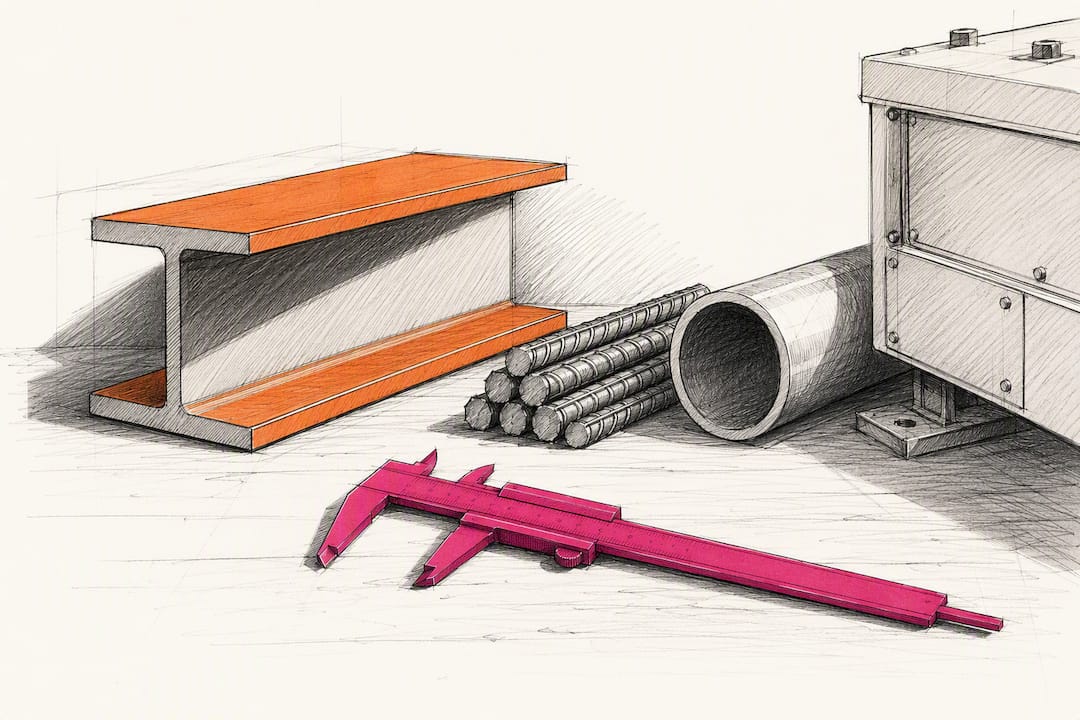
Iron and steel must go through every manufacturing process, from melting to coating, inside the United States. That covers structural beams, rebar, pipe, and the paint or galvanizing applied afterward. A steel beam melted in Pittsburgh but coated overseas does not qualify.
Manufactured products need to be manufactured in the U.S., and the cost of domestic components generally has to clear a majority threshold set by the relevant regulation. Think HVAC units, pumps, electrical panels, and prefabricated fixtures.
Construction materials are items where the manufacturing process itself has to occur domestically. Concrete, glass, lumber, and drywall fall here.
The Department of Commerce’s BABA overview lays out these categories and confirms the effective date of May 14, 2022 for obligated awards. That same guidance spells out what does not count as a covered construction material:
- Cement, cementitious materials, and their binding agents or additives
- Aggregates such as stone, sand, and gravel
- Tools and temporary equipment used to build the project but not incorporated into it
That last exemption trips up a lot of estimators. If it is not part of the finished structure, it is not subject to the domestic-content test, even if it is on the job site every day.
Which Federal Awards and Entities Must Comply
BABA attaches to federal financial assistance, meaning grants, cooperative agreements, loans, and loan guarantees tied to infrastructure. It does not automatically apply to every federally touched dollar. It applies when the funding instrument itself carries the Buy America condition, which the EPA’s BABA overview confirms by naming the infrastructure categories covered at minimum.
Compliance flows downhill, and that is where a lot of subcontractors get caught off guard. Consider how the obligation moves through a project:
- The federal agency obligates funding and applies the Buy America term to the award.
- The prime recipient, often a state department of transportation or a municipal utility, must write that same term into every subaward and contract.
- Subcontractors and material suppliers inherit the requirement through those flow-down clauses, whether or not they ever read the original grant agreement.
Infrastructure categories typically covered include roads and bridges, water and wastewater systems, public transit, broadband expansion, airports, energy and transmission projects, and public buildings. If your project touches any of those and federal assistance dollars are in the funding stack, assume BABA applies until you confirm otherwise. Our guide to public works contract compliance walks through how those flow-down clauses typically get written into subcontracts.
How Waivers Work and When You Qualify for One
Agencies can excuse noncompliance under three statutory grounds, and knowing which one applies changes your entire sourcing strategy.
- Public interest waivers apply when strict enforcement would work against the broader goals of the funding program.
- Nonavailability waivers apply when no domestic producer can supply the material in sufficient quantity or quality.
- Unreasonable cost waivers apply when sourcing domestically would increase the total project cost by more than 25%, a threshold confirmed by the Department of Energy’s BABA guidance.
Waivers come in two flavors: general applicability waivers that cover an entire category of materials agency-wide, and project-specific waivers tied to one award. Both types go through a public comment period before final approval, and NARA’s waiver posting process can take up to 90 calendar days from request to resolution.
That timeline matters for your schedule. If you suspect a waiver is needed, start the conversation with your funding recipient early, not after you have already lost weeks chasing an unavailable material. Check the agency’s posted waiver list before you assume a shortage justifies an exception; someone may have already requested and secured one for the exact item you need.
Your Bid-to-Closeout Compliance Checklist
Treat BABA compliance like a chain with five links. Break one, and the whole thing fails an audit.
- Pre-bid: Identify the funding agency and pull the award’s actual terms. Check that agency’s waiver list before you price anything, and start requesting domestic-content declarations, certificates of origin, and supplier invoices for every major material category.
- Bid submission: Build conditional pricing for any item where domestic sourcing is uncertain, so you are not stuck absorbing a cost overrun mid-project. Write flow-down clauses into every subcontract, and keep an assumption log documenting which materials you assumed were compliant and why.
- Post-award: Collect and file supplier proofs as materials arrive, not months later when someone asks for them. Set a standard operating procedure for material acceptance so your site superintendent has a checklist, not a guess, when a delivery shows up.
- Change orders: Treat every substitution as a fresh compliance check. A last-minute swap to a different manufacturer can reintroduce noncompliance risk you thought you had closed out.
- Waiver support: If a recipient needs to request a waiver, your documentation of nonavailability or cost impact becomes the evidence the agency reviews. Quotes from multiple domestic suppliers showing the cost delta, or written confirmation that no U.S. producer can meet the spec, both carry weight.
Our breakdown of submitting a compliant public sector bid covers the pre-bid steps in more depth, and our 2026 guide to public construction contract compliance is worth bookmarking for the post-award documentation piece.
Pro Tip: Build your supplier documentation request into your standard RFQ template now, before you have a live bid on the clock. Waiting until you need a certificate of origin under deadline pressure is how compliant contractors end up scrambling.
Where Compliance Breaks Down and How to Avoid It
Most BABA disputes trace back to one of two failures: misclassification or missing paperwork.
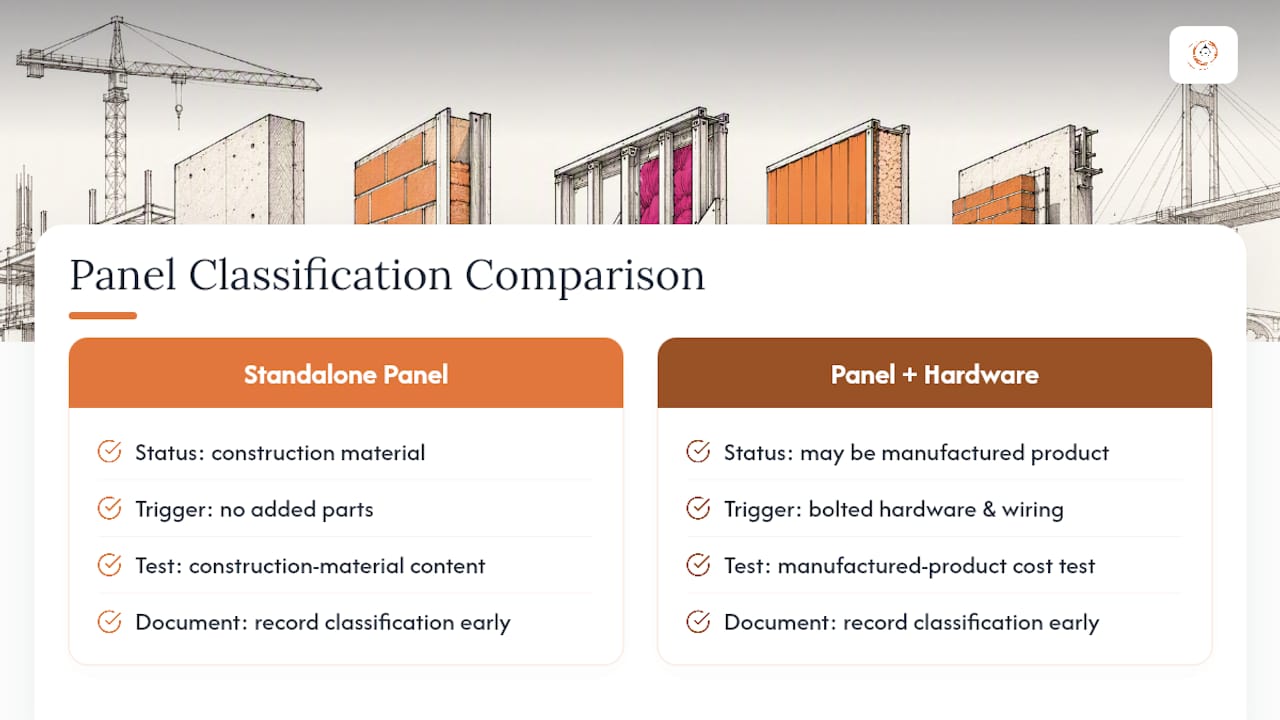
Misclassification happens when a construction material gets combined with other components and quietly becomes a manufactured product, which triggers a different content test entirely. A concrete panel is a construction material until you bolt hardware and wiring into it, at which point it may need to pass the manufactured-product cost threshold instead. Document the classification decision and your reasoning in the procurement file the moment you make it, not after a reviewer questions it.
The second failure is simpler: contractors wait too long to verify supplier documentation, then discover a gap after materials are already on-site. Reduce that risk with staged procurement, early prequalification of U.S. manufacturers, and supplier scouting through NIST’s Hollings Manufacturing Extension Partnership, a free federal service built to connect contractors with domestic sources.
Official Resources for Waivers, Guidance, and Supplier Data
Bookmark these before you need them mid-bid:
- Commerce’s BABA page for statutory text and category definitions
- 2 CFR part 184 for the regulatory framework agencies use to implement the Act
- EPA’s BABA overview for infrastructure category scope
- NARA’s grants waiver page for posted waiver requests and public comment windows
- The White House Made in America office for policy framing and OMB guidance links
- NIST MEP supplier scouting for locating domestic manufacturers
When you cite a waiver in your procurement file, reference the specific agency posting and date, not just the general statute. Reviewers want to see you checked the current list, not an old one.
Why Compliance Deserves a Business Decision, Not Just a Legal One
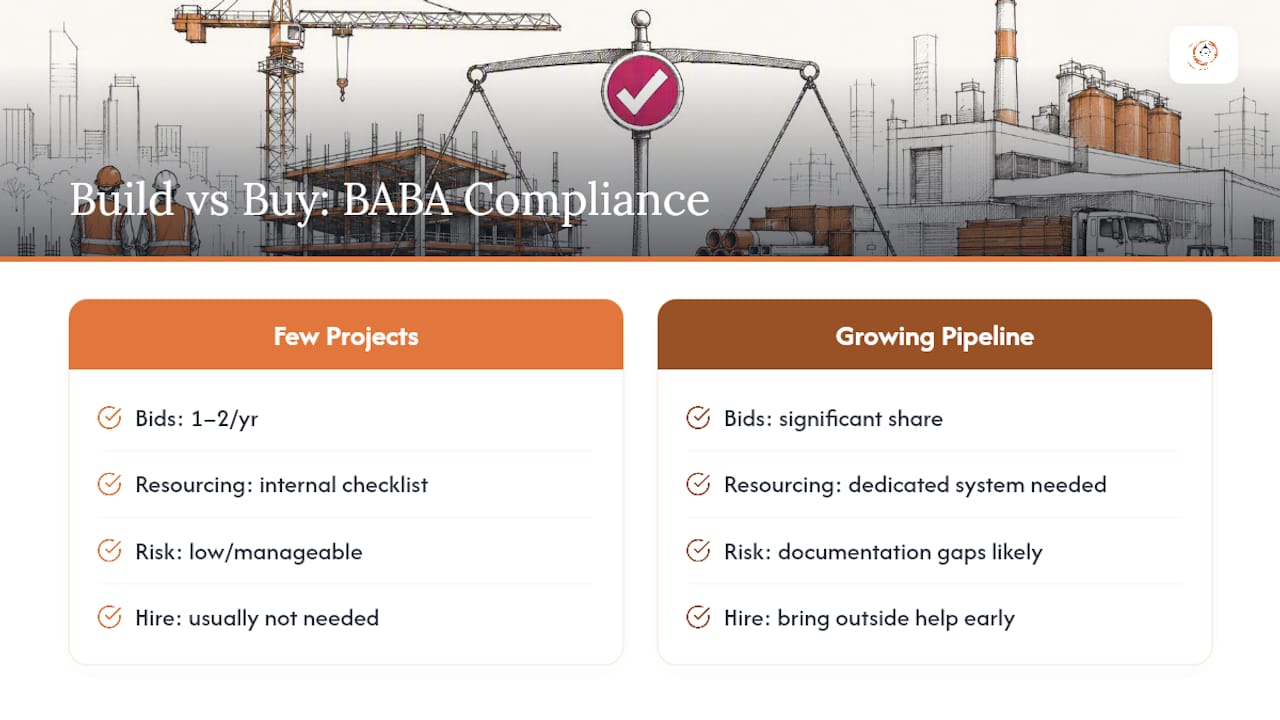
BABA compliance is not only a legal question; it is a resourcing question. For a $2 million to $10 million contractor bidding federal-assistance work for the first time, the real risk usually isn’t the statute itself. It’s the internal capacity to track supplier documentation across a dozen material categories while still running the job.
Rowena Tulacz has spent more than three decades advising construction businesses on the operational and business-development side of scaling, including how growth-stage contractors position themselves for federal procurement work. Her take: if your team is already stretched managing job costing and scheduling, bolting a compliance tracking system on top without outside support is how documentation gaps happen.
The decision rule is straightforward. If you are bidding one or two federally assisted projects a year, a disciplined internal checklist may cover it. If federal work is becoming a real share of your pipeline, bring in outside procurement expertise before your first noncompliance finding, not after.
— Rowena Tulacz
If your team is weighing whether to build that compliance capacity in house or bring in outside support, R. Construction Solutions’ construction consulting services work with growth-stage contractors on exactly this kind of federal procurement positioning, from RFP preparation to past-performance documentation. R Construction Solutions LLC does not hold WBE, DBE, or MBE certification, but the firm’s advisory work centers on helping contractors build the systems that keep them eligible for and competitive on federally assisted work.
Sources
- Build America Buy America | U.S. Department of Commerce
- Build America Buy America | U.S. Department of Energy
- Build America, Buy America (BABA) Act for Federal Financial Assistance | National Archives
- Build America, Buy America (BABA) Act Overview | US EPA
Recommended
- Build an Estimating Checklist for General Contractor Projects
- Commercial Contractor Licensing Requirements Checklist 2026
- Public Works Contracts: What Contractors Must Do to Comply
- How to Submit a Compliant Public Sector Construction Bid
Running the job and the business at the same time? One short email a week — change orders, billing, job costing, scheduling. Free, no pitch. Subscribe.
Free and unconditional. No call required, no obligation, unsubscribe anytime.