
Public Works Contracts: What Contractors Must Do to Comply
To bid, win, and perform a public works contract, you need eight things locked down: active Sam registration, valid state or local licensure, agency prequalification where required, bid and performance bonds, prevailing wage compliance backed by certified payrolls, the required federal or state contract clauses incorporated into your paperwork, a Buy America/BABA material traceability process, and documentation that can survive an audit. Miss any one of these and you risk a bounced bid, a payment hold, or worse.
Public works contracting rewards discipline more than it rewards low bids. Agencies award to bidders who are both responsive (submitted the right paperwork) and responsible (proven capacity to perform), and the contractors who lose money on public jobs almost always trip over compliance mechanics, not the actual construction work.
Before you submit anything, run through this list:
- Confirm your SAM.gov registration is active, not expired or “in progress”
- Verify your contractor license covers the project’s classification and jurisdiction
- Check whether the agency requires separate prequalification beyond SAM
- Line up bid bond capacity with your surety before you commit to a number
- Pull the correct Davis-Bacon or state prevailing wage determination for the trades involved
- Set up (or confirm) your certified payroll process for weekly submission
- Identify whether Buy America or BABA domestic sourcing rules apply to your materials
- Build a compliance folder before the contract starts, not after the first audit request
The stakes are not abstract. Wage violations trigger restitution and civil penalties. Missing Buy America certification on a federally funded project can lead to a public finding and a three-year bar from future contract awards. Agencies do not negotiate on these points, and neither do federal auditors.
Key Takeaways
Public works compliance succeeds when contractors treat SAM.gov registration, bonding, prevailing wage documentation, and Buy America traceability as one connected system rather than separate checkboxes.
| Point | Details |
|---|---|
| Registration comes first | Keep SAM.gov registration active well before any bid deadline; it’s free and required for federal awards. |
| Bonding capacity gates growth | Present audited financials, experience lists, and a clean backlog schedule to expand your surety line. |
| Wage compliance is weekly, not occasional | Submit certified payrolls every week using the correct wage determination for the trade and locality. |
| Buy America needs a paper trail | Build a traceability worksheet showing country of origin for every covered material before installation. |
| R Construction Solutions LLC builds the system | Its consulting services help contractors set up compliance readiness reviews, payroll processes, and bonding packages. |
Table of Contents
- How to Understand Public Works Contract Requirements From the Start
- Which Federal and State Clauses Show Up in Every Solicitation?
- What Bonds and Retainage Should You Expect on a Public Job?
- How Do Prevailing Wage and Certified Payroll Rules Work?
- What Do Agencies Require at Bid Time?
- What Should Your Compliance Checklist Look Like Before and After Award?
- What Compliance Mistakes Get Contractors Into Trouble?
- How Should You Read a Solicitation for Hidden Compliance Risk?
- Where Small and Mid-Sized Contractors Actually Fall Short
- How R Construction Solutions LLC Helps You Get Contract-Ready
- Where to Find the Official Forms and Guidance
- Sources
How to Understand Public Works Contract Requirements From the Start
A public works contract is any agreement for constructing, altering, or repairing infrastructure, buildings, or facilities that is funded, in whole or part, by a government entity. Roads, bridges, water treatment plants, schools, public housing, broadband expansion tied to federal grants. If public dollars fund it, it almost always qualifies.
The tricky part is not identifying an obviously public project. It is catching the ones that look private but carry public strings. A privately owned utility upgrade that receives a federal infrastructure grant can trigger Davis-Bacon wage rules even though the site itself is privately held. A city sidewalk repair funded through a state revolving loan program might fall under state prevailing wage law but not the state’s formal procurement bidding statute. These dual-trigger situations catch experienced contractors off guard because they assume one funding source means one set of rules.
Run through this sequence before you assume anything about a solicitation:
- Check the funding source and program name listed in the solicitation. Federal-aid highway money, HUD community development funds, and state revolving loan funds each carry different flow-down obligations.
- Identify the controlling statute or grant terms. Federal-aid highway work falls under Title 23; many building projects fall under state procurement codes; grant-funded work often incorporates federal terms by reference even when the owner is a local municipality.
- Confirm the agency’s own definitions in its procurement manual. States define “public work” differently, and some exclude maintenance-only contracts or contracts below a dollar threshold.
- Flag dual-trigger risk where state and federal rules overlap, since compliance with one does not automatically satisfy the other.
Pro Tip: A project can trigger prevailing wage obligations under a state labor code without being subject to that state’s competitive bidding statute at all. Always check wage-rule applicability and procurement-rule applicability as two separate questions, because agencies rarely spell out the distinction in the solicitation itself.
Which Federal and State Clauses Show Up in Every Solicitation?
Most public works solicitations pull from the same handful of statutory sources, and once you recognize them, reading a new RFP gets considerably faster.
Davis-Bacon and Related Acts (DBRA) require you to pay locally prevailing wages and fringe benefits to laborers and mechanics on federally funded construction contracts over $2,000. This is the single most consequential clause in the entire federal contracting framework, and it shows up constantly.
FHWA Form FHWA-1273, formally titled Required Contract Provisions, must be physically incorporated into federal-aid highway construction contracts. The Federal Highway Administration mandates that this form carry Buy America, Davis-Bacon, EEO, debarment, safety, and wage and hour clauses, and 23 CFR Part 633 requires the same provisions flow down to every subcontractor tier.
2 CFR Part 200, the Uniform Guidance, governs how federal grant dollars get spent by states and localities. When a city uses a federal grant to fund a project, the grant’s flow-down clauses under Part 200 become part of your contract even if the prime agreement never mentions the federal program by name.
Buy America and Build America, Buy America (BABA) require domestic sourcing for iron, steel, and increasingly other manufactured products on covered infrastructure projects. BABA requires 100% domestic sourcing certification for iron and steel, backed by traceability documentation and, frequently, third-party validation.
Debarment and suspension certifications require you to certify that neither your firm nor its principals are currently barred from federal contracting. EEO and Affirmative Action clauses impose hiring and reporting obligations. The Contract Work Hours and Safety Standards Act sets overtime and safety baselines on federal construction contracts. And NEPA-related environmental flow-down clauses appear on any project with federal environmental review triggers.
| Clause or requirement | Governing statute/regulation | What you must provide |
|---|---|---|
| Prevailing wage (DBRA) | 40 USC et seq. | Wage determination compliance, certified payrolls |
| FHWA-1273 provisions | 23 CFR Part 633 | Physical incorporation into contract and subcontracts |
| Uniform Guidance flow-down | 2 CFR Part 200 | Compliance with grant-specific procurement and reporting terms |
| Buy America / BABA | 41 USC 8303; BABA | Domestic sourcing certification, traceability documentation |
| Debarment certification | 2 CFR Part | Signed certification of eligibility |
| EEO/Affirmative Action | Executive Order | Hiring reports, workforce documentation |
| Work hours/safety | Contract Work Hours and Safety Standards Act | Overtime compliance records |
Pro Tip: Read the “exceptions” or “waivers” section of every solicitation closely. Agencies occasionally grant a Buy America waiver for a specific material category when no domestic supplier exists, but that waiver applies only to the item named. Applying it broadly to your whole material list is one of the fastest ways to fail an audit.
What Bonds and Retainage Should You Expect on a Public Job?
Nearly every public works contract above a modest dollar threshold requires three distinct bonds, each guaranteeing a different obligation.

A bid bond guarantees you will honor your bid price and sign the contract if awarded, typically set at a small percentage of the bid amount. A performance bond guarantees you will complete the work according to contract terms, and a payment bond guarantees your subcontractors and suppliers get paid even if you go under mid-project. Federal contracts follow the Miller Act, which requires performance and payment bonds on federal construction contracts over a defined monetary threshold. Most states run a parallel “Little Miller Act” that imposes similar bonding requirements on state and local public works, though thresholds and bond percentages vary by state.
| Bond or holdback type | Typical trigger | Common range |
|---|---|---|
| Bid bond | Federal Miller Act and most state statutes | 5% of bid amount |
| Performance bond | Miller Act threshold: contracts over $150,000 | 100% of contract value |
| Payment bond | Miller Act threshold: contracts over $150,000 | 100% of contract value |
| Retainage | Progress payments on most public contracts | 5% per payment |
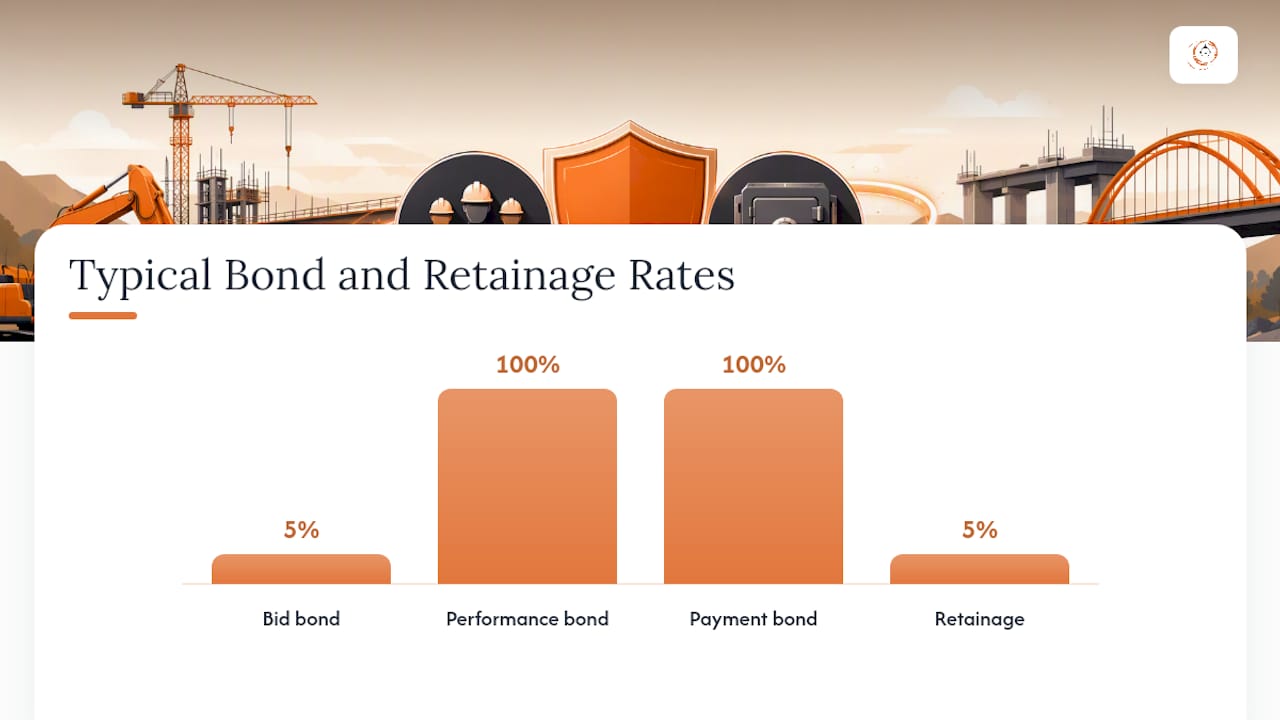
Sureties evaluate your bonding capacity based on audited or reviewed financial statements, a documented project experience list, and your current backlog schedule showing what work you already have committed. A thin backlog schedule or unaudited financials will cap your bonding line regardless of how strong your field crew is.
Pro Tip: If your bonding capacity is falling short of the contract sizes you want to pursue, the SBA Surety Bond Guarantee Program can back a portion of your bond on contracts up to certain federal thresholds, effectively giving your surety more comfort to extend a larger line. Present your surety with organized financials, a clean experience list, and a realistic backlog before you ask for a capacity increase, not after you’ve already lost a bid over it.
How Do Prevailing Wage and Certified Payroll Rules Work?
Getting wage compliance wrong is the single most common way contractors lose money on public works after the contract is already signed.
Your core obligations break down into four steps:
- Find the controlling wage determination for the project’s location and construction type (building, highway, heavy, or residential) before you finalize labor costs in your bid.
- Pay each worker the base wage plus fringe benefits listed for their classification, either as cash or through a bona fide benefit plan contribution.
- Submit certified payroll weekly, using Form WH-347 or an agency-approved equivalent, listing hours, classifications, and wages paid for every worker on the job.
- Retain supporting records including time cards, payroll registers, and fringe benefit documentation for the retention period specified in your contract, commonly three years.
Matching trades to the correct wage determination sounds simple until you have a laborer performing carpenter-level work on part of a shift. Wage determinations are classification-specific, and locality matters just as much as trade. A determination pulled for the wrong county or the wrong construction type is a common finding in DOL audits.
Watch for these traps specifically:
- Misclassifying skilled workers as laborers to pay a lower base rate
- Treating an owner-operator as exempt from prevailing wage when the work performed is covered
- Applying fringe benefit credits incorrectly, especially when a plan doesn’t meet bona fide plan standards
- Assuming state prevailing wage rules and federal Davis-Bacon rules are interchangeable when they set different rates or coverage rules
Certified payroll records that agencies and auditors expect to see include worker name and classification, hours worked by day, gross wages, fringe benefit contributions or cash equivalents, and deductions. Keep these organized by contract and by week, not bundled across projects, because an auditor pulling one contract’s records should not have to sort through unrelated jobs to find them.
What Do Agencies Require at Bid Time?
Public agencies procure construction work through a handful of standard methods, and each one changes what you need to submit and how you compete.
Sealed bidding (also called low-bid or competitive sealed bidding) awards to the lowest responsive and responsible bidder, with minimal negotiation. Qualifications-based selection evaluates firms on experience and technical capacity before price ever enters the conversation, common on design services and some design-build procurements. Best-value procurement weighs price against technical criteria using a scoring formula the agency discloses in the solicitation. Design-build procurement combines design and construction responsibility into a single award, usually through a two-step qualifications and price process.
Responsiveness and responsibility are not the same thing, and confusing them costs contractors bids they should have won. Responsiveness means you submitted every required form, signature, and certification with your bid package exactly as instructed. Responsibility means the agency believes you actually have the capacity, licensing, and track record to perform the work. A bid can be perfectly responsible and still get thrown out for being nonresponsive over a missing signature page.
Before you submit, confirm your bid package includes:
- Bid bond in the correct form and amount
- Non-collusion and debarment certifications, signed
- Buy America/BABA certification where the solicitation requires it
- Current contractor license covering the project’s classification, an area worth reviewing against our commercial contractor licensing checklist
- Documentation of good-faith effort toward any subcontracting participation goals
- Written acknowledgment of every addendum issued before bid opening
Run an internal pre-bid review at least 48 hours before submission, checking every signature line, every certification, and every addendum against your master checklist. Missing addendum #3 because it arrived two days before bid opening is a common, entirely avoidable disqualification.
What Should Your Compliance Checklist Look Like Before and After Award?
Winning the bid is the easy part compared to staying compliant through the life of the contract. Build your readiness around two phases: what needs to be in place before you sign, and what needs to run continuously after.
Before award, confirm:
- SAM.gov registration is active and will remain active through the anticipated award date
- Insurance certificates are current and name the agency as an additional insured where required
- Your surety has confirmed bonding authority for this specific contract size
- Your certified payroll system, whether a dedicated payroll platform or a manual spreadsheet process, is tested and ready
- You’ve pulled and filed the correct wage determination for every trade on the job
- Your Buy America traceability process is built and someone owns it
After award, maintain these controls:
- Confirm the required federal or state clauses are physically incorporated into your contract and every subcontract
- Run certified payroll submission on a fixed weekly schedule, not on a “when we get to it” basis
- Keep a live material traceability log tracking country of origin and domestic content percentage for every covered material
- Post required wage and safety notices at the job site as required
- Set an internal audit schedule, quarterly at minimum, to review your own compliance folder before an agency does
- Keep an open line with the contracting officer rather than surprising them with problems after the fact
Your compliance folder should hold certified payrolls, fringe benefit affidavits, Buy America certifications and traceability records, signed bond forms, safety logs, and every change order tied to the project. Agencies and auditors consistently look for one centralized compliance folder with source documents rather than a scattered file structure across job sites and office drives.
A useful rhythm: check certified payroll accuracy weekly, update your traceability log with every material delivery, and reconcile your compliance folder monthly against your project schedule.
Pro Tip: Treat every public contract as if a funding agency audit is scheduled six months out, even when none is announced. Contractors who build documentation habits early rarely scramble when the actual audit letter arrives, and the ones who don’t usually lose weeks reconstructing records from memory.
What Compliance Mistakes Get Contractors Into Trouble?
The same handful of failures show up in audit findings across nearly every public agency, and most of them are entirely preventable with basic process discipline.
- Missing or late certified payrolls are the most common finding in DOL wage compliance reviews
- Using the wrong wage determination, often because the project’s construction type or locality was misidentified at bid time
- No Buy America traceability, meaning materials were installed with no documentation proving domestic content
- Missing subcontractor flow-down, where required clauses never made it into a lower-tier subcontract
- Incomplete bonding at the wrong contract value or with the wrong bond type entirely
- Fraudulent or falsified payroll reporting, the most serious category and the one most likely to trigger criminal referral
The consequences scale with severity. Wage errors typically mean restitution to affected workers plus possible civil penalties. Buy America failures can lead to a public agency finding and, under 41 USC 8303, a three-year bar from future contract eligibility. Serious or repeated violations can result in contract termination, suspension, or full debarment from federal contracting altogether.
If you discover a problem, notify the contracting officer promptly rather than waiting to see if it surfaces on its own. Document your corrective action in writing, and if the issue touches wage restitution or a Buy America certification you’re unsure about, bring in counsel or a compliance advisor before you respond to the agency.
Pro Tip: Keep a running issues register for every contract, logging the date a problem was discovered, what caused it, and what corrective action you took. A well-documented issues register is often the difference between an agency treating an error as an honest mistake versus a pattern of noncompliance.
How Should You Read a Solicitation for Hidden Compliance Risk?
A ten-minute scan before you commit to a bid can save you from pricing a job wrong or missing a clause that changes your entire compliance workload.
Run this visual scan on every new solicitation:
- Identify the funding source and program name in the first few pages
- Note every form the solicitation says must be returned with the bid itself
- Find the wage determination reference and confirm it matches the project location and type
- Look for Buy America or BABA language and any required certification forms
- Check bond and insurance thresholds against your current bonding capacity
- Flag any audit, reporting, or record-retention clauses beyond the standard boilerplate
- Note project-specific environmental or safety requirements tied to the site conditions
When you spot phrasing like “contractor shall certify domestic content of all iron and steel products,” that triggers a supplier verification step before you can even finalize your material pricing. Language requiring “monthly compliance reports to the awarding agency” means budgeting internal labor hours for reporting that a purely private job would never require. And a clause referencing “environmental review completed under NEPA” signals you may inherit permitting conditions you didn’t negotiate.
Build a dedicated compliance column into your takeoff or estimating worksheet, right alongside material and labor line items, similar to the structure in our estimating checklist for general contractor projects. Flag every clause that changes your cost basis or adds documentation labor there, so it shows up in your price rather than surprising your project manager after mobilization.
Where Small and Mid-Sized Contractors Actually Fall Short
The gap I see most often in growing contracting firms isn’t a lack of knowledge about Davis-Bacon or Buy America. It’s the absence of a system that makes compliance happen automatically instead of relying on one person’s memory.
Fragmented documentation is the most common pattern. Certified payrolls live in one folder, Buy America certifications in an email thread, and bond forms in someone’s desk drawer. When an audit letter arrives, the firm spends two weeks reconstructing a paper trail that should have taken twenty minutes to pull. Poorly defined standard operating procedures for certified payroll and material traceability compound the problem, because the process depends entirely on whoever happens to be handling it that week rather than a repeatable routine.
Bonding surprises catch contractors who haven’t had an honest conversation with their surety in years. A firm assumes their bonding line covers a $2 million project because it covered one two years ago, without accounting for a thinner backlog schedule or a bigger current workload. And weak supplier vetting shows up constantly in BABA compliance, where a contractor trusts a supplier’s verbal assurance of domestic content instead of requiring documentation before the material ever ships.
If you’re triaging where to fix things first, prioritize by risk and cost together. Wage compliance and Buy America traceability carry the highest legal exposure, so fix those systems first even if they feel administrative rather than urgent. Bonding conversations come next, ideally before you need a bigger line, not during a bid deadline. Documentation habits, while lower risk in the short term, compound the fastest if left alone.
Pro Tip: Assign one person as your contract compliance owner for every active public contract, and write a short standard operating procedure for each contract type you commonly pursue. That single role, even part-time, closes most of the gaps that come from institutional knowledge living in someone’s head instead of in a written process.
How R Construction Solutions LLC Helps You Get Contract-Ready
Most of the gaps described above aren’t knowledge gaps. They’re system gaps, and systems are what R Construction Solutions LLC builds for a living. Our construction consulting services walk contractors through federal procurement readiness, compliance audits before an agency ever asks, certified payroll setup, Buy America documentation support, and the financial packaging your surety needs to extend more bonding capacity.

The services that matter most for public works readiness include:
- A pre-bid readiness review that catches missing certifications and licensing gaps before you submit
- Post-award compliance monitoring, so your certified payroll and traceability logs stay audit-ready throughout the project
- Training for payroll administrators on wage determination lookups and certified payroll submission
- Federal procurement consulting covering SAM.gov strategy, NAICS positioning, and past performance packaging
If you’re comparing advisory support against handling compliance in-house, our guide on evaluating construction consulting proposals walks through what to look for. When you’re ready to close the gaps between where your compliance systems are today and where a public works audit expects them to be, reach out to R Construction Solutions LLC through the consulting services page and start with a readiness review.
Where to Find the Official Forms and Guidance
- GSA’s SAM.gov scam warning to confirm registration is free and avoid third-party registration schemes
- Our public construction contract compliance guide for deeper documentation and record-retention practices
- The Trenchless Maine guide to compliance in sewer repair for a project-level look at environmental and permitting flow-down on infrastructure work
This article is general information, not a substitute for advice from a qualified lawyer. Consult a qualified legal professional about your own circumstances before acting on anything here.
Sources
- The Build America, Buy America Act (BABA) mandates that contractors certify that 100% of iron and steel used in federal infrastructure projects is domestically sourced, requiring third-party validation and clear traceability documentation for all project materials.
- §8303. Contracts for public works
- Contract Provisions for Federal-aid Construction and Service Contracts Required by FHWA or Other Agencies
- 23 CFR Part 633 — Required contract provisions (Form FHWA–1273) and related regulations
- Sam