
Design-Build Estimate Components: What's Included | R. Construction Solutions
A design-build estimate is a single, unified budget that covers every cost from the first design conversation to the final punch list. At its core, it includes:
- Design fees — architecture, engineering, and any specialty consulting billed directly to the project from day one
- Soft costs — CAD support, BIM software licensing, pre-construction consulting, and internal staff time
- Direct construction costs — labor hours and rates, materials with price variation allowances, equipment rental or ownership, and subcontractor fees organized by scope
- Indirect costs — permits, legal fees, temporary utilities, small tools, and consumables that support the work but don’t become part of the building
- Contingency allowances — a separate line item, distinct from base costs, to absorb identified risks and unknowns
- Escalation provisions — adjustments for inflation when construction start dates shift or material markets move
What separates a design-build estimate from a traditional bid is the unified budget structure. Design and construction costs live in the same document, tracked against a single Guaranteed Maximum Price (GMP). That integration changes how you build the estimate, how you update it, and how you protect your margin across the full project lifecycle.
Table of Contents
- How the design-build process shapes your estimate at every phase
- What goes into a design-build cost estimate: a full breakdown
- How design-build contracts shape cost allocation and budget control
- Expert practices for accurate design-build estimating
- Why design-build estimates give you a real budgeting advantage
- R Construction Solutions LLC helps you estimate with confidence
- Key Takeaways
How the design-build process shapes your estimate at every phase
The estimate doesn’t arrive fully formed. It evolves through each stage of the project, and understanding where you are in the process tells you exactly how much confidence to place in any given number. The Design-Build Institute of America identifies five key phases that directly influence how estimates develop.
- Team selection. Cost input begins here. The estimator helps qualify the project’s feasibility against the owner’s budget before a single drawing exists. Conceptual pricing at this stage relies heavily on historical data and performance specifications, not detailed plans.
- Project planning. Scope, schedule, and site conditions get defined. The estimate starts taking shape around performance requirements, and assumptions must be documented clearly because every number depends on them.
- Schematic design. This is where conceptual estimates carry the most weight. Systems and assemblies are priced by function, not by specific products. Contingencies are high because design flexibility is still wide open.
- Construction. The estimate transitions from budgeting tool to cost-control document. Subcontractor scopes are finalized, material buyouts happen, and the estimate is reconciled against actual commitments.
- Post-construction. Final cost accounting closes out the job code, captures lessons learned, and feeds your historical data for the next conceptual estimate.
The practical implication: your estimate at schematic design is not the same document as your estimate at construction start. Treat each phase update as a formal revision, not a casual adjustment. Scope drift happens when teams stop reconciling the evolving design against the cost model at each stage.
What goes into a design-build cost estimate: a full breakdown
A thorough design-build estimate breakdown covers four cost layers. Each one carries distinct accounting treatment and different risk profiles.
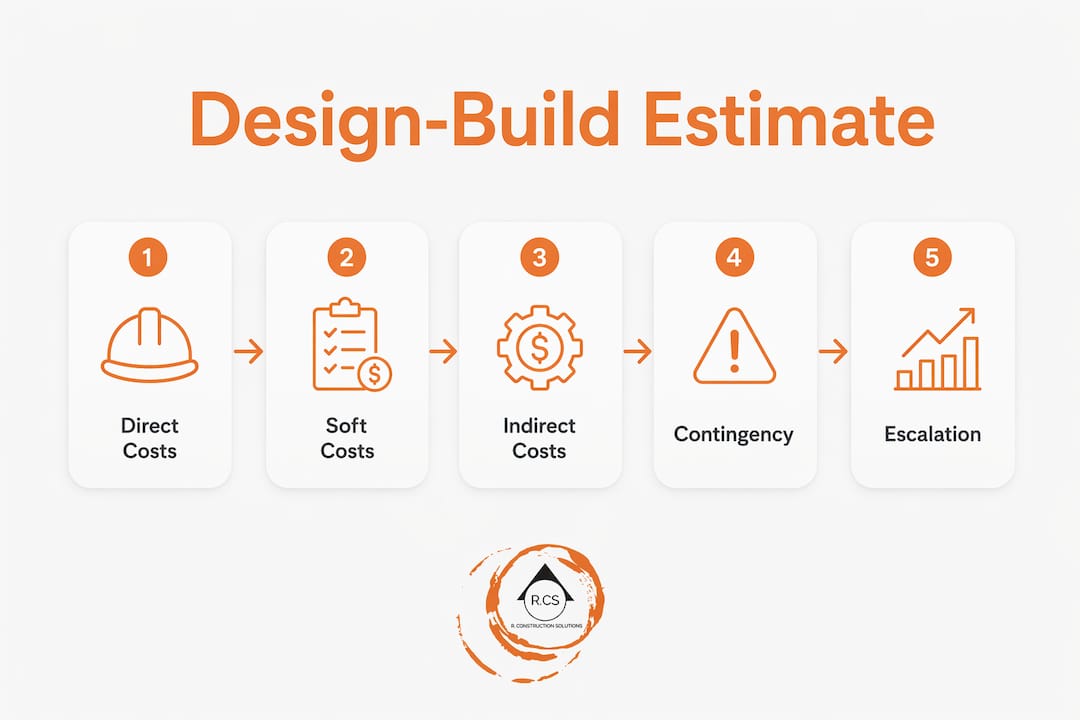
Direct costs
Direct costs are expenses tied exclusively to your project. They include:
- Labor — crew hours, wage rates, burden (payroll taxes, benefits, workers’ comp), and productivity assumptions for each scope
- Materials — quantities with price variation allowances built in, especially for steel, lumber, and concrete where market volatility is real
- Equipment — rental rates or ownership cost allocation, fuel, and operator time
- Subcontractors — scoped by trade, with their own labor, material, and overhead baked into their number
Soft costs and design fees
This is where design-build estimates diverge most sharply from traditional construction bids. All design-related costs — internal architecture staff time, third-party consultant fees, BIM modeling, and pre-construction expenses — must be charged directly to the project’s job code from the start. Firms that run these costs through overhead instead of the project budget consistently underestimate total project cost and compress their gross margin without realizing it.

Indirect costs
Indirect costs support the project without becoming part of the physical structure. They include permitting fees, legal and contract review, temporary facilities, site security, small tools, and consumables. Don’t underestimate this category on complex projects — permitting alone on a large commercial job can run into significant dollars and weeks of schedule.
Contingency and escalation
The Construction Cost Estimating Guide is clear on this: contingency is a separate line item, not a percentage quietly folded into unit prices. It covers risks associated with the base estimate’s assumptions — things that might happen, not things you know will happen. Escalation is different. It adjusts the estimate for market price movement between the time you price the work and the time you actually buy materials or execute subcontracts.
| Cost Category | What It Covers | Notes |
|---|---|---|
| Design fees | Architecture, engineering, specialty consulting | Charge to project job code from inception |
| BIM/CAD licensing | Software, modeling, coordination tools | Often missed in traditional estimates |
| Pre-construction consulting | Feasibility, value engineering, site analysis | Soft cost, front-loaded |
| Labor | Crew wages, burden, productivity assumptions | Largest direct cost on most projects |
| Materials | Quantities plus price variation allowances | Include escalation buffer for volatile items |
| Equipment | Rental rates or ownership cost allocation | Include fuel and operator time |
| Subcontractors | Trade scopes with their own overhead | Verify scope coverage before accepting number |
| Permits and legal fees | Entitlements, code review, contract review | Indirect cost, often underestimated |
| Temporary facilities | Site office, utilities, fencing, security | Indirect cost |
| Contingency | Risk reserve for base estimate unknowns | Separate line, not buried in unit prices |
| Escalation | Market price adjustment for delayed starts | Tied to procurement schedule |
Pro Tip: Document every assumption behind your contingency percentage. A 5% contingency on a well-defined scope means something very different from 5% on a schematic-level estimate with open systems. The number without the assumption is just noise.
How design-build contracts shape cost allocation and budget control
The contract structure in design-build is what makes the estimate function differently from a traditional bid. A single contract covers both design services and construction delivery. That means one entity is responsible for cost, schedule, and performance — and the estimate is the financial backbone of that commitment.
Design-build contracts frequently use a Guaranteed Maximum Price structure. Under a GMP, the design-builder is at risk for project price and completion. The owner’s maximum obligation is capped, but the design-builder absorbs cost overruns above that ceiling. This creates a direct incentive to estimate accurately and manage scope tightly throughout design.
Under a GMP contract, two contingency pools typically exist:
- Construction contingency — largely under the design-builder’s control, used for field conditions and quantity variances
- Design contingency — typically retained under greater owner control, used when design decisions drive scope changes
Continuous cost-to-complete tracking against the GMP is not optional under this structure. It’s the mechanism that prevents losses. Scope changes must be priced and documented through formal change order processes, not absorbed informally into the contingency. When scope changes are handled informally, the contingency erodes before the project is half done.
The estimator’s role in this structure goes beyond number-crunching. Per the Design-Build Done Right Best Practices Primer, the estimator acts as a value-balancing advisor, reconciling the owner’s budget ceiling with the evolving technical requirements of the design. That means pushing back on design decisions that exceed budget, proposing alternatives, and keeping the cost model current as the design matures. It’s a more demanding role than traditional estimating, and firms that staff it with junior estimators tend to find out why that’s a mistake.

Expert practices for accurate design-build estimating
Getting the estimate right in design-build requires discipline that goes beyond knowing the cost categories. Here’s what separates firms that protect their margins from those that don’t.
Treat the estimate as a living document. A design-build estimate must be continuously updated against the GMP as design progresses. Each design phase should trigger a formal estimate reconciliation. If the updated number exceeds the GMP, that’s a decision point — not something to paper over with optimism.
Document every assumption, inclusion, and exclusion. The basis of estimate report is as important as the number itself. Owners and project managers need to know what the estimate covers and what it doesn’t. Specialty equipment, owner-furnished items, specific permit fees, and phasing assumptions all need to be stated explicitly. Undocumented assumptions are where disputes are born.
Charge all design costs to the project from day one. Running internal architecture or engineering time through overhead instead of the project job code is one of the most common cost accounting errors in design-build. It makes the project look more profitable than it is during design, then creates a margin problem at construction closeout.
Keep contingency separate from the base estimate. Folding contingency into unit prices obscures risk. A transparent contingency line tells the owner and the project team exactly how much risk reserve exists and what it’s protecting against. It also makes it easier to manage contingency responsibly as the project progresses.
Build escalation clauses into contracts when start dates are uncertain. Material markets move. A project priced in Q1 that doesn’t break ground until Q4 faces real cost exposure on steel, lumber, and mechanical equipment. Escalation clauses tied to published indices protect both parties and keep the estimate honest.
Balance the owner’s budget ceiling with technical design realities. This is the core tension in design-build estimating. The Design-Build Done Right framework emphasizes that estimators must operate reliably in conditions of significant uncertainty, managing large amounts of historical price data while balancing the wants and desires of multiple stakeholders. That requires both technical skill and the confidence to deliver difficult news when the design is running ahead of the budget.
Pro Tip: Use a construction estimating checklist to verify that every cost category is covered before you submit. Missed line items in design-build don’t just affect the bid — they affect your GMP exposure for the entire project duration.
Why design-build estimates give you a real budgeting advantage
The integrated structure of a design-build estimate isn’t just an accounting preference. It produces measurable operational advantages for contractors and project managers who use it correctly.
- Single-source accountability. One contract, one estimate, one team responsible for both design and construction costs. That eliminates the finger-pointing between architect and contractor that drives disputes in traditional delivery. When the number is wrong, there’s no ambiguity about who owns the fix.
- Earlier feasibility decisions. Because the estimator is involved from team selection onward, owners get cost feedback before design dollars are spent. That means financing decisions, scope trade-offs, and go/no-go calls happen when they’re still cheap to make.
- Tighter cost control through design integration. The estimator’s presence during design phases means cost implications of design decisions are visible in real time. A structural system change that adds $200,000 gets flagged during schematic design, not during buyout.
- Faster project delivery. Design and construction phases can overlap when the cost model is managed actively. That schedule compression translates directly into reduced general conditions costs and earlier owner occupancy.
- Reduced risk exposure. Contingency is sized against documented risks, not guesswork. Escalation provisions are built into the contract. The construction contingency budget is tracked against actual commitments, not estimated loosely.
- Flexibility to respond to market conditions. When material prices shift or a subcontractor scope changes, the integrated estimate makes it straightforward to model alternatives and present the owner with real options rather than a change order surprise.
For a comprehensive look at estimate components across project types, the Won2Build field guide covers the full list in practical detail.
R Construction Solutions LLC helps you estimate with confidence
Accurate design-build estimating is one of the highest-leverage skills a growth-stage contractor can develop. A well-built estimate protects your GMP, reduces scope disputes, and gives you the cost visibility to make smart decisions throughout the project. A weak one compounds risk at every phase.
R Construction Solutions LLC works directly with contractors doing $1M–$10M in annual revenue who need to sharpen their estimating process, improve bid accuracy, and reduce cost exposure on larger jobs. Rowena Tulacz brings more than 30 years of operations and business development experience in the construction industry, with specific expertise in job costing, financial management, and the systems that keep estimates aligned with actual project performance. This isn’t generic small business advice — it’s advisory built around how construction businesses actually operate.
If your estimates are missing cost categories, your contingency is getting absorbed before construction starts, or your GMP commitments are creating margin pressure, that’s a process problem with a practical solution. Visit R Construction Solutions LLC’s consulting services to learn how the firm supports contractors with estimating support, bid preparation, and project cost management.
Key Takeaways
A complete design-build estimate integrates design fees, direct construction costs, indirect costs, contingency, and escalation into a single unified budget tracked against a Guaranteed Maximum Price.
| Point | Details |
|---|---|
| Unified budget structure | Design and construction costs belong in one document, tracked against a single GMP from project inception. |
| Soft costs must be job-coded | Design fees, BIM licensing, and internal staff time must be charged to the project job code from day one to avoid margin distortion. |
| Contingency is a separate line item | Contingency should never be buried in unit prices — it must be visible, documented, and tied to specific identified risks. |
| Estimate is a living document | Every design phase milestone requires a formal estimate reconciliation against the GMP to prevent scope drift and cost overruns. |
| R Construction Solutions LLC | Provides estimating support and bid preparation for growth-stage contractors who need tighter cost control and stronger GMP management. |