
Commercial Construction Licensing Requirements: 2026 Playbook
To meet commercial construction licensing requirements, you need to complete five actions before pulling a single permit: identify every jurisdiction involved (state or province plus county and city), confirm the exact license class for your commercial scope, satisfy exam, experience, financial, bond, and insurance requirements, complete municipal registration, and file your state or provincial application. There is no national commercial contractor license in North America. Licensing is managed by individual U.S. states and Canadian provinces, with frequent municipal overlays that can block permits even when a state license is active.
TL;DR checklist:
- Build your jurisdiction list (state/province + county/city)
- Confirm your qualifying individual and their documented experience
- Schedule required exams (business/law, trade, or NASCLA)
- Assemble financial statements, surety bond, and insurance certificates
- Complete municipal registration before pulling permits
- Submit state or provincial application
- Calendar renewals and continuing education (CE) obligations
R Construction Solutions LLC helps growth-stage contractors manage this entire process so licensing never blocks a bid.
Table of Contents
- How does commercial construction licensing work across North America?
- What is the step-by-step process to obtain your commercial license?
- What do licensing boards typically require from commercial contractors?
- How long does commercial licensing take, and what does it cost?
- Why do municipal registrations still block permits after you’re licensed?
- How do you build a proactive licensing compliance system as you scale?
- When should you hire a licensing consultant or construction attorney?
- Key Takeaways
- Licensing as a growth strategy, not a compliance checkbox
- How R Construction Solutions LLC helps you clear the licensing hurdle
- Primary sources and tools to verify licensing requirements
How does commercial construction licensing work across North America?
There is no single national license for commercial contractors in North America. Each U.S. state and Canadian province sets its own rules, and municipalities frequently add a second layer of registration on top.
| Licensing Category | Count / Status |
|---|---|
| U.S. states requiring a state-level GC license | 27 states |
| U.S. states with no statewide GC license (local regulation) | 15 states |
| States accepting the NASCLA Accredited Examination | 16 states |
| Canadian provinces with distinct licensing regimes | All provinces |
27 U.S. states require a state-level general contractor license. The NASCLA Accredited Examination is accepted in 16 states as of 2026, replacing individual state trade exams in participating jurisdictions.
The NASCLA Accredited Examination for Commercial General Building Contractors lets you carry one exam score into multiple states instead of retaking a trade exam in each one. That said, each state still requires separate bonding, insurance certificates, application fees, and registration filings. NASCLA eliminates exam repetition, not the full licensing process.
Canadian requirements differ markedly by province. Quebec’s RBQ requires licensure for all construction work. Alberta requires COR safety certification for jobs over $100,000. British Columbia builder licensing and HPO warranty enrollment carry significant annual fees. Verify each province’s official board directly.
What is the step-by-step process to obtain your commercial license?
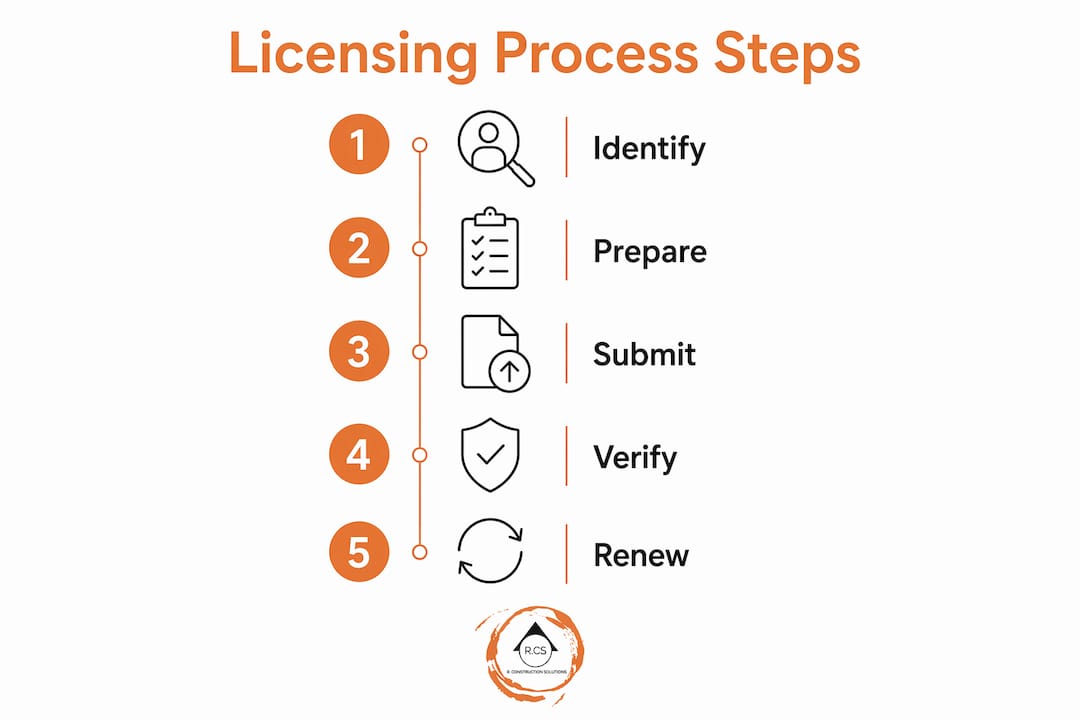
Follow these steps in order. Skipping or reordering them is the most common cause of delays.
- Map your jurisdictions. List every state or province and every county or city where you plan to work. Identify the applicable license class and any monetary thresholds that trigger licensing requirements (for example, Arkansas requires a commercial license for projects $50,000 or more).
- Identify your qualifying individual. This person must meet the board’s experience requirements and will be named on the license. Collect W-2s, affidavits, and verifiable project references. A 1099 subcontractor or part-time consultant cannot serve as a qualifier in most states.
- Confirm exam requirements and schedule testing. Most states require a business and law exam plus a trade exam. North Carolina accepts NASCLA for the Building classification. Plan 4–8 weeks of focused prep per exam portion.
- Assemble your financials. Boards typically require working capital, net worth documentation, or a surety bond. North Carolina’s Unlimited tier, for example, requires $150,000 working capital or a $1,000,000 surety bond. Financial statements must be CPA-prepared and formatted to board specifications.
- Secure bond and insurance. Obtain a surety bond from a carrier rated A- or better by A.M. Best. Secure general liability and workers’ compensation certificates. Name the municipality as an additional insured where local registration requires it.
- Submit state or provincial application and municipal registration simultaneously. Filing the state application first and the municipal registration later is a common mistake. Run both in parallel to avoid permit denial.
Pro Tip: Begin the NASCLA pathway or reciprocity steps the moment you identify a new target state, not at bid time. Exam scheduling windows and board processing times can add 8–12 weeks to your timeline.

What do licensing boards typically require from commercial contractors?
Boards across the U.S. and Canada converge on the same core requirements, though thresholds and formats vary significantly by jurisdiction.
Exam types:
- Business and law exam (contracts, lien law, OSHA, tax, state statutes)
- Trade knowledge exam (IBC, IRC, NEC, or classification-specific codes)
- NASCLA Accredited Examination as a trade-exam substitute in participating states
Experience verification: Boards require full-time supervisory or project management experience, not general construction time. Vague descriptions are rejected. Supporting documentation typically includes employer references with license numbers, dates of employment, and a description of work performed. Some boards accept sworn affidavits from licensed contractors who supervised the work.
Financial eligibility: State licensing frameworks vary widely. North Carolina ties license tiers directly to working capital with increasing thresholds for Limited, Intermediate, and Unlimited tiers. Financial statements must be CPA-prepared; generic bank statements are not accepted.
| Document | Who Signs or Attests | Where to Source |
|---|---|---|
| Financial statement (audited or reviewed) | CPA or licensed accountant | Your accounting firm |
| Surety bond | Licensed surety carrier (A-rated by A.M. Best) | Surety broker |
| GL and workers’ comp certificates | Insurance carrier | Your insurance agent |
| Qualifying individual affidavit | Company officer or RME | Company records + notary |
| Exam results | Testing vendor (PSI, Prometric) | Board-approved test center |
Bond and insurance specifics: Bond requirements vary depending on state and license class. California requires a contractor’s license bond of several tens of thousands of dollars. General liability minimums typically run $300,000–$1,000,000 per occurrence. Workers’ compensation is required in virtually every state if you have employees.
How long does commercial licensing take, and what does it cost?
Expect 4–12 weeks for application intake and board review in most states, plus additional time for exam scheduling, bond underwriting, and municipal registration processing.
Typical cost components:
- Application fees vary depending on state and license tier
- Exam prep courses: $100–$400 per portion
- Surety bond premiums are a small percentage of the bond amount annually
- General liability insurance costs vary widely for small contracting businesses.
- CPA-prepared financial statements: varies by firm
Steps that reduce delays:
- Pre-audit your financials before applying so the CPA statement is board-ready on day one
- Pre-qualify your surety carrier and confirm A.M. Best rating before the application is submitted
- Run municipal registration in parallel with the state application, not after
- Schedule exams immediately after confirming eligibility, not after the application is submitted
Why do municipal registrations still block permits after you’re licensed?
A valid state license does not guarantee permit approval at the local level. Local building departments routinely reject permit filings when local contractor registration is missing, COI language is incorrect, or subcontractor compliance gaps exist.
Common local requirements include business tax receipts, occupational licenses, local contractor registration with the building department, and certificates of insurance naming the municipality or county as an additional insured with specific wording.
Common automatic rejections:
- Missing local contractor registration at time of permit filing
- COI that does not name the correct additional insured or uses incorrect wording
- Subcontractors who are not locally registered in jurisdictions that require it
- Expired or incorrect bond documentation on file with the local office
Practical steps to avoid these traps: verify the exact COI wording required by each municipality before ordering certificates, register with the local building department before pulling any permits, and schedule a pre-submittal meeting with the city or county when entering a new market.
Pro Tip: Build a one-page municipal checklist for every metro you target. Include the registration office, required COI wording, business tax receipt requirements, and renewal dates. That single document prevents last-minute stop-work orders.
How do you build a proactive licensing compliance system as you scale?
Reactive licensing management, where you scramble to get credentials when a bid opportunity appears, is one of the most preventable growth blockers in commercial contracting.
- Assign a licensing owner. One person or a retained consultant is accountable for every jurisdiction’s status, renewal dates, and CE obligations.
- Maintain a jurisdiction master list. Track every state, province, county, and city where you hold or need credentials. Update it every time you enter a new market.
- Calendar renewals and CE. Tie renewal dates to your bid and procurement calendar so expiring credentials never jeopardize an active bid.
- Build a qualifying individual succession plan. If your qualifier leaves, your license is at risk. Identify and develop a backup before you need one.
- Use a document management system. Store sealed financial statements, COIs, bond certificates, and exam results in one accessible location. Procore and similar platforms support permit-tracking dashboards that reduce manual follow-up.
Pro Tip: Tie license renewal dates directly to your estimating and bidding workflow. A license that expires during a bid cycle can disqualify your firm from award, even if the work hasn’t started.
When should you hire a licensing consultant or construction attorney?
Some licensing situations are straightforward enough to handle internally. Others carry enough complexity or risk that outside help pays for itself quickly.
Hire a licensing consultant when:
- You are expanding into two or more new states within 90 days
- Your qualifying individual’s experience documentation is incomplete or disputed
- Financial eligibility is borderline and requires surety structuring
- You lack internal bandwidth to manage parallel state and municipal filings
Hire a construction licensing attorney when:
- A board has issued a disciplinary notice or initiated a complaint
- A contract’s enforceability is being challenged on licensing grounds
- You need a legal opinion on scope-of-work classifications
Consultant procurement checklist:
- Request references from contractors in your revenue range ($1M–$10M)
- Ask for sample deliverables: a jurisdiction map, a completed application package, and a renewal calendar
- Confirm confidentiality practices for financial statements and qualifying individual data
- Verify the consultant’s familiarity with your target states and municipal overlays
A construction advisor who has managed multi-state licensing for growth-stage firms will compress your timeline and reduce rejection risk significantly.
Key Takeaways
Meeting commercial construction licensing requirements is a multi-jurisdiction process requiring jurisdiction mapping, qualified personnel, board-ready financials, A-rated surety bonds, and proactive municipal registration before any permit is filed.
| Point | Details |
|---|---|
| No national license exists | You must satisfy each state, province, and municipality separately — 27 U.S. states require a state-level GC license. |
| NASCLA reduces exam burden | The NASCLA Accredited Examination is accepted in 16 states as of 2026, eliminating repeated trade exams for multi-state expansion. |
| Municipal registration is non-negotiable | A valid state license does not guarantee permit approval; local registration and correct COI wording must be in place first. |
| Financial readiness determines your tier | Working capital, net worth, or surety bond thresholds determine which license tier you qualify for — prepare financials early. |
| R Construction Solutions LLC | Provides jurisdictional mapping, application assembly, financial readiness review, and municipal registration support for growth-stage contractors. |
Licensing as a growth strategy, not a compliance checkbox
Most contractors treat licensing as a one-time paperwork event. That framing costs them bids, delays mobilization, and in some cases voids contract enforceability entirely. The contractors who scale past $5M in commercial revenue consistently treat their license portfolio the way they treat their bonding capacity: as a strategic asset that either opens or closes market opportunities.
The qualifying individual is the most underestimated risk in this entire system. Firms lose their license eligibility when a key employee leaves and no succession plan exists. That is not a licensing problem. It is an organizational risk management problem, and it belongs in your retention and HR strategy, not just your compliance checklist.
Proactive licensing also changes how you bid. When your credentials are current, your COIs are correctly worded, and your municipal registrations are already in place, you can respond to opportunities in new markets within days instead of weeks. That speed advantage compounds over time.
The 30/90/180-day framework in this article is not theoretical. Growth-stage firms that map jurisdictions, pre-qualify their surety, and build a licensing calendar before they need it consistently report fewer bid disqualifications and faster mobilization on awarded contracts.
How R Construction Solutions LLC helps you clear the licensing hurdle
Licensing complexity should not be the reason you pass on a profitable bid. R Construction Solutions LLC works directly with commercial contractors doing $1M–$10M in annual revenue who are ready to scale regionally but need a structured process to get there.
Consulting deliverables include jurisdictional mapping across U.S. states and Canadian provinces, application assembly and financial readiness review, surety carrier introductions, municipal registration and permit submittal coordination, and renewal and CE calendar management. You get a clear picture of exactly what you need, in every market you are targeting, with a timeline that fits your bid pipeline.
Ready to remove licensing as a growth blocker? Request a licensing assessment with R Construction Solutions LLC and get a clear action plan within days.
Primary sources and tools to verify licensing requirements
Use these official sources to confirm requirements before applying. Never rely on aggregators alone.
Official licensing boards and regulatory bodies:
- NASCLA member-state list and exam information
- Your state contractor licensing board (search “[your state] contractor licensing board” for the official site)
- Your provincial licensing authority (RBQ for Quebec, HPO for BC, Service Alberta for Alberta)
- Local municipal building department (search “[your city] building department contractor registration”)
Federal identifiers (required for certain work):
- IRS EIN: required for all business entities
- SAM.gov registration: required if pursuing federal construction contracts
Digital tools and resources:
- PSI and Prometric: exam scheduling for most state licensing boards
- A.M. Best: verify surety carrier ratings before purchasing a bond
- Procore: permit-tracking and document management for active license portfolios
- Your state’s online application portal (California’s CSLB, Florida’s DBPR, and others are fully online)
| Resource | Purpose | How to Access |
|---|---|---|
| NASCLA.org | Exam reciprocity and member-state list | nascla.org |
| State contractor licensing board | Application, renewal, and status verification | Search “[state] contractor licensing board” |
| Municipal building department | Local registration and COI requirements | Search “[city/county] building department” |
| PSI / Prometric | Exam scheduling | psiexams.com / prometric.com |
| A.M. Best | Surety carrier rating verification | ambest.com |
| SAM.gov | Federal contractor registration | sam.gov |
This article provides general information about commercial construction licensing requirements in North America. Requirements change frequently. Verify current rules directly with each jurisdiction’s official licensing board or a qualified professional before submitting any application.