
Why Construction Firms Adopt Procore Systems in 2026
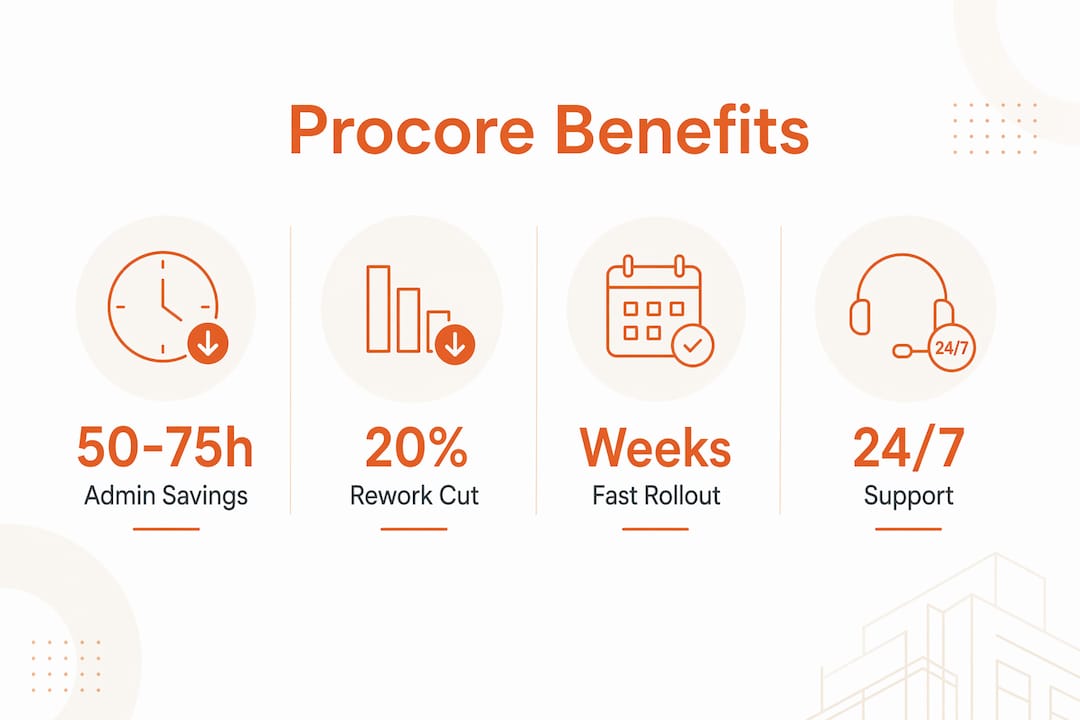
Procore is a cloud-based construction management platform that gives field teams and office staff a single place to manage drawings, schedules, budgets, and daily logs in real time. Construction firms adopt Procore systems because the platform replaces fragmented spreadsheets, paper logs, and disconnected email chains with one live data environment. The results are measurable. Firms report 50–75 hours saved weekly on administrative tasks after adoption. That kind of time recovery does not come from working harder. It comes from eliminating duplicate data entry and giving every team member access to the same current information, whether they are on the job site or in the office.
Why construction firms adopt Procore systems for operational efficiency
The core operational benefit of Procore adoption is time. Firms that implement the platform report 45% increases in usage shortly after training, which signals that field teams actually engage with the tool rather than avoiding it. That engagement translates directly into fewer hours spent chasing paperwork and more hours spent building.
Specific efficiency gains show up in three areas:
- Timecard automation: Field supervisors confirm hours digitally instead of collecting paper timesheets. Payroll accuracy improves, and the back-and-forth between field and accounting drops significantly.
- Daily logs: Superintendents complete logs on a mobile device in real time. Office staff receive accurate, timestamped records without making phone calls or waiting for end-of-day reports.
- RFI and submittal tracking: Procore routes requests automatically, timestamps every response, and keeps a full audit trail. Teams stop hunting through email threads to find the latest answer.
The shift from data entry to data confirmation is the key design principle behind Procore’s field tools. Field teams confirm rather than create records, which reduces friction and errors at the source. For a mid-sized contractor managing multiple active projects, that difference in daily workflow adds up to dozens of recovered hours each week.
Pro Tip: Start your Procore rollout with timecards and daily logs. These modules deliver visible wins within the first two weeks and build the organizational momentum needed to adopt more complex features like cost management and scheduling.
How does Procore reduce rework and schedule delays?
Rework is one of the most expensive problems in construction. Building from an outdated drawing or missing a change order costs money, time, and credibility with owners. Procore addresses this by making the latest version of every document available to every stakeholder in real time.
Firms using Procore report a 20% reduction in rework and change-order risk. They also close out projects approximately one week sooner on average. Those numbers reflect what happens when field crews stop guessing and start confirming.
| Risk Factor | Impact Without Procore | Impact With Procore |
|---|---|---|
| Outdated drawings in field | High frequency of rework | Real-time access to current drawings |
| Change-order disputes | Manual tracking, frequent gaps | Full audit trail with timestamps |
| Project closeout speed | Extended punch list process | Digital punch lists accelerate exit |
| Rework and change-order risk | Uncontrolled | Reduced by approximately 20% |
| Schedule delays | Common due to data silos | Reduced through live document access |
A cloud-based single source of truth eliminates the silos that cause these problems. When every subcontractor, project manager, and owner’s representative works from the same live documents, the number of conflicting instructions drops. Decisions get made faster because the data is already there. The role of the project manager in construction shifts from firefighting to forward planning, which is where their skills create the most value.
Digital punch lists deserve specific attention. When closeout tasks are tracked in Procore rather than on paper or in a shared spreadsheet, items get assigned, completed, and verified faster. That one-week improvement in closeout speed is not a minor convenience. On a $10 million project, one week of reduced general conditions costs can represent tens of thousands of dollars returned to the bottom line.
What implementation strategies enable successful Procore adoption?
Procore adoption fails when firms treat it as an IT deployment. It succeeds when leadership treats it as a change management project. The distinction matters because the technology is only as effective as the people using it consistently.
A phased rollout is the most reliable path to full adoption. Here is the sequence that works:
- Start with timecards and daily logs. These tools are simple, touch every field employee daily, and produce immediate, visible results. Early wins build confidence and reduce resistance.
- Add RFIs and submittals in week two or three. Once field teams are comfortable logging into Procore daily, adding document management feels like a natural extension rather than a new burden.
- Introduce cost management and scheduling after field adoption is stable. These modules require more training and process alignment, but they land more smoothly when the team already trusts the platform.
- Assign a dedicated implementation manager. Phased rollout approaches with a named internal owner enable firms to complete the transition in weeks rather than months.
- Run short, frequent training sessions tied to current project work. A 20-minute session that walks a superintendent through logging a real RFI on their active project beats a two-hour classroom session every time.
The leadership mandate piece is non-negotiable. Without formal SOPs and enforcement, employees revert to legacy processes within weeks. That reversion is not laziness. It is human nature. People default to what they know when the new system feels optional. Making Procore usage a documented requirement, tied to performance expectations, closes that gap.
Pro Tip: Hold a 15-minute weekly check-in during the first month of rollout. Ask field supervisors what is working and what is confusing. Small adjustments made early prevent large resistance problems later.
Procore’s 24/7 customer support and mobile-first design reduce the learning curve significantly. Field workers who are comfortable with a smartphone can navigate the app without extensive technical training. That accessibility is a major reason why construction project management tools built on Procore’s model have gained traction across firms of all sizes.
How does Procore support scaling and quality in growing firms?
Growth without systems creates chaos. A firm managing three projects can run on gut feel and personal relationships. A firm managing fifteen projects cannot. Technology becomes necessary to scale with consistent quality and financial predictability as project complexity increases.
Procore replaces gut-feel decisions with standardized digital workflows. Every project follows the same process for logging daily conditions, tracking change orders, and managing submittals. That consistency means a project manager stepping onto a new job site can orient themselves in minutes rather than days. It also means that financial forecasting becomes reliable because the data feeding it is accurate and current.
Key benefits for firms scaling from regional to multi-market operations include:
- Consistent quality across job sites: Standardized workflows mean every superintendent follows the same process, regardless of location or project type.
- Real-time financial visibility: Cost management tools in Procore tie field data directly to budget tracking, so project managers see cost trends before they become overruns.
- Faster onboarding for new hires: New project managers and superintendents learn one system rather than adapting to each project manager’s personal filing method.
- Stronger owner relationships: Owners who receive real-time access to project data through Procore’s owner portal report higher confidence in the contractor’s professionalism.
- Reduced dependence on key individuals: When data lives in a shared platform rather than one person’s email, the firm is protected when staff turn over.
Process standardization across teams is the foundation of sustainable growth. Procore provides the platform. Leadership provides the discipline to use it consistently. Together, they create the conditions for a firm to grow without losing control of quality or profitability. The project manager’s role evolves from coordinator to strategic operator when the platform handles the data logistics.
Key Takeaways
Construction firms that adopt Procore systems gain measurable efficiency, reduced rework, and the operational consistency needed to scale profitably.
| Point | Details |
|---|---|
| Time savings are immediate | Firms report 50–75 hours saved weekly on admin tasks after Procore adoption. |
| Rework drops with live data | Real-time document access reduces rework and change-order risk by approximately 20%. |
| Phased rollout drives success | Starting with timecards and daily logs builds momentum and reduces resistance. |
| Leadership mandate is required | SOPs and enforcement prevent teams from reverting to legacy manual processes. |
| Scaling requires standardization | Consistent digital workflows enable quality control and financial forecasting across multiple projects. |
What I’ve learned watching firms go all-in on Procore
The firms that get the most out of Procore are not the ones with the biggest technology budgets. They are the ones whose leadership decided, clearly and publicly, that the old way was no longer acceptable.
I have seen contractors spend months debating which modules to activate while their field teams kept using paper logs. The platform sat unused because no one made it mandatory. Then a project manager on one job site started using daily logs consistently, and the superintendent on the next project noticed how much faster closeout went. That peer example did more than any training session.
What Procore actually does, at its best, is shift the culture of a firm. Field teams stop feeling like they are doing paperwork for the office. They start feeling like they are contributing to a shared record that protects everyone, including themselves, when disputes arise. That shift in perception is worth more than any single feature.
The firms I have seen struggle with adoption almost always share one trait. They treated Procore as a software purchase rather than an operational commitment. Technology does not fix broken processes. It amplifies whatever process you already have. If your daily log discipline is weak before Procore, the platform will expose that weakness faster, not hide it.
My honest recommendation is to pick two modules, make them mandatory on day one, and hold the line for 30 days. The resistance will peak in week two and drop sharply by week four. After that, the team starts asking when you are adding the next module.
— Rowena
How Rconstructionsolutions supports your Procore implementation
Rconstructionsolutions works with contractors who are ready to move from manual processes to digital operations, and who want the transition to stick.

With over 30 years of hands-on construction experience, the team at Rconstructionsolutions has guided firms through Procore rollouts that go beyond software setup. The focus is on process standardization, team training, and the change management work that determines whether adoption succeeds or stalls. Firms scaling from $5 million to $50 million in revenue need more than a platform. They need a plan that connects the technology to their actual workflows and financial goals. Rconstructionsolutions provides that plan through construction consulting services built specifically for contractors who want measurable results, not generic advice.
FAQ
What is Procore used for in construction?
Procore is a cloud-based platform used to manage drawings, schedules, budgets, daily logs, RFIs, and submittals across construction projects. It connects field teams and office staff through a single live data environment.
How much time can firms save by adopting Procore?
Firms report saving 50–75 hours weekly on administrative tasks after implementing Procore, primarily through automated timecards and digital daily logs.
How long does Procore implementation take?
A phased rollout starting with timecards and daily logs can be completed in weeks. Dedicated implementation managers and structured training accelerate the transition significantly.
Does Procore reduce rework on construction projects?
Procore reduces rework and change-order risk by approximately 20% by giving all stakeholders real-time access to the latest drawings, RFIs, and project documents.
What is the biggest reason Procore adoption fails?
Adoption fails when firms treat Procore as an IT tool rather than a change management effort. Without formal SOPs, enforcement, and leadership commitment, teams revert to manual legacy processes within weeks.