
Construction Advisor Role in Business Growth: 2026 Guide | R. Construction Solutions
A construction advisor is defined as a strategic partner who guides contractors through financial decisions, risk management, and operational planning to drive measurable business growth. This role goes well beyond traditional project management. Where a project manager executes tasks, a construction advisor shapes the decisions that determine whether your business grows profitably or simply gets busier. The role of construction advisor in business growth covers everything from bonding capacity and working capital strategy to bid pricing and contract risk review. Organizations like the ICAC (Institute of Construction Advisor Certification) and firms like Vessel Advisors have documented how this strategic function separates contractors who scale from those who stall.
How does a construction advisor drive business growth?
Early engagement of construction advisors during the planning phase prevents the most expensive mistakes in construction. Feasibility errors caught before design begins cost a fraction of what they cost to fix during execution. Approval delays, zoning conflicts, and scope misalignments are all problems that surface late when no advisor is involved early.
When you bring an advisor in at the pre-construction stage, they coordinate stakeholders before conflicts develop. They align architects, engineers, permitting authorities, and subcontractors around a shared project framework. That coordination alone can compress timelines by weeks on mid-sized commercial projects.
Timing is critical; early advisory engagement allows direct influence over procurement strategy, contract structure, and program setup. Waiting until problems arise reduces the advisor’s impact and raises recovery costs significantly. The difference between proactive and reactive advisory is often measured in six figures on projects above $2 million.
- Feasibility review before design locks in scope and budget
- Stakeholder alignment reduces approval delays and scope creep
- Procurement strategy set early produces better subcontractor pricing
- Contract structure reviewed before signing prevents costly disputes
- Program setup from day one keeps scheduling realistic and trackable
Pro Tip: Bring your construction advisor into the project before you submit for permits, not after. The earlier they influence procurement and contract terms, the greater the return on their fee.
Construction consultants typically charge 1%–5% of total project cost depending on scope and phase involvement. On a $5 million project, that is $50,000–$250,000. When advisor involvement prevents a single major redesign or contract dispute, that fee pays for itself many times over.
What strategic benefits do advisors provide beyond project management?
The shift from technician to trusted advisor is the most important transition in construction consulting. Construction advisors move from task execution to strategic influence, justifying decisions to lenders and bonding companies while adding high-value judgment that internal teams cannot provide. This is the difference between someone who manages a schedule and someone who tells you whether to take the project at all.
Controllers handle accounting accuracy, but strategic advisors manage bonding strategy, bid pricing, backlog analysis, and working capital planning. Those functions drive profitable growth. A contractor who only has a controller knows their numbers. A contractor with a strategic advisor knows what those numbers mean for their next move.
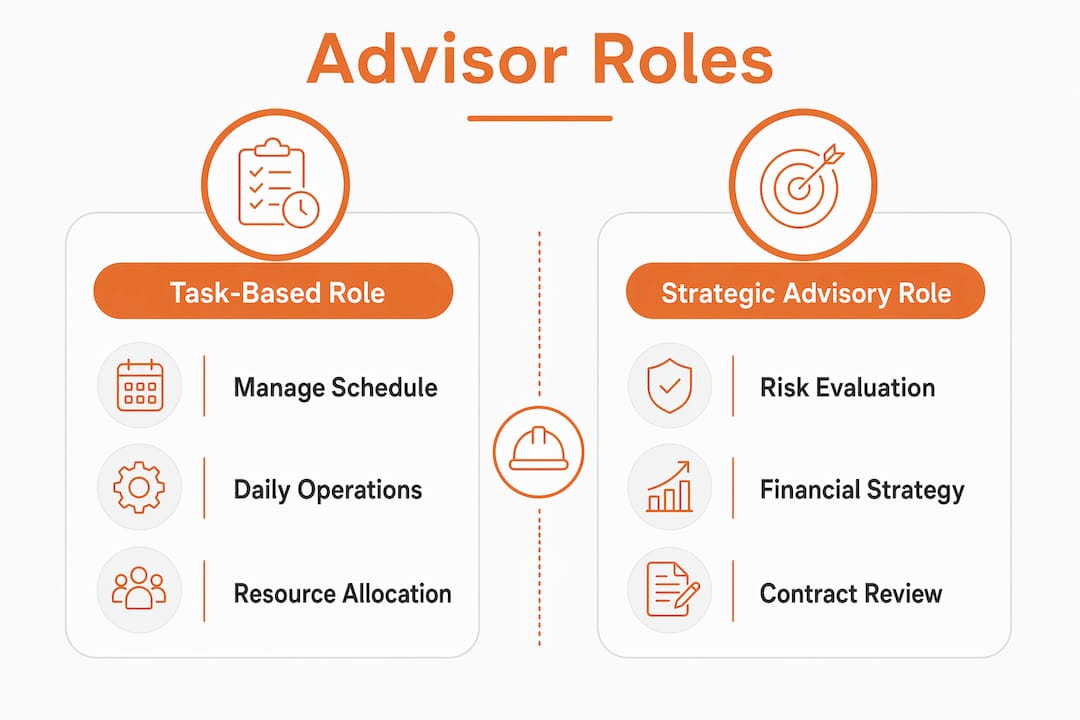
Objectivity from advisors allows unbiased contract and risk review, helping identify weak project points that internal teams miss due to proximity. When you have worked with a subcontractor for years, you may overlook contract language that exposes you to liability. An outside advisor reads that contract without the relationship bias.
| Task-Based Role | Strategic Advisory Role |
|---|---|
| Manages project schedule | Evaluates whether project fits growth strategy |
| Tracks budget spending | Analyzes WIP schedule and job costing trends |
| Coordinates subcontractors | Structures contracts to reduce risk exposure |
| Reports on project status | Advises on bonding capacity and bid pricing |
| Handles day-to-day issues | Identifies systemic operational weaknesses |
Pro Tip: Ask any advisor candidate to walk you through a real contract risk review they performed. If they cannot show you specific language they flagged and the outcome it prevented, they are operating as a technician, not a strategic partner.
Advisors who engage before risks crystallize create the most value by influencing critical choices rather than just executing tasks. That principle separates advisory services in construction from standard consulting engagements.
How do advisors produce measurable financial results?
Professional advisory services can save millions by reorganizing timelines, renegotiating supplier contracts, and implementing cost-saving technologies. These are not theoretical savings. Real-world cases document advisors restructuring a project’s critical path to eliminate three weeks of general conditions costs on a $10 million build, producing savings above $180,000 on labor and equipment alone.

Supplier contract renegotiations are another high-return area. An advisor reviewing your material procurement agreements may identify pricing that has not been benchmarked in two or three years. On large residential or commercial projects, renegotiating concrete, steel, or lumber supply contracts can reduce direct costs by 3%–8%. That margin improvement flows directly to your bottom line.
Financial oversight through WIP (work-in-progress) schedule analysis and job costing review gives advisors a real-time view of project health. Most contractors rely on accounting reports that reflect what already happened. Advisors use WIP data to project where a job is heading, flagging overbilling risks, underbilling exposure, and cost overruns before they become losses.
Key operational improvements contractors see from advisor involvement include:
- Reduction in change order disputes through clearer contract scope definitions
- Faster payment cycles from improved billing documentation and lien waiver processes
- Lower bonding costs as advisors help contractors present stronger financial profiles to surety companies
- Better subcontractor performance through structured prequalification and accountability frameworks
- Improved cash flow forecasting through integrated job costing and WIP reporting
The impact of construction advisors on financial performance is most visible when contractors scale. Rconstructionsolutions has documented mid-sized firms growing from $5 million to $50 million in revenue when advisory services addressed both operational efficiency and financial leadership simultaneously.
What steps help contractors integrate advisors effectively?
Selecting the right advisory engagement model determines how much value you extract. Three structures work well for most contractors.
- Fixed-fee engagements work best for defined projects or specific deliverables like a contract review, a WIP audit, or a bonding strategy assessment. You know the cost upfront and the scope is clear.
- Retainer models suit contractors who need ongoing strategic support across multiple projects or business functions. Monthly retainers typically cover financial oversight, bid review, and periodic operational assessments.
- Milestone-based models tie advisor fees to project phases or business outcomes. This structure aligns advisor incentives with your results and works well for growth-focused engagements.
Successful advisory engagements improve contractor capabilities and governance rather than creating dependency on outside support. The best advisors transfer knowledge to your team. If your advisor is still solving the same problems for you after 18 months, the engagement is not structured correctly.
Best practices for getting the most from your advisor relationship:
- Define clear deliverables and success metrics before the engagement starts
- Share financial data, project reports, and operational workflows openly
- Schedule regular review sessions, not just crisis calls
- Assign an internal point of contact who owns the advisor relationship
- Evaluate the engagement quarterly against agreed KPIs
Before you hire, use a structured contractor’s guide to questions to assess advisor fit. Ask about their direct experience with contractors at your revenue level, their approach to financial oversight, and how they measure success. A strong advisor will answer those questions with specifics, not generalities.
You should also clarify whether the advisor has experience with construction safety planning during pre-construction phases, since safety plan gaps are a common source of project delays and insurance complications.
Key takeaways
A construction advisor’s greatest value comes from early, strategic engagement that shapes financial decisions, contract structures, and operational systems before problems develop.
| Point | Details |
|---|---|
| Engage advisors early | Bring advisors in before permits and procurement to influence critical project foundations. |
| Strategic role vs. accounting | Advisors manage bonding, bid pricing, and backlog; controllers manage accounting accuracy. |
| Objectivity reduces risk | External advisors identify contract and schedule weaknesses that internal teams overlook. |
| Measurable financial impact | Advisor involvement produces savings through timeline restructuring, supplier renegotiation, and WIP oversight. |
| Build internal capability | Structure engagements to transfer knowledge to your team and avoid long-term dependency. |
What i have learned about advisors after 30 years in this industry
The most common mistake I see contractors make is treating advisory services as a last resort. They call an advisor when a project is already in trouble, a dispute has escalated, or cash flow has hit a wall. At that point, the advisor is doing damage control, not growth strategy. The value ceiling drops dramatically.
What I have observed over decades of working with contractors is that the ones who grow consistently treat their advisor the way a CFO treats a board. They bring them in before decisions are made, not after. They share uncomfortable financial data. They ask hard questions and expect direct answers.
There is also a misconception that advisory services are only for large general contractors. Mid-sized residential and commercial contractors at the $3 million to $15 million revenue range often have the most to gain. They are large enough to have complex financial and operational problems but small enough that those problems have not yet been systematically addressed.
The shift from transactional consulting to true partnership takes time. It requires trust, transparency, and a willingness to be challenged. Contractors who build that kind of relationship with their advisor do not just complete better projects. They build businesses that can survive market downturns, scale without chaos, and attract better clients.
The contractors I have seen struggle most are those who hire an advisor, resist sharing real numbers, and then wonder why the engagement did not move the needle. Advisors work with the information you give them. Give them everything.
— Rowena
Ready to put strategic advisory to work for your business?
Rconstructionsolutions delivers construction consulting services built specifically for contractors who are ready to grow with intention. With over 30 years of hands-on construction experience, the team at Rconstructionsolutions goes beyond generic advice to provide financial leadership, operational oversight, and project advisory that produce real results.

Whether you are a residential contractor scaling past $5 million or a commercial firm targeting $50 million, Rconstructionsolutions tailors every engagement to your specific operational and financial goals. Explore practical tools and templates at The Sandbox to support your team between advisory sessions. The next step toward profitable, sustainable growth starts with a conversation.
FAQ
What is a construction advisor’s primary role?
A construction advisor is a strategic partner who guides contractors on financial decisions, risk management, bonding strategy, and operational planning. Their role extends well beyond project management to influence business growth outcomes directly.
When should a contractor hire a construction advisor?
Engagement early in feasibility or pre-design allows advisors to influence critical project foundations and reduce future risk. Waiting until problems arise limits the advisor’s impact and increases recovery costs.
How much do construction advisory services cost?
Construction consultants typically charge 1%–5% of total project cost, depending on scope and phase involvement. Retainer and fixed-fee models are also common for ongoing strategic support.
How do advisors differ from project managers?
Project managers execute tasks and manage day-to-day operations. Construction advisors influence strategic decisions including bid pricing, contract structure, bonding capacity, and financial oversight that determine long-term profitability.
How do i assess whether an advisor is the right fit?
Review a structured list of questions to evaluate advisor experience, financial expertise, and approach to building your internal team’s capabilities. Ask for specific examples of measurable outcomes they have delivered for contractors at your revenue level.