
How to Hire the Right Team for a Scaling Construction Firm
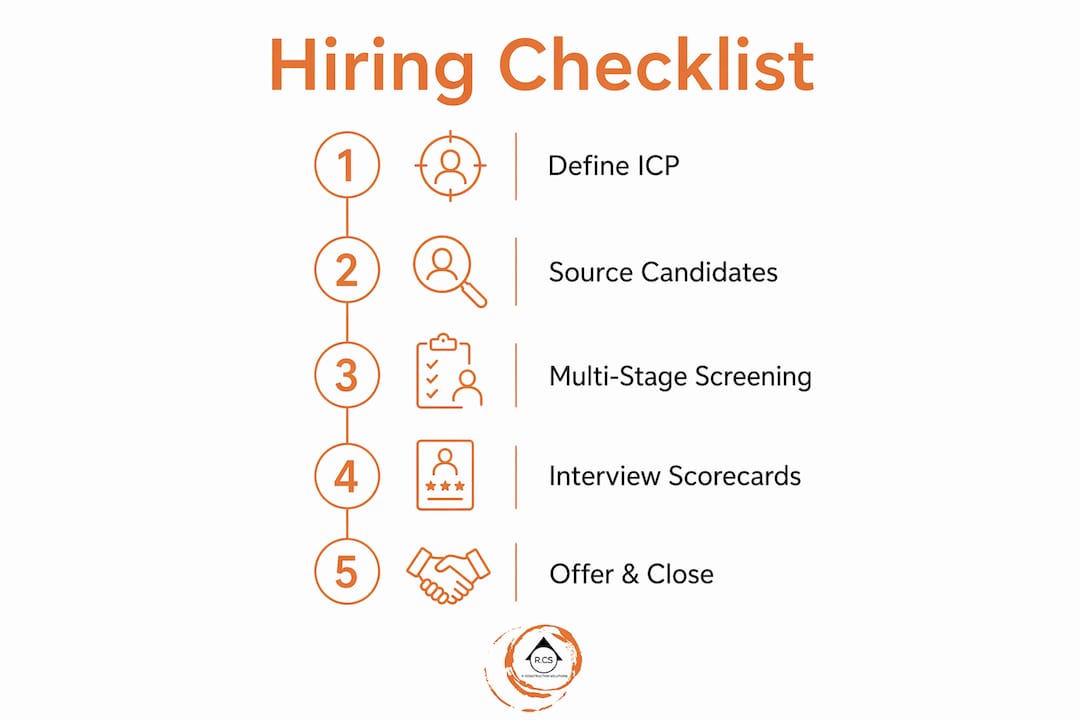
The single highest-impact move you can make right now is to build a repeatable hiring funnel: define an outcome-focused Ideal Candidate Profile, run every candidate through multi-stage screening, score interviews with standardized scorecards, make a competitive offer, and execute a structured 30/60/90 onboarding plan. That system, not a single great hire, is what lets a scaling construction business grow without breaking.
Start this week with three tasks: (1) write an outcome-focused ICP for your highest-priority open role, (2) map the sourcing channels you will use, and (3) schedule a structured interview with a scored rubric. According to a 2026 industry survey, 63% of contractors plan to increase headcount this year, yet more than 80% report persistent difficulty filling both craft and salaried positions. Firms that treat recruiting as an ongoing operational discipline, the same way they treat estimating or project controls, protect their schedule and their margin. R Construction Solutions LLC was built to help contractors do exactly that.

Table of Contents
- What does a hiring checklist for scaling contractors look like?
- Who should you hire first when your firm is scaling?
- How do you build an outcome-focused Ideal Candidate Profile?
- Which sourcing channels and screening steps actually work for construction hiring?
- How do you use interview scorecards to make better hiring decisions?
- How do you craft offers that close hires in a competitive market?
- What does a 30/60/90 onboarding plan look like for construction hires?
- What are realistic hiring timelines and cost ranges for a growing firm?
- How R Construction Solutions LLC helps growth-stage contractors hire and scale
- Key Takeaways
- The hiring mistake most owners make, and what to do instead
- Templates, checklists, and sources to use now
- Ready to build a hiring system that scales with your firm?
What does a hiring checklist for scaling contractors look like?
You do not need a 40-step HR manual. You need a short, repeatable checklist you can run every time a role opens. Work through these steps in order:
- Define role priority. Confirm which open role most directly threatens schedule, margin, or capacity right now.
- Draft an outcome-focused ICP. Write what success looks like at 30, 60, and 90 days, not just a list of years of experience.
- Choose sourcing channels. Pick two or three channels that actually reach your candidate type: trade schools, referrals, industry job boards, or a specialized recruiter.
- Start multi-stage screening. Resume review, a skills or work-sample check, a phone screen, and a structured interview, in that order.
- Schedule structured interviews. Use a scored rubric so every interviewer grades the same criteria.
- Prepare an offer package. Know your compensation band, travel or relocation details, and start date before you extend an offer.
- Plan 30/60/90 onboarding. Assign a mentor, set first-project responsibilities, and schedule milestone check-ins.
For estimator roles specifically, the Construction Estimator Hiring Checklist from R Construction Solutions LLC gives you a ready-to-run screening template you can adapt immediately.
Pro Tip: The panic hire, the one you make because a project mobilizes in three weeks and you have nobody, almost always costs more than the vacancy did. Run a small, continuous sourcing effort even when you are not actively filling a role. Keep two or three warm candidates in your pipeline at all times.
Who should you hire first when your firm is scaling?
Role priority is not about org charts. It is about which vacancy most directly threatens your next project’s schedule or your firm’s margin. Here is the sequencing that holds across most growth-stage contractors:
- Project manager. A missing PM delays mobilization, erodes client trust, and forces the owner to manage the job. Hire this role before you commit to a contract you cannot staff.
- Superintendent. Field execution depends on this person. Without a qualified superintendent, schedule slippage and rework costs compound fast.
- Senior estimator. Winning the right work at the right margin is a revenue function. A weak or absent estimator means you are either leaving money on the table or buying work you cannot deliver profitably.
- Foreman / lead trades. Once PM and superintendent are covered, foreman-level hires protect daily productivity and crew retention.
- Specialty trades and labor. Fill these last, but plan for them earliest, because skilled trades in carpentry, electrical, plumbing, HVAC, and equipment operation remain in especially short supply across North America.
The decision criteria are straightforward: look at your pipeline for the next 90 days, identify the contract type and project size, then map the skill gaps against those requirements. A single missing superintendent on a commercial project can delay mobilization by weeks, and that delay translates directly to overhead burn and potential liquidated damages. The U.S. construction industry needs to bring in around 349,000 net new workers in 2026 alone to maintain equilibrium, which means the competition for every qualified candidate is real and immediate.

How do you build an outcome-focused Ideal Candidate Profile?
A resume-focused job description tells candidates what they need to have. An outcome-focused ICP tells them what they need to accomplish. That shift changes who applies and how you evaluate them.
A solid ICP covers six elements:
- Core responsibilities. Two or three sentences on what the role owns day-to-day.
- Must-have technical outcomes. Specific deliverables: “Manage submittals and RFIs for a $4M commercial tenant improvement within a 14-week schedule.”
- Decision authority. What can this person approve without escalation? Budget threshold, subcontractor selection, change orders?
- Reporting lines. Who does this person report to, and who reports to them?
- Relocation and travel requirements. State these clearly upfront. Experienced PMs and superintendents value transparency about project scope and reporting hierarchy; vague job postings drive off the candidates you most want.
- Success in 90 days. One concrete statement of what “good” looks like at the end of the probation period.
Sample 90-day success statement for a project manager role:
“By Day 90, this PM has taken full ownership of the submittal log, has conducted at least two owner progress meetings independently, and has delivered a three-week lookahead schedule that the superintendent confirms is accurate and executable.”
That statement does more screening work than a bullet list of certifications. Candidates who cannot picture themselves doing it will self-select out. Candidates who can will show up to the interview with specific examples.
Pro Tip: Build your ICP from the last time the role was done well, not from a generic job description template. Ask the person who previously held the role, or the supervisor who worked with them, what the first 90 days actually looked like when things went right.
Which sourcing channels and screening steps actually work for construction hiring?
Construction talent does not concentrate on general job boards. You need to go where the candidates are, and then run a screening process tight enough to protect your time.
Sourcing channels that reach construction candidates
- Trade schools and apprenticeship programs. Community colleges with construction management programs and union apprenticeship pipelines are underused by most growth-stage firms.
- Employee referrals. Tie referral bonuses to retention milestones (90 days, six months) rather than to the hire date. This aligns the referring employee’s incentive with your actual goal.
- Industry job boards. Construction-specific boards reach candidates who are actively looking within the trade.
- Proactive market mapping and direct outreach. Senior leaders are often off the market before a project even starts. Reaching out to passive candidates 3–6 months ahead of preconstruction roles, and 60–90 days ahead of PM and superintendent needs, reduces schedule risk significantly.
- Specialized recruiters. For critical roles, a recruiter with a pre-vetted talent pool shortens time-to-fill and reduces the risk of a bad hire. Experienced team leaders in construction are often placed through networks that general job boards never reach.
- AI-assisted sourcing. 16% of construction firms now use AI for recruitment, training, or HR functions. Automated resume screening and outreach sequencing can reduce administrative load on small teams.
A multi-stage screening workflow
Run candidates through these stages in sequence:
- Resume screen. Filter for role-relevant project types, contract values, and certifications.
- Skills check or work sample. For estimators, a takeoff exercise. For PMs, a schedule review or RFI response scenario.
- Phone screen. Fifteen to twenty minutes to confirm compensation expectations, availability, and basic fit before investing in a full interview.
- Structured interview. Scored rubric, same questions for every candidate.
- Reference and background check. Collect documents early. Pending background check statuses often reflect manual verification delays at county courts rather than actual disqualifying findings. Set candidate expectations upfront and ask for employment verification documents at the offer stage to avoid last-minute withdrawals.
Track these four metrics: time-to-fill for critical roles, offer acceptance rate, first-year retention, and vacancy-related schedule slippage. These four KPIs connect your hiring performance directly to project outcomes.
How do you use interview scorecards to make better hiring decisions?
Gut feel is not a hiring system. A standardized scorecard forces every interviewer to grade the same criteria on the same scale, which makes candidate comparisons defensible and reduces the influence of unconscious bias.
Use a 1–5 scale across these five dimensions:
- Technical competence. Can they do the specific work this role requires? Ask for a concrete example from a comparable project.
- Project fit. Does their experience match your project type, contract size, and delivery method?
- Safety mindset. How do they describe their approach to site safety? Listen for ownership language, not just compliance language.
- Communication. How clearly do they explain a complex situation? Construction communication failures are expensive.
- Culture fit. Do they demonstrate accountability, follow-through, and respect for trades and clients?
Standardized 1–5 scorecards are critical to reducing bias and preventing subjective decisions. Grade candidates on identical criteria rather than comparing impressions after the fact.
Sample question bank by role
Project manager: “Walk me through how you managed a scope change that threatened your schedule. What did you do, and what was the outcome?”
Superintendent: “Describe a time when a subcontractor fell behind. How did you identify it early, and what did you do to recover the schedule?”
Estimator: “Tell me about a bid where your initial estimate was significantly off from the final cost. What caused the gap, and what did you change afterward?”
After each interview, have every interviewer submit scores independently before any group discussion. This prevents the first person to speak from anchoring everyone else’s assessment.
Pro Tip: Calibrate your interviewers before the first round. Agree on what a “3” looks like for each criterion, not just what a “5” looks like. Calibration takes 20 minutes and eliminates most of the score variance that makes comparisons meaningless.
How do you craft offers that close hires in a competitive market?
A strong offer is not just a number. It is a complete picture of the role, the project, and what success looks like. Senior construction professionals evaluate offers on multiple dimensions, and the ones you most want to hire have options.
Every offer package should include:
- Base pay. Use a defined compensation band based on market data for the role, region, and project type. Have this conversation early in the process, not at the offer stage.
- Bonuses or project incentives. Tie performance bonuses to specific, measurable outcomes: on-time delivery, budget performance, safety record.
- Travel and relocation details. State per diem rates, mileage reimbursement, and relocation assistance explicitly. Ambiguity here kills offers.
- Role authority. What can this person decide without escalation? Experienced hires need to know they have real authority, not just a title.
- Reporting structure. Who do they report to, and how does that person operate? This matters more to senior hires than most owners expect.
- Start date and notice period. Be realistic. A qualified PM or superintendent at another firm typically needs three to four weeks minimum.
Transparency about project scope and success metrics improves close rates for senior hires. Candidates who know exactly what they are walking into, the project type, the client, the schedule pressure, and the team they will work with, are more likely to accept and less likely to leave in the first six months.
Pro Tip: Have the compensation conversation at the phone screen stage, not after two rounds of interviews. Discovering a $20,000 gap at the offer stage wastes everyone’s time and damages your reputation in a market where candidates talk to each other.
What does a 30/60/90 onboarding plan look like for construction hires?
The first 90 days determine whether a new hire stays. A structured onboarding plan is not an HR formality; it is a retention tool and a performance accelerator.
- Days 1–30: Orient and connect. Complete safety orientation and site-specific training. Introduce the new hire to key project stakeholders, subcontractors, and internal team members. Assign a mentor, ideally a peer-level colleague who knows the firm’s systems and culture. Set up access to project management software (Procore, Buildertrend, or your platform of choice) and review the active project portfolio.
- Days 31–60: Take ownership of defined tasks. The new hire takes the lead on a specific, bounded scope: managing the submittal log, running a weekly subcontractor coordination meeting, or completing a takeoff package independently. The mentor shifts from guide to reviewer.
- Days 61–90: Demonstrate independent performance. The new hire operates with minimal supervision on their primary responsibilities. Schedule a formal 90-day review against the success criteria written into the ICP. Address any gaps with a clear development plan rather than a vague “let’s see how it goes.”
Retention hooks that actually work
- Clear career path: show the new hire what the next role looks like and what it takes to get there.
- Structured feedback: monthly one-on-ones in the first year, not just an annual review.
- Training and apprenticeship support: pay for OSHA 30, project management certifications, or continuing education.
- Project variety: rotate high-performers across project types to build their skills and keep them engaged.
Pro Tip: Track your probation pass rate. If more than one in five new hires does not clear the 90-day mark, the problem is usually in the screening process, not the onboarding. Fix the funnel before you fix the orientation.
What are realistic hiring timelines and cost ranges for a growing firm?
Planning a hire without a timeline is how firms end up mobilizing projects without the people they need. Build these ranges into your project schedule and your budget.
| Role | Typical Time-to-Fill | Key Cost Categories |
|---|---|---|
| Project manager / superintendent | 60–90 days | Recruiter fee (if used), sign-on, relocation, overtime coverage during vacancy |
| Senior estimator | — | Advertising, skills assessment, potential sign-on |
| Foreman / lead trades | 30–60 days | Job board advertising, referral bonus, onboarding time |
| Specialty trades / craft labor | — | Trade school outreach, union coordination, drug/background screening |
These time-to-fill ranges reflect market conditions for leadership roles in 2026. Preconstruction roles like schedulers and MEP coordinators often require 3–6 months of lead time.
Cost categories to budget for every hire:
- Advertising and job board fees. Even targeted posts on construction-specific boards carry a cost.
- Recruiter or retained search fees. Typically a percentage of first-year base salary for placed candidates.
- Sign-on and relocation. Common for senior hires being relocated from another market.
- Overtime and coverage costs. The cost of carrying a vacant role is real: other team members absorb the work, productivity drops, and schedule risk increases.
- Background check and screening fees. County court timing varies and can delay final reports; budget for a two-to-four-week window on thorough checks.
Every week a PM or superintendent role sits vacant on an active project translates to direct overhead burn and potential schedule slippage. Firms that treat hiring timelines as a project planning input, not an afterthought, protect their margins.
A construction company growth planning checklist can help you align hiring timelines with your project pipeline and financial plan before you post a single job.
How R Construction Solutions LLC helps growth-stage contractors hire and scale
R Construction Solutions LLC offers construction industry recruiting and consulting services built specifically for contractors doing $1M–$10M in annual revenue who have outgrown ad-hoc hiring but have not yet built a full HR function.
Services relevant to scaling hires include:
- Construction industry recruiting: placement of project managers, superintendents, estimators, and specialty trades personnel.
- ICP development and scorecard design: building the hiring infrastructure so your process is repeatable, not dependent on who happens to be available to interview.
- Onboarding design: structuring the first 90 days so new hires perform and stay.
- Strategic advisory: aligning your hiring plan with your project pipeline, financial capacity, and growth targets.
Rowena Tulacz brings 30+ years of operations and business development experience in the construction industry, with direct expertise in project management system implementation, workflow optimization, and business development strategy. The Construction Estimator Hiring Checklist is one example of the practical, ready-to-use resources R Construction Solutions LLC makes available to contractors.
Every engagement is built around a signed engagement letter and delivered by a team that has worked inside the construction industry, not around it. To discuss a recruiting or consulting engagement, contact Rowena Tulacz directly at [email protected] or visit rconstructionsolutions.com.
Key Takeaways
Building the right team for a scaling construction firm requires a repeatable hiring funnel, role prioritization tied to project risk, and structured onboarding that converts new hires into retained performers.
| Point | Details |
|---|---|
| Build a repeatable funnel | Run every hire through ICP → screening → scorecard → offer → 30/60/90 onboarding, every time. |
| Prioritize by project risk | Hire PMs and superintendents first; their absence directly threatens schedule and margin. |
| Start sourcing early | PMs and superintendents take 60–90 days to fill; preconstruction roles need 3–6 months of lead time. |
| Score every interview | Use a 1–5 scorecard across five criteria to make candidate comparisons defensible and consistent. |
| R Construction Solutions LLC | Offers recruiting placement, ICP design, and advisory for growth-stage contractors across the U.S. |
The hiring mistake most owners make, and what to do instead
The most common hiring failure I see in growth-stage construction firms is not a bad hire. It is the absence of a system. Owners who have 30 years of experience reading people still make reactive, last-minute decisions because they never built the infrastructure to hire any other way. They post a job when a project is already mobilizing, interview two candidates in a week, and pick the one who seemed more confident. Then they wonder why first-year turnover is high and why the same roles keep opening.
The playbook in this article is not complicated. An outcome-focused ICP, a multi-stage screen, a scored interview, a complete offer, and a 90-day onboarding plan. What makes it hard is discipline, specifically, running the same process when you are busy and when you are not. Firms that treat hiring as an operational system rather than a periodic emergency protect their schedules, reduce turnover costs, and build teams that compound in capability over time. The ones that do not keep paying the same price, over and over, for the same problem.
Templates, checklists, and sources to use now
Start with these resources before you post your next job:
- Construction Estimator Hiring Checklist (R Construction Solutions LLC): A role-specific screening checklist for estimator hires. Adapt the structure for PM and superintendent roles.
- Construction Consulting Services (R Construction Solutions LLC): Details on recruiting placement, advisory, and ICP development engagements.
- 2026 Construction Hiring and Business Outlook Report (Daily Reporter / AGC): Market data on headcount plans, difficulty filling roles, and AI adoption in construction HR.
- Construction labor shortages in 2026 (Builder Outlook): Context on the 349,000-worker gap and its effect on scheduling, pricing, and workforce strategy.
- Background screening explained (HireRight): Plain-language guide to what pending status means and how to manage candidate expectations during the check process.
- Construction firm organizational structure guide (R Construction Solutions LLC): Helps you define reporting lines and decision authority when building ICPs for new roles.
Ready to build a hiring system that scales with your firm?
Most growth-stage contractors are not losing bids because of their pricing. They are losing capacity because they cannot staff the work they win. R Construction Solutions LLC solves that problem directly: recruiting placement for PMs, superintendents, and estimators; ICP and scorecard development so your process runs without you; and strategic advisory that connects your hiring plan to your project pipeline and financial targets.

Rowena Tulacz and the R Construction Solutions LLC team work with contractors doing $1M–$10M in annual revenue across the United States, from general contractors and specialty subcontractors to mechanical, electrical, and concrete firms. The engagement starts with a conversation about where your hiring is breaking down and what it is costing you in schedule and margin.
Visit the construction consulting services page to review service options and request an engagement, or reach out directly at [email protected]. The first step is a scoped conversation, not a long-term commitment.