Find Construction Projects by Phase With 5 Sources for Contractors
The fastest way to find construction projects is to pull from five source classes at once: SAM.gov for federal solicitations, municipal permit and planning portals for early private-sector signals, plan rooms and bid boards for documents and addenda, commercial project-intelligence platforms for enriched private coverage, and local business journals for context. Once you know where to look, open an intake record for every lead and run it through a go/no-go filter before an estimator touches it.
TL;DR:
- Using multiple sources like SAM.gov, municipal permit portals, plan rooms, and private project platforms increases the chances of finding active bidding opportunities before they are awarded.
- Prioritize leads quickly by capturing key project details within 24 to 48 hours and applying a strict go/no-go filter based on location, capacity, and relationship factors.
- Focus outreach efforts on different project phases: influence architects during design, prequalify with GCs during bidding, and target awarded GCs during construction for substitutions.
- Paid platforms expand private project coverage and contact data, becoming worthwhile when bidding across multiple markets or trades and manual search time becomes costly.
- Maintaining a structured pipeline and tracking key KPIs like backlog coverage ratio, value win rate, and margin win rate helps inform source expansion and bidding strategies.
Table of Contents
- How Do You Find Construction Projects Worth Bidding On?
- How Do You Prioritize Which Opportunities to Chase?
- Design, Bid, or Build: Why Timing Determines Your Odds
- Free vs. Paid: What Coverage Actually Costs You
- Turning Leads Into Bids: Intake, CRM, and Pipeline
- Prequalification, Federal Work, and the KPIs That Matter
- What Legal Rules Apply When You Pull Project Data?
- Buy the Data, Build It Yourself, or Bring in Help?
- Bookmark These Sources Today
- Sources
- FAQ
How Do You Find Construction Projects Worth Bidding On?
Speed matters more than volume when you’re sourcing work. A list of 200 leads means nothing if half are already awarded by the time your estimator opens the file. Work through these sources in order of how fast they turn into an actual bid document.
SAM.gov is the authoritative, no-cost federal procurement portal listing every open federal solicitation, amendment, and award notice. Search by NAICS code and set-aside type, and set saved-search alerts so new notices land in your inbox instead of requiring a daily manual check. Federal notices typically include the scope of work, bonding requirements, submission deadline, and a point of contact, which is more structured data than you’ll get from most private listings.
Municipal permit portals and planning commission agendas are where private work shows up first, often months before a general contractor issues a formal bid package. A commercial building permit filed with a city planning department signals a project moving from design into construction, and planning commission agendas often list variance requests and site plan reviews for projects that haven’t hit any bid board yet.
Plan rooms and bid boards hold the actual documents: plans, specs, and addenda. PlanHub has built out a growing free tier for local and regional bids, which makes it a reasonable starting point for subcontractors targeting regional work without a subscription commitment.
Commercial project-intelligence platforms add what public boards can’t: private project coverage, enriched contact data, and filtering by trade, valuation, and publish date. Roundups of the market group these into commercial project-intel platforms, extensive bidding databases, and the federal portal as the three broad categories worth knowing.
Round out your search with:
- Local business journals and trade press covering announced developments and groundbreakings
- Municipal economic development office newsletters
- County assessor and zoning change filings
- Chamber of commerce project announcements
How Do You Prioritize Which Opportunities to Chase?
Not every lead deserves an estimator’s time. A disciplined intake process protects your bidding capacity and keeps your win rate honest.
Capture these fields within 24 to 48 hours of finding a lead:
- Project name, address, and owner or GC
- Bid due date and procurement type (public, private, negotiated, design-build)
- Scope and trade classification
- Estimated project value
- Bonding and insurance requirements
- Source and date discovered
- Assigned estimator or reviewer
From there, run a binary go/no-go filter. Is the project inside your service area? Do you have the licensing, bonding capacity, and crew availability to actually perform it? Do you have a relationship with the owner or GC, or is this a cold submission into an unfamiliar prequalification pool? Practitioner guidance on construction bidding consistently points to this kind of strict bid/no-bid triage as the difference between a healthy pipeline and a buried estimating team.
Log every no-bid decision with a reason code. That log becomes a feedback loop. If you’re rejecting half your leads for “outside service area,” your source mix is wrong, not your team.
Pro Tip: Score urgency separately from fit. A project that’s a perfect capability match but two weeks from bid date should rank below a mediocre-fit project still in design. You can’t win a bid you don’t have time to build.
Design, Bid, or Build: Why Timing Determines Your Odds
The same project sends different signals depending on its phase, and your outreach needs to match.
During design, the signals are architect and engineer filings, spec-writing activity, and planning commission submittals. This is the window to get your product or subcontractor capabilities into the specification itself. Outreach here targets the design team, not the GC.
During bid, the signals are issued bid documents, addenda releases, and posted bid dates. This is where prequalification actually matters. Reply rates on cold outreach tied to a specific active project run around 3% to 6% when the message is enriched with real project detail, far above generic cold contact.
During construction, the window narrows to substitutions and change orders, and only if you already have a foothold on the job.
A short timing checklist:
- Design phase: target architects and engineers, aim for spec influence
- Bid phase: target GCs and owners, aim for prequalification
- Build phase: target the awarded GC, aim for change-order or substitution work
Influence decays fast once a phase closes. A subcontractor pitching capabilities after the bid date has already lost most of its leverage.
Free vs. Paid: What Coverage Actually Costs You
SAM.gov and municipal permit feeds cost nothing and reliably deliver federal solicitations and early public permit activity. That’s a real foundation, not a placeholder until you can afford something better.
Paid commercial platforms typically add coverage the free tier can’t reach: private, invitation-only projects that never touch a public board, enriched owner and GC contact data, and integrations with takeoff and estimating software. Industry reporting has noted that private, invitation-only projects now represent a large share of commercial work, which is exactly the gap permit feeds and public boards can’t close on their own.
Pricing on these platforms generally runs on seat-based subscriptions with a trial period built in. That trial is the right window to measure ROI. Track how many hours your team spends on manual searching now, then compare that against what a 30-day pilot surfaces.
A paid subscription tends to make sense once your firm invests in Construction SEO Services to enhance digital marketing and win more bids.
- Your firm is bidding public and private work simultaneously
- You have a dedicated business development or estimating role
- Manual search time is measurably cutting into estimator hours
- You’re expanding into new geographic markets or trades
Turning Leads Into Bids: Intake, CRM, and Pipeline
A lead that sits in someone’s inbox isn’t a lead, it’s a liability. Build a single intake queue that feeds directly into your CRM and estimating workflow.
Minimum fields for your CRM record: bid due date, assigned estimator, bonding status, scope of work, estimated value, and lead source. That last field matters more than most contractors realize. It tells you which sources are actually converting, so you can stop paying for or wasting time on the ones that aren’t.
A workable seven-stage preconstruction pipeline looks like this:
- Intake (lead captured and logged)
- Triage (go/no-go decision)
- Subcontractor solicitation
- Estimate assembly
- Internal review
- Sign-off
- Submission
Prioritize integrations with permit APIs, plan-room exports, and your takeoff software so leads move without manual re-entry. Review the pipeline weekly, and if fewer than three qualified opportunities entered the queue that week, that’s your signal to expand your source mix before it shows up as a revenue gap next quarter. Tools built for construction bid automation can cut a lot of the manual re-entry out of this process entirely.
Prequalification, Federal Work, and the KPIs That Matter
Rowena Tulacz has spent more than 30 years in construction operations and business development, advising contracting firms on the systems side of winning work, not the trade side.
Before chasing federal solicitations, get your prequalification documentation in order: bonding capacity letters, current insurance certificates, and a clean past-performance narrative. R Construction Solutions LLC’s construction consulting services include federal procurement consulting for exactly this reason, since SAM.gov registration and NAICS strategy trip up more firms than the bidding itself does.
Track three KPIs weekly:
- Backlog coverage ratio: active plus submitted bids divided by your target annual revenue
- Value win rate: dollar value won divided by dollar value bid
- Margin win rate: wins weighted by actual profitability, not just award count
If your backlog coverage ratio is thin, that’s your cue to widen your source mix now, not after the slow season hits.
What Legal Rules Apply When You Pull Project Data?
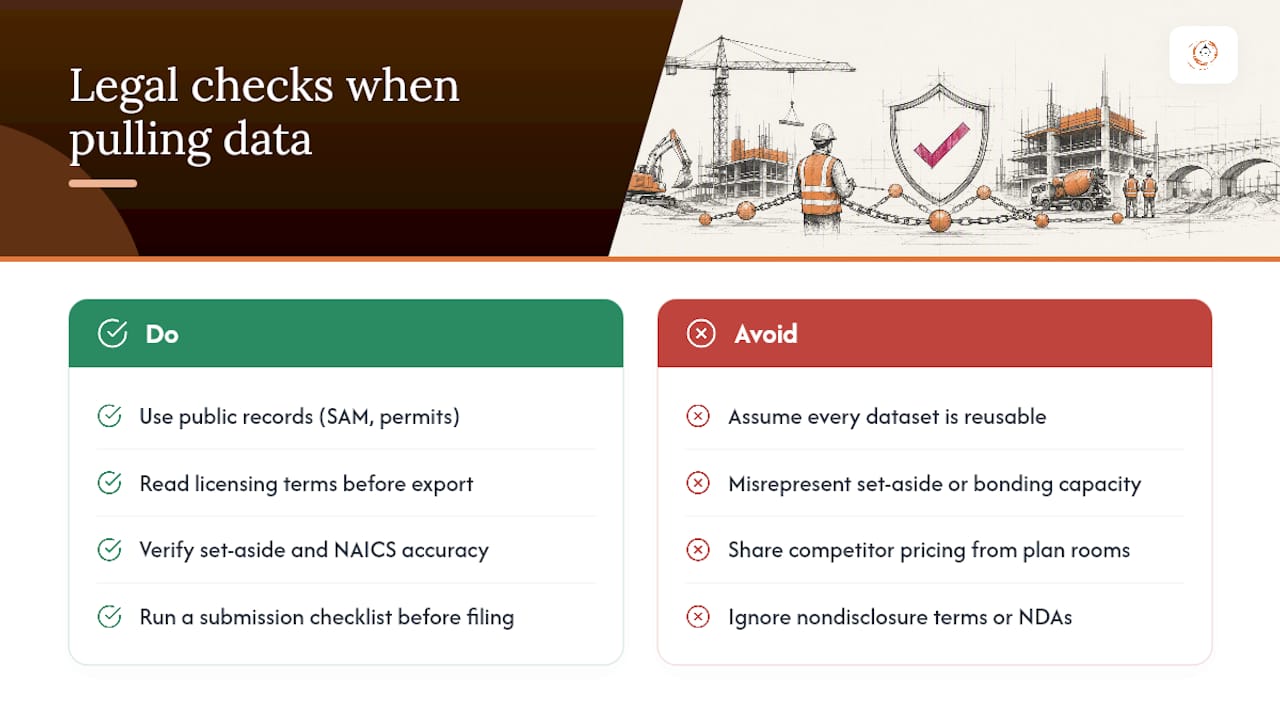
Public procurement data on SAM.gov and municipal permit portals is public record, and pulling it, filtering it, and acting on it carries no legal risk. Scraping restrictions and terms-of-service limits come into play with some commercial platforms and private plan rooms, so read the licensing terms before you export or redistribute bulk data rather than assuming every dataset is yours to repackage.
Federal work adds its own layer. Set-aside eligibility, NAICS code accuracy, and past-performance representations in a federal proposal all carry compliance weight under FAR and, for certain contracts, DFARS. Misrepresenting a set-aside status or bonding capacity isn’t a paperwork slip, it can disqualify a bid or trigger a suspension from future federal awards.
On the private side, respect nondisclosure terms tied to invitation-only bid packages, and never share a competitor’s submitted pricing that you happen to see through a shared plan room. If your firm is pursuing public work for the first time, a compliant public sector bid submission walks through the documentation requirements before you’re deep into a proposal you can’t legally finish. None of this requires a law degree to manage. It requires a checklist and someone who checks it before submission, not after.
Buy the Data, Build It Yourself, or Bring in Help?
Buying full platform coverage pays off once your pipeline spans multiple markets or trades. A DIY mix of SAM.gov and permit feeds works fine for a single-market subcontractor. Bring in outside advisory support when your intake is inconsistent or you’re chasing federal work without a compliance process. There’s no universally right answer, only the one that matches your firm’s current bandwidth.
— Rowena Tulacz
Bookmark These Sources Today
Start with SAM.gov for federal work, your city’s permit and planning commission portal for private signals, and a PlanHub or similar plan-room trial for local bid documents.
Sources
- 7 best construction project databases in 2026
- Buyer intent data providers — HGI Insights
- Sam
- Construction bidding process 2026 — Scaling Legends
FAQ
How Do You Find Construction Projects?
Combine SAM.gov for federal solicitations, municipal permit and planning portals for early private signals, plan rooms like PlanHub for documents, and a commercial project-intelligence platform for enriched private coverage, then run every lead through an intake and triage process.
Is Construction Slowing Down in 2026?
Activity varies sharply by region, trade, and public versus private funding sources, so no single national trend applies evenly across the industry. Watching permit filing volume in your specific target markets gives a far more reliable read than any national headline.
What’s a Good App for Construction Project Leads?
PlanHub works well for contractors starting with local and regional bids because of its free tier, while commercial project-intelligence platforms add private project coverage and CRM integrations for firms ready to scale sourcing.
What Is the Best Website for Construction Bid Opportunities?
There’s no single best site. SAM.gov is the required starting point for federal work, and pairing it with municipal permit portals and a plan-room subscription covers the private-sector gap that federal listings alone can’t fill.
Recommended
- Top 5 ccande.com Alternatives Construction Agencies 2026
- Top 5 Bidsest.com Alternatives Agencies 2026
- Best edgeestimates.com Alternatives for Contractors in 2026
- Top 5 dynamicprecon.com Alternatives Agencies 2026
Running the job and the business at the same time? One short email a week — change orders, billing, job costing, scheduling. Free, no pitch. Subscribe.
Free and unconditional. No call required, no obligation, unsubscribe anytime.