
Design-Assist for Mechanical Contractors: A Strategic Guide | R. Construction Solutions
Design-assist is defined as a collaborative project delivery method where mechanical contractors engage during the design phase to provide constructability, budget, and scheduling input while the architect or engineer of record retains full design responsibility. For mechanical contractors, this means your expertise enters the project when design changes are still inexpensive to make. The result is fewer surprises at bid day, fewer change orders in the field, and a project team that actually understands what it costs to build what the drawings show. Understanding what design-assist means for mechanical contractors is the first step toward using it to your competitive advantage.
What does design-assist mean for mechanical contractors?
Design-assist is a collaborative delivery strategy where mechanical contractors engage early, typically during the schematic or design development phase, to provide real-time input on constructability, material costs, and system coordination. The design professional, whether a mechanical engineer or architect, retains legal responsibility and signs the final drawings. Your role is to inform, not to own the design.

This distinction matters. Many contractors confuse design-assist with design-build, where the contractor assumes full design liability. In design-assist, you contribute expertise without taking on the engineer’s legal exposure. That separation protects you while still giving the project team access to your field knowledge.
The model works because mechanical systems are among the most complex and cost-sensitive elements of any building. HVAC, plumbing, and piping systems involve long-lead equipment, tight spatial coordination, and significant labor costs. Getting a mechanical contractor’s input during design development, rather than after construction documents are complete, prevents the kind of coordination conflicts that generate costly requests for information and field rework.
Pro Tip: Ask the project owner or general contractor to define your design-assist scope in writing before the engagement starts. Verbal agreements about “providing input” leave you exposed to scope creep with no compensation.
What benefits do mechanical contractors gain from design-assist?
The core benefit is cost accuracy. Early conflict resolution and accurate pricing reduce the risk of late-stage rework that blows project budgets. When you price a system during design development, you are pricing something you helped shape. That is fundamentally different from bidding a set of drawings you have never seen before.
The specific advantages mechanical contractors gain include:
- Fewer RFIs and change orders. Your input resolves coordination conflicts before they become field problems. A mechanical contractor who flags a duct clearance issue during design development prevents a costly ceiling redesign during construction.
- No bid-day price shocks. You build your budget alongside the design, so your final number reflects the actual project, not a set of assumptions made under time pressure.
- Early procurement planning. Long-lead mechanical equipment like custom air handling units, chillers, and specialty pumps can be identified and ordered months earlier than in a traditional bid process. That alone can prevent schedule delays of six to twelve weeks on complex projects.
- Reduced rework. Systems designed with your input fit the building the first time. Rework is one of the largest hidden costs in mechanical contracting, and design-assist attacks it at the source.
- Stronger client relationships. Owners who experience design-assist on one project tend to seek the same contractor for the next one. You become a trusted partner, not just a low bidder.
- Better scheduling. Parallel workflows during design development mean your shop drawings and procurement activities can start before construction documents are finalized.
Upfront contractor effort is offset by reduced change orders, cost overruns, and schedule delays. The math favors early involvement on any project with complex mechanical systems.
Pro Tip: Track every cost-saving suggestion you make during the design phase. Document the original design cost versus the revised cost after your input. That data becomes your ROI case for the next design-assist opportunity.
How does the design-assist process work for mechanical contractors?
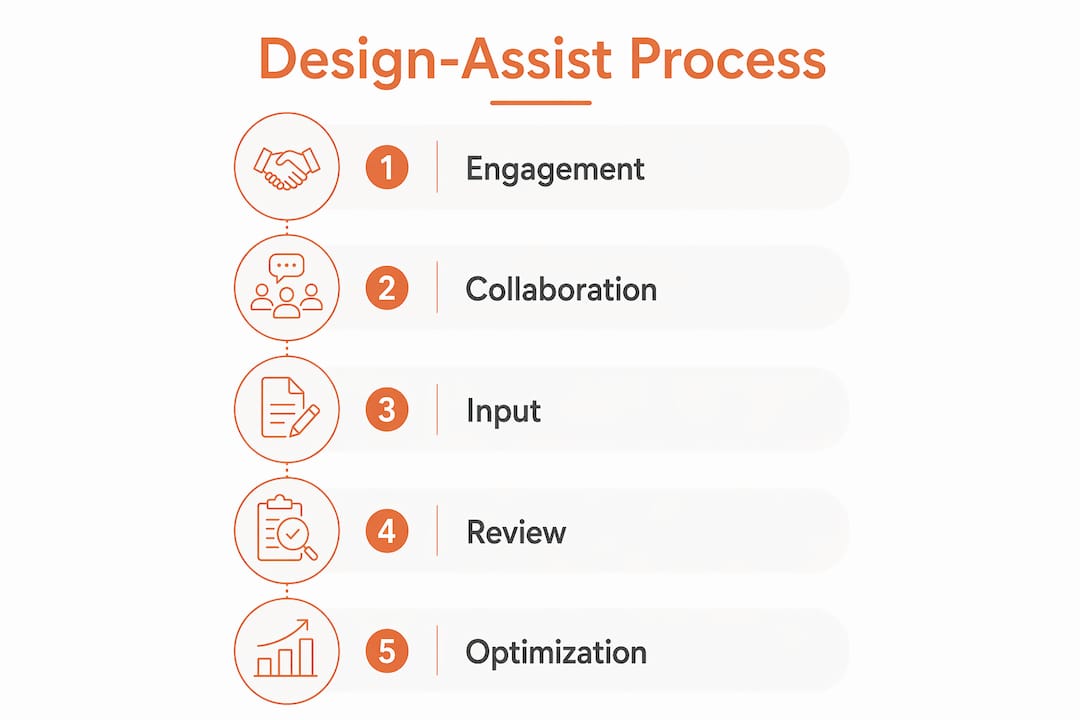
The process follows the design phases used by architects and engineers, typically organized around the American Institute of Architects’ standard phases: schematic design, design development, and construction documents.
-
Engagement at schematic or design development phase. You join the project team before the design is locked. The earlier you engage, the more influence your input carries. Most design-assist engagements begin at the design development phase, when system layouts are taking shape but spatial decisions are still flexible.
-
Providing constructability comments. You review drawings and models, then submit written comments identifying conflicts, cost risks, and constructability issues. These comments must be formal and documented, not verbal. Written constructability comments and budget reconciliation are non-negotiable for design-assist success.
-
Participating in federated BIM coordination. Most design-assist engagements on commercial projects involve Building Information Modeling. You contribute your mechanical model to a federated model that includes structural, architectural, and other trade systems. Clash detection in BIM catches conflicts that would otherwise appear as change orders in the field.
-
Budget reconciliation at design milestones. At each design phase gate, you reconcile your budget estimate against the evolving design. If the design exceeds budget, you flag it immediately. This prevents the bid-day shock that plagues traditional delivery.
-
Incorporating feedback into construction documents. The design professional takes your input and incorporates it into the final construction documents. This step is where many design-assist engagements fail. If your feedback disappears between design development and the final drawings, you have spent time and money for nothing.
-
Transitioning to construction. Once construction documents are complete, your design-assist role ends and your construction scope begins. The transition should be defined in your contract from the start.
Pro Tip: Request a formal feedback log that tracks every comment you submit and confirms whether the design team incorporated it. This protects you and holds the design team accountable for using your input.
What challenges and pitfalls must mechanical contractors avoid in design-assist?
Design-assist creates real value, but only when managed correctly. The most common failure mode is poor integration of contractor feedback, where the contractor invests time and expertise but the design team ignores the input. The result is a traditional coordination problem with an added upfront cost.
Pitfalls to watch for include:
- Confusing design-assist with design-build. These are different contracts with different liability structures. In design-assist, the design professional retains full liability and signs the drawings. If your contract language suggests you are responsible for the design outcome, push back immediately.
- Unclear contract language. Vague scope definitions lead to disputes about what you were paid to do. Your contract should specify deliverables, review cycles, compensation for preconstruction services, and what happens if the project does not proceed to construction.
- Underestimating upfront time. Design-assist requires real hours from your estimating and project management teams. Those hours have a cost. Factor them into your preconstruction fee.
- Failing to document contributions. If your input is not documented, it did not happen. Undocumented contributions cannot be tracked, valued, or used to demonstrate ROI to future clients.
- Assuming the design team will manage the process. Architects and engineers are not always experienced with design-assist workflows. You may need to drive the process, set meeting agendas, and follow up on feedback incorporation.
The contractors who succeed in design-assist treat it like a managed service, not a favor. They charge for their preconstruction time, document every contribution, and hold the design team accountable for using their input.
How does design-assist compare to other project delivery methods?
The three delivery methods mechanical contractors encounter most often are design-bid-build, design-build, and design-assist. Each distributes risk, responsibility, and contractor involvement differently.
| Delivery Method | Contractor involvement | Design responsibility | Risk profile |
|---|---|---|---|
| Design-bid-build | Post-design only | Design professional | High bid risk, high change order exposure |
| Design-build | Full design and construction | Contractor | High design liability, single accountability |
| Design-assist | During design development | Design professional | Shared input, reduced change order risk |
Design-bid-build keeps contractors out of the design process entirely. You bid a complete set of drawings you had no hand in creating. Errors, omissions, and coordination conflicts become your problem in the field, and they generate change orders that damage client relationships.
Design-build puts you in charge of both design and construction. That creates efficiency but also transfers significant legal liability. Mechanical contractors in design-build must carry professional liability insurance or partner with a licensed engineer, which adds cost and complexity.
Design-assist sits between these two models. You contribute expertise without assuming design liability. The design professional retains responsibility for the final drawings, but your input shapes those drawings in ways that make them more buildable and more accurately priced. For mechanical contractors on complex commercial, healthcare, or data center projects, design-assist is the delivery method most likely to produce a profitable, low-conflict project.
What practical steps can mechanical contractors take to succeed in design-assist?
Success in design-assist requires preparation before the first project meeting. Contractors who show up without internal processes for preconstruction input waste their own time and lose credibility with design teams.
- Select the right projects. Design-assist works best on complex mechanical systems, long-lead equipment, tight schedules, and repeat-client relationships. It is less effective on simple projects where the design is already well-defined.
- Build a preconstruction process. Assign a dedicated estimator or project manager to design-assist engagements. That person owns the feedback log, attends design meetings, and tracks budget reconciliation at each milestone.
- Use collaborative BIM platforms. 3D model markup and local supply chain knowledge convert your cooperation into schedule and budget certainty. Invest in the technology and train your team to use it.
- Track and report your contributions. Build a simple log that records each comment, the design response, and the estimated cost or schedule impact. Share this log with the owner at project milestones.
- Communicate ROI clearly. Owners and general contractors respond to numbers. “Our input reduced the mechanical budget by $180,000 and eliminated three weeks of schedule risk” is a statement that wins the next design-assist engagement.
- Build relationships with design professionals. The best design-assist opportunities come from engineers and architects who trust your team. Invest in those relationships between projects, not just during them.
Understanding how early involvement reduces project risk is the foundation of a successful design-assist practice.
Pro Tip: After your first design-assist project, conduct an internal debrief. Identify what your team contributed, what the design team incorporated, and what you would do differently. That debrief becomes your process improvement plan for the next engagement.
Key takeaways
Design-assist gives mechanical contractors the most leverage when they engage early, document every contribution, and hold the design team accountable for incorporating their input into final construction documents.
| Point | Details |
|---|---|
| Early engagement drives value | Join the project at design development, when system layouts are still flexible and changes are inexpensive. |
| Design liability stays with the engineer | The design professional signs the drawings; your role is to inform, not to own the design outcome. |
| Documentation is non-negotiable | Track every constructability comment and budget input to demonstrate ROI and protect your scope. |
| Long-lead procurement starts early | Identify specialty equipment during design development to prevent schedule delays of weeks or months. |
| Preconstruction fees are justified | Charge for your design-assist time and track the savings your input generates to build the business case. |
Why design-assist is the most underused tool in mechanical contracting
I have worked with mechanical contractors who treat design-assist as a favor they do for preferred clients. That framing costs them money. Design-assist is a service, and it should be priced and managed like one.
The contractors I have seen get the most out of it share one habit: they treat their local market knowledge as a product. They know what a chiller costs this quarter, which suppliers have lead time problems, and which system configurations their crews can install efficiently. That knowledge is worth real money to a design team working from national cost databases and theoretical system layouts.
The shift I am watching in 2026 is design-assist moving from a niche practice on large healthcare and data center projects to a standard expectation on mid-size commercial work. Owners who have experienced it once do not want to go back to bid-day surprises and field change orders. Mechanical contractors who build this capability now will have a significant advantage as that expectation spreads.
The uncomfortable truth is that most contractors avoid design-assist because the upfront time feels like a cost with no guaranteed return. But upfront design-assist fees typically avoid far costlier late-stage change orders, producing net project savings. The risk of not engaging early is almost always higher than the risk of investing in preconstruction.
— Rowena
How Rconstructionsolutions supports mechanical contractors in design-assist
Mechanical contractors who want to build a real design-assist practice need more than good intentions. They need structured preconstruction processes, clear contract language, and a way to track and communicate the value they create.

Rconstructionsolutions works directly with mechanical contractors to build those capabilities. With over 30 years of hands-on construction experience, the team helps contractors define their design-assist scope, set up contribution tracking systems, and position their preconstruction services as a competitive differentiator. Whether you are preparing for your first design-assist engagement or refining a process that is not producing results, construction consulting services from Rconstructionsolutions give you a clear path forward. Reach out to discuss your 2026 project pipeline and how design-assist can improve your margins and client relationships.
FAQ
What does design-assist mean for mechanical contractors?
Design-assist means mechanical contractors engage during the design phase to provide constructability, cost, and scheduling input while the engineer of record retains full design responsibility. The contractor informs the design without assuming legal liability for it.
How is design-assist different from design-build?
In design-assist, the design professional retains full liability and signs the construction documents. In design-build, the contractor assumes responsibility for both design and construction, which requires professional liability coverage.
When does a mechanical contractor get involved in design-assist?
Mechanical contractors typically engage at the schematic or design development phase, before construction documents are finalized. Earlier engagement produces more influence over system layouts and greater cost savings.
What are the biggest risks in a design-assist engagement?
The largest risk is investing preconstruction time and having your input ignored in the final drawings. Requiring a formal feedback log and written confirmation of incorporated comments mitigates this risk directly.
Does design-assist cost mechanical contractors money upfront?
Yes, design-assist requires real preconstruction hours that should be compensated through a preconstruction services fee. Those upfront costs are consistently offset by reduced change orders and fewer field coordination conflicts.