Davis Bacon Wages for Contractors: SAM.gov, Per Cell Payroll, SF-1444
If your contract is federal or federally assisted and a federally funded or assisted contract, you must pay the locally prevailing Davis-Bacon wage, including base hourly rate plus fringe benefits, as listed on the DOL wage determination for your county and craft. Your first moves are simple: pull the correct wage determination from SAM.gov, start weekly certified payrolls with a signed Statement of Compliance, and file an SF-1444 the moment a classification is missing. Skip any of these and you risk withheld contract funds.
TL;DR:
- Contractors must carefully verify the correct wage determination for each project location and work type before bidding, as rates vary by county and project scope.
- Accurate classification of workers based on actual duties is essential to prevent misclassification and avoid potential wage violations during audits.
- Submitting certified payrolls with detailed, signed statements of compliance and proper classification documentation mitigates the risk of withholding and legal penalties.
- Failure to update wage determinations for multi-year or multi-county projects increases the risk of paying incorrect wages and facing enforcement actions.
- Prior planning at bid stage—such as mapping work to proper classifications and documenting fringe benefit plans—significantly reduces the likelihood of audits and costly compliance issues.
Table of Contents
- What Triggers Davis-Bacon Wage Requirements?
- How Do You Find the Right Wage Determination on SAM.gov?
- What Do the Base Wage and Fringe Numbers Actually Mean?
- What Must WH-347 Certified Payroll Reports Include?
- When Do You Need to File an SF-1444 Conformance Request?
- What Happens During a Davis-Bacon Audit or Withholding Action?
- Practical Steps to Reduce Davis-Bacon Audit Risk
- How Is the Service Contract Act Different From Davis-Bacon?
- Where Did the Davis-Bacon Act Come From, and What Does It Cover?
- How Often Do Wage Determinations Get Updated?
- Who Is Responsible for What Under Davis-Bacon?
- What Happens Beyond Withholding When Contractors Violate Davis-Bacon?
- How Can Workers Verify They’re Being Paid Correctly?
- Building Compliance Into Your Bid Process, Not Just Your Payroll
- How R Construction Solutions Helps You Stay Ahead of Davis-Bacon Risk
- Sources
What Triggers Davis-Bacon Wage Requirements?
The Davis-Bacon Act covers laborers and mechanics working on federally funded construction, alteration, or repair of public buildings or public works. Related Acts extend nearly identical wage rules to projects that receive federal financial assistance, grants, or loan guarantees, even when a state or local agency administers the contract. This combined framework is why contractors call it “Davis-Bacon and Related Acts,” or DBRA, rather than treating the statute as a single narrow rule.
Coverage depends on the funding source and the nature of the work, not on the size of your company or your role on the job. Every subcontractor performing covered work owes the same prevailing wage as the prime contractor, regardless of tier. Coverage also follows the worksite, not your home office, so a crew based in one state working a project two states away must be paid according to the wage determination for the county where the work happens.
A few edge cases trip up experienced contractors:
- Material delivery to a site by your own driver can be covered if the driver also performs onsite labor.
- Off-site fabrication for a specific project is sometimes covered, depending on the contract clauses.
- Maintenance work is usually excluded, but capital repairs and alterations are not.
Always read the contract’s Davis-Bacon clause and check with the contracting agency before assuming a task falls outside coverage.
How Do You Find the Right Wage Determination on SAM.gov?
Every wage determination lives in one place: the Sam database. Pulling the correct one takes five steps, and skipping any of them is how contractors end up paying the wrong rate for months without noticing.
- Go to the SAM.gov wage determinations search and filter by state, then county.
- Select the construction type that matches your scope: building, residential, heavy, or highway. A single project can carry more than one type if it mixes site work.
- Note the WD identifier, which includes a state code, year, and sequence number, plus the current modification number.
- Confirm you’re using the WD modification in effect on the date the contract was awarded, not the date you’re bidding.
- Download and save the PDF to your project folder immediately, with the mod number in the file name.
Multi-county or linear projects, like utility corridors or road resurfacing, require applying the correct WD to each county segment rather than defaulting to one rate for the whole job.
Pro Tip: If a wage determination looks stale, incomplete, or inconsistent with a neighboring county’s rates for the same craft, call the contracting officer before bid day. Waiting until after award to flag a bad WD costs you leverage.
What Do the Base Wage and Fringe Numbers Actually Mean?
A wage determination lists two numbers per classification: the base hourly rate and the hourly fringe benefit amount. Add them together and you get the total prevailing wage you owe that worker for every hour of covered work, regardless of how you split the payment between cash and benefits.
Matching your crew to the right row on the WD is where most classification disputes start. DOL evaluates the actual duties performed that week, not the job title on your org chart or the classification you use for state licensing. A worker who frames walls in the morning and runs conduit in the afternoon may need to be paid at two different classification rates for the hours in each, tracked separately on the certified payroll.
Fringe benefits can be delivered two ways:
- Cash in lieu, added directly to the paycheck, which is simple but fully taxable as wages.
- Bona fide benefit plans — health insurance, retirement contributions, apprenticeship funds — which often cost employers less in effective payroll tax exposure than paying the equivalent amount as cash.
Choosing a bona fide plan over cash in lieu is frequently the more cost-efficient path once payroll taxes are factored in, but the plan has to be genuinely funded and documented, not a paper arrangement.
What Must WH-347 Certified Payroll Reports Include?
Federal regulation 29 C.F.R. § 5.5 requires every covered contractor and subcontractor to submit certified payroll weekly, along with a signed Statement of Compliance attesting the wages paid match the applicable wage determination. Using Form WH-347 itself is optional. Any format that captures the same fields satisfies the requirement, but WH-347 is the format most agencies expect to see, and DOL now offers a fillable web-based generator that cuts down on transcription errors.
The fields that matter most for compliance review are:
- Wage determination number and modification in effect for that pay period
- Labor classification for each worker, matched to actual duties performed
- Columns 6A, 6B, and 6C, which report hourly rate, overtime rate, and fringe benefit rate separately
- The signed certification, which carries legal weight if it turns out to be false
| WH-347 Element | What It Captures | Why It Matters |
|---|---|---|
| Wage determination number | The exact WD and mod applied | Confirms the crew was paid off the correct, current rate |
| Labor classification | Job duties, not job title | Root cause of most misclassification audits |
| Columns 6A/6B/6C | Base rate, overtime, fringe | Shows total wage matches base plus fringe |
| Statement of Compliance | Signed certification | Legal attestation; false statements carry separate liability |
Payroll records must be kept for three years after project completion, and prime contractors remain on the hook for verifying every subcontractor’s certified payroll, not just their own. A workflow like the one described in why certified payroll compliance matters on public projects is worth building into your standard project setup.
When Do You Need to File an SF-1444 Conformance Request?
If the work your crew performs doesn’t match any classification on the wage determination, you file Form SF-1444 to request a conforming classification and rate. The contracting officer completes and submits SF-1444, typically with input from the contractor on the proposed classification, duties, and rate, and the request needs the agreement of the affected workers or their representative where applicable.
You don’t have to stop work while DOL reviews the request. The interim-pay rule lets you pay the proposed rate starting the first day that classification performs work, provided the rate you propose bears a reasonable relationship to rates already on the WD for comparable skill and effort.
Common conformance mistakes include:
- Proposing a rate far below comparable classifications on the same WD, which invites rejection
- Writing a job description so broad it looks like an attempt to combine two classifications into one lower-paid role
- Failing to attach documentation showing why no existing classification fits
A clean SF-1444 submission with a defensible rate and clear duties description moves faster through DOL review than a vague one.
What Happens During a Davis-Bacon Audit or Withholding Action?
The contracting agency and the Department of Labor’s Wage and Hour Division both have authority under 29 C.F.R. § 5.5 to withhold accrued contract payments when wage violations are found, and funds can be cross-withheld from other contracts you hold with the same agency if the current project doesn’t have enough left to cover the shortfall.
Audits tend to get triggered by:
- Worker complaints about pay that doesn’t match posted wage rates
- Missing or inconsistent certified payrolls
- Misclassification patterns, especially crews paid a single low rate across multiple trades
- Apprenticeship ratio violations or unregistered apprentices billed at trainee rates
- Certifications that don’t reconcile with time cards or invoices
Withheld funds get applied first to make workers whole for back wages, with DOL/WHD regional offices managing distribution. Contractors have the right to contest findings and request a hearing before funds are permanently disbursed, but by that point you’re litigating after the fact rather than preventing the problem. Reviewing your FAR versus DFARS obligations before bidding clarifies which withholding clauses actually apply to your contract type.
Practical Steps to Reduce Davis-Bacon Audit Risk
Reducing exposure comes down to catching errors before they reach a paycheck, not fixing them after DOL calls.
- Capture the wage determination and mod number at bid time and store it in the project folder.
- Map every job duty to a WD classification before crews mobilize, not after payroll runs.
- Require a per-cell payroll review, checking each entry against the WD, before releasing subcontractor progress payments.
- Document approval of any bona fide fringe benefit plan in writing.
- Assign one person to sign the WH-347 certification and hold them accountable for accuracy.
Pro Tip: Practitioner experience consistently shows that misclassification and fringe-reporting errors, not underpayment on purpose, cause most audit findings. A five-minute duty-to-classification check per worker each week catches most of these before they become a withholding notice.
Build a documented cure cycle for payroll mistakes. When DOL opens an inquiry, a paper trail showing you caught and corrected an error internally carries real weight.
How Is the Service Contract Act Different From Davis-Bacon?
The Service Contract Act (SCA) and the Davis-Bacon Act both set minimum wage floors on federal contracts, but they cover different work. Davis-Bacon applies to construction, alteration, and repair of buildings and public works. The SCA applies to contracts whose principal purpose is furnishing services, things like janitorial work, security guards, food service, or IT support on a federal contract.
The practical difference that trips contractors up is mixed-scope contracts. A facilities contract that includes both routine maintenance (SCA) and a capital repair project (Davis-Bacon) can trigger both wage schedules on the same job, applied to different workers or different phases of work. Getting this wrong usually means underpaying whichever category of worker falls under the stricter schedule.
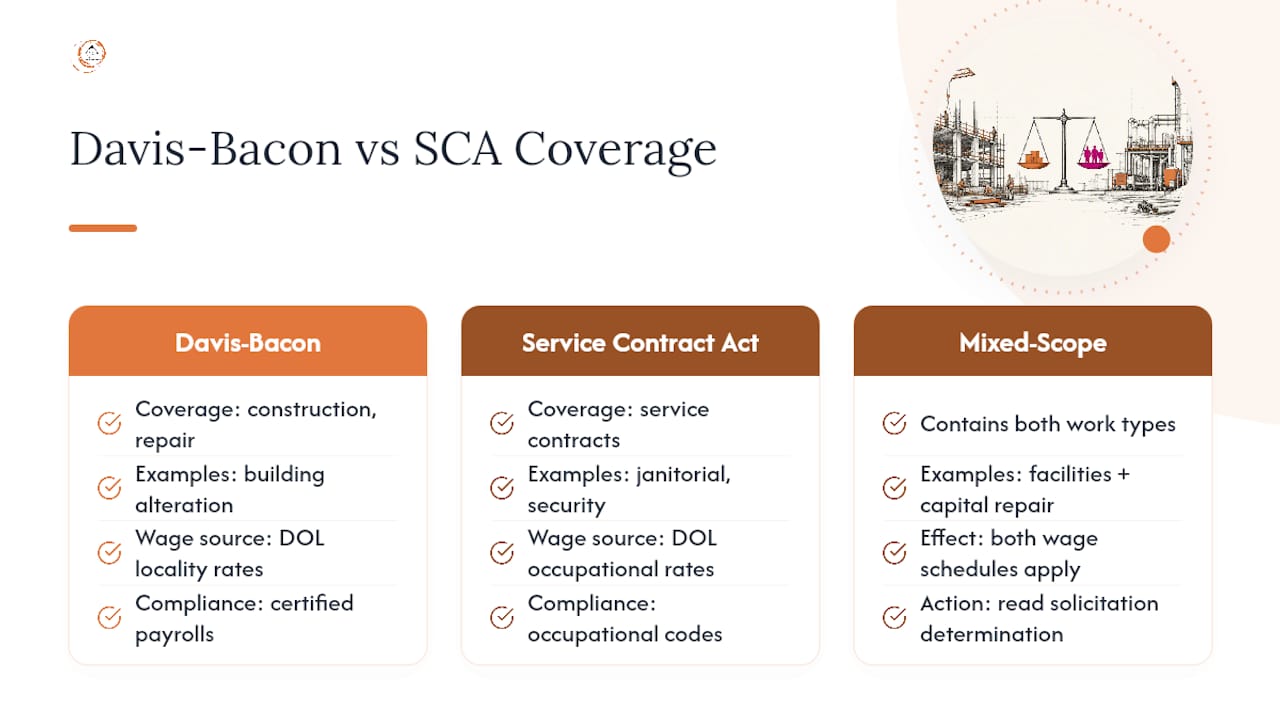
Wage rates also come from different sources. Davis-Bacon rates come from DOL wage determinations tied to locality and construction type. SCA rates come from DOL wage determinations too, but they’re built around occupational categories drawn from a separate wage survey process, and they update on a different schedule tied to collective bargaining agreements or annual surveys rather than construction market data.
For a contractor bidding both types of work, the safest approach is to treat every contract’s labor category individually. Don’t assume that because a contract touches a federal building, all labor on it falls under Davis-Bacon. Read the wage determination attached to your specific solicitation. If it references SCA occupational codes instead of construction trade classifications, you’re looking at a different compliance framework entirely, one that needs its own certified payroll approach.
Where Did the Davis-Bacon Act Come From, and What Does It Cover?
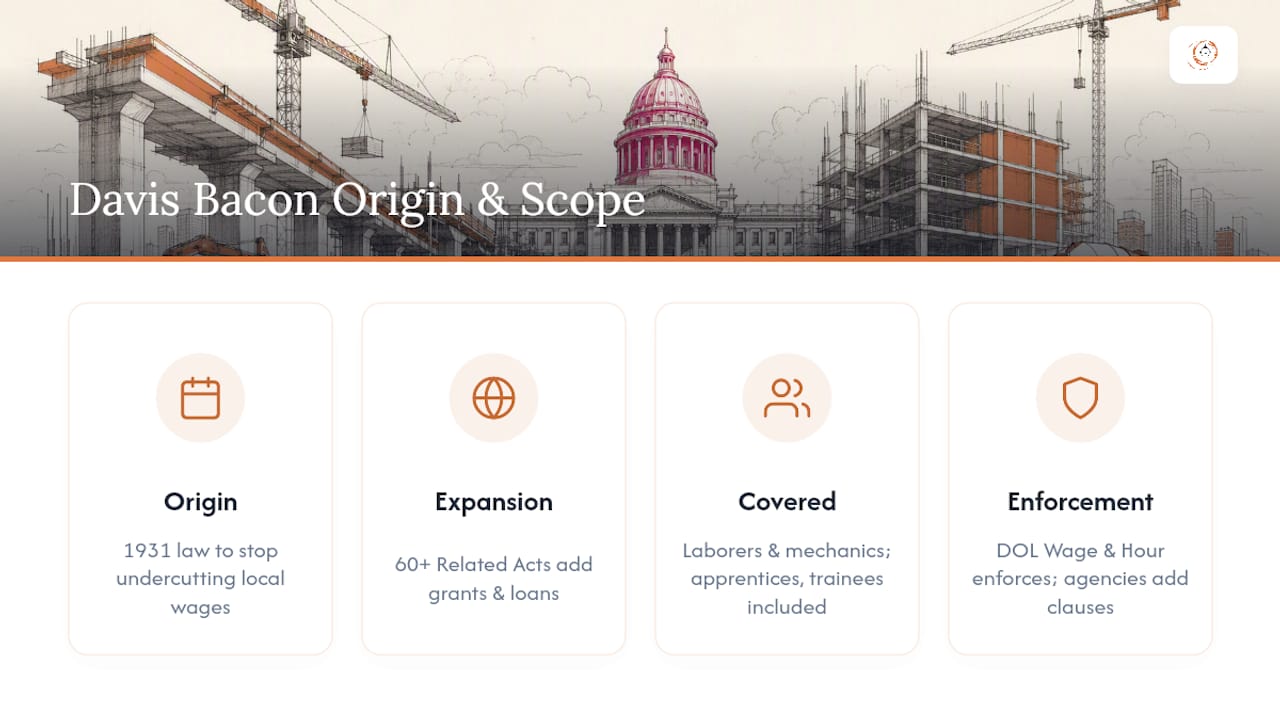
Congress passed the Davis-Bacon Act in 1931, during the construction slowdown of the early Depression, after underbidding contractors began importing out-of-area labor at wages well below what local construction workers were earning. The law’s original purpose was straightforward: stop federal construction spending from undercutting local wage standards.
Over the following decades, Congress folded in more than 60 “Related Acts,” which extend Davis-Bacon wage requirements to construction funded through federal grants, loans, and loan guarantees rather than direct federal contracts. That’s why a locally awarded contract for a federally funded water treatment plant or affordable housing project still carries Davis-Bacon obligations even though no federal agency signed the prime contract.
The scope today covers laborers and mechanics, a category that includes apprentices, trainees, and helpers, working onsite on covered construction, alteration, or repair. It does not extend to architects, engineers, or supervisors who don’t perform manual labor, and it generally excludes off-site material suppliers unless they also perform onsite work. The Department of Labor’s Wage and Hour Division administers the wage determination process and enforcement, while individual contracting agencies embed the required clauses into their solicitations and monitor compliance on their own projects. Understanding what public works contracts require at the solicitation stage saves a lot of confusion once the contract is underway.
How Often Do Wage Determinations Get Updated?
DOL updates wage determinations on a rolling basis, driven by wage survey data and, more often in practice, by union collective bargaining agreement changes for the relevant craft and locality. There’s no fixed annual calendar. A WD for a busy metro county might see several modifications in a year, while a rural county with little federal construction activity might go a long time without a revision.
This is exactly why the modification number matters more than the base WD identifier. Two contracts in the same county, same craft, awarded eight months apart, can carry meaningfully different rates if a mod was issued in between. Locking in the WD mod that was active on the date of contract award, and documenting it, protects you if a later revision raises rates during construction. You’re not required to retroactively apply a mod issued after award, but you are required to apply the correct one that was live when the contract was signed.
Multi-year contracts or ones with option periods sometimes require re-checking the WD when an option is exercised, depending on the contract clause structure. This is a detail that catches contractors off guard on longer public works jobs. Build a WD-recheck step into your contract administration calendar rather than assuming the rate you started with holds for the life of the project. For projects spanning several counties, keep a simple mapping table linking each work segment to its applicable WD and mod, updated as segments are completed.
Who Is Responsible for What Under Davis-Bacon?
Prime contractors carry the heaviest compliance burden. You’re accountable not just for your own crews’ wages but for verifying that every subcontractor on the job, at every tier, is paying correctly and submitting accurate certified payrolls. If a third-tier subcontractor underpays, the prime can still face withholding on the contract.
Subcontractors owe the same wage determination as the prime for covered work, and they’re required to submit their own certified payrolls, usually routed through the prime contractor rather than directly to the agency. A subcontractor who assumes “the prime handles compliance” is exposed just as much as one who never checked the WD at all.
Contracting agencies hold a different role: they embed the Davis-Bacon clauses into the solicitation, confirm the correct WD is attached before award, and monitor for compliance during construction, often through periodic interviews with workers onsite. Agencies also process SF-1444 conformance requests and have the authority to withhold payments when violations surface.
DOL’s Wage and Hour Division sits above both. It issues and updates wage determinations, investigates complaints, adjudicates conformance disputes, and provides the enforcement backbone that gives the whole system teeth. Contractors sometimes assume the contracting agency is the only body watching, but WHD can and does open independent investigations, particularly following a worker complaint.
What Happens Beyond Withholding When Contractors Violate Davis-Bacon?
Withholding contract funds is the most common remedy, but it’s not the only one, and treating it as the ceiling of your risk is a mistake. Contractors found in violation can be debarred from future federal contracts for up to three years, a consequence that often hurts far more than the wage restitution itself for a firm that depends on public work.
Falsifying certified payroll records carries separate exposure. A signed Statement of Compliance that misrepresents wages paid can trigger criminal liability under federal false statement statutes, independent of any civil wage recovery. This isn’t a theoretical risk. DOL has referred certified payroll falsification cases for criminal prosecution in cases involving deliberate, repeated misreporting.
Liquidated damages can also apply under related contract clauses for violations tied to overtime and safety standards on the same project, layering additional financial exposure on top of back wage liability. And a debarment or violation finding follows your firm into future past-performance evaluations, affecting your ability to win future federal or federally assisted work well after the original project closes out.
The pattern in most serious cases isn’t a single underpayment error. It’s a combination of misclassification, inaccurate certification, and a failure to correct the problem once flagged, compounding into a finding that’s much harder to walk back than a first-time payroll mistake caught early.
How Can Workers Verify They’re Being Paid Correctly?
Workers on federally funded projects have a right to see the wage determination posted at the job site, typically alongside other required labor law postings. If it isn’t posted, workers can ask the contractor or contracting officer for a copy, and it should match what’s filed with the certified payroll.
A worker who suspects underpayment can compare their pay stub against the WD classification and rate for the work they actually performed that week, not the job title on their paycheck. Fringe benefits should show up either as an add-on to cash wages or as documented contributions to a real benefit plan, not simply disappear from the math.
Workers can file a complaint directly with the Department of Labor’s Wage and Hour Division if the numbers don’t reconcile, and WHD investigates independently of the contracting agency. Complaints can be filed without retaliation protection concerns, since federal law prohibits contractors from punishing workers for raising wage complaints on covered projects. Keeping personal copies of pay stubs and hours worked is the simplest safeguard a worker has if a dispute later requires proof.
Building Compliance Into Your Bid Process, Not Just Your Payroll
The contractors who get burned by Davis-Bacon rarely get burned on the paperwork. They get burned because compliance was treated as a payroll department problem instead of a bid-stage decision. By the time your crew is on-site and classifications are set, you’ve already locked in your exposure.
What actually works is deciding, before you submit a bid, exactly which classifications the scope requires and whether the wage determination on file supports the labor mix you’re planning to use. That’s a business development and estimating discipline, not a clerical one. I’d argue the conventional advice, “just fill out WH-347 correctly,” misses where the real risk starts. Get the classification strategy right at bid time and the paperwork mostly takes care of itself.
— Rowena Tulacz
How R Construction Solutions Helps You Stay Ahead of Davis-Bacon Risk
Getting Davis-Bacon compliance right at bid time, not after award, is where R Construction Solutions LLC focuses its work with contractors bidding federally funded projects. Instead of discovering a classification gap or a payroll error mid-project, you build the wage determination review, per-cell payroll checks, and conformance drafting into your process before mobilization.

R Construction Solutions LLC offers certified payroll review to catch classification mismatches before they reach a WH-347 submission, federal procurement consulting to help you navigate SAM.gov registration and set-aside eligibility, and estimating support built specifically for prevailing-wage bids where labor cost accuracy determines whether you win or lose margin on award. R Construction Solutions LLC does not hold WBE, DBE, or MBE certification, and makes no claim to. What the firm brings instead is three decades of operational and business development experience applied directly to how contractors staff, price, and document federal work. If you’re preparing a bid on a federally assisted project or want a second set of eyes on your current payroll process, explore R Construction Solutions’ consulting services and set up a compliance review before your next payroll cycle.
Sources
- Davis-Bacon and Related Acts — U.S. Department of Labor
- Sam
- 29 C.F.R. § 5.5 — Certified payroll requirements (Cornell LII)
Recommended
- Public Works Contracts: What Contractors Must Do to Comply
- Why Certified Payroll Compliance Matters on Public Projects
- Contractor Business Assessment Explained for Contractors
- Daily Field Reports for Contractors: 2026 Best Practices
Running the job and the business at the same time? One short email a week — change orders, billing, job costing, scheduling. Free, no pitch. Subscribe.
Free and unconditional. No call required, no obligation, unsubscribe anytime.

