Daily Field Reports for Contractors: 2026 Best Practices
Why daily field reports are your most powerful project tool
Daily field reports are the primary contemporaneous record in US construction projects, and in 2026, they carry more weight than ever. Courts, arbitrators, and contract administrators treat a report written the day events occurred as far more credible than any reconstruction assembled weeks later. Federal law does not mandate them, but commercial and government contracts almost universally require daily submission, often with specific fields and deadlines.
The role of daily field reports for contractors goes well beyond compliance paperwork. A well-prepared report defends against back-charges, verifies delay claims, and documents unauthorized changes before they become six-figure disputes. When small issues go unrecorded, they snowball into problems that memory alone cannot fix.
Every effective daily field report covers:
- Weather conditions and their impact on scheduled work
- Manpower counts by role or crew, including subcontractor presence
- Equipment on site, in use, or sitting idle
- Materials delivered and consumed, with quantities
- Work performed and exact locations on site
- Safety incidents and near-misses
- Delays and deviations from the approved schedule
- Visitor and inspector logs, including any verbal instructions given
Consistent reporting enforces accountability without confrontation. When field supervisors know their activities are logged daily, they document clearly and avoid omissions.

1. Key components that make daily field reports reliable
A report is only as strong as what it contains. Vague entries like “work performed” look fine in a binder and collapse the moment a lawyer examines them. Standard daily report data include weather, manpower counts by role, equipment use, materials delivered and consumed, work location, safety incidents, and schedule deviations.
Beyond the basics, these elements separate defensible reports from weak ones:
- Timestamped photo attachments that show conditions, progress, and any changed circumstances
- Authorized signatures from the superintendent or project manager, confirming the report is binding
- Specific names for anyone who gave or received instructions on site
- Production quantities tied to work areas, not just general descriptions
- Standardized templates that prevent missed fields under time pressure
Pro Tip: A report signed Friday for work done Monday is significantly weaker in arbitration. Sign at the end of each shift, not the end of the week.
2. Best practices for collaborative reporting across your team
Collaborative reporting is where most contractors leave accuracy on the table. The most effective model puts data entry with foremen and subcontractors who are physically present on site, while general contractor project managers focus on review and sign-off. That separation keeps reports grounded in field reality rather than office assumptions.
Practical steps to build a collaborative reporting culture:
- Require subcontractors to submit their own daily activity logs covering their crew, equipment, and work completed
- Set a firm daily deadline, such as 6:00 PM, for all report submissions
- Have the GC project manager review and countersign the consolidated report before distribution
- Respond to unusual entries within 24 hours so field staff learn the system works
- Rotate brief report reviews into weekly team meetings to reinforce standards
Pro Tip: Social accountability drives compliance more reliably than technology alone. When a project manager calls to check in if a report isn’t received by 6:30 PM, submission rates improve within weeks, not months.
When subcontractors know their activities are systematically logged each day, it creates a natural incentive to document clearly, reducing disputes before they start.
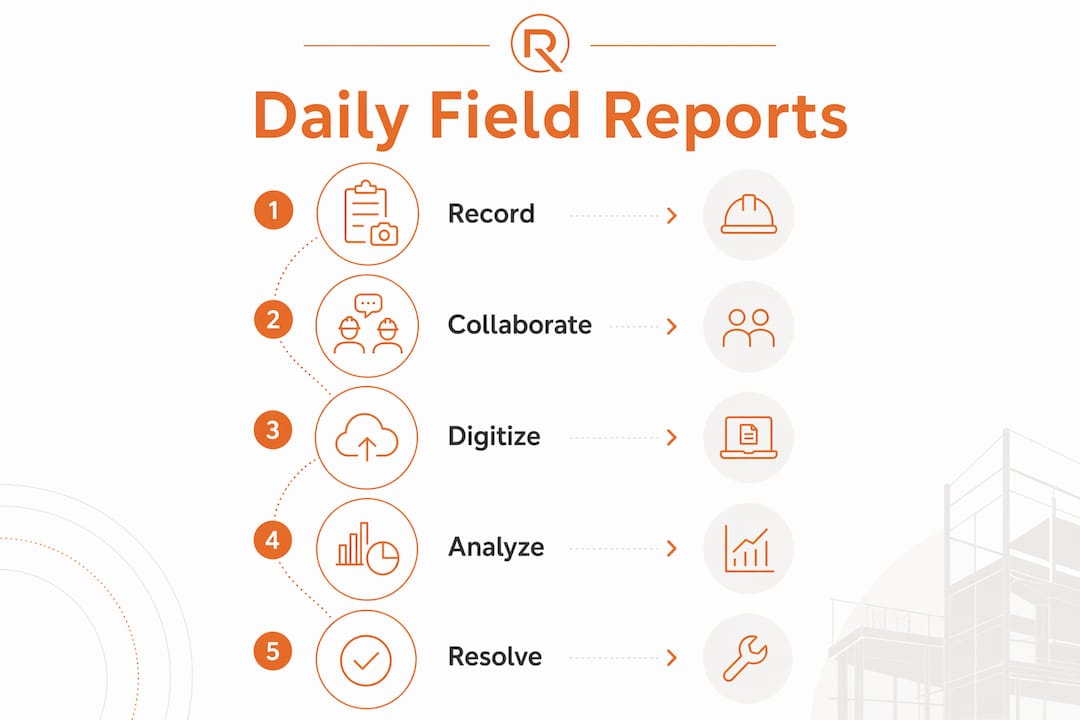
3. How digital tools transform daily field reporting
Mobile platforms have removed the biggest barrier to consistent reporting: the gap between where work happens and where documentation gets done. Digital tools allow instant submission, photo attachment, automatic weather data, and embedded metadata, reducing manual errors and saving significant time per person each day compared to paper-based processes.
Key technology benefits for your reporting workflow:
- Real-time submission from any mobile device eliminates end-of-day scrambles
- Auto-generated weather data based on project location removes a common omission
- Photo metadata stamps embed time and location automatically, strengthening evidentiary value
- Searchable digital records speed up dispute resolution by making specific entries findable in seconds
- Client-facing reporting apps with daily photos and checklists reduce site visits and increase owner satisfaction
- Integration with job costing, procurement, and scheduling turns field data into operational intelligence rather than isolated records
Platforms like LifeSafety.ai’s site diary module offer structured daily logging built specifically for construction teams, with real-time tracking that connects field entries to broader project oversight. Explore AI-powered reporting tools to see how automation is reshaping contractor workflows in 2026.
4. Operational benefits of consistent daily field reports
Routine daily reporting changes how you manage a project, not just how you document it. Early pattern identification of recurring delays or resource constraints becomes possible when you have a daily data trail rather than a weekly summary written from memory.
The operational gains stack up across every project phase:
- Labor visibility: Daily manpower logs reveal deployment gaps before they affect the schedule
- Equipment accountability: Idle equipment logged daily surfaces utilization problems early
- Job cost accuracy: Field data tied directly to cost codes reflects reality, not back-office estimates
- Procurement responsiveness: Material shortages noted in daily reports reach purchasing teams the same day
- Dispute reduction: Contemporaneous timestamped evidence shifts arguments from “did this happen?” to “what does it mean?” — a far more productive conversation
- Culture of precision: When reporting is a shared daily habit, contractual enforcement happens naturally, without confrontation
The best contractors treat daily reports as operational intelligence tools, integrating field data with scheduling and procurement to shift from reactive problem-solving to proactive management.
5. How Rconstructionsolutions helps contractors get reporting right
After 30+ years working directly with residential and commercial contractors, Rconstructionsolutions has seen one pattern repeat: contractors who treat daily reports as operational intelligence, not administrative burden, grow faster and dispute less. The firms that scaled from $5 million to $50 million in revenue did not get there by working harder. They built systems, and daily reporting was foundational to every one of them.
Here is what that looks like in practice:
- Role clarity: Assign data entry to foremen and subcontractors on site; reserve project manager time for review, sign-off, and follow-up
- Tailored training: Veteran field staff respond to protection-framing (“here’s a real case where bad documentation cost a contractor $400K”). Newer foremen need a template walkthrough and a clear list of six non-negotiable fields
- Template discipline: Start with weather, manpower, work performed by area, equipment, changed conditions, and safety events. Once those six fields become habit, add detail
- AI-driven tools: Rconstructionsolutions integrates AI-driven estimating and consulting technologies that connect daily field data to job costing and scheduling, giving contractors a real-time picture of project health
Pro Tip: If your daily report form takes more than 12 minutes to complete, it’s too complex. A well-designed template with six core fields takes an experienced superintendent under 10 minutes. Complexity kills compliance.
Hands-on construction consulting from Rconstructionsolutions covers exactly this kind of workflow design, from report structure to team training to technology integration.
Common challenges and pitfalls in daily field reporting
The most common failure is not skipping reports entirely. It’s filling them out badly. Vague language, missing signatures, no weather data, and no manpower counts create a paper trail that looks complete and falls apart under scrutiny.
Delayed writing is the second major problem. A report reconstructed two days after the fact loses credibility in arbitration, regardless of how accurate it feels. The third pitfall is complexity overload: a 47-field form that takes 25 minutes will not get completed properly under field pressure.
Avoid these traps by:
- Writing entries as facts only, no opinions or predictions (“Owner’s rep instructed crew to stop work at 9:15 AM pending RFI #47” not “Owner caused another delay”)
- Keeping the form to six non-negotiable fields until the habit is established
- Tying submission to the end-of-shift routine so it never becomes a separate task
- Training field staff with role-specific approaches rather than one-size-fits-all instruction
How daily field reports support dispute resolution and claims management
Daily reports function as legal depositions when prepared contemporaneously with timestamps and authorized signatures. Courts favor reports with specific timestamps and factual language over reconstructions or memory-based accounts, making report structure directly tied to legal defensibility.
For delay claims, your reports need to document the day the delay started, the specific cause with names and instructions, the crew and equipment idled, and the duration. Differing site conditions must be documented the day they are found, with photos and written notice to the owner the same day. Most contracts require “prompt written notice,” and courts have interpreted that as anywhere from 24 hours to 7 days.
Daily reports also protect against back-charges. Detailed manpower logs with work locations are often the only evidence that can refute a false claim that your crew damaged a subcontractor’s work or blocked site access.
What an effective daily field report template looks like
A practical daily field report template covers six core sections, each with a defined scope:
| Section | What to capture |
|---|---|
| Date, weather, and site conditions | Temperature, precipitation, wind; impact on work |
| Manpower | Crew names or counts by trade, hours worked, subcontractor presence |
| Equipment | Each piece on site, in use or idle, with operator noted |
| Work performed | Task, location on site, quantities completed |
| Delays and changed conditions | Cause, who gave instruction, time, crew affected |
| Safety and incidents | Near-misses, injuries, inspections, visitor log |
Every entry should be factual and specific. “Poured 45 CY of concrete at grid lines B4 through D6, 7:00 AM to 11:30 AM” is defensible. “Concrete work done in morning” is not. Attach timestamped photos to any entry involving a changed condition, safety event, or disputed instruction.
Key Takeaways
Daily field reports are the single most reliable tool contractors have for project oversight, legal protection, and operational control — and their value depends entirely on how consistently and accurately they are completed.
| Point | Details |
|---|---|
| Contemporaneous records win disputes | Reports written the same day carry more legal weight than any reconstruction assembled later. |
| Six core fields drive compliance | Weather, manpower, work performed, equipment, changed conditions, and safety events cover the non-negotiables. |
| Digital tools save 2–3 hours daily | Instant submission, auto-weather, and photo metadata reduce errors and administrative time per person. |
| Role clarity improves accuracy | Foremen and subcontractors enter data; project managers review, sign off, and follow up. |
| Reports are operational intelligence | Integrating daily data with job costing and scheduling shifts teams from reactive to proactive management. |
Put better reporting to work with Rconstructionsolutions

Rconstructionsolutions brings 30+ years of hands-on construction consulting to contractors who want reporting systems that actually protect and grow their business. From template design and team training to AI-driven tools that connect field data to your financials, the team builds workflows that fit your operation, not a generic playbook.
Ready to turn your daily reports into a competitive advantage? Explore construction consulting services tailored to contractors at every stage of growth.