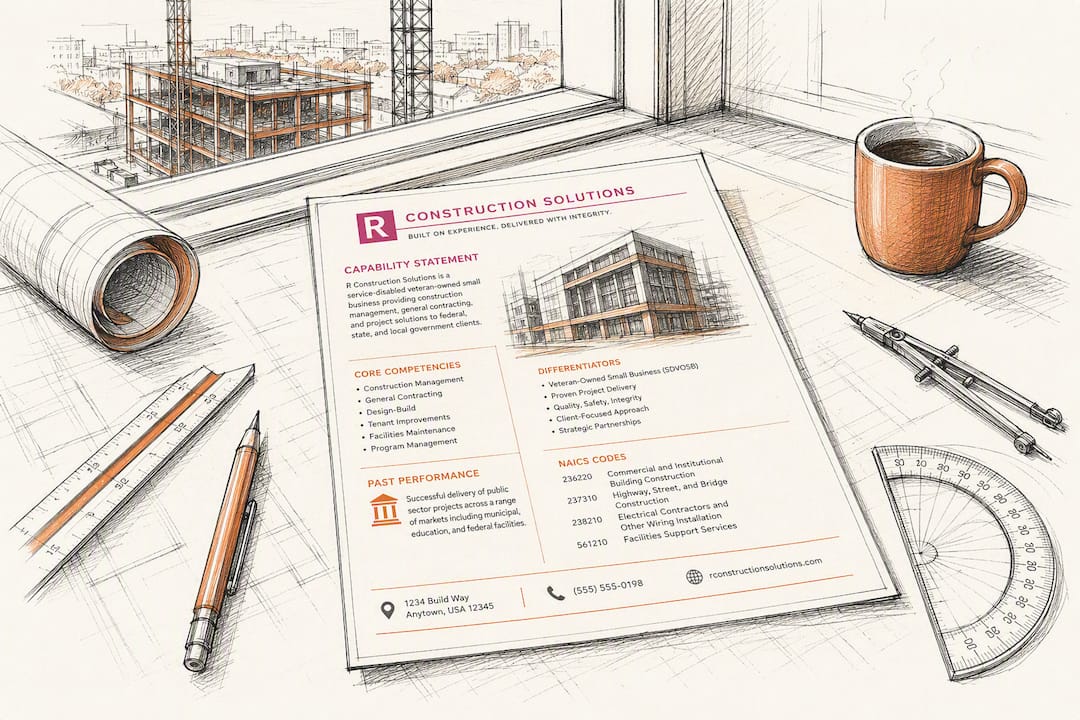
One Page Construction Capability Statement Wins for US Contractors
A capability statement is a one-page sales sheet that tells a government buyer or general contractor exactly what your firm builds, who you’ve built it for, and why you’re the safer bet. The single rule that matters most: keep it to one page, tailor it to the specific buyer, and lead with your top three competencies and one recent, comparable project. Everything else is refinement.
TL;DR:
- Capability statements must highlight three key competencies and recent, relevant projects from the last three to five years, tailored to each specific buyer.
- They need to include verified identifiers such as UEI, CAGE code, NAICS codes, bonding capacity, insurance limits, and state licenses, which are crucial for eligibility screening.
- Visual design should be simple, with a two- or three-column layout and fixed data placements, ensuring quick skimming on a mobile device or during a brief review.
- Focus on concrete, verifiable differentiators such as low EMR, bonding limits, or equipment ownership, placing the top two near the competencies for immediate impact.
- Regular updates and targeted versions for different sectors or agencies improve response rates and help avoid disqualification due to outdated or vague information.
Table of Contents
- What to include: the five core blocks every construction capability statement needs
- Format and layout: one page that scans fast
- Past performance: what to show and how to choose the right projects
- Differentiators: craft concrete, verifiable claims that win shortlists
- Company data & compliance fields contractors must never omit
- Tailoring and version control: make targeted versions for agencies and primes
- Common mistakes, red flags, and a final pre-send checklist
- Expert edge: practical tips from R. Construction Solutions for statements that pass the first scan
- Distribution strategies and best practices
- Author perspective: why capability statements are infrastructure, not marketing collateral
- How R. Construction Solutions helps you build a bid-ready statement
- Authoritative resources for verification
- Sources
What to include: the five core blocks every construction capability statement needs
The HHS guidance on writing a capability statement lays out the fields a buyer expects to see, and construction firms need to translate them into trade-specific language, not generic corporate copy.
Structure the page around five blocks:
- Core competencies: verb-first scope lines (“Install commercial HVAC systems up to 50 tons”) aligned to your NAICS codes, not vague category names.
- Past performance: client name, your role, contract value, completion year, and one measurable outcome per project.
- Differentiators: claims a competitor can’t copy, backed by a number.
- Company data: UEI, CAGE code, NAICS codes, bonding limits, insurance carrier, and state license number.
- Contact: one named decision maker with a direct phone number and email, not a generic info inbox.
A contracting officer or estimator spends seconds on this document. Every missing field is a reason to move to the next firm’s statement.
Format and layout: one page that scans fast
Design for skimming, not reading. A capability statement is closer to a highway billboard than a brochure: the reader is moving fast and needs the key facts in one glance.
- Keep it to one page, exported as a PDF, never an editable Word file.
- Use a two- or three-column grid so competencies, past performance, and company data sit in separate visual zones.
- Place UEI, CAGE, and NAICS codes in a fixed location, usually a sidebar or footer, so buyers can find them without hunting.
- Use one accent color for section headers, generous white space, and body text no smaller than 10 point.
- Name the file something searchable, like CompanyName_Capability_Statement.pdf.
Pro Tip: Open the PDF on your phone before you send it. If you have to pinch and zoom to read your own company name, an estimator scanning it between meetings will give up in seconds.
Past performance: what to show and how to choose the right projects
Choose three to five projects, and choose them for relevance, not size. A $2 million tenant buildout matters more to a buyer soliciting a $2 million renovation than your biggest job ever if that job was a different scope entirely. LegalClarity’s breakdown of capability statement formatting recommends recent, comparable work, generally from the last three to five years, since older projects carry less weight with reviewers.
Format each entry the same way:
- Client or owner name, and the general contractor’s name if you worked as a subcontractor.
- A short, verb-first scope description (“Renovated 40,000 sq ft medical office under occupied conditions”).
- Contract value and year of completion.
- One measurable outcome: schedule performance, cost savings, safety record, or change-order rate.
If your government past performance is thin, lean on strong commercial projects or highlight key personnel who managed comparable federal work at a previous employer. Buyers care about proven capability more than the label on the contract.
Differentiators: craft concrete, verifiable claims that win shortlists
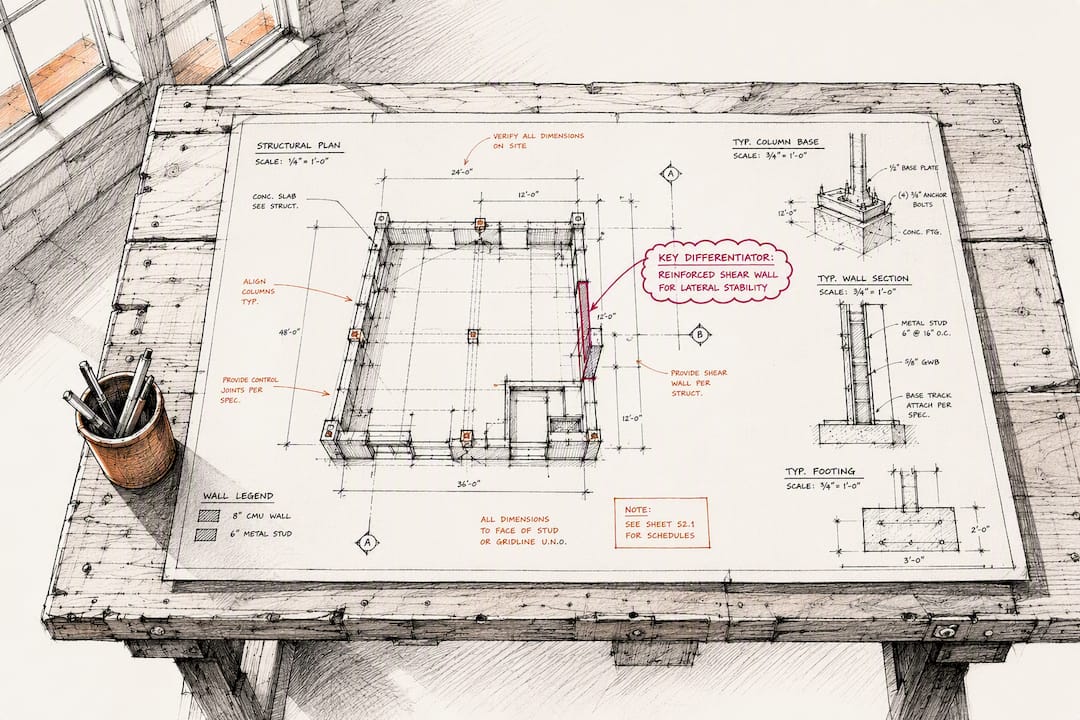
A differentiator only works if it’s a number someone can check. “Quality-focused” means nothing. “Zero OSHA recordables across 140,000 labor hours in 2025” means everything.
Strong differentiator categories for contractors include:
- Bonding capacity (single project and aggregate limits).
- Experience Modification Rate (EMR) below industry average.
- Owned equipment fleet, listed by type and count.
- Mobilization or response time for emergency work.
- Security clearances held by key personnel.
Document every claim before it goes on the page. Keep your surety letter, EMR certificate, and equipment list on hand so you can back up each number if a buyer asks. Place your two strongest differentiators near the top of the page, right under your competencies, so an estimator sees them before they’ve decided to move on.
Company data & compliance fields contractors must never omit
These fields aren’t filler. They’re what lets a contracting officer verify your firm in SAM.gov before a human ever reads your narrative, and construction procurement carries its own layer of scrutiny around bonding and prequalification, as outlined in Part 236 of the Federal Acquisition Regulation.
- UEI and CAGE code: copy these directly from your active SAM.gov registration; typos here are a fast disqualifier.
- NAICS codes: list your primary code first, followed by two or three related codes that reflect actual work you perform, not aspirational ones.
- Bonding capacity: state both single-project and aggregate limits, since a solicitation requiring a bond above your single-project limit will screen you out before anyone reads your differentiators.
- Insurance and state license: list your general liability limits and license number plainly, near the bonding figures, so a reviewer sees your full risk profile in one place.
A licensing requirements checklist can help you confirm you have every state document current before you finalize these fields.
Tailoring and version control: make targeted versions for agencies and primes
A single generic capability statement blasted to every prospect underperforms a version built for the specific buyer, according to guidance from Civic Contracts on winning capability statements. Build a workflow instead of a one-off document.
- Build one master template with your full competency list, complete project history, and verified company data.
- Create three or four targeted versions: federal, state and public works, commercial general contractor, and specialty trade.
- Before each submission, swap the lead past-performance project and reorder competencies to mirror the solicitation’s language.
- Name files consistently (Company_Target_Date.pdf) and review every version quarterly, since past performance older than five years loses persuasive weight.
This same discipline pairs well with how you submit a compliant public sector bid, since both processes depend on matching your language to the buyer’s exact requirements.
Common mistakes, red flags, and a final pre-send checklist
The fastest disqualifiers are missing bonding figures, no UEI or CAGE code, and competency lines so vague they could describe any contractor in the country. Overstating certifications or bonding capacity carries real risk beyond a rejected bid, since inaccurate claims can create legal exposure if a buyer later verifies the numbers.
Before you send anything, confirm:
- Every competency line starts with a verb and states a specific scope.
- You have three to five recent, comparable projects listed.
- One named contact appears with a direct phone and email.
- UEI, CAGE, NAICS, and bonding figures are current and verified.
- The file is saved as a PDF, not an editable Word document.
Estimators reportedly scan a capability statement for scope match in under 10 seconds. Every item on that checklist exists to survive that first ten seconds.
Expert edge: practical tips from R. Construction Solutions for statements that pass the first scan
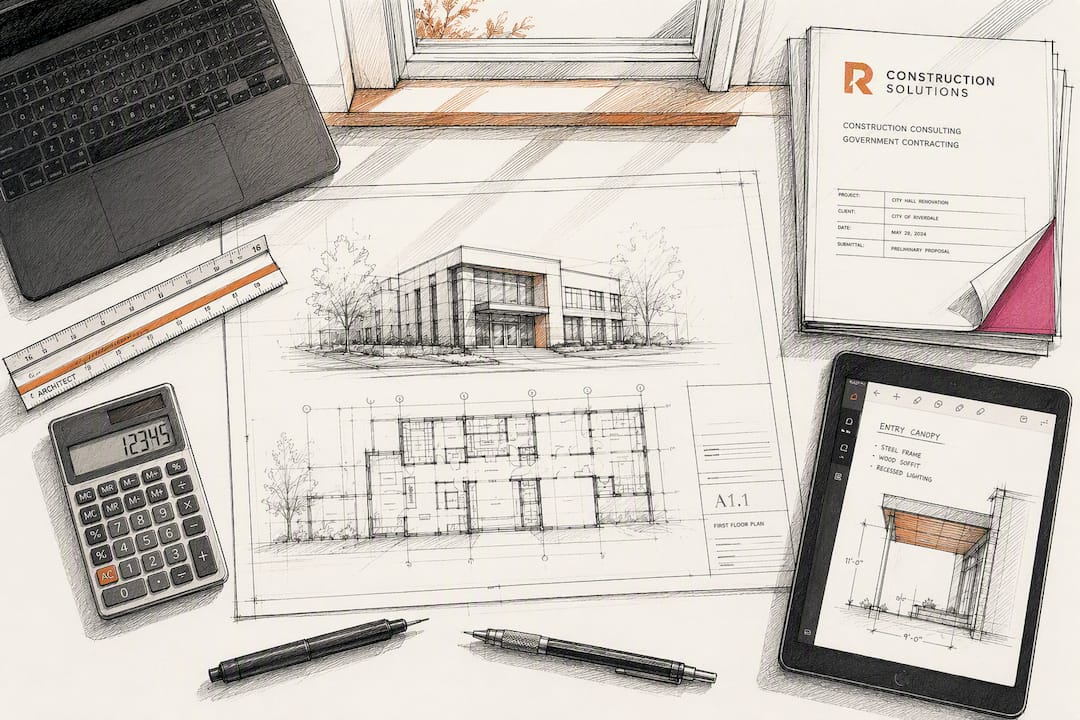
Before you write a single number, gather your surety letter, current insurance declarations, state license PDF, and signed permission from past-performance contacts to list them. That paperwork trail is what lets you defend every claim if a buyer calls to verify.
Turn key-personnel resumes into past-performance lines by pulling the same fields you’d use for a company project: client, scope, value, and outcome, attributed to the individual rather than the firm.
Pro Tip: Assign one person, not a committee, to own quarterly updates. A capability statement that nobody owns quietly goes stale, and stale numbers are worse than no numbers at all.
Distribution strategies and best practices
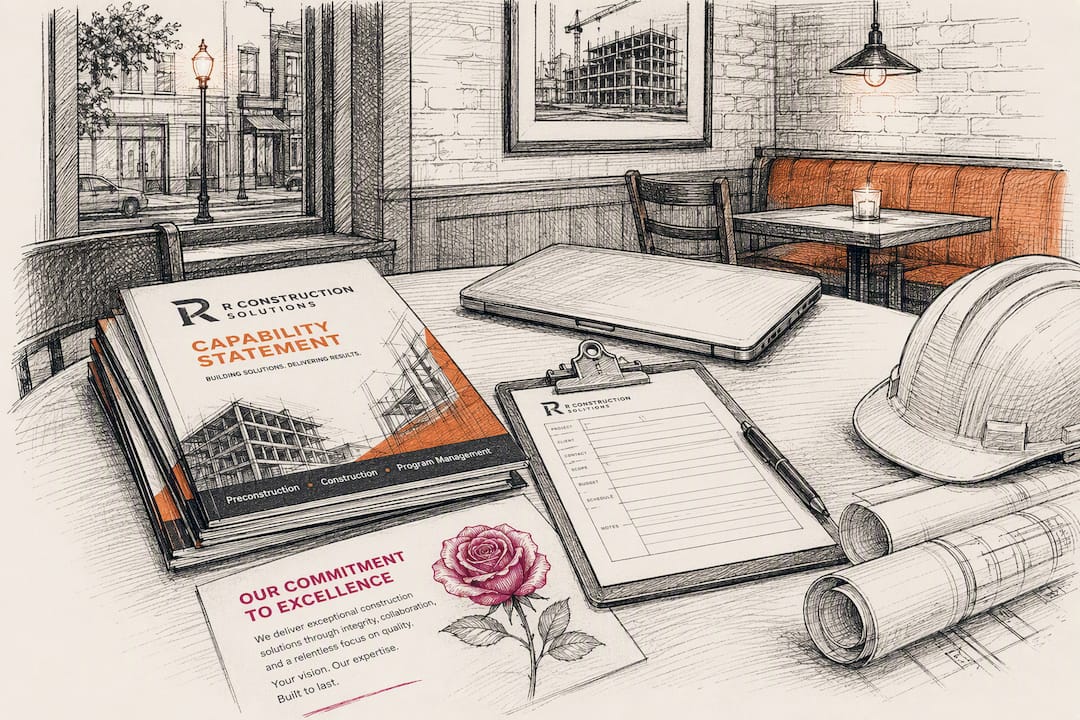
A capability statement earns nothing sitting in a folder on your desktop. Distribution has to be deliberate, and it works differently depending on the audience.
For federal and state buyers, upload your statement to your SAM.gov profile and attach it to every capability briefing you request with a contracting officer or small business liaison. Many agencies host industry days and matchmaking events specifically so contractors can hand a statement directly to a program office; bring printed copies, but always follow up with the PDF by email within 24 hours.
For general contractors and commercial prospects, attach the statement to every prequalification package, bid inquiry, and subcontractor registration form you submit. Keep a copy in your CRM tied to each prime contractor relationship so your business development team sends the correct tailored version, not whatever file happens to be open. Following the version-control workflow covered earlier makes this step almost automatic once it’s built.
Trade shows, industry association meetings, and local chamber events are underused distribution points for small contractors. A one-page PDF handed to a facilities director at a regional builders’ exchange event often does more than a cold email. Pair digital distribution through your website and LinkedIn profile with these in-person touches, and revisit your distribution list every time you update the construction bid automation tools or CRM you use to track outreach. A commercial project checklist is a useful companion resource when you’re assembling the project list you’ll eventually pull past-performance lines from.
Author perspective: why capability statements are infrastructure, not marketing collateral
Tailored statements convert because buyers can tell the difference between a document built for them and one built for everyone. DIY works fine once your team has the discipline to update it quarterly; bring in outside help when your win rate stalls despite decent bid volume, which usually signals a positioning problem, not a paperwork one.
— Rowena Tulacz
How R. Construction Solutions helps you build a bid-ready statement
Most contractors don’t lose bids because their work is weak. They lose because their capability statement buries the proof under vague language and missing fields, while a competitor’s one-pager answers every question a reviewer has in the first ten seconds. R Construction Solutions LLC built its federal procurement consulting practice around fixing exactly that gap for contractors who don’t have a proposal department but still need documents that read like they do.
A 30-minute capability statement review covers your NAICS strategy, bonding presentation, and past-performance formatting against what buyers in your target markets actually screen for. If you’re starting from scratch, R Construction Solutions LLC can build your master template and one tailored version, delivered as a polished PDF plus an editable source file your team can update quarterly. Pricing is scoped per engagement based on how much of the groundwork, like verified bonding letters and NAICS research, is already done. Visit the construction consulting services page to book a review and get a straight answer on what your current statement is missing.
Authoritative resources for verification
Verify identifiers directly at SAM.gov guidance from HHS, and review construction-specific procurement rules in FAR Part 236 before finalizing bonding language.
Sources
- How to Write a Good Capability Statement — HHS
- PART 236—Construction and Architect-Engineer Contracts — govinfo
- Writing a Winning Capability Statement (With Template) — Civic Contracts
- Construction capability statement template: what to include — LegalClarity
Recommended
- Project Commissioned: Your 30-90 Day Post-Award Playbook
- How to Submit a Compliant Public Sector Construction Bid
- Small Business Set-Aside Contracts: A Guide for Contractors
Running the job and the business at the same time? One short email a week — change orders, billing, job costing, scheduling. Free, no pitch. Subscribe.
Free and unconditional. No call required, no obligation, unsubscribe anytime.