Mechanical Estimating: Why Commissioning Costs Matter | R. Construction Solutions
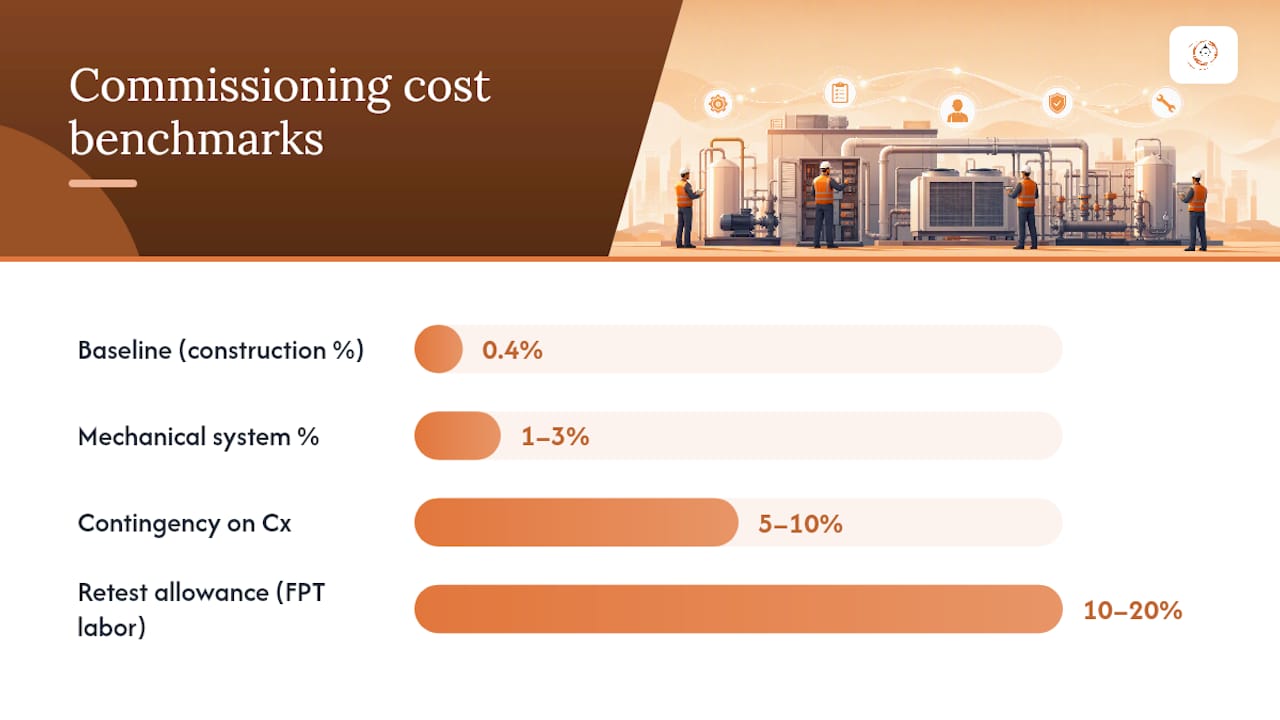
Commissioning costs belong in every mechanical estimate because commissioning is a discrete, measurable scope of work with its own labor, documentation, and testing requirements — not a vague quality gesture. According to a meta-analysis published in Energy Efficiency, the median commissioning cost for new construction is $1.16/ft2, representing roughly 0.4% of total construction cost. That number is small enough to feel optional and large enough to blow your margin when it shows up as a change order after award. The DOE’s updated analysis confirms commissioning is cost-effective across nearly 1,500 commercial buildings, with payback periods that often fall well under five years for existing buildings.
The primary cost line-items every estimator should carry in a mechanical bid:
- Commissioning Authority (CxA) fee — typically owner-contracted but sometimes passed through the GC
- Contractor labor for Functional Performance Tests (FPTs) — technician hours to witness, operate, and document
- Testing, Adjusting, and Balancing (TAB) — separate agency scope, often a direct subcontract
- Controls testing and verification — BAS/DDC point-by-point checks
- Manufacturer/vendor start-up — factory-required commissioning for chillers, boilers, AHUs
- Documentation, O&M manuals, and as-builts — submittal labor and reproduction costs
- Owner and operator training — scheduled sessions with sign-off
- Retest and deficiency correction labor — the line item most estimators forget
- Travel and reimbursable expenses — site visits, mileage, per diem for remote projects
Key Takeaways
Commissioning costs belong in every mechanical estimate as a discrete, documented scope — priced from the Cx Plan, protected by clear retest language, and justified with the $1.16/ft2 median cost and 13% median energy savings evidence.
| Point | Details |
|---|---|
| Price commissioning as discrete scope | Carry CxA fee, FPT labor, TAB, controls, start-up, documentation, training, and retest allowance as separate line items. |
| Use $1.16/ft2 as a floor, not a ceiling | The median new-construction figure ($1.16/ft2 or 0.4% of total construction) is a baseline for early budgeting; projects with advanced controls, manufacturer start-up, or mission-critical environments routinely exceed this and should be budgeted higher. |
| Retest allowance is non-negotiable | Carry 10–20% of FPT labor as a named retest allowance and confirm in writing who pays for retests beyond the first attempt. |
| Spec review prevents the biggest surprises | Check CxA scope, FPT count, retest payment responsibility, and pass/fail criteria before finalizing your number. |
| R Construction Solutions LLC | Provides commissioning scope review, bid preparation support, and spec alignment for mechanical contractors across the U.S. |
Table of Contents
- Why mechanical estimates include commissioning costs: the full scope breakdown
- How do you convert commissioning scope into dollars in your estimate?
- What project signals drive commissioning costs higher?
- Which contract and spec clauses create the most estimator exposure?
- Does commissioning actually pay back its cost?
- Estimator template and worked example for a typical office building
- What advisors see most often in commissioning bids
- How R Construction Solutions LLC supports commissioning estimating
- Sources
Why mechanical estimates include commissioning costs: the full scope breakdown
Commissioning is not a single task. It is a sequence of coordinated activities that the PNNL technical guidance maps across the mechanical contractor, TAB agency, and controls contractor — each carrying distinct cost exposure. Understanding who pays what, and where each cost sits in your bid, is the first step to pricing it correctly.
The Building Commissioning Association’s sample specification language (Appendix B) is explicit: mechanical and controls contractors must include commissioning responsibilities in their quoted prices. That is not a suggestion. When a CxA is named in the contract, your participation in FPTs, submittals, and training is contractually required scope.
The retest allowance deserves special attention. Northwestern University’s commissioning specification covers up to two FPTs per item under the owner’s contract; any additional retests may be charged back to the contractor. If your bid does not carry a retest line, you are self-insuring that risk.
How do you convert commissioning scope into dollars in your estimate?
Three pricing methods work in practice, and the right one depends on how much design information you have at bid time.
Method 1: Rule-of-thumb normalization ($/ft2 or % of construction). Use the $1.16/ft2 median or the 0.4% of construction figure as a baseline sanity check on early-design or design-build bids. Remember, these numbers are floors; critical or complex projects (such as hospitals and labs) often come in much higher and must be adjusted upward accordingly.
Method 2: Percent of mechanical system cost. Many estimators carry commissioning at 1–3% of the mechanical subcontract value. This scales naturally with system complexity and is easy to defend in a bid review.
Method 3: Bottom-up labor-hour build-up. The most defensible method for negotiated work or projects with a detailed Cx Plan. Per mechanical SOW guidance, you must quantify technician hours for each FPT and reference the applicable protocol (ASHRAE Guideline 0, LEED, or owner-specific).
Step-by-step worked calculation framework:
- Count the number of systems and terminal units requiring FPTs (pull from the Cx Plan or equipment schedule).
- Assign labor hours per FPT: 2–4 hours for simple terminal units, 8–16 hours for complex AHUs or chillers.
- Multiply by your fully burdened technician rate. The MSBA work-order template provides sample hourly rate categories (principal, senior engineer, commissioning agent, technician) as a realistic benchmark.
- Add TAB as a separate lump sum from a TAB subcontractor quote or $/diffuser estimate.
- Add manufacturer start-up costs from equipment submittals or vendor quotes.
- Add documentation and training hours at your office labor rate.
- Apply a retest allowance of 10–20% on FPT labor.
- Add travel and reimbursables as a separate line, or quote as reimbursable at cost.
- Apply a 5–10% contingency on the total commissioning subtotal for ambiguous scope.
When to favor each method:
- Early design or conceptual budget: use $/ft2 or % of construction for a quick placeholder.
- Design development or near-bid with a Cx Plan: use % of mechanical cost as a check, then refine with bottom-up hours.
- Negotiated GMP or design-assist: always use bottom-up hours with documented assumptions.
Pro Tip: Carry retest labor as a named allowance, not buried in contingency. When the owner asks what the allowance covers, you can point to the spec clause — that conversation protects your margin far better than a silent contingency line.
What project signals drive commissioning costs higher?
Not every mechanical job commissions at $1.16/ft2. Several factors push costs well above that median, and missing them at bid time is how a competitive number becomes a money-losing job. Contractor Magazine’s guidance for mechanical estimators specifically flags commissioning as one of the hidden spec-driven costs that turns a winning bid into a losing one.
- Building type and criticality. Hospitals, laboratories, and data centers carry more systems, tighter tolerances, and more FPTs per square foot than office buildings. Expect commissioning costs to run 2–4 times the median on critical-environment projects.
- System count and terminal device density. More VAV boxes, fan coil units, or hydronic zones mean more FPTs. Doubling the terminal unit count does not double commissioning labor linearly — it often increases it disproportionately because scheduling and documentation time grows with each additional point.
- Controls sophistication. A project with a fully integrated BAS, demand-controlled ventilation, and complex sequencing requires point-by-point verification that can easily exceed the mechanical labor hours for FPTs.
- Retrofit vs. new construction. Existing buildings add access constraints, unknown as-built conditions, and coordination with occupied spaces. Retrofit commissioning typically runs 20–40% higher per system than equivalent new construction work.
- Geographic travel and site logistics. Remote sites, multi-building campuses, or phased occupancy schedules add travel time and per diem costs that are easy to underestimate.
- Number of retests. Each failed FPT that requires a return visit multiplies labor and travel costs. Projects with aggressive pass/fail criteria or complex sequences fail more often on the first attempt.
- Manufacturer involvement requirements. Some equipment specs require factory-authorized start-up with a manufacturer’s representative present. That cost is real and not always in the equipment price.
Pro Tip: When a spec lists FPTs but does not define the number or the pass/fail criteria, treat that as an open-ended obligation. Request a clarification from the GC or owner before bid. A simple written question — “Please confirm the total number of FPTs required and the acceptance criteria for each system type” — creates a paper trail and often surfaces scope the spec writer left ambiguous.
Which contract and spec clauses create the most estimator exposure?
The most expensive commissioning surprises do not come from the work itself. They come from contract language that shifts cost and risk to the contractor in ways that are easy to miss during a fast bid review.
Review these items before you price any mechanical bid with commissioning scope:
- CxA scope definition. Is the CxA’s scope attached to the contract? Vague CxA scopes expand during construction, and the contractor’s participation obligation expands with them.
- Number of FPTs. Defined or open-ended? Open-ended FPT requirements are one of the most common sources of commissioning overruns.
- Retest payment responsibility. Who pays for retests beyond the first attempt? As the Northwestern University spec illustrates, some owners cover two FPTs per item; others push all retest costs to the contractor.
- Manufacturer start-up obligations. Does the spec require factory-authorized start-up, or is a qualified technician sufficient? Factory-authorized start-up costs more and takes longer to schedule.
- Submittal and O&M deliverable requirements. Some specs require multiple submittal rounds, redline as-builts, and bound O&M manuals with indexed tabs. Price the labor, not just the printing.
- TAB scope and verification. Is TAB a separate prime contract, a subcontract to the mechanical contractor, or included in the CxA scope? Confirm before you bid.
- Pass/fail acceptance criteria. Tight tolerances (±5% airflow vs. ±10%) directly affect how many FPTs pass on the first attempt.
- Scheduling constraints. Owner-imposed commissioning windows (e.g., commissioning must complete before a specific occupancy date) can force overtime or multiple mobilizations.
The Building Commissioning Association’s Appendix B and PNNL contractor guidance both describe typical contractor duties in detail — use them as a checklist against the project spec to identify gaps.
Pro Tip: At bid, include a short scope clarification note: “Commissioning participation includes [X] FPTs per the Cx Plan dated [date]. Additional FPTs or retests beyond [Y] per system are excluded and will be priced as a change order.” That one sentence eliminates the most common post-award dispute.
Does commissioning actually pay back its cost?
The short answer is yes, and the evidence is specific enough to use in a client conversation. The DOE/LBNL analysis of nearly 1,500 commercial buildings confirms commissioning is cost-effective, with reliable energy savings and payback periods that support the investment. The meta-analysis in Energy Efficiency found median whole-building energy savings of approximately 13% for new construction — savings that begin accruing from the first year of occupancy.

NIST’s commissioning cost-benefit review reinforces this, finding that commissioning reduces energy use and lifecycle costs, while also identifying that unclear scope definitions remain a primary barrier to adoption. That barrier is exactly what a well-structured estimate addresses.
Beyond energy, commissioning delivers non-energy benefits that matter to owners and decision-makers:
- Improved indoor air quality and occupant comfort, reducing tenant complaints and lease risk
- Documented operator training, which reduces maintenance errors and extends equipment life
- Fewer post-occupancy change orders, because deficiencies are caught before the owner takes possession
- A complete O&M package that supports warranty claims and future capital planning
For the contractor, the business case is equally direct. A system that fails after occupancy generates call-back labor, warranty parts, and potential litigation. Commissioning catches those failures before they become your problem.
Estimator template and worked example for a typical office building
The template below is structured for a 50,000 ft2 office building with a standard VAV HVAC system, one AHU, 60 VAV boxes, a chiller, and a BAS. Adjust unit rates to your market and labor agreements.
On a $10 million construction budget, this total represents approximately 1.1% of construction cost — well above the 0.4% median, which is consistent for projects with higher controls and start-up complexity. Use $1.16/ft2 and 0.4% of construction as a low baseline: many real projects will require a higher allocation.
Worked calculation steps:
- Pull the equipment schedule and Cx Plan to confirm system count and FPT scope.
- Assign hours per FPT type using your historical data or the ranges above.
- Price TAB from a subcontractor quote or your $/diffuser benchmark.
- Confirm manufacturer start-up requirements from equipment specs.
- Add documentation and training hours based on the submittal schedule.
- Apply the retest allowance as a named line, not buried in overhead.
- Add travel as a separate reimbursable or fixed allowance.
- Apply contingency on the commissioning subtotal, separate from your main job contingency.
Pro Tip: Attach a one-page scope note to every commissioning estimate. List what is included, what is excluded, the number of FPTs assumed, and the retest policy. When the GC or owner reviews your number, that note answers their first three questions before they ask them. It also becomes your change-order justification if scope expands.
What advisors see most often in commissioning bids
The most consistent pattern in mechanical bids that go sideways on commissioning is not a math error. It is a scope assumption that was never written down.
Estimators price the FPTs they can see in the spec and ignore the ones the CxA will add during construction. They carry TAB as a line item but forget that the spec requires TAB verification by the CxA as a separate activity. They price one round of documentation and discover the owner wants three submittal rounds plus a bound O&M manual with indexed tabs.
Three rules that help when reviewing commissioning exposure in a bid:
- If the Cx Plan is not attached to the bid documents, ask for it. A Cx Plan defines the FPT scope precisely. Without it, you are pricing a blank check.
- Treat every retest clause as a potential cost center. Price the retest allowance explicitly, and confirm in writing whether the owner or contractor pays for retests beyond the first attempt.
- Separate the CxA fee from contractor commissioning costs in your estimate. Owners often push back on commissioning costs because they conflate the CxA fee (which they may be paying separately) with the contractor’s participation labor. Showing them as distinct line items eliminates that confusion.
When presenting commissioning costs to an owner, lead with the lifecycle savings argument — the 13% median energy savings figure from the meta-analysis is specific enough to be credible and general enough to apply to most commercial buildings. Then show your line-item breakdown. Owners who understand what they are buying rarely push back on a well-documented commissioning number.
How R Construction Solutions LLC supports commissioning estimating
Commissioning exposure is one of the most common places mechanical contractors leave money on the table or absorb unexpected losses. R Construction Solutions LLC works directly with mechanical contractors and subcontractors on estimating support and bid preparation, including commissioning scope review, spec alignment, and retest risk analysis.

The firm’s mechanical contractor advisory services are built for contractors who want cleaner bids, fewer post-award surprises, and a defensible scope note on every commissioning line item.
Working with R Construction Solutions LLC on commissioning estimating delivers:
- A reviewed commissioning scope aligned to the project spec and Cx Plan
- Named line items with documented assumptions, ready for GC or owner review
- Retest and allowance language that protects your margin
- A faster bid prep process with fewer scope gaps
Contact Rowena Tulacz at Rconstructionsolutions to discuss your next mechanical bid.
Sources
These sources give you the data and procedural language to defend commissioning costs in any bid review or owner conversation.
- New DOE Research Strengthens Business Case for Building Commissioning | Department of Energy
- Building commissioning: a golden opportunity for reducing energy costs and greenhouse gas emissions in the United States | Energy Efficiency | Springer Nature Link
- Commissioning Cost-Benefit and Persistence of Savings: A Report on Cost-Effective Commissioning
- PNNL technical guidance on commissioning and contractor responsibilities
- NU_23-0800-2018 – commissioning of HVAC systems (Northwestern University)
- Appendix B — commissioning sample specification language
- How to win more work as a mechanical estimator — tips for getting the cost of a project right (Contractor Magazine)
Store these as a reference folder in your project files. When an owner questions the commissioning line item, pulling a DOE study and a public-owner spec takes thirty seconds and ends the conversation.